

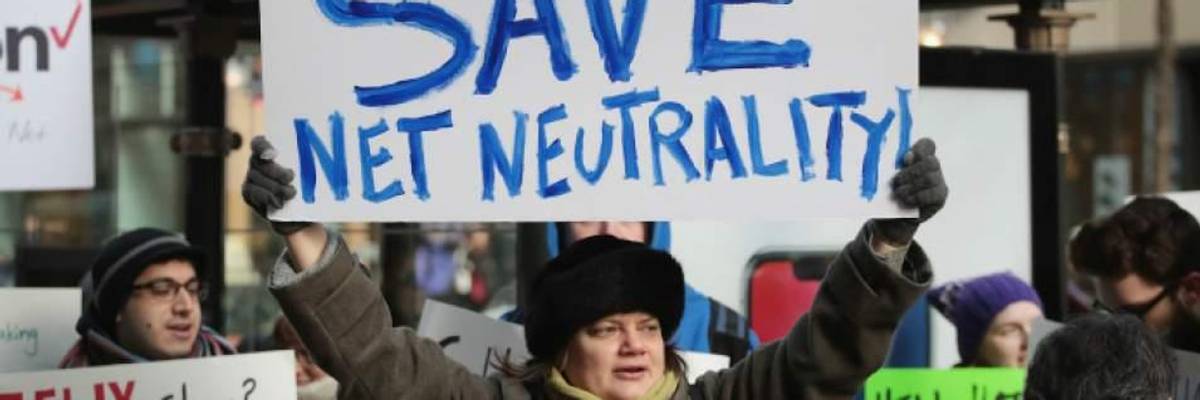
"I've had more than one congressional office tell me that Net Neutrality is one of the main issues motivating young people across the political spectrum, ranking right up with marijuana legalization." (Photo: Scott Olson/Getty Images)
What's Next for Net Neutrality in Congress and the Courts
We have a real chance to defeat FCC Chairman Ajit Pai’s attack on Net Neutrality.
On Tuesday, all 47 Senate Democrats announced they would co-sponsor a "resolution of disapproval" to overturn the FCC's Net Neutrality-killing vote last December.
Add in the pledged support from the two Senate independents as well as Republican Susan Collins, and we have 50 votes.
In other words, we need just one more vote to pass a bill in the Senate.
This is a remarkable testament to how much momentum we have in the fight to restore Net Neutrality. For one, the resolution of disapproval drafted by Massachusetts Sen. Ed Markey hasn't even been introduced yet -- that can't happen until after the FCC rules are published in the Federal Register.
This level of support is remarkable. More importantly, all this momentum is 100 percent the result of grassroots pressure -- no big companies had anything to do with it.
Years of organizing by Free Press Action Fund and our allies are paying off -- and, thanks to Pai's brazen and tone-deaf assault on the open internet, a whole new generation of internet activists is mobilizing.
When I was on Capitol Hill last week, senator after senator mentioned how many young people (including their own children) were talking to them about Net Neutrality.
Politicians are hearing constantly about Net Neutrality from young voters -- online whenever they tweet, on the phones ringing at their offices, and in the streets. I've had more than one congressional office tell me that Net Neutrality is one of the main issues motivating young people across the political spectrum, ranking right up with marijuana legalization.
This is new, and it's upending the usual political calculus.
That doesn't mean it won't be an uphill fight. We still need a few more Republicans in the Senate (one more vote plus insurance). If you live in a state besides Maine with a Republican senator, they need to hear from you.
If you make your living online or own a business, they need to hear from you twice.
The bill also must pass the House, where Rep. Mike Doyle is lining up support for a companion resolution. Over there, we need to capitalize on the Senate momentum and fend off an onslaught of phone- and cable-industry lobbying.
We caught our opponents off guard in the Senate, and we're still weeks if not months from a final vote. So we have to keep up the pressure, keep the debate in the public view and keep industry lobbyists from undermining support for this legislation.
With each congressional office getting thousands of calls for Net Neutrality and close to zero supporting Pai -- and with Net Neutrality looking like a real issue in the 2018 elections -- we've got a shot at passing the resolution. If you haven't yet called your members of Congress, please do it now.
And, yes, the president would need to sign this bill. I don't want to get too far ahead of myself, so I'll just say we welcome that fight.
Right now, passing this essential legislation is the main focus of our direct lobbying inside D.C. and our outside organizing alongside our allies in Team Internet -- the volunteer-driven effort that has already put together more than 1,300 in-district meetings and local rallies.
Sign up today and we'll connect you with other activists near you.
Ajit Pai: We'll See You in Court
Of course, legislation isn't the only way to fix what the FCC did. On Tuesday, Free Press filed one of the very first lawsuits aimed at overturning the agency's Net Neutrality repeal.
We'll be teaming up with experienced Supreme Court lawyers and our allies at New America's Open Technology Institute and Public Knowledge as the litigation progresses, while coordinating our efforts with other challengers, including 22 state attorneys general led by New York's Eric Schneiderman and internet companies like Mozilla.
Tuesday's filing was a preliminary strike to ensure that public-interest groups have a say in where the case is heard. Much is still in play as to when and where the case will go, but Free Press will be leading the charge.
We've seen how effective courts can be in slowing or stopping Trump-era attacks, and we have a winning record to build on in defending Net Neutrality in court.
With your continued support, this is a case we can win.
An Urgent Message From Our Co-Founder
Dear Common Dreams reader, It’s been nearly 30 years since I co-founded Common Dreams with my late wife, Lina Newhouser. We had the radical notion that journalism should serve the public good, not corporate profits. It was clear to us from the outset what it would take to build such a project. No paid advertisements. No corporate sponsors. No millionaire publisher telling us what to think or do. Many people said we wouldn't last a year, but we proved those doubters wrong. Together with a tremendous team of journalists and dedicated staff, we built an independent media outlet free from the constraints of profits and corporate control. Our mission has always been simple: To inform. To inspire. To ignite change for the common good. Building Common Dreams was not easy. Our survival was never guaranteed. When you take on the most powerful forces—Wall Street greed, fossil fuel industry destruction, Big Tech lobbyists, and uber-rich oligarchs who have spent billions upon billions rigging the economy and democracy in their favor—the only bulwark you have is supporters who believe in your work. But here’s the urgent message from me today. It's never been this bad out there. And it's never been this hard to keep us going. At the very moment Common Dreams is most needed, the threats we face are intensifying. We need your support now more than ever. We don't accept corporate advertising and never will. We don't have a paywall because we don't think people should be blocked from critical news based on their ability to pay. Everything we do is funded by the donations of readers like you. When everyone does the little they can afford, we are strong. But if that support retreats or dries up, so do we. Will you donate now to make sure Common Dreams not only survives but thrives? —Craig Brown, Co-founder |
On Tuesday, all 47 Senate Democrats announced they would co-sponsor a "resolution of disapproval" to overturn the FCC's Net Neutrality-killing vote last December.
Add in the pledged support from the two Senate independents as well as Republican Susan Collins, and we have 50 votes.
In other words, we need just one more vote to pass a bill in the Senate.
This is a remarkable testament to how much momentum we have in the fight to restore Net Neutrality. For one, the resolution of disapproval drafted by Massachusetts Sen. Ed Markey hasn't even been introduced yet -- that can't happen until after the FCC rules are published in the Federal Register.
This level of support is remarkable. More importantly, all this momentum is 100 percent the result of grassroots pressure -- no big companies had anything to do with it.
Years of organizing by Free Press Action Fund and our allies are paying off -- and, thanks to Pai's brazen and tone-deaf assault on the open internet, a whole new generation of internet activists is mobilizing.
When I was on Capitol Hill last week, senator after senator mentioned how many young people (including their own children) were talking to them about Net Neutrality.
Politicians are hearing constantly about Net Neutrality from young voters -- online whenever they tweet, on the phones ringing at their offices, and in the streets. I've had more than one congressional office tell me that Net Neutrality is one of the main issues motivating young people across the political spectrum, ranking right up with marijuana legalization.
This is new, and it's upending the usual political calculus.
That doesn't mean it won't be an uphill fight. We still need a few more Republicans in the Senate (one more vote plus insurance). If you live in a state besides Maine with a Republican senator, they need to hear from you.
If you make your living online or own a business, they need to hear from you twice.
The bill also must pass the House, where Rep. Mike Doyle is lining up support for a companion resolution. Over there, we need to capitalize on the Senate momentum and fend off an onslaught of phone- and cable-industry lobbying.
We caught our opponents off guard in the Senate, and we're still weeks if not months from a final vote. So we have to keep up the pressure, keep the debate in the public view and keep industry lobbyists from undermining support for this legislation.
With each congressional office getting thousands of calls for Net Neutrality and close to zero supporting Pai -- and with Net Neutrality looking like a real issue in the 2018 elections -- we've got a shot at passing the resolution. If you haven't yet called your members of Congress, please do it now.
And, yes, the president would need to sign this bill. I don't want to get too far ahead of myself, so I'll just say we welcome that fight.
Right now, passing this essential legislation is the main focus of our direct lobbying inside D.C. and our outside organizing alongside our allies in Team Internet -- the volunteer-driven effort that has already put together more than 1,300 in-district meetings and local rallies.
Sign up today and we'll connect you with other activists near you.
Ajit Pai: We'll See You in Court
Of course, legislation isn't the only way to fix what the FCC did. On Tuesday, Free Press filed one of the very first lawsuits aimed at overturning the agency's Net Neutrality repeal.
We'll be teaming up with experienced Supreme Court lawyers and our allies at New America's Open Technology Institute and Public Knowledge as the litigation progresses, while coordinating our efforts with other challengers, including 22 state attorneys general led by New York's Eric Schneiderman and internet companies like Mozilla.
Tuesday's filing was a preliminary strike to ensure that public-interest groups have a say in where the case is heard. Much is still in play as to when and where the case will go, but Free Press will be leading the charge.
We've seen how effective courts can be in slowing or stopping Trump-era attacks, and we have a winning record to build on in defending Net Neutrality in court.
With your continued support, this is a case we can win.
On Tuesday, all 47 Senate Democrats announced they would co-sponsor a "resolution of disapproval" to overturn the FCC's Net Neutrality-killing vote last December.
Add in the pledged support from the two Senate independents as well as Republican Susan Collins, and we have 50 votes.
In other words, we need just one more vote to pass a bill in the Senate.
This is a remarkable testament to how much momentum we have in the fight to restore Net Neutrality. For one, the resolution of disapproval drafted by Massachusetts Sen. Ed Markey hasn't even been introduced yet -- that can't happen until after the FCC rules are published in the Federal Register.
This level of support is remarkable. More importantly, all this momentum is 100 percent the result of grassroots pressure -- no big companies had anything to do with it.
Years of organizing by Free Press Action Fund and our allies are paying off -- and, thanks to Pai's brazen and tone-deaf assault on the open internet, a whole new generation of internet activists is mobilizing.
When I was on Capitol Hill last week, senator after senator mentioned how many young people (including their own children) were talking to them about Net Neutrality.
Politicians are hearing constantly about Net Neutrality from young voters -- online whenever they tweet, on the phones ringing at their offices, and in the streets. I've had more than one congressional office tell me that Net Neutrality is one of the main issues motivating young people across the political spectrum, ranking right up with marijuana legalization.
This is new, and it's upending the usual political calculus.
That doesn't mean it won't be an uphill fight. We still need a few more Republicans in the Senate (one more vote plus insurance). If you live in a state besides Maine with a Republican senator, they need to hear from you.
If you make your living online or own a business, they need to hear from you twice.
The bill also must pass the House, where Rep. Mike Doyle is lining up support for a companion resolution. Over there, we need to capitalize on the Senate momentum and fend off an onslaught of phone- and cable-industry lobbying.
We caught our opponents off guard in the Senate, and we're still weeks if not months from a final vote. So we have to keep up the pressure, keep the debate in the public view and keep industry lobbyists from undermining support for this legislation.
With each congressional office getting thousands of calls for Net Neutrality and close to zero supporting Pai -- and with Net Neutrality looking like a real issue in the 2018 elections -- we've got a shot at passing the resolution. If you haven't yet called your members of Congress, please do it now.
And, yes, the president would need to sign this bill. I don't want to get too far ahead of myself, so I'll just say we welcome that fight.
Right now, passing this essential legislation is the main focus of our direct lobbying inside D.C. and our outside organizing alongside our allies in Team Internet -- the volunteer-driven effort that has already put together more than 1,300 in-district meetings and local rallies.
Sign up today and we'll connect you with other activists near you.
Ajit Pai: We'll See You in Court
Of course, legislation isn't the only way to fix what the FCC did. On Tuesday, Free Press filed one of the very first lawsuits aimed at overturning the agency's Net Neutrality repeal.
We'll be teaming up with experienced Supreme Court lawyers and our allies at New America's Open Technology Institute and Public Knowledge as the litigation progresses, while coordinating our efforts with other challengers, including 22 state attorneys general led by New York's Eric Schneiderman and internet companies like Mozilla.
Tuesday's filing was a preliminary strike to ensure that public-interest groups have a say in where the case is heard. Much is still in play as to when and where the case will go, but Free Press will be leading the charge.
We've seen how effective courts can be in slowing or stopping Trump-era attacks, and we have a winning record to build on in defending Net Neutrality in court.
With your continued support, this is a case we can win.