SUBSCRIBE TO OUR FREE NEWSLETTER
Daily news & progressive opinion—funded by the people, not the corporations—delivered straight to your inbox.
5
#000000
#FFFFFF
To donate by check, phone, or other method, see our More Ways to Give page.
Daily news & progressive opinion—funded by the people, not the corporations—delivered straight to your inbox.
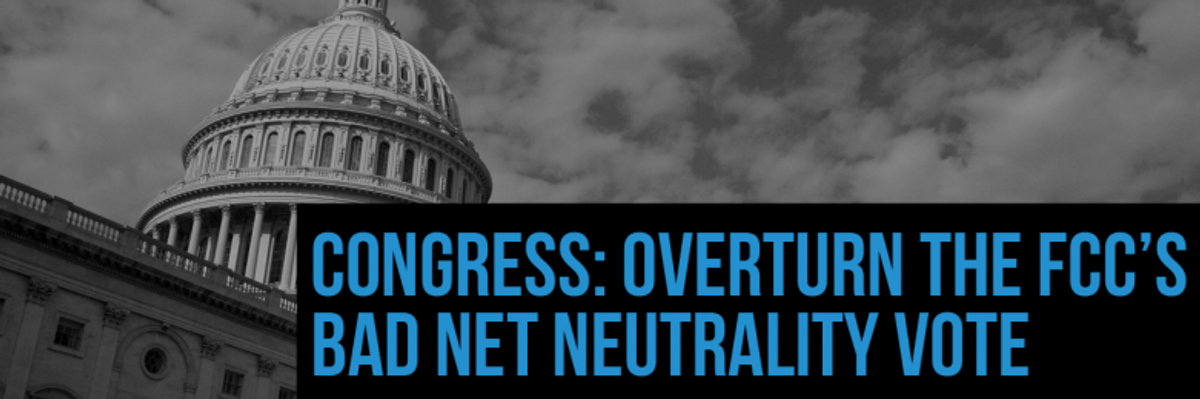
Using the Congressional Review Act (CRA), explains Floberg, Congress can pass a resolution that would nullify the FCC's planned repeal of the Net Neutrality rules. (Image: Free Press)
This Thursday, FCC Chairman Ajit Pai and the two other Republican commissioners will vote to strike down our Net Neutrality protections and break the open internet.
We haven't made it easy for them. Millions of us have been fighting back online and off, calling on dozens of lawmakers to stand with us, and doing all we can to defeat Pai's plan.
There's still a small chance we could stop this vote -- but if we lose the rules, what's next?
First of all, Free Press will take the FCC to court. Suing the FCC poses the best chance for us to win back strong Title II protections.
While our legal team battles in the courts, we need to urge our champions in Congress to pass a "resolution of disapproval" to overturn the FCC's decision.
That's right. Congress has the power to restore the Net Neutrality rules we fought so hard for.
Using the Congressional Review Act (CRA), Congress can pass a resolution that would nullify the FCC's planned repeal of the Net Neutrality rules.
You may remember the CRA from last spring, when privacy opponents used it to roll back the Obama-era FCC's strong broadband-privacy rules. If we lose Net Neutrality, we need to turn the tables.
The CRA empowers Congress to review new regulations and pass a joint resolution of disapproval to overrule any recent regulations it doesn't like. Overturning Pai's misleadingly named "Restoring Internet Freedom Order" would leave us with the exact same Net Neutrality protections we won in 2015, based on the firm legal grounding of Title II.
Think of it as a double negative: If we repeal Pai's repeal, we end up right back where we started -- with strong Net Neutrality rules.
Longtime Net Neutrality supporters Sen. Ed Markey and Rep. Mike Doyle have already gotten the ball rolling, promising to introduce a resolution of disapproval as soon as Pai moves forward with his plans to end the open internet.
Perhaps most importantly, a resolution of disapproval would avoid the dangerous pitfalls of negotiating a new Net Neutrality bill. While new legislation would force us to compromise for weaker rules to win bipartisan support, a resolution of disapproval would completely restore our current strong rules.
Passing new Net Neutrality legislation would be like reinventing the wheel: risky, and more effort than it's worth. Passing a resolution of disapproval would be just like hitting the "undo" button.
As Free Press fights for Net Neutrality in the courts and in the streets, we need our allies in Congress to fight side by side for a clean rollback of Pai's bogus plan.
Dear Common Dreams reader, It’s been nearly 30 years since I co-founded Common Dreams with my late wife, Lina Newhouser. We had the radical notion that journalism should serve the public good, not corporate profits. It was clear to us from the outset what it would take to build such a project. No paid advertisements. No corporate sponsors. No millionaire publisher telling us what to think or do. Many people said we wouldn't last a year, but we proved those doubters wrong. Together with a tremendous team of journalists and dedicated staff, we built an independent media outlet free from the constraints of profits and corporate control. Our mission has always been simple: To inform. To inspire. To ignite change for the common good. Building Common Dreams was not easy. Our survival was never guaranteed. When you take on the most powerful forces—Wall Street greed, fossil fuel industry destruction, Big Tech lobbyists, and uber-rich oligarchs who have spent billions upon billions rigging the economy and democracy in their favor—the only bulwark you have is supporters who believe in your work. But here’s the urgent message from me today. It's never been this bad out there. And it's never been this hard to keep us going. At the very moment Common Dreams is most needed, the threats we face are intensifying. We need your support now more than ever. We don't accept corporate advertising and never will. We don't have a paywall because we don't think people should be blocked from critical news based on their ability to pay. Everything we do is funded by the donations of readers like you. When everyone does the little they can afford, we are strong. But if that support retreats or dries up, so do we. Will you donate now to make sure Common Dreams not only survives but thrives? —Craig Brown, Co-founder |
This Thursday, FCC Chairman Ajit Pai and the two other Republican commissioners will vote to strike down our Net Neutrality protections and break the open internet.
We haven't made it easy for them. Millions of us have been fighting back online and off, calling on dozens of lawmakers to stand with us, and doing all we can to defeat Pai's plan.
There's still a small chance we could stop this vote -- but if we lose the rules, what's next?
First of all, Free Press will take the FCC to court. Suing the FCC poses the best chance for us to win back strong Title II protections.
While our legal team battles in the courts, we need to urge our champions in Congress to pass a "resolution of disapproval" to overturn the FCC's decision.
That's right. Congress has the power to restore the Net Neutrality rules we fought so hard for.
Using the Congressional Review Act (CRA), Congress can pass a resolution that would nullify the FCC's planned repeal of the Net Neutrality rules.
You may remember the CRA from last spring, when privacy opponents used it to roll back the Obama-era FCC's strong broadband-privacy rules. If we lose Net Neutrality, we need to turn the tables.
The CRA empowers Congress to review new regulations and pass a joint resolution of disapproval to overrule any recent regulations it doesn't like. Overturning Pai's misleadingly named "Restoring Internet Freedom Order" would leave us with the exact same Net Neutrality protections we won in 2015, based on the firm legal grounding of Title II.
Think of it as a double negative: If we repeal Pai's repeal, we end up right back where we started -- with strong Net Neutrality rules.
Longtime Net Neutrality supporters Sen. Ed Markey and Rep. Mike Doyle have already gotten the ball rolling, promising to introduce a resolution of disapproval as soon as Pai moves forward with his plans to end the open internet.
Perhaps most importantly, a resolution of disapproval would avoid the dangerous pitfalls of negotiating a new Net Neutrality bill. While new legislation would force us to compromise for weaker rules to win bipartisan support, a resolution of disapproval would completely restore our current strong rules.
Passing new Net Neutrality legislation would be like reinventing the wheel: risky, and more effort than it's worth. Passing a resolution of disapproval would be just like hitting the "undo" button.
As Free Press fights for Net Neutrality in the courts and in the streets, we need our allies in Congress to fight side by side for a clean rollback of Pai's bogus plan.
This Thursday, FCC Chairman Ajit Pai and the two other Republican commissioners will vote to strike down our Net Neutrality protections and break the open internet.
We haven't made it easy for them. Millions of us have been fighting back online and off, calling on dozens of lawmakers to stand with us, and doing all we can to defeat Pai's plan.
There's still a small chance we could stop this vote -- but if we lose the rules, what's next?
First of all, Free Press will take the FCC to court. Suing the FCC poses the best chance for us to win back strong Title II protections.
While our legal team battles in the courts, we need to urge our champions in Congress to pass a "resolution of disapproval" to overturn the FCC's decision.
That's right. Congress has the power to restore the Net Neutrality rules we fought so hard for.
Using the Congressional Review Act (CRA), Congress can pass a resolution that would nullify the FCC's planned repeal of the Net Neutrality rules.
You may remember the CRA from last spring, when privacy opponents used it to roll back the Obama-era FCC's strong broadband-privacy rules. If we lose Net Neutrality, we need to turn the tables.
The CRA empowers Congress to review new regulations and pass a joint resolution of disapproval to overrule any recent regulations it doesn't like. Overturning Pai's misleadingly named "Restoring Internet Freedom Order" would leave us with the exact same Net Neutrality protections we won in 2015, based on the firm legal grounding of Title II.
Think of it as a double negative: If we repeal Pai's repeal, we end up right back where we started -- with strong Net Neutrality rules.
Longtime Net Neutrality supporters Sen. Ed Markey and Rep. Mike Doyle have already gotten the ball rolling, promising to introduce a resolution of disapproval as soon as Pai moves forward with his plans to end the open internet.
Perhaps most importantly, a resolution of disapproval would avoid the dangerous pitfalls of negotiating a new Net Neutrality bill. While new legislation would force us to compromise for weaker rules to win bipartisan support, a resolution of disapproval would completely restore our current strong rules.
Passing new Net Neutrality legislation would be like reinventing the wheel: risky, and more effort than it's worth. Passing a resolution of disapproval would be just like hitting the "undo" button.
As Free Press fights for Net Neutrality in the courts and in the streets, we need our allies in Congress to fight side by side for a clean rollback of Pai's bogus plan.