SUBSCRIBE TO OUR FREE NEWSLETTER
Daily news & progressive opinion—funded by the people, not the corporations—delivered straight to your inbox.
5
#000000
#FFFFFF
To donate by check, phone, or other method, see our More Ways to Give page.
Daily news & progressive opinion—funded by the people, not the corporations—delivered straight to your inbox.
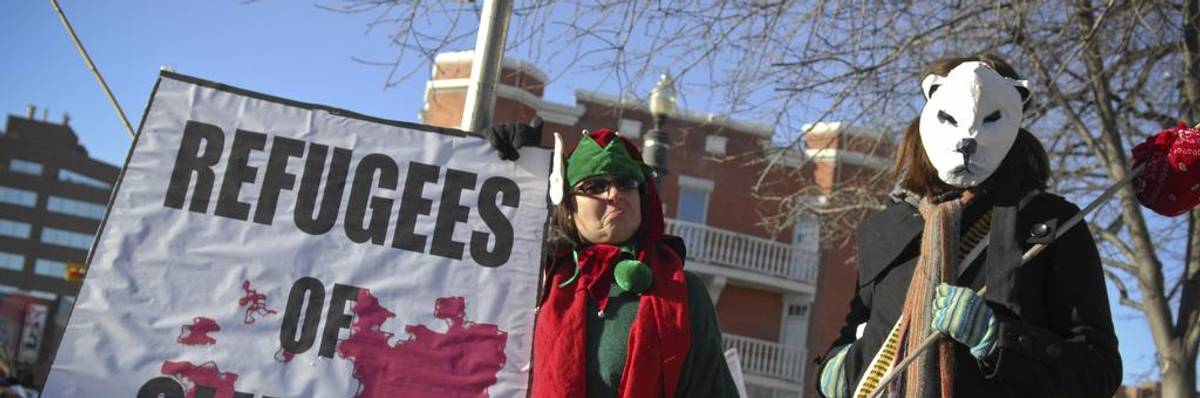
A group calling themselves Climate Change Refugees gathered on 17th Avenue in Calgary, Alberta on December 8th, 2007 for the International Day of Action on Climate Change. (Photo: Tavis Ford/Flickr/cc)
The United States' abandonment of global migration and climate change agreements in the same year could be disastrous for climate refugees.
When it comes to addressing the growing problem of climate change induced displacement, neither the UN's Global Compact on Migration nor the Paris Climate Change agreement go far enough. With or without the support of the United States, we need both of these agreements to be more ambitious and implemented faster, to protect some of the world's most vulnerable people.
Yet despite the challenges, here at the epicentre of climate displacement, across the Pacific, people are searching for higher ground, rather than giving up. That's why this week, we, civil society leaders from around the world, are making a global declaration on climate change induced displacement.
During this week's International Civil Society Week (ICSW) meeting in Suva, Fiji, we've heard from people from around the world, who are grappling with global problems at the local level.
They include leaders from across the Pacific who are fighting the twin global problems of nuclear waste and climate change. In the Marshall Islands, leftover nuclear waste from US nuclear tests have already left Runit Island uninhabitable. Now rising sea levels are leaving the people of the Marshall Islands with fewer and fewer options of dry land that is also safe from radiation.
The good news of 2017, although it will not help the Marshall Islands, is that UN member states - 53 so far - banded together to introduce a nuclear test ban treaty. It may be a pipe dream - as rhetoric between North Korea and the United States escalates - but it was a show of unity, that together we can achieve seemingly impossible global goals.
That the Nobel Prize committee chose to honour the International Campaign to Abolish Nuclear Weapons (ICAN) with the 2017 Nobel Peace Prize for their efforts to achieve the treaty, was also a major recognition of the work that civil society coalitions do, often behind the scenes, to solve global problems.
Civil society is also working tirelessly behind the scenes on other global issues, including climate change and migration. Collectively we believe that now is the time to sound the alarm on an emerging global problem unlike any we have seen before.
While conflicts, natural disasters, poverty and famine have all caused mass displacement in the past, climate change induced displacement will be like nothing we have ever seen before. And, it will come on top of the displacement from conflicts, poverty and inequality that we are already struggling to coordinate.
This year's disastrous hurricane season in the Caribbean was particularly severe because of warmer oceans. We've season unprecedented cyclones in the Pacific over the past two years. Already, entire islands are being left uninhabitable for months, but soon the equation may change and that time period may become years.
And while climate induced displacement is often associated with small tropical islands, that's far from the whole picture. Droughts spurred on by super El Ninos force farmers off their land. Monsoonal floods of low-lying highly populated river delta areas leave millions homeless year in year out. And these are all events that are happening already. As temperatures rise, oceans warm and acidify, weather events become more severe, the situation will only get worse.
That's why, this week, CIVICUS, together with the Pacific Islands Development Forum are calling for the UN's global migration compact to recognise climate change as a driver of both internal and international displacement. In the words of my colleagues from the Pacific Islands, this means striving first and foremost to limit warming to 1.5 degrees: "1.5 to stay alive."
We also need governments to recommit to the human rights of people who are forced to move because of climate change. It's also important that we commit to those who are the most vulnerable to climate displacement and include them in our efforts to find solutions.
For those on the frontlines of climate-induced migration, there is really no choice. We have to act now, because "we're not drowning," not yet, not now, not ever, "we're fighting."
Dear Common Dreams reader, It’s been nearly 30 years since I co-founded Common Dreams with my late wife, Lina Newhouser. We had the radical notion that journalism should serve the public good, not corporate profits. It was clear to us from the outset what it would take to build such a project. No paid advertisements. No corporate sponsors. No millionaire publisher telling us what to think or do. Many people said we wouldn't last a year, but we proved those doubters wrong. Together with a tremendous team of journalists and dedicated staff, we built an independent media outlet free from the constraints of profits and corporate control. Our mission has always been simple: To inform. To inspire. To ignite change for the common good. Building Common Dreams was not easy. Our survival was never guaranteed. When you take on the most powerful forces—Wall Street greed, fossil fuel industry destruction, Big Tech lobbyists, and uber-rich oligarchs who have spent billions upon billions rigging the economy and democracy in their favor—the only bulwark you have is supporters who believe in your work. But here’s the urgent message from me today. It's never been this bad out there. And it's never been this hard to keep us going. At the very moment Common Dreams is most needed, the threats we face are intensifying. We need your support now more than ever. We don't accept corporate advertising and never will. We don't have a paywall because we don't think people should be blocked from critical news based on their ability to pay. Everything we do is funded by the donations of readers like you. When everyone does the little they can afford, we are strong. But if that support retreats or dries up, so do we. Will you donate now to make sure Common Dreams not only survives but thrives? —Craig Brown, Co-founder |
The United States' abandonment of global migration and climate change agreements in the same year could be disastrous for climate refugees.
When it comes to addressing the growing problem of climate change induced displacement, neither the UN's Global Compact on Migration nor the Paris Climate Change agreement go far enough. With or without the support of the United States, we need both of these agreements to be more ambitious and implemented faster, to protect some of the world's most vulnerable people.
Yet despite the challenges, here at the epicentre of climate displacement, across the Pacific, people are searching for higher ground, rather than giving up. That's why this week, we, civil society leaders from around the world, are making a global declaration on climate change induced displacement.
During this week's International Civil Society Week (ICSW) meeting in Suva, Fiji, we've heard from people from around the world, who are grappling with global problems at the local level.
They include leaders from across the Pacific who are fighting the twin global problems of nuclear waste and climate change. In the Marshall Islands, leftover nuclear waste from US nuclear tests have already left Runit Island uninhabitable. Now rising sea levels are leaving the people of the Marshall Islands with fewer and fewer options of dry land that is also safe from radiation.
The good news of 2017, although it will not help the Marshall Islands, is that UN member states - 53 so far - banded together to introduce a nuclear test ban treaty. It may be a pipe dream - as rhetoric between North Korea and the United States escalates - but it was a show of unity, that together we can achieve seemingly impossible global goals.
That the Nobel Prize committee chose to honour the International Campaign to Abolish Nuclear Weapons (ICAN) with the 2017 Nobel Peace Prize for their efforts to achieve the treaty, was also a major recognition of the work that civil society coalitions do, often behind the scenes, to solve global problems.
Civil society is also working tirelessly behind the scenes on other global issues, including climate change and migration. Collectively we believe that now is the time to sound the alarm on an emerging global problem unlike any we have seen before.
While conflicts, natural disasters, poverty and famine have all caused mass displacement in the past, climate change induced displacement will be like nothing we have ever seen before. And, it will come on top of the displacement from conflicts, poverty and inequality that we are already struggling to coordinate.
This year's disastrous hurricane season in the Caribbean was particularly severe because of warmer oceans. We've season unprecedented cyclones in the Pacific over the past two years. Already, entire islands are being left uninhabitable for months, but soon the equation may change and that time period may become years.
And while climate induced displacement is often associated with small tropical islands, that's far from the whole picture. Droughts spurred on by super El Ninos force farmers off their land. Monsoonal floods of low-lying highly populated river delta areas leave millions homeless year in year out. And these are all events that are happening already. As temperatures rise, oceans warm and acidify, weather events become more severe, the situation will only get worse.
That's why, this week, CIVICUS, together with the Pacific Islands Development Forum are calling for the UN's global migration compact to recognise climate change as a driver of both internal and international displacement. In the words of my colleagues from the Pacific Islands, this means striving first and foremost to limit warming to 1.5 degrees: "1.5 to stay alive."
We also need governments to recommit to the human rights of people who are forced to move because of climate change. It's also important that we commit to those who are the most vulnerable to climate displacement and include them in our efforts to find solutions.
For those on the frontlines of climate-induced migration, there is really no choice. We have to act now, because "we're not drowning," not yet, not now, not ever, "we're fighting."
The United States' abandonment of global migration and climate change agreements in the same year could be disastrous for climate refugees.
When it comes to addressing the growing problem of climate change induced displacement, neither the UN's Global Compact on Migration nor the Paris Climate Change agreement go far enough. With or without the support of the United States, we need both of these agreements to be more ambitious and implemented faster, to protect some of the world's most vulnerable people.
Yet despite the challenges, here at the epicentre of climate displacement, across the Pacific, people are searching for higher ground, rather than giving up. That's why this week, we, civil society leaders from around the world, are making a global declaration on climate change induced displacement.
During this week's International Civil Society Week (ICSW) meeting in Suva, Fiji, we've heard from people from around the world, who are grappling with global problems at the local level.
They include leaders from across the Pacific who are fighting the twin global problems of nuclear waste and climate change. In the Marshall Islands, leftover nuclear waste from US nuclear tests have already left Runit Island uninhabitable. Now rising sea levels are leaving the people of the Marshall Islands with fewer and fewer options of dry land that is also safe from radiation.
The good news of 2017, although it will not help the Marshall Islands, is that UN member states - 53 so far - banded together to introduce a nuclear test ban treaty. It may be a pipe dream - as rhetoric between North Korea and the United States escalates - but it was a show of unity, that together we can achieve seemingly impossible global goals.
That the Nobel Prize committee chose to honour the International Campaign to Abolish Nuclear Weapons (ICAN) with the 2017 Nobel Peace Prize for their efforts to achieve the treaty, was also a major recognition of the work that civil society coalitions do, often behind the scenes, to solve global problems.
Civil society is also working tirelessly behind the scenes on other global issues, including climate change and migration. Collectively we believe that now is the time to sound the alarm on an emerging global problem unlike any we have seen before.
While conflicts, natural disasters, poverty and famine have all caused mass displacement in the past, climate change induced displacement will be like nothing we have ever seen before. And, it will come on top of the displacement from conflicts, poverty and inequality that we are already struggling to coordinate.
This year's disastrous hurricane season in the Caribbean was particularly severe because of warmer oceans. We've season unprecedented cyclones in the Pacific over the past two years. Already, entire islands are being left uninhabitable for months, but soon the equation may change and that time period may become years.
And while climate induced displacement is often associated with small tropical islands, that's far from the whole picture. Droughts spurred on by super El Ninos force farmers off their land. Monsoonal floods of low-lying highly populated river delta areas leave millions homeless year in year out. And these are all events that are happening already. As temperatures rise, oceans warm and acidify, weather events become more severe, the situation will only get worse.
That's why, this week, CIVICUS, together with the Pacific Islands Development Forum are calling for the UN's global migration compact to recognise climate change as a driver of both internal and international displacement. In the words of my colleagues from the Pacific Islands, this means striving first and foremost to limit warming to 1.5 degrees: "1.5 to stay alive."
We also need governments to recommit to the human rights of people who are forced to move because of climate change. It's also important that we commit to those who are the most vulnerable to climate displacement and include them in our efforts to find solutions.
For those on the frontlines of climate-induced migration, there is really no choice. We have to act now, because "we're not drowning," not yet, not now, not ever, "we're fighting."