SUBSCRIBE TO OUR FREE NEWSLETTER
Daily news & progressive opinion—funded by the people, not the corporations—delivered straight to your inbox.
5
#000000
#FFFFFF
To donate by check, phone, or other method, see our More Ways to Give page.
Daily news & progressive opinion—funded by the people, not the corporations—delivered straight to your inbox.
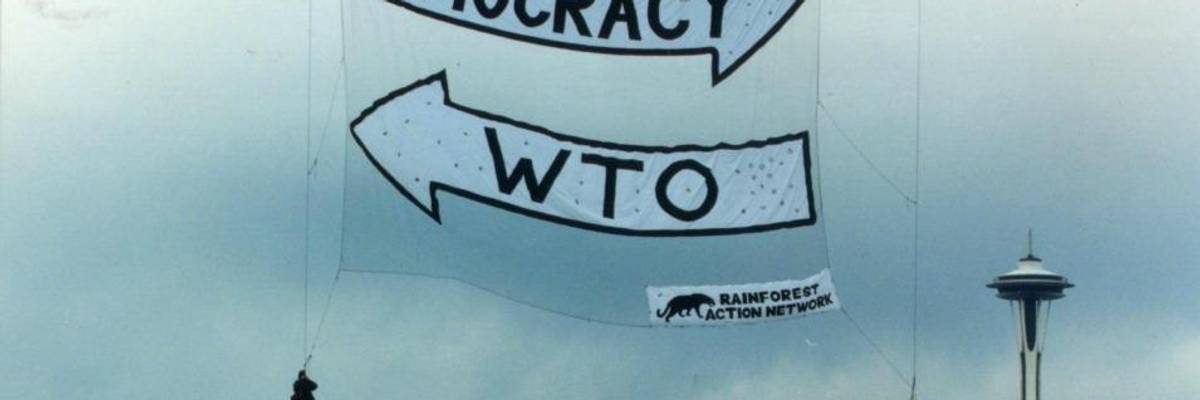
"It's therefore hardly surprising that the multinational corporate lobbyists representing the likes of Shell, Amazon and Monsanto all got to keep their WTO accreditation and will wine and dine officials, as is the usual practice." (Photo: Dang Ngo / Rainforest Action Network)
Trade deals affect people's everyday lives from the food we eat to the energy we use, and should not be discussed in secret, behind closed doors. Yet sadly, this is exactly what is happening at this year's upcoming World Trade Organization meeting in Buenos Aires from 10-13 December.
Friends of the Earth International has been advocating for a fair and sustainable trade agenda for over two decades, yet this is the first time we have been banned from participating in the WTO.
In an unprecedented move, the Argentine government revoked our accreditation, together with 60 individuals from a diverse range of trade unions, farmers' and consumer rights organisations.
The official reason for our ban is that we have "been making explicate calls for violent protests on social media, desiring to create scenes of chaos and intimidation." Yet this information can be disproved simply by checking our Twitter account, which has never made incitements to violence.
"Locking people out of the WTO will only further undermine its legitimacy."
At the same time, we do not shy away disagreeing with many of the pro-corporate policies and deals being pushed by the WTO and the Argentine government, which are often stumbling blocks for action on climate change.
When India's National Solar Mission, which aims to bring energy to millions of people by building 100 GW of solar energy, was found "guilty" by the WTO of creating local jobs, we spoke up.
We have also protested WTO policies that penalise and prohibit developing countries from undertaking public stockholding programmes. This blocks food sovereignty for the world's poorest, and livelihoods for peasant, indigenous and small-scale farmers, yet allows the EU and USA to provide massive global market distorting subsidies that beef up agribusiness interests while ruining farmers abroad.
A crackdown on our rights to debate and oppose such trade policies is an attack on our ability to decide what kind of world we want to live in. The backlash against civil society by President Mauricio Macri's government in Argentina is worrying, and reveals the true face of his government: neoliberal, corporate and serving one-per-cent of the population.
It's therefore hardly surprising that the multinational corporate lobbyists representing the likes of Shell, Amazon and Monsanto all got to keep their WTO accreditation and will wine and dine officials, as is the usual practice. It is these same multinationals that own or orchestrate the supply chains for over 50% of world trade, yet account for only 2% of the world's jobs.
If WTO Director General Roberto Azevedo allows the meeting in Argentina, he is complicit in attempts to silence the voice of civil society. Locking people out of the WTO will only further undermine its legitimacy.
This decision is part of on an ongoing pattern of decreasing transparency in trade deals. The Regional Comprehensive Economic Partnership (RCEP) being negotiated by 16 Asian countries is done so almost completely in secret, and offers limited to no meaningful public participation. Most elected officials will have, at best, limited access to the negotiating texts, under strict confidentiality rules, and these will remain out of reach for civil society groups and citizens. The ad-hoc and often token stakeholder consultations are far from sufficient to make the process transparent or participatory.
"Citizens have a right to know how the deal is being negotiated, who is influencing it, and what is being put on the table."
Millions of Europeans that protested against the Transatlantic Trade and Investment Partnership (TTIP) were driven to action by the devastating impact of the deal on people and the environment, but also the fact that it was negotiated behind closed doors. People want a say in determining their future.
Around 30% of the Global World Product is trade related. These negotiations will impact people's jobs, domestic regulations and healthcare. Citizens have a right to know how the deal is being negotiated, who is influencing it, and what is being put on the table.
There are many international negotiations that provide a greater degree of transparency. For example, the United Nations Inter-Governmental Working Group on Multinational Enterprises with regards to Human Rights, in which civil society are seen as an active partner, give observers and experts a chance to attend sessions and provide input.
Regardless of attempts' to silence us, we will continue demanding a new trade system--one which is based on the cooperation of people, direct fair trade networks between producers and consumers, decent jobs, a sustainable environmental policy, human rights, responsible energy and food sovereignty for local communities.
Dear Common Dreams reader, It’s been nearly 30 years since I co-founded Common Dreams with my late wife, Lina Newhouser. We had the radical notion that journalism should serve the public good, not corporate profits. It was clear to us from the outset what it would take to build such a project. No paid advertisements. No corporate sponsors. No millionaire publisher telling us what to think or do. Many people said we wouldn't last a year, but we proved those doubters wrong. Together with a tremendous team of journalists and dedicated staff, we built an independent media outlet free from the constraints of profits and corporate control. Our mission has always been simple: To inform. To inspire. To ignite change for the common good. Building Common Dreams was not easy. Our survival was never guaranteed. When you take on the most powerful forces—Wall Street greed, fossil fuel industry destruction, Big Tech lobbyists, and uber-rich oligarchs who have spent billions upon billions rigging the economy and democracy in their favor—the only bulwark you have is supporters who believe in your work. But here’s the urgent message from me today. It's never been this bad out there. And it's never been this hard to keep us going. At the very moment Common Dreams is most needed, the threats we face are intensifying. We need your support now more than ever. We don't accept corporate advertising and never will. We don't have a paywall because we don't think people should be blocked from critical news based on their ability to pay. Everything we do is funded by the donations of readers like you. When everyone does the little they can afford, we are strong. But if that support retreats or dries up, so do we. Will you donate now to make sure Common Dreams not only survives but thrives? —Craig Brown, Co-founder |
Trade deals affect people's everyday lives from the food we eat to the energy we use, and should not be discussed in secret, behind closed doors. Yet sadly, this is exactly what is happening at this year's upcoming World Trade Organization meeting in Buenos Aires from 10-13 December.
Friends of the Earth International has been advocating for a fair and sustainable trade agenda for over two decades, yet this is the first time we have been banned from participating in the WTO.
In an unprecedented move, the Argentine government revoked our accreditation, together with 60 individuals from a diverse range of trade unions, farmers' and consumer rights organisations.
The official reason for our ban is that we have "been making explicate calls for violent protests on social media, desiring to create scenes of chaos and intimidation." Yet this information can be disproved simply by checking our Twitter account, which has never made incitements to violence.
"Locking people out of the WTO will only further undermine its legitimacy."
At the same time, we do not shy away disagreeing with many of the pro-corporate policies and deals being pushed by the WTO and the Argentine government, which are often stumbling blocks for action on climate change.
When India's National Solar Mission, which aims to bring energy to millions of people by building 100 GW of solar energy, was found "guilty" by the WTO of creating local jobs, we spoke up.
We have also protested WTO policies that penalise and prohibit developing countries from undertaking public stockholding programmes. This blocks food sovereignty for the world's poorest, and livelihoods for peasant, indigenous and small-scale farmers, yet allows the EU and USA to provide massive global market distorting subsidies that beef up agribusiness interests while ruining farmers abroad.
A crackdown on our rights to debate and oppose such trade policies is an attack on our ability to decide what kind of world we want to live in. The backlash against civil society by President Mauricio Macri's government in Argentina is worrying, and reveals the true face of his government: neoliberal, corporate and serving one-per-cent of the population.
It's therefore hardly surprising that the multinational corporate lobbyists representing the likes of Shell, Amazon and Monsanto all got to keep their WTO accreditation and will wine and dine officials, as is the usual practice. It is these same multinationals that own or orchestrate the supply chains for over 50% of world trade, yet account for only 2% of the world's jobs.
If WTO Director General Roberto Azevedo allows the meeting in Argentina, he is complicit in attempts to silence the voice of civil society. Locking people out of the WTO will only further undermine its legitimacy.
This decision is part of on an ongoing pattern of decreasing transparency in trade deals. The Regional Comprehensive Economic Partnership (RCEP) being negotiated by 16 Asian countries is done so almost completely in secret, and offers limited to no meaningful public participation. Most elected officials will have, at best, limited access to the negotiating texts, under strict confidentiality rules, and these will remain out of reach for civil society groups and citizens. The ad-hoc and often token stakeholder consultations are far from sufficient to make the process transparent or participatory.
"Citizens have a right to know how the deal is being negotiated, who is influencing it, and what is being put on the table."
Millions of Europeans that protested against the Transatlantic Trade and Investment Partnership (TTIP) were driven to action by the devastating impact of the deal on people and the environment, but also the fact that it was negotiated behind closed doors. People want a say in determining their future.
Around 30% of the Global World Product is trade related. These negotiations will impact people's jobs, domestic regulations and healthcare. Citizens have a right to know how the deal is being negotiated, who is influencing it, and what is being put on the table.
There are many international negotiations that provide a greater degree of transparency. For example, the United Nations Inter-Governmental Working Group on Multinational Enterprises with regards to Human Rights, in which civil society are seen as an active partner, give observers and experts a chance to attend sessions and provide input.
Regardless of attempts' to silence us, we will continue demanding a new trade system--one which is based on the cooperation of people, direct fair trade networks between producers and consumers, decent jobs, a sustainable environmental policy, human rights, responsible energy and food sovereignty for local communities.
Trade deals affect people's everyday lives from the food we eat to the energy we use, and should not be discussed in secret, behind closed doors. Yet sadly, this is exactly what is happening at this year's upcoming World Trade Organization meeting in Buenos Aires from 10-13 December.
Friends of the Earth International has been advocating for a fair and sustainable trade agenda for over two decades, yet this is the first time we have been banned from participating in the WTO.
In an unprecedented move, the Argentine government revoked our accreditation, together with 60 individuals from a diverse range of trade unions, farmers' and consumer rights organisations.
The official reason for our ban is that we have "been making explicate calls for violent protests on social media, desiring to create scenes of chaos and intimidation." Yet this information can be disproved simply by checking our Twitter account, which has never made incitements to violence.
"Locking people out of the WTO will only further undermine its legitimacy."
At the same time, we do not shy away disagreeing with many of the pro-corporate policies and deals being pushed by the WTO and the Argentine government, which are often stumbling blocks for action on climate change.
When India's National Solar Mission, which aims to bring energy to millions of people by building 100 GW of solar energy, was found "guilty" by the WTO of creating local jobs, we spoke up.
We have also protested WTO policies that penalise and prohibit developing countries from undertaking public stockholding programmes. This blocks food sovereignty for the world's poorest, and livelihoods for peasant, indigenous and small-scale farmers, yet allows the EU and USA to provide massive global market distorting subsidies that beef up agribusiness interests while ruining farmers abroad.
A crackdown on our rights to debate and oppose such trade policies is an attack on our ability to decide what kind of world we want to live in. The backlash against civil society by President Mauricio Macri's government in Argentina is worrying, and reveals the true face of his government: neoliberal, corporate and serving one-per-cent of the population.
It's therefore hardly surprising that the multinational corporate lobbyists representing the likes of Shell, Amazon and Monsanto all got to keep their WTO accreditation and will wine and dine officials, as is the usual practice. It is these same multinationals that own or orchestrate the supply chains for over 50% of world trade, yet account for only 2% of the world's jobs.
If WTO Director General Roberto Azevedo allows the meeting in Argentina, he is complicit in attempts to silence the voice of civil society. Locking people out of the WTO will only further undermine its legitimacy.
This decision is part of on an ongoing pattern of decreasing transparency in trade deals. The Regional Comprehensive Economic Partnership (RCEP) being negotiated by 16 Asian countries is done so almost completely in secret, and offers limited to no meaningful public participation. Most elected officials will have, at best, limited access to the negotiating texts, under strict confidentiality rules, and these will remain out of reach for civil society groups and citizens. The ad-hoc and often token stakeholder consultations are far from sufficient to make the process transparent or participatory.
"Citizens have a right to know how the deal is being negotiated, who is influencing it, and what is being put on the table."
Millions of Europeans that protested against the Transatlantic Trade and Investment Partnership (TTIP) were driven to action by the devastating impact of the deal on people and the environment, but also the fact that it was negotiated behind closed doors. People want a say in determining their future.
Around 30% of the Global World Product is trade related. These negotiations will impact people's jobs, domestic regulations and healthcare. Citizens have a right to know how the deal is being negotiated, who is influencing it, and what is being put on the table.
There are many international negotiations that provide a greater degree of transparency. For example, the United Nations Inter-Governmental Working Group on Multinational Enterprises with regards to Human Rights, in which civil society are seen as an active partner, give observers and experts a chance to attend sessions and provide input.
Regardless of attempts' to silence us, we will continue demanding a new trade system--one which is based on the cooperation of people, direct fair trade networks between producers and consumers, decent jobs, a sustainable environmental policy, human rights, responsible energy and food sovereignty for local communities.