SUBSCRIBE TO OUR FREE NEWSLETTER
Daily news & progressive opinion—funded by the people, not the corporations—delivered straight to your inbox.
5
#000000
#FFFFFF
To donate by check, phone, or other method, see our More Ways to Give page.
Daily news & progressive opinion—funded by the people, not the corporations—delivered straight to your inbox.
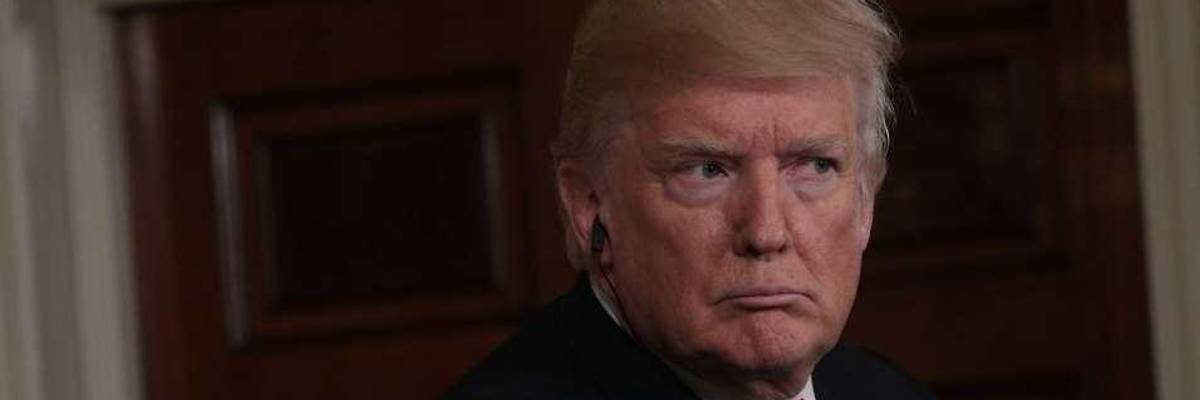
"By saying and doing whatever he believes it takes for him to come out on top, Donald Trump has abused the trust we place in a president to preserve and protect the nation's capacity for self-government." (Photo by Alex Wong/Getty Images)
In a radio interview on Thursday, Trump said "the saddest thing is, because I am the President of the United States, I am not supposed to be involved with the Justice Department. I'm not supposed to be involved with the FBI. I'm not supposed to be doing the kind of things I would love to be doing."
Trump then asked, referring to the Department and the FBI, "why aren't they going after Hillary Clinton with her emails and with her dossier?"
In a series of tweets Friday morning, Trump directly called on the Justice Department and the FBI to "do what is right and proper" by launching criminal probes of Hillary Clinton.
Trump's obvious aim was to deflect attention from special counsel Robert Mueller's probe of his campaign, and of the indictments issued against his campaign aides.
But by calling on the Justice Department to investigate Hillary Clinton, and lamenting he cannot do "the kind of things I would love to be doing," Trump crossed a particularly dangerous line.
In a democracy bound by the rule of law, presidents do not prosecute their political opponents. Nor, until now, have they tried to stir up public anger toward their former opponents.
Our democratic system of government depends on presidents putting that system above their own partisan aims.
As Harvard political scientist Archon Fung has noted, once an election is over, candidates' graciousness to one another is an important demonstration of their commitment to the democratic system over the specific outcomes they fought to achieve.
This helps reestablish civility and social cohesion. It reminds the public that our allegiance is not toward a particular person or party but to our system of government.
Think of Al Gore's concession speech to George W. Bush in 2000, after five weeks of a bitterly contested election and just one day after the Supreme Court ruled 5-4 in favor of Bush. "I say to President-elect Bush that what remains of partisan rancor must now be put aside, and may God bless his stewardship of this country."
Gore publicly bowed to the institutions of our democracy. "Now the U.S. Supreme Court has spoken. Let there be no doubt, while I strongly disagree with the court's decision, I accept it ... And tonight, for the sake of our unity as a people and the strength of our democracy, I offer my concession."
Bush's response to Gore was no less gracious: "Vice president Gore and I put our hearts and hopes into our campaigns; we both gave it our all. We shared similar emotions. I understand how difficult this moment must be for vice president Gore and his family. He has a distinguished record of service to our country as a congressman, a senator and as vice president."
Many voters continued to doubt the legitimacy of Bush's victory, but there was no social unrest, no civil war. Americans didn't retreat into warring tribes.
Think of what might have occurred if Gore had bitterly accused Bush of winning fraudulently, and blamed the five Republican appointees on the Supreme Court for siding with Bush for partisan reasons.
Think of what might have happened if, during his campaign, Bush had promised to put Gore in jail for various improprieties, and then, after he won, called on the Justice Department and the FBI to launch a criminal investigation of Gore.
These statements - close to ones that Donald Trump has actually made - might have imperiled the political stability of the nation.
Instead, Gore and Bush made the same moral choice their predecessors made at the end of every previous American presidential election, and for the same reason.
They understood that the demonstrations of respect for each other and for the Constitution confirmed the nation's commitment to our system of government. This was far more important than their own losses or wins.
Donald Trump has no such concern.
This is the essence of Trump's failure as president - not that he has chosen one set of policies over another, or has lied repeatedly and chronically, or even that he has behaved in childish and vindictive ways unbecoming a president.
It is that he has sacrificed the processes and institutions of American democracy to achieve his own selfish ends.
By saying and doing whatever he believes it takes for him to come out on top, Donald Trump has abused the trust we place in a president to preserve and protect the nation's capacity for self-government.
This will be his most damaging and most damning legacy.
Dear Common Dreams reader, It’s been nearly 30 years since I co-founded Common Dreams with my late wife, Lina Newhouser. We had the radical notion that journalism should serve the public good, not corporate profits. It was clear to us from the outset what it would take to build such a project. No paid advertisements. No corporate sponsors. No millionaire publisher telling us what to think or do. Many people said we wouldn't last a year, but we proved those doubters wrong. Together with a tremendous team of journalists and dedicated staff, we built an independent media outlet free from the constraints of profits and corporate control. Our mission has always been simple: To inform. To inspire. To ignite change for the common good. Building Common Dreams was not easy. Our survival was never guaranteed. When you take on the most powerful forces—Wall Street greed, fossil fuel industry destruction, Big Tech lobbyists, and uber-rich oligarchs who have spent billions upon billions rigging the economy and democracy in their favor—the only bulwark you have is supporters who believe in your work. But here’s the urgent message from me today. It's never been this bad out there. And it's never been this hard to keep us going. At the very moment Common Dreams is most needed, the threats we face are intensifying. We need your support now more than ever. We don't accept corporate advertising and never will. We don't have a paywall because we don't think people should be blocked from critical news based on their ability to pay. Everything we do is funded by the donations of readers like you. When everyone does the little they can afford, we are strong. But if that support retreats or dries up, so do we. Will you donate now to make sure Common Dreams not only survives but thrives? —Craig Brown, Co-founder |
In a radio interview on Thursday, Trump said "the saddest thing is, because I am the President of the United States, I am not supposed to be involved with the Justice Department. I'm not supposed to be involved with the FBI. I'm not supposed to be doing the kind of things I would love to be doing."
Trump then asked, referring to the Department and the FBI, "why aren't they going after Hillary Clinton with her emails and with her dossier?"
In a series of tweets Friday morning, Trump directly called on the Justice Department and the FBI to "do what is right and proper" by launching criminal probes of Hillary Clinton.
Trump's obvious aim was to deflect attention from special counsel Robert Mueller's probe of his campaign, and of the indictments issued against his campaign aides.
But by calling on the Justice Department to investigate Hillary Clinton, and lamenting he cannot do "the kind of things I would love to be doing," Trump crossed a particularly dangerous line.
In a democracy bound by the rule of law, presidents do not prosecute their political opponents. Nor, until now, have they tried to stir up public anger toward their former opponents.
Our democratic system of government depends on presidents putting that system above their own partisan aims.
As Harvard political scientist Archon Fung has noted, once an election is over, candidates' graciousness to one another is an important demonstration of their commitment to the democratic system over the specific outcomes they fought to achieve.
This helps reestablish civility and social cohesion. It reminds the public that our allegiance is not toward a particular person or party but to our system of government.
Think of Al Gore's concession speech to George W. Bush in 2000, after five weeks of a bitterly contested election and just one day after the Supreme Court ruled 5-4 in favor of Bush. "I say to President-elect Bush that what remains of partisan rancor must now be put aside, and may God bless his stewardship of this country."
Gore publicly bowed to the institutions of our democracy. "Now the U.S. Supreme Court has spoken. Let there be no doubt, while I strongly disagree with the court's decision, I accept it ... And tonight, for the sake of our unity as a people and the strength of our democracy, I offer my concession."
Bush's response to Gore was no less gracious: "Vice president Gore and I put our hearts and hopes into our campaigns; we both gave it our all. We shared similar emotions. I understand how difficult this moment must be for vice president Gore and his family. He has a distinguished record of service to our country as a congressman, a senator and as vice president."
Many voters continued to doubt the legitimacy of Bush's victory, but there was no social unrest, no civil war. Americans didn't retreat into warring tribes.
Think of what might have occurred if Gore had bitterly accused Bush of winning fraudulently, and blamed the five Republican appointees on the Supreme Court for siding with Bush for partisan reasons.
Think of what might have happened if, during his campaign, Bush had promised to put Gore in jail for various improprieties, and then, after he won, called on the Justice Department and the FBI to launch a criminal investigation of Gore.
These statements - close to ones that Donald Trump has actually made - might have imperiled the political stability of the nation.
Instead, Gore and Bush made the same moral choice their predecessors made at the end of every previous American presidential election, and for the same reason.
They understood that the demonstrations of respect for each other and for the Constitution confirmed the nation's commitment to our system of government. This was far more important than their own losses or wins.
Donald Trump has no such concern.
This is the essence of Trump's failure as president - not that he has chosen one set of policies over another, or has lied repeatedly and chronically, or even that he has behaved in childish and vindictive ways unbecoming a president.
It is that he has sacrificed the processes and institutions of American democracy to achieve his own selfish ends.
By saying and doing whatever he believes it takes for him to come out on top, Donald Trump has abused the trust we place in a president to preserve and protect the nation's capacity for self-government.
This will be his most damaging and most damning legacy.
In a radio interview on Thursday, Trump said "the saddest thing is, because I am the President of the United States, I am not supposed to be involved with the Justice Department. I'm not supposed to be involved with the FBI. I'm not supposed to be doing the kind of things I would love to be doing."
Trump then asked, referring to the Department and the FBI, "why aren't they going after Hillary Clinton with her emails and with her dossier?"
In a series of tweets Friday morning, Trump directly called on the Justice Department and the FBI to "do what is right and proper" by launching criminal probes of Hillary Clinton.
Trump's obvious aim was to deflect attention from special counsel Robert Mueller's probe of his campaign, and of the indictments issued against his campaign aides.
But by calling on the Justice Department to investigate Hillary Clinton, and lamenting he cannot do "the kind of things I would love to be doing," Trump crossed a particularly dangerous line.
In a democracy bound by the rule of law, presidents do not prosecute their political opponents. Nor, until now, have they tried to stir up public anger toward their former opponents.
Our democratic system of government depends on presidents putting that system above their own partisan aims.
As Harvard political scientist Archon Fung has noted, once an election is over, candidates' graciousness to one another is an important demonstration of their commitment to the democratic system over the specific outcomes they fought to achieve.
This helps reestablish civility and social cohesion. It reminds the public that our allegiance is not toward a particular person or party but to our system of government.
Think of Al Gore's concession speech to George W. Bush in 2000, after five weeks of a bitterly contested election and just one day after the Supreme Court ruled 5-4 in favor of Bush. "I say to President-elect Bush that what remains of partisan rancor must now be put aside, and may God bless his stewardship of this country."
Gore publicly bowed to the institutions of our democracy. "Now the U.S. Supreme Court has spoken. Let there be no doubt, while I strongly disagree with the court's decision, I accept it ... And tonight, for the sake of our unity as a people and the strength of our democracy, I offer my concession."
Bush's response to Gore was no less gracious: "Vice president Gore and I put our hearts and hopes into our campaigns; we both gave it our all. We shared similar emotions. I understand how difficult this moment must be for vice president Gore and his family. He has a distinguished record of service to our country as a congressman, a senator and as vice president."
Many voters continued to doubt the legitimacy of Bush's victory, but there was no social unrest, no civil war. Americans didn't retreat into warring tribes.
Think of what might have occurred if Gore had bitterly accused Bush of winning fraudulently, and blamed the five Republican appointees on the Supreme Court for siding with Bush for partisan reasons.
Think of what might have happened if, during his campaign, Bush had promised to put Gore in jail for various improprieties, and then, after he won, called on the Justice Department and the FBI to launch a criminal investigation of Gore.
These statements - close to ones that Donald Trump has actually made - might have imperiled the political stability of the nation.
Instead, Gore and Bush made the same moral choice their predecessors made at the end of every previous American presidential election, and for the same reason.
They understood that the demonstrations of respect for each other and for the Constitution confirmed the nation's commitment to our system of government. This was far more important than their own losses or wins.
Donald Trump has no such concern.
This is the essence of Trump's failure as president - not that he has chosen one set of policies over another, or has lied repeatedly and chronically, or even that he has behaved in childish and vindictive ways unbecoming a president.
It is that he has sacrificed the processes and institutions of American democracy to achieve his own selfish ends.
By saying and doing whatever he believes it takes for him to come out on top, Donald Trump has abused the trust we place in a president to preserve and protect the nation's capacity for self-government.
This will be his most damaging and most damning legacy.