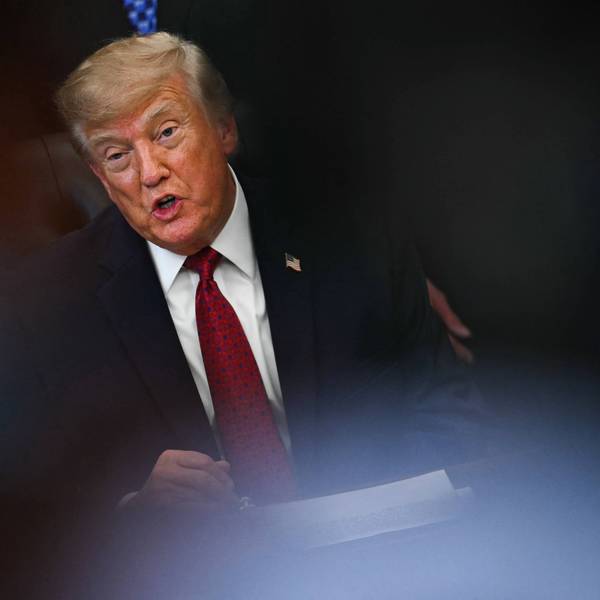


Most Republicans see the world so differently from Democrats that they approve of a president whom most Democrats deplore. (Photo: Scott Olson/Getty Images)
Have We Reached Trump's Tipping Point?
Democrats find Trump so repugnant that they find it hard to imagine that any American would support him. Nonetheless, he’s tightened his grip on most Republican voters.
Even by Trump regime standards, the past several weeks have been unusually tumultuous. First, Trump botched aid to Puerto Rico; then, he muffed condolence calls to widows. Now he's being condemned by two Republican Senators. Have we reached the long-awaited "tipping point?" Is this the beginning of the end of the Trump era?
Since Trump took office, Democrats have been waiting for one of two events. Either Trump would mature and begin to act presidential, or his base would desert him. After nine months, it's clear that Trump is not going to change. (On October 24, Republican Senator Jeff Flake deplored Trump's "reckless, outrageous, and undignified behavior.") Given Trump's inflexibility, are we nearing the point where his base deserts him?
According to the political website FiveThirtyEight, Trump's popularity has remained stable for five months. It's currently at 56.7 percent disapprove and 37.2 percent approve; since May, Trump's approval ratings have stayed within a band of 54 to 56 percent disapprove and 37 to 39 percent approve. He's an unpopular President but, based on this metric, his base is sticking with him.
Democrats find Trump so repugnant that they find it hard to imagine that any American would support him. Nonetheless, he's tightened his grip on most Republican voters. There are three reasons for this.
The first is that Trump commands the right-wing media. While the mainstream media (MSNBC, CNN, New York Times, Washington Post and others) have reported adversely on Trump's behavior, the distinctly right-wing media (Fox, Breitbart and others) have been supportive. New Yorker columnist Elizabeth Drew noted Trump's political skills: "He can... make use of social media, Fox News and friendly talk shows to keep [his base] loyal."
To gauge the gap between left-wing and right-wing media, turn on your TV and use the remote control to switch back and forth between "The Rachel Maddow Show" on MSNBC and "Sean Hannity" on Fox News. The two shows emphasize different topics and have dramatically different perspectives on Trump.
In addition, Republicans no longer trust the mainstream media. In August, The Economist published a poll indicating, "When Republicans were asked whether they trusted Mr Trump more than the New York Times, the Washington Post or CNN, at least 70 percent sided with the president each time."
A second reason why Trump has tightened his grip on the Republican base is that he expresses their worldview. (The latest Gallup Poll indicates that 80 percent of Republicans approve of Trump). In his classic, Moral Politics, University of California professor George Lakoff notes that conservatives and liberals have two vastly different worldviews; conservatives have a "strict father" worldview and liberals have a "nurturant parent" worldview. Recently, Lakoff observed: "Most Trump supporters have Strict Father morality... They see Trump as bringing America back to their values in a powerful way, making their values respectable and in line with the way the country is being run. Trump's presidency has given them self-respect. Their self-respect is more important than the details of his policies, even if some of those policies hurt them."
This worldview chasm is made clear by the difference between Democrats and Republicans on key issues. Recently, Pew Research updated their landmark study of American political behavior on the left and right. On immigration, study participants were asked if immigrants "Strengthen the U.S. with hard work and talents." The average participant agreed (65 percent) but no "Country-First Conservatives" agreed (0 percent); they saw immigrants as "a burden."
Most Republicans see the world so differently from Democrats that they approve of a president whom most Democrats deplore.
There's a final reason why Trump's base is loyal: He knows how to tailor his message to make each Republican constituency believe that Trump will deliver their most cherished political objective. Pew Research divides Republican voters into four segments: Core Conservatives (13 percent), Country First Conservatives (6 percent), Market Skeptics (12 percent), and New Era Enterprisers (11 percent); for a total of 42 percent of the electorate. Trump has promised Core Conservatives that he will deliver massive tax cuts. He has promised Country First Conservatives that he will "build the wall." (And he has promised conservative evangelical Christians that he will guarantee "religious liberty.")
The Pew study indicates why Trump has Trump has held onto his base but also suggests his vulnerabilities. Obviously, at some point he has to deliver on his promises.
In addition, the Pew study indicates that Trump's aberrant behavior is beginning to wear on Republican voters. Core Conservatives and Country First Conservatives generally approve of the way he conducts himself. In contrast, only 24 percent of Market Skeptics like the way Trump conducts himself as President; only 32 percent regard him as "even-tempered." (Only 49 percent of New Era Enterprisers describe Trump as honest.)
The Pew data suggests there is room for Trump's approval ratings to plummet due to his "reckless, outrageous, and undignified behavior" and his failure to deliver on his key promises. We're inching closer to Trump's tipping point.
We are at a crossroads
This country and this world are at a monumental crossroads. In a few short weeks, US voters will have an opportunity to beat back the forces of fascism and confront the billionaires who are rigging the economy, our media system, and our democracy, making it increasingly impossible for ordinary people to get by. We’re not just talking about the election. We’re talking about what must be done once these fascist elements are vanquished from power. We need a bolder set of solutions than what either major party has so far been willing to offer and a working-class movement ready to fight like hell for it. Trump didn't emerge from nowhere. The conditions that fueled MAGA authoritarianism were created by decades of radical neoliberal economic policies and a corrupt political system dominated by corporate interests. They slashed taxes on the super-rich, promising that the benefits would trickle down. They said giveaways to the corporate titans would make life more affordable for the rest of us. It was all bullshit. And when a bitter, betrayed populace searches for someone to blame, right-wing demagogues have little trouble finding scapegoats. People know when they're being lied to, but you won't hear any of this from the corporate media. Only independent journalism—powered and funded by people who believe in building a better world—can deliver truly trustworthy daily news. Our Fall Campaign is underway, and we need your help. To power our newsroom through the rest of the year, we need to raise $125,000 by midnight on October 31. So if you share our vision, please contribute whatever you can to sustain our work. |
Even by Trump regime standards, the past several weeks have been unusually tumultuous. First, Trump botched aid to Puerto Rico; then, he muffed condolence calls to widows. Now he's being condemned by two Republican Senators. Have we reached the long-awaited "tipping point?" Is this the beginning of the end of the Trump era?
Since Trump took office, Democrats have been waiting for one of two events. Either Trump would mature and begin to act presidential, or his base would desert him. After nine months, it's clear that Trump is not going to change. (On October 24, Republican Senator Jeff Flake deplored Trump's "reckless, outrageous, and undignified behavior.") Given Trump's inflexibility, are we nearing the point where his base deserts him?
According to the political website FiveThirtyEight, Trump's popularity has remained stable for five months. It's currently at 56.7 percent disapprove and 37.2 percent approve; since May, Trump's approval ratings have stayed within a band of 54 to 56 percent disapprove and 37 to 39 percent approve. He's an unpopular President but, based on this metric, his base is sticking with him.
Democrats find Trump so repugnant that they find it hard to imagine that any American would support him. Nonetheless, he's tightened his grip on most Republican voters. There are three reasons for this.
The first is that Trump commands the right-wing media. While the mainstream media (MSNBC, CNN, New York Times, Washington Post and others) have reported adversely on Trump's behavior, the distinctly right-wing media (Fox, Breitbart and others) have been supportive. New Yorker columnist Elizabeth Drew noted Trump's political skills: "He can... make use of social media, Fox News and friendly talk shows to keep [his base] loyal."
To gauge the gap between left-wing and right-wing media, turn on your TV and use the remote control to switch back and forth between "The Rachel Maddow Show" on MSNBC and "Sean Hannity" on Fox News. The two shows emphasize different topics and have dramatically different perspectives on Trump.
In addition, Republicans no longer trust the mainstream media. In August, The Economist published a poll indicating, "When Republicans were asked whether they trusted Mr Trump more than the New York Times, the Washington Post or CNN, at least 70 percent sided with the president each time."
A second reason why Trump has tightened his grip on the Republican base is that he expresses their worldview. (The latest Gallup Poll indicates that 80 percent of Republicans approve of Trump). In his classic, Moral Politics, University of California professor George Lakoff notes that conservatives and liberals have two vastly different worldviews; conservatives have a "strict father" worldview and liberals have a "nurturant parent" worldview. Recently, Lakoff observed: "Most Trump supporters have Strict Father morality... They see Trump as bringing America back to their values in a powerful way, making their values respectable and in line with the way the country is being run. Trump's presidency has given them self-respect. Their self-respect is more important than the details of his policies, even if some of those policies hurt them."
This worldview chasm is made clear by the difference between Democrats and Republicans on key issues. Recently, Pew Research updated their landmark study of American political behavior on the left and right. On immigration, study participants were asked if immigrants "Strengthen the U.S. with hard work and talents." The average participant agreed (65 percent) but no "Country-First Conservatives" agreed (0 percent); they saw immigrants as "a burden."
Most Republicans see the world so differently from Democrats that they approve of a president whom most Democrats deplore.
There's a final reason why Trump's base is loyal: He knows how to tailor his message to make each Republican constituency believe that Trump will deliver their most cherished political objective. Pew Research divides Republican voters into four segments: Core Conservatives (13 percent), Country First Conservatives (6 percent), Market Skeptics (12 percent), and New Era Enterprisers (11 percent); for a total of 42 percent of the electorate. Trump has promised Core Conservatives that he will deliver massive tax cuts. He has promised Country First Conservatives that he will "build the wall." (And he has promised conservative evangelical Christians that he will guarantee "religious liberty.")
The Pew study indicates why Trump has Trump has held onto his base but also suggests his vulnerabilities. Obviously, at some point he has to deliver on his promises.
In addition, the Pew study indicates that Trump's aberrant behavior is beginning to wear on Republican voters. Core Conservatives and Country First Conservatives generally approve of the way he conducts himself. In contrast, only 24 percent of Market Skeptics like the way Trump conducts himself as President; only 32 percent regard him as "even-tempered." (Only 49 percent of New Era Enterprisers describe Trump as honest.)
The Pew data suggests there is room for Trump's approval ratings to plummet due to his "reckless, outrageous, and undignified behavior" and his failure to deliver on his key promises. We're inching closer to Trump's tipping point.
Even by Trump regime standards, the past several weeks have been unusually tumultuous. First, Trump botched aid to Puerto Rico; then, he muffed condolence calls to widows. Now he's being condemned by two Republican Senators. Have we reached the long-awaited "tipping point?" Is this the beginning of the end of the Trump era?
Since Trump took office, Democrats have been waiting for one of two events. Either Trump would mature and begin to act presidential, or his base would desert him. After nine months, it's clear that Trump is not going to change. (On October 24, Republican Senator Jeff Flake deplored Trump's "reckless, outrageous, and undignified behavior.") Given Trump's inflexibility, are we nearing the point where his base deserts him?
According to the political website FiveThirtyEight, Trump's popularity has remained stable for five months. It's currently at 56.7 percent disapprove and 37.2 percent approve; since May, Trump's approval ratings have stayed within a band of 54 to 56 percent disapprove and 37 to 39 percent approve. He's an unpopular President but, based on this metric, his base is sticking with him.
Democrats find Trump so repugnant that they find it hard to imagine that any American would support him. Nonetheless, he's tightened his grip on most Republican voters. There are three reasons for this.
The first is that Trump commands the right-wing media. While the mainstream media (MSNBC, CNN, New York Times, Washington Post and others) have reported adversely on Trump's behavior, the distinctly right-wing media (Fox, Breitbart and others) have been supportive. New Yorker columnist Elizabeth Drew noted Trump's political skills: "He can... make use of social media, Fox News and friendly talk shows to keep [his base] loyal."
To gauge the gap between left-wing and right-wing media, turn on your TV and use the remote control to switch back and forth between "The Rachel Maddow Show" on MSNBC and "Sean Hannity" on Fox News. The two shows emphasize different topics and have dramatically different perspectives on Trump.
In addition, Republicans no longer trust the mainstream media. In August, The Economist published a poll indicating, "When Republicans were asked whether they trusted Mr Trump more than the New York Times, the Washington Post or CNN, at least 70 percent sided with the president each time."
A second reason why Trump has tightened his grip on the Republican base is that he expresses their worldview. (The latest Gallup Poll indicates that 80 percent of Republicans approve of Trump). In his classic, Moral Politics, University of California professor George Lakoff notes that conservatives and liberals have two vastly different worldviews; conservatives have a "strict father" worldview and liberals have a "nurturant parent" worldview. Recently, Lakoff observed: "Most Trump supporters have Strict Father morality... They see Trump as bringing America back to their values in a powerful way, making their values respectable and in line with the way the country is being run. Trump's presidency has given them self-respect. Their self-respect is more important than the details of his policies, even if some of those policies hurt them."
This worldview chasm is made clear by the difference between Democrats and Republicans on key issues. Recently, Pew Research updated their landmark study of American political behavior on the left and right. On immigration, study participants were asked if immigrants "Strengthen the U.S. with hard work and talents." The average participant agreed (65 percent) but no "Country-First Conservatives" agreed (0 percent); they saw immigrants as "a burden."
Most Republicans see the world so differently from Democrats that they approve of a president whom most Democrats deplore.
There's a final reason why Trump's base is loyal: He knows how to tailor his message to make each Republican constituency believe that Trump will deliver their most cherished political objective. Pew Research divides Republican voters into four segments: Core Conservatives (13 percent), Country First Conservatives (6 percent), Market Skeptics (12 percent), and New Era Enterprisers (11 percent); for a total of 42 percent of the electorate. Trump has promised Core Conservatives that he will deliver massive tax cuts. He has promised Country First Conservatives that he will "build the wall." (And he has promised conservative evangelical Christians that he will guarantee "religious liberty.")
The Pew study indicates why Trump has Trump has held onto his base but also suggests his vulnerabilities. Obviously, at some point he has to deliver on his promises.
In addition, the Pew study indicates that Trump's aberrant behavior is beginning to wear on Republican voters. Core Conservatives and Country First Conservatives generally approve of the way he conducts himself. In contrast, only 24 percent of Market Skeptics like the way Trump conducts himself as President; only 32 percent regard him as "even-tempered." (Only 49 percent of New Era Enterprisers describe Trump as honest.)
The Pew data suggests there is room for Trump's approval ratings to plummet due to his "reckless, outrageous, and undignified behavior" and his failure to deliver on his key promises. We're inching closer to Trump's tipping point.