SUBSCRIBE TO OUR FREE NEWSLETTER
Daily news & progressive opinion—funded by the people, not the corporations—delivered straight to your inbox.
5
#000000
#FFFFFF
To donate by check, phone, or other method, see our More Ways to Give page.
Daily news & progressive opinion—funded by the people, not the corporations—delivered straight to your inbox.
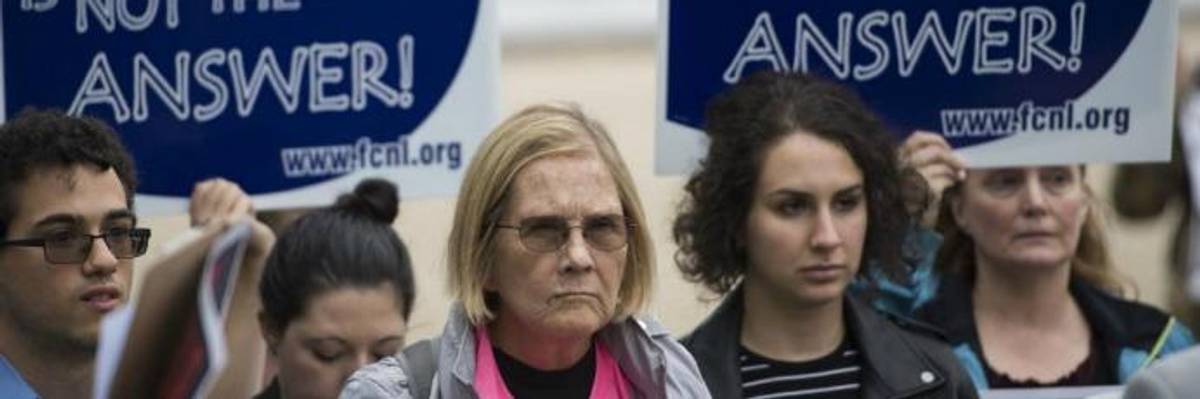
People hold up signs during a protest calling for the Trump administration to continue diplomacy with Iran near the White House in Washington, D.C. on Oct. 12. (Photo: Andrew Caballero-Reynolds/AFP/Getty Images)
The first age of nuclear nightmares came in the 1950s and 1960s. They chiefly afflicted the young. Their parents had experienced nuclear realities by way of bombs on Hiroshima and Nagasaki. That was part of a war, and ended it. It was normalized and rational, though in a basically ungraspable way.
Their kids grew up in a peaceful world haunted by nuclear terrors. Their teachers taught them to "duck and cover" beneath their desks if they saw the nuclear flash. They had nightmares (and waking ones) of it. The only moment of apparent imminence came during the 1962 Cuba Missile Crisis. It all receded gradually, via detente, a non-proliferation treaty and the Cold War's demise.
Now it's back. The minds of the young (in particular) are haunted by nuclear annihilation. If, at this moment, as you're reading, you saw a nuclear flash illuminate the sky, you'd be shattered but not surprised. It's there again as imminent, due largely, but not solely, to Trump. Why not solely? Because generations of earlier leaders failed to act to eliminate those weapons and instead built dazzling models of international relations based on them. Trump has arrived, in a way, to demonstrate the true meaning of their bullshit.
Why especially among youth? They have a future but no (adult) past, and fear they won't live to see it. The rest of us have already had lives we steered ourselves. "Do you think God can exist in a world with nuclear weapons?" asked a millennial--not hysterically, matter-of-factly. They are a quirky demographic.
Along with daily, waking horrors, come new ways to think about politics. I had a friend, the late Art Pape, who left university in his second year, in 1962, to become Canada's first full time worker for nuclear disarmament. It seemed daring then. Later that image morphed into elderly white people in Birkenstocks demonstrating outside nuclear facilities and looking like Jeremy Corbyn.
Now, remarkably, Corbyn is young again! In a U.K. parliamentary debate on renewing the Trident missile system, he was pilloried by his political and media peers for saying, "I do not believe the threat of mass murder is a legitimate way to go about dealing with international relations."
Another millennial I know was inspired, almost transported, by those words. Corbyn has been saying them in some form for half a century. The respectable voices in politics and public discourse simply snicker at his phrasing. But when the young hear it, in sober, adult forums, it gives them hope: they aren't alone.
In fact, what Corbyn says is entirely sensible, it's pure reason, and when the nuclear flash happens, and the skin is dripping off the faces of vast urban populations, everyone will suddenly get it. The sages of Mutual Assured Destruction will smack their own foreheads and say, "How did we miss that?"
Other signs of anti-nuke renewal? Last summer, almost two-thirds of UN members passed a non-binding ban on nuclear weapons. Did you know there was no such thing? The nuclear non-proliferation treaty way back in 1968 tried to prevent new nukers but left original possessors (the Security Council five plus Israel, with India and Pakistan since) untouched.
There's a hilarious clause by which they're supposed to work "in good faith" to eliminate their arsenals. The new ban is meant to "stigmatize" nuclear weapons, a weird idea. Rape and cannibalism don't need stigmatization (or far less). Chemical and biological weapons and anti-personnel mines are already illegal. The Nobel Peace Prize this year went to the nuke-banning campaign.
The U.S., U.K. and France chorused, "We do not intend to sign, ratify or ever become party," since a ban "is incompatible with...nuclear deterrence" which makes us so secure. They sounded petulant, like they'd taken Trump lessons.
Tell it to the young, watching through the terrifying prism of Trump. Maybe the next step in nuclear deterrence should be a Trump non-proliferation treaty.
Where does Canada stand? Nowhere. Didn't attend UN sessions or support the ban. Certainly didn't want to irk the U.S. in the midst of our brilliant, sunny effort to cling to NAFTA.
Also: Trudeau's government, for obscure reasons, wants desperately to win a 2019 seat on the Security Council. There it could be a "moderating" voice for causes like global peace. So it declines to speak out on the defining peace issue of the age. You figure it out.
Dear Common Dreams reader, It’s been nearly 30 years since I co-founded Common Dreams with my late wife, Lina Newhouser. We had the radical notion that journalism should serve the public good, not corporate profits. It was clear to us from the outset what it would take to build such a project. No paid advertisements. No corporate sponsors. No millionaire publisher telling us what to think or do. Many people said we wouldn't last a year, but we proved those doubters wrong. Together with a tremendous team of journalists and dedicated staff, we built an independent media outlet free from the constraints of profits and corporate control. Our mission has always been simple: To inform. To inspire. To ignite change for the common good. Building Common Dreams was not easy. Our survival was never guaranteed. When you take on the most powerful forces—Wall Street greed, fossil fuel industry destruction, Big Tech lobbyists, and uber-rich oligarchs who have spent billions upon billions rigging the economy and democracy in their favor—the only bulwark you have is supporters who believe in your work. But here’s the urgent message from me today. It's never been this bad out there. And it's never been this hard to keep us going. At the very moment Common Dreams is most needed, the threats we face are intensifying. We need your support now more than ever. We don't accept corporate advertising and never will. We don't have a paywall because we don't think people should be blocked from critical news based on their ability to pay. Everything we do is funded by the donations of readers like you. When everyone does the little they can afford, we are strong. But if that support retreats or dries up, so do we. Will you donate now to make sure Common Dreams not only survives but thrives? —Craig Brown, Co-founder |
The first age of nuclear nightmares came in the 1950s and 1960s. They chiefly afflicted the young. Their parents had experienced nuclear realities by way of bombs on Hiroshima and Nagasaki. That was part of a war, and ended it. It was normalized and rational, though in a basically ungraspable way.
Their kids grew up in a peaceful world haunted by nuclear terrors. Their teachers taught them to "duck and cover" beneath their desks if they saw the nuclear flash. They had nightmares (and waking ones) of it. The only moment of apparent imminence came during the 1962 Cuba Missile Crisis. It all receded gradually, via detente, a non-proliferation treaty and the Cold War's demise.
Now it's back. The minds of the young (in particular) are haunted by nuclear annihilation. If, at this moment, as you're reading, you saw a nuclear flash illuminate the sky, you'd be shattered but not surprised. It's there again as imminent, due largely, but not solely, to Trump. Why not solely? Because generations of earlier leaders failed to act to eliminate those weapons and instead built dazzling models of international relations based on them. Trump has arrived, in a way, to demonstrate the true meaning of their bullshit.
Why especially among youth? They have a future but no (adult) past, and fear they won't live to see it. The rest of us have already had lives we steered ourselves. "Do you think God can exist in a world with nuclear weapons?" asked a millennial--not hysterically, matter-of-factly. They are a quirky demographic.
Along with daily, waking horrors, come new ways to think about politics. I had a friend, the late Art Pape, who left university in his second year, in 1962, to become Canada's first full time worker for nuclear disarmament. It seemed daring then. Later that image morphed into elderly white people in Birkenstocks demonstrating outside nuclear facilities and looking like Jeremy Corbyn.
Now, remarkably, Corbyn is young again! In a U.K. parliamentary debate on renewing the Trident missile system, he was pilloried by his political and media peers for saying, "I do not believe the threat of mass murder is a legitimate way to go about dealing with international relations."
Another millennial I know was inspired, almost transported, by those words. Corbyn has been saying them in some form for half a century. The respectable voices in politics and public discourse simply snicker at his phrasing. But when the young hear it, in sober, adult forums, it gives them hope: they aren't alone.
In fact, what Corbyn says is entirely sensible, it's pure reason, and when the nuclear flash happens, and the skin is dripping off the faces of vast urban populations, everyone will suddenly get it. The sages of Mutual Assured Destruction will smack their own foreheads and say, "How did we miss that?"
Other signs of anti-nuke renewal? Last summer, almost two-thirds of UN members passed a non-binding ban on nuclear weapons. Did you know there was no such thing? The nuclear non-proliferation treaty way back in 1968 tried to prevent new nukers but left original possessors (the Security Council five plus Israel, with India and Pakistan since) untouched.
There's a hilarious clause by which they're supposed to work "in good faith" to eliminate their arsenals. The new ban is meant to "stigmatize" nuclear weapons, a weird idea. Rape and cannibalism don't need stigmatization (or far less). Chemical and biological weapons and anti-personnel mines are already illegal. The Nobel Peace Prize this year went to the nuke-banning campaign.
The U.S., U.K. and France chorused, "We do not intend to sign, ratify or ever become party," since a ban "is incompatible with...nuclear deterrence" which makes us so secure. They sounded petulant, like they'd taken Trump lessons.
Tell it to the young, watching through the terrifying prism of Trump. Maybe the next step in nuclear deterrence should be a Trump non-proliferation treaty.
Where does Canada stand? Nowhere. Didn't attend UN sessions or support the ban. Certainly didn't want to irk the U.S. in the midst of our brilliant, sunny effort to cling to NAFTA.
Also: Trudeau's government, for obscure reasons, wants desperately to win a 2019 seat on the Security Council. There it could be a "moderating" voice for causes like global peace. So it declines to speak out on the defining peace issue of the age. You figure it out.
The first age of nuclear nightmares came in the 1950s and 1960s. They chiefly afflicted the young. Their parents had experienced nuclear realities by way of bombs on Hiroshima and Nagasaki. That was part of a war, and ended it. It was normalized and rational, though in a basically ungraspable way.
Their kids grew up in a peaceful world haunted by nuclear terrors. Their teachers taught them to "duck and cover" beneath their desks if they saw the nuclear flash. They had nightmares (and waking ones) of it. The only moment of apparent imminence came during the 1962 Cuba Missile Crisis. It all receded gradually, via detente, a non-proliferation treaty and the Cold War's demise.
Now it's back. The minds of the young (in particular) are haunted by nuclear annihilation. If, at this moment, as you're reading, you saw a nuclear flash illuminate the sky, you'd be shattered but not surprised. It's there again as imminent, due largely, but not solely, to Trump. Why not solely? Because generations of earlier leaders failed to act to eliminate those weapons and instead built dazzling models of international relations based on them. Trump has arrived, in a way, to demonstrate the true meaning of their bullshit.
Why especially among youth? They have a future but no (adult) past, and fear they won't live to see it. The rest of us have already had lives we steered ourselves. "Do you think God can exist in a world with nuclear weapons?" asked a millennial--not hysterically, matter-of-factly. They are a quirky demographic.
Along with daily, waking horrors, come new ways to think about politics. I had a friend, the late Art Pape, who left university in his second year, in 1962, to become Canada's first full time worker for nuclear disarmament. It seemed daring then. Later that image morphed into elderly white people in Birkenstocks demonstrating outside nuclear facilities and looking like Jeremy Corbyn.
Now, remarkably, Corbyn is young again! In a U.K. parliamentary debate on renewing the Trident missile system, he was pilloried by his political and media peers for saying, "I do not believe the threat of mass murder is a legitimate way to go about dealing with international relations."
Another millennial I know was inspired, almost transported, by those words. Corbyn has been saying them in some form for half a century. The respectable voices in politics and public discourse simply snicker at his phrasing. But when the young hear it, in sober, adult forums, it gives them hope: they aren't alone.
In fact, what Corbyn says is entirely sensible, it's pure reason, and when the nuclear flash happens, and the skin is dripping off the faces of vast urban populations, everyone will suddenly get it. The sages of Mutual Assured Destruction will smack their own foreheads and say, "How did we miss that?"
Other signs of anti-nuke renewal? Last summer, almost two-thirds of UN members passed a non-binding ban on nuclear weapons. Did you know there was no such thing? The nuclear non-proliferation treaty way back in 1968 tried to prevent new nukers but left original possessors (the Security Council five plus Israel, with India and Pakistan since) untouched.
There's a hilarious clause by which they're supposed to work "in good faith" to eliminate their arsenals. The new ban is meant to "stigmatize" nuclear weapons, a weird idea. Rape and cannibalism don't need stigmatization (or far less). Chemical and biological weapons and anti-personnel mines are already illegal. The Nobel Peace Prize this year went to the nuke-banning campaign.
The U.S., U.K. and France chorused, "We do not intend to sign, ratify or ever become party," since a ban "is incompatible with...nuclear deterrence" which makes us so secure. They sounded petulant, like they'd taken Trump lessons.
Tell it to the young, watching through the terrifying prism of Trump. Maybe the next step in nuclear deterrence should be a Trump non-proliferation treaty.
Where does Canada stand? Nowhere. Didn't attend UN sessions or support the ban. Certainly didn't want to irk the U.S. in the midst of our brilliant, sunny effort to cling to NAFTA.
Also: Trudeau's government, for obscure reasons, wants desperately to win a 2019 seat on the Security Council. There it could be a "moderating" voice for causes like global peace. So it declines to speak out on the defining peace issue of the age. You figure it out.