

SUBSCRIBE TO OUR FREE NEWSLETTER
Daily news & progressive opinion—funded by the people, not the corporations—delivered straight to your inbox.
5
#000000
#FFFFFF
To donate by check, phone, or other method, see our More Ways to Give page.
Daily news & progressive opinion—funded by the people, not the corporations—delivered straight to your inbox.
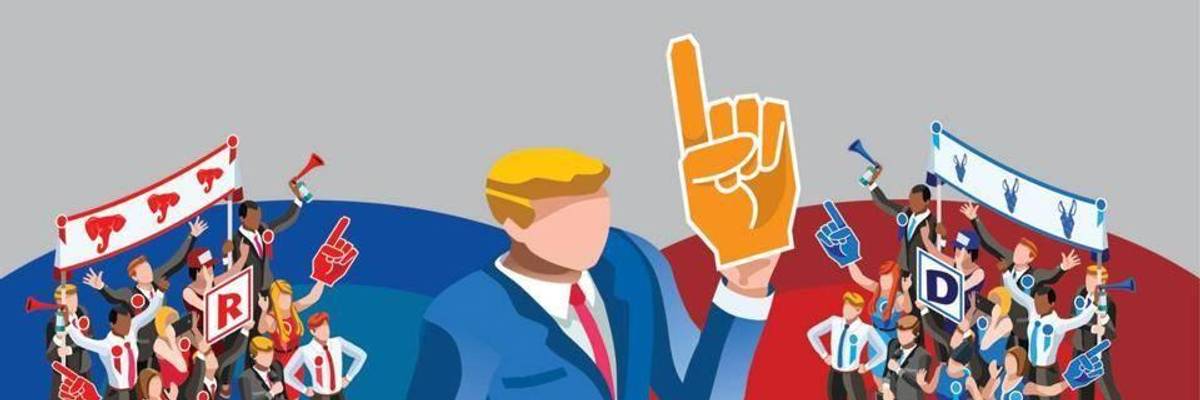
"The essential mindset of fandom, which instinctively privileges competition over cooperation, aggression over empathy, and tribal allegiance over communalism." (Photo: Samantha Stamas/globe staff/ap)
There is no doubt that our president's latest beef, against pro football players who protest during the national anthem, arises from his addiction to conflict and his keen instinct for race-baiting.
But as the feud lit up Twitter and cable news, I kept thinking about George Orwell's 1945 essay "The Sporting Spirit."
"Serious sport has nothing to do with fair play," Orwell wrote. "It is bound up with hatred, jealousy, boastfulness, disregard of all rules, and sadistic pleasure in violence. In other words, it is war without shooting."
Orwell observed that the cultural fervor for sports, integral to ancient empires, had been embraced by modern ones. "There cannot be much doubt that the whole thing is bound up with the rise of nationalism -- that is, with the lunatic modern habit of identifying oneself with large power units and seeing everything in terms of competitive prestige."
Does any of this sound familiar?
Indeed, the glaring irony of Trump's attack on pro sports is that Trumpism itself arises from a mindset in which American voters think of themselves not as citizens with divergent policy agendas, but as fans who root for different teams.
The most obvious evidence of this is the rise of negative partisanship. In the 1950s, only 10 percent of voters had negative feelings toward the opposing party. That number now stands at 90 percent.
A 2014 study of political attitudes conducted by political scientists at Stanford and Princeton concluded that "hostile feelings for the opposing party are ingrained to a degree that exceeds discrimination based on race." These negative feelings are not based primarily on ideological differences. They are tribal in nature.
Political insiders scoffed at Trump's simplistic view of the world, his incessant talk of winners and losers, his penchant for picking fights, and for reducing complex issues into us-against-them brawls.
But Trump intuited the truth that lurks in the heart of every serious sports fan, which is that life is a zero-sum game. There is no room for compromise or moral nuance. You're either on the winning side or the losing one.
As a candidate, he tapped into same primal animus that causes Red Sox fans to chant "Yankees Suck!" and Ohio State alums to shun those who wear Michigan colors.
What the 2016 election revealed was just how pervasive the sporting spirit has become. Republicans, even those who felt Trump was dangerously unqualified for office, voted for him anyway. Why? Because he was on their team.
The same attitude clearly guided high-ranking members of his campaign when they met with Russians promising dirt on Hillary Clinton. Based on what we know, the peril of accepting help from a hostile foreign power never occurred to these guys. They were too intent on victory. Anyone who might help them do so -- from Vladimir Putin to David Duke -- was on their side.
This is not to suggest that Trump was alone in exploiting these dynamics. We live in a country, after all, that has turned every form of human endeavor, from cooking to dancing to courtship, into a competition.
In some sense, Trump was simply being more honest than his predecessors. President Obama, for instance, was continually celebrating sports as a source of cultural unity and enlightenment.
In his final public appearance at the White House, with the World Champion Chicago Cubs, Obama drew "a direct line between Jackie Robinson and me standing here." He went on to note that sports could change hearts "in a way that politics or business doesn't . . . sometimes it speaks to something better in us."
It's a lovely sentiment, but one that overlooks the essential mindset of fandom, which instinctively privileges competition over cooperation, aggression over empathy, and tribal allegiance over communalism.
Trump gets this. His entire worldview is bound up in the "competitive prestige" that Orwell cited. His unique ability to exploit the dark side of our sporting spirit remains the fount of his political power.
Part of the reason he's so good at dividing us as a people, in other words, is because we've had so much practice at dividing ourselves.
Dear Common Dreams reader, It’s been nearly 30 years since I co-founded Common Dreams with my late wife, Lina Newhouser. We had the radical notion that journalism should serve the public good, not corporate profits. It was clear to us from the outset what it would take to build such a project. No paid advertisements. No corporate sponsors. No millionaire publisher telling us what to think or do. Many people said we wouldn't last a year, but we proved those doubters wrong. Together with a tremendous team of journalists and dedicated staff, we built an independent media outlet free from the constraints of profits and corporate control. Our mission has always been simple: To inform. To inspire. To ignite change for the common good. Building Common Dreams was not easy. Our survival was never guaranteed. When you take on the most powerful forces—Wall Street greed, fossil fuel industry destruction, Big Tech lobbyists, and uber-rich oligarchs who have spent billions upon billions rigging the economy and democracy in their favor—the only bulwark you have is supporters who believe in your work. But here’s the urgent message from me today. It's never been this bad out there. And it's never been this hard to keep us going. At the very moment Common Dreams is most needed, the threats we face are intensifying. We need your support now more than ever. We don't accept corporate advertising and never will. We don't have a paywall because we don't think people should be blocked from critical news based on their ability to pay. Everything we do is funded by the donations of readers like you. When everyone does the little they can afford, we are strong. But if that support retreats or dries up, so do we. Will you donate now to make sure Common Dreams not only survives but thrives? —Craig Brown, Co-founder |
There is no doubt that our president's latest beef, against pro football players who protest during the national anthem, arises from his addiction to conflict and his keen instinct for race-baiting.
But as the feud lit up Twitter and cable news, I kept thinking about George Orwell's 1945 essay "The Sporting Spirit."
"Serious sport has nothing to do with fair play," Orwell wrote. "It is bound up with hatred, jealousy, boastfulness, disregard of all rules, and sadistic pleasure in violence. In other words, it is war without shooting."
Orwell observed that the cultural fervor for sports, integral to ancient empires, had been embraced by modern ones. "There cannot be much doubt that the whole thing is bound up with the rise of nationalism -- that is, with the lunatic modern habit of identifying oneself with large power units and seeing everything in terms of competitive prestige."
Does any of this sound familiar?
Indeed, the glaring irony of Trump's attack on pro sports is that Trumpism itself arises from a mindset in which American voters think of themselves not as citizens with divergent policy agendas, but as fans who root for different teams.
The most obvious evidence of this is the rise of negative partisanship. In the 1950s, only 10 percent of voters had negative feelings toward the opposing party. That number now stands at 90 percent.
A 2014 study of political attitudes conducted by political scientists at Stanford and Princeton concluded that "hostile feelings for the opposing party are ingrained to a degree that exceeds discrimination based on race." These negative feelings are not based primarily on ideological differences. They are tribal in nature.
Political insiders scoffed at Trump's simplistic view of the world, his incessant talk of winners and losers, his penchant for picking fights, and for reducing complex issues into us-against-them brawls.
But Trump intuited the truth that lurks in the heart of every serious sports fan, which is that life is a zero-sum game. There is no room for compromise or moral nuance. You're either on the winning side or the losing one.
As a candidate, he tapped into same primal animus that causes Red Sox fans to chant "Yankees Suck!" and Ohio State alums to shun those who wear Michigan colors.
What the 2016 election revealed was just how pervasive the sporting spirit has become. Republicans, even those who felt Trump was dangerously unqualified for office, voted for him anyway. Why? Because he was on their team.
The same attitude clearly guided high-ranking members of his campaign when they met with Russians promising dirt on Hillary Clinton. Based on what we know, the peril of accepting help from a hostile foreign power never occurred to these guys. They were too intent on victory. Anyone who might help them do so -- from Vladimir Putin to David Duke -- was on their side.
This is not to suggest that Trump was alone in exploiting these dynamics. We live in a country, after all, that has turned every form of human endeavor, from cooking to dancing to courtship, into a competition.
In some sense, Trump was simply being more honest than his predecessors. President Obama, for instance, was continually celebrating sports as a source of cultural unity and enlightenment.
In his final public appearance at the White House, with the World Champion Chicago Cubs, Obama drew "a direct line between Jackie Robinson and me standing here." He went on to note that sports could change hearts "in a way that politics or business doesn't . . . sometimes it speaks to something better in us."
It's a lovely sentiment, but one that overlooks the essential mindset of fandom, which instinctively privileges competition over cooperation, aggression over empathy, and tribal allegiance over communalism.
Trump gets this. His entire worldview is bound up in the "competitive prestige" that Orwell cited. His unique ability to exploit the dark side of our sporting spirit remains the fount of his political power.
Part of the reason he's so good at dividing us as a people, in other words, is because we've had so much practice at dividing ourselves.
There is no doubt that our president's latest beef, against pro football players who protest during the national anthem, arises from his addiction to conflict and his keen instinct for race-baiting.
But as the feud lit up Twitter and cable news, I kept thinking about George Orwell's 1945 essay "The Sporting Spirit."
"Serious sport has nothing to do with fair play," Orwell wrote. "It is bound up with hatred, jealousy, boastfulness, disregard of all rules, and sadistic pleasure in violence. In other words, it is war without shooting."
Orwell observed that the cultural fervor for sports, integral to ancient empires, had been embraced by modern ones. "There cannot be much doubt that the whole thing is bound up with the rise of nationalism -- that is, with the lunatic modern habit of identifying oneself with large power units and seeing everything in terms of competitive prestige."
Does any of this sound familiar?
Indeed, the glaring irony of Trump's attack on pro sports is that Trumpism itself arises from a mindset in which American voters think of themselves not as citizens with divergent policy agendas, but as fans who root for different teams.
The most obvious evidence of this is the rise of negative partisanship. In the 1950s, only 10 percent of voters had negative feelings toward the opposing party. That number now stands at 90 percent.
A 2014 study of political attitudes conducted by political scientists at Stanford and Princeton concluded that "hostile feelings for the opposing party are ingrained to a degree that exceeds discrimination based on race." These negative feelings are not based primarily on ideological differences. They are tribal in nature.
Political insiders scoffed at Trump's simplistic view of the world, his incessant talk of winners and losers, his penchant for picking fights, and for reducing complex issues into us-against-them brawls.
But Trump intuited the truth that lurks in the heart of every serious sports fan, which is that life is a zero-sum game. There is no room for compromise or moral nuance. You're either on the winning side or the losing one.
As a candidate, he tapped into same primal animus that causes Red Sox fans to chant "Yankees Suck!" and Ohio State alums to shun those who wear Michigan colors.
What the 2016 election revealed was just how pervasive the sporting spirit has become. Republicans, even those who felt Trump was dangerously unqualified for office, voted for him anyway. Why? Because he was on their team.
The same attitude clearly guided high-ranking members of his campaign when they met with Russians promising dirt on Hillary Clinton. Based on what we know, the peril of accepting help from a hostile foreign power never occurred to these guys. They were too intent on victory. Anyone who might help them do so -- from Vladimir Putin to David Duke -- was on their side.
This is not to suggest that Trump was alone in exploiting these dynamics. We live in a country, after all, that has turned every form of human endeavor, from cooking to dancing to courtship, into a competition.
In some sense, Trump was simply being more honest than his predecessors. President Obama, for instance, was continually celebrating sports as a source of cultural unity and enlightenment.
In his final public appearance at the White House, with the World Champion Chicago Cubs, Obama drew "a direct line between Jackie Robinson and me standing here." He went on to note that sports could change hearts "in a way that politics or business doesn't . . . sometimes it speaks to something better in us."
It's a lovely sentiment, but one that overlooks the essential mindset of fandom, which instinctively privileges competition over cooperation, aggression over empathy, and tribal allegiance over communalism.
Trump gets this. His entire worldview is bound up in the "competitive prestige" that Orwell cited. His unique ability to exploit the dark side of our sporting spirit remains the fount of his political power.
Part of the reason he's so good at dividing us as a people, in other words, is because we've had so much practice at dividing ourselves.

