SUBSCRIBE TO OUR FREE NEWSLETTER
Daily news & progressive opinion—funded by the people, not the corporations—delivered straight to your inbox.
5
#000000
#FFFFFF
To donate by check, phone, or other method, see our More Ways to Give page.
Daily news & progressive opinion—funded by the people, not the corporations—delivered straight to your inbox.
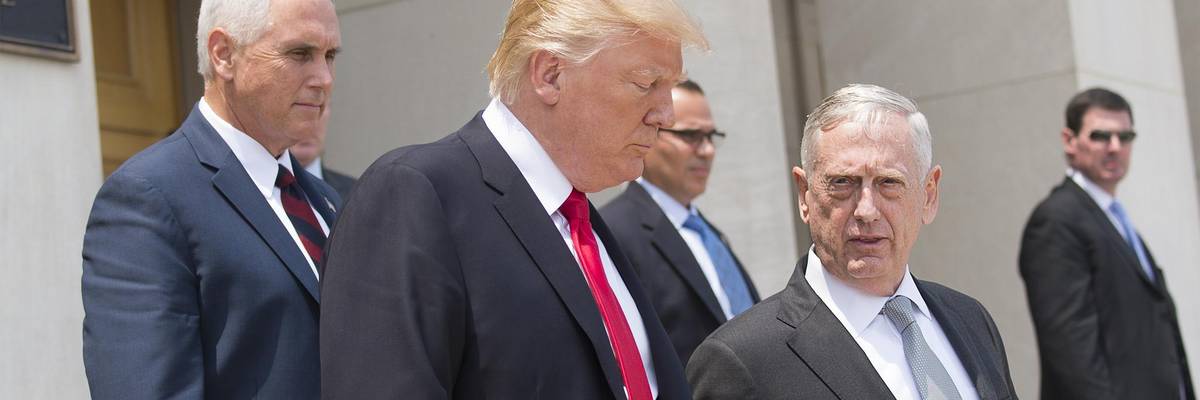
Secretary of Defense Jim Mattis speaks to President Donald Trump and Vice President Mike Pence at the Pentagon after a National Security Council meeting. (Photo: Joint Chiefs of Staff/Flickr/cc)
In a democracy, no one should be comforted to hear that generals have imposed discipline on an elected head of state. That was never supposed to happen in the United States. Now it has.
Among the most enduring political images of the 20th century was the military junta. It was a group of grim-faced officers--usually three--who rose to control a state. The junta would tolerate civilian institutions that agreed to remain subservient, but in the end enforced its own will. As recently as a few decades ago, military juntas ruled important countries including Chile, Argentina, Turkey, and Greece.
These days the junta system is making a comeback in, of all places, Washington. Ultimate power to shape American foreign and security policy has fallen into the hands of three military men: General James Mattis, the secretary of defense; General John Kelly, President Trump's chief of staff; and General H.R. McMaster, the national security adviser. They do not put on their ribbons to review military parades or dispatch death squads to kill opponents, as members of old-style juntas did. Yet their emergence reflects a new stage in the erosion of our political norms and the militarization of our foreign policy. Another veil is dropping.
Given the president's ignorance of world affairs, the emergence of a military junta in Washington may seem like welcome relief. After all, its three members are mature adults with global experience--unlike Trump and some of the wacky political operatives who surrounded him when he moved into the White House. Already they have exerted a stabilizing influence. Mattis refuses to join the rush to bomb North Korea, Kelly has imposed a measure of order on the White House staff, and McMaster pointedly distanced himself from Trump's praise for white nationalists after the violence in Charlottesville.
Being ruled by generals seems preferable to the alternative. It isn't.
Military officers, like all of us, are products of their background and environment. The three members of Trump's junta have 119 years of uniformed service between them. They naturally see the world from a military perspective and conceive military solutions to its problems. That leads toward a distorted set of national priorities, with military "needs" always rated more important than domestic ones.
Trump has made clear that when he must make foreign policy choices, he will defer to "my generals." Mattis, the new junta's strongman, is the former head of Central Command, which directs American wars in the Middle East and Central Asia. Kelly is also an Iraq veteran. McMaster has commanded troops in Iraq and Afghanistan almost without interruption since he led a tank company in the 1991 Gulf War.
Military commanders are trained to fight wars, not to decide whether fighting makes strategic sense. They may be able to tell Trump how many troops are necessary to sustain our present mission in Afghanistan, for example, but they are not trained either to ask or answer the larger question of whether the mission serves America's long-term interest. That is properly the job of diplomats. Unlike soldiers, whose job is to kill people and break things, diplomats are trained to negotiate, defuse conflicts, coolly assess national interest and design policies to advance it. Notwithstanding Mattis's relative restraint on North Korea, all three members of Trump's junta promote the confrontational approach that has brought protracted war in Afghanistan, Iraq and beyond, while fueling tension in Europe and East Asia.
Our new junta is different from classic ones like, for example, the "National Council for Peace and Order" that now rules Thailand. First, our junta's interest is only international relations, not domestic policy. Second, it did not seize power in a coup, but derives its authority from the favor of an elected president. Third and most important, it main goal is not to impose a new order but to enforce an old one.
Last month, President Trump faced a crucial decision about the future of America's war in Afghanistan. This was a potential turning point. Four years ago Trump tweeted, "Let's get out of Afghanistan." If he had followed that impulse and announced that he was bringing American troops home, the political and military elite in Washington would have been stunned. But junta members swung into action. They persuaded Trump to announce that instead of withdrawing, he would do the opposite: reject "rapid exit" from Afghanistan, increase troop strength, and continue "killing terrorists."
It is no great surprise that Trump has been drawn into the foreign policy mainstream; the same happened to President Obama early in his presidency. More ominous is that Trump has turned much of his power over to generals. Worst of all, many Americans find this reassuring. They are so disgusted by the corruption and shortsightedness of our political class that they turn to soldiers as an alternative. It is a dangerous temptation.
Dear Common Dreams reader, It’s been nearly 30 years since I co-founded Common Dreams with my late wife, Lina Newhouser. We had the radical notion that journalism should serve the public good, not corporate profits. It was clear to us from the outset what it would take to build such a project. No paid advertisements. No corporate sponsors. No millionaire publisher telling us what to think or do. Many people said we wouldn't last a year, but we proved those doubters wrong. Together with a tremendous team of journalists and dedicated staff, we built an independent media outlet free from the constraints of profits and corporate control. Our mission has always been simple: To inform. To inspire. To ignite change for the common good. Building Common Dreams was not easy. Our survival was never guaranteed. When you take on the most powerful forces—Wall Street greed, fossil fuel industry destruction, Big Tech lobbyists, and uber-rich oligarchs who have spent billions upon billions rigging the economy and democracy in their favor—the only bulwark you have is supporters who believe in your work. But here’s the urgent message from me today. It's never been this bad out there. And it's never been this hard to keep us going. At the very moment Common Dreams is most needed, the threats we face are intensifying. We need your support now more than ever. We don't accept corporate advertising and never will. We don't have a paywall because we don't think people should be blocked from critical news based on their ability to pay. Everything we do is funded by the donations of readers like you. When everyone does the little they can afford, we are strong. But if that support retreats or dries up, so do we. Will you donate now to make sure Common Dreams not only survives but thrives? —Craig Brown, Co-founder |
In a democracy, no one should be comforted to hear that generals have imposed discipline on an elected head of state. That was never supposed to happen in the United States. Now it has.
Among the most enduring political images of the 20th century was the military junta. It was a group of grim-faced officers--usually three--who rose to control a state. The junta would tolerate civilian institutions that agreed to remain subservient, but in the end enforced its own will. As recently as a few decades ago, military juntas ruled important countries including Chile, Argentina, Turkey, and Greece.
These days the junta system is making a comeback in, of all places, Washington. Ultimate power to shape American foreign and security policy has fallen into the hands of three military men: General James Mattis, the secretary of defense; General John Kelly, President Trump's chief of staff; and General H.R. McMaster, the national security adviser. They do not put on their ribbons to review military parades or dispatch death squads to kill opponents, as members of old-style juntas did. Yet their emergence reflects a new stage in the erosion of our political norms and the militarization of our foreign policy. Another veil is dropping.
Given the president's ignorance of world affairs, the emergence of a military junta in Washington may seem like welcome relief. After all, its three members are mature adults with global experience--unlike Trump and some of the wacky political operatives who surrounded him when he moved into the White House. Already they have exerted a stabilizing influence. Mattis refuses to join the rush to bomb North Korea, Kelly has imposed a measure of order on the White House staff, and McMaster pointedly distanced himself from Trump's praise for white nationalists after the violence in Charlottesville.
Being ruled by generals seems preferable to the alternative. It isn't.
Military officers, like all of us, are products of their background and environment. The three members of Trump's junta have 119 years of uniformed service between them. They naturally see the world from a military perspective and conceive military solutions to its problems. That leads toward a distorted set of national priorities, with military "needs" always rated more important than domestic ones.
Trump has made clear that when he must make foreign policy choices, he will defer to "my generals." Mattis, the new junta's strongman, is the former head of Central Command, which directs American wars in the Middle East and Central Asia. Kelly is also an Iraq veteran. McMaster has commanded troops in Iraq and Afghanistan almost without interruption since he led a tank company in the 1991 Gulf War.
Military commanders are trained to fight wars, not to decide whether fighting makes strategic sense. They may be able to tell Trump how many troops are necessary to sustain our present mission in Afghanistan, for example, but they are not trained either to ask or answer the larger question of whether the mission serves America's long-term interest. That is properly the job of diplomats. Unlike soldiers, whose job is to kill people and break things, diplomats are trained to negotiate, defuse conflicts, coolly assess national interest and design policies to advance it. Notwithstanding Mattis's relative restraint on North Korea, all three members of Trump's junta promote the confrontational approach that has brought protracted war in Afghanistan, Iraq and beyond, while fueling tension in Europe and East Asia.
Our new junta is different from classic ones like, for example, the "National Council for Peace and Order" that now rules Thailand. First, our junta's interest is only international relations, not domestic policy. Second, it did not seize power in a coup, but derives its authority from the favor of an elected president. Third and most important, it main goal is not to impose a new order but to enforce an old one.
Last month, President Trump faced a crucial decision about the future of America's war in Afghanistan. This was a potential turning point. Four years ago Trump tweeted, "Let's get out of Afghanistan." If he had followed that impulse and announced that he was bringing American troops home, the political and military elite in Washington would have been stunned. But junta members swung into action. They persuaded Trump to announce that instead of withdrawing, he would do the opposite: reject "rapid exit" from Afghanistan, increase troop strength, and continue "killing terrorists."
It is no great surprise that Trump has been drawn into the foreign policy mainstream; the same happened to President Obama early in his presidency. More ominous is that Trump has turned much of his power over to generals. Worst of all, many Americans find this reassuring. They are so disgusted by the corruption and shortsightedness of our political class that they turn to soldiers as an alternative. It is a dangerous temptation.
In a democracy, no one should be comforted to hear that generals have imposed discipline on an elected head of state. That was never supposed to happen in the United States. Now it has.
Among the most enduring political images of the 20th century was the military junta. It was a group of grim-faced officers--usually three--who rose to control a state. The junta would tolerate civilian institutions that agreed to remain subservient, but in the end enforced its own will. As recently as a few decades ago, military juntas ruled important countries including Chile, Argentina, Turkey, and Greece.
These days the junta system is making a comeback in, of all places, Washington. Ultimate power to shape American foreign and security policy has fallen into the hands of three military men: General James Mattis, the secretary of defense; General John Kelly, President Trump's chief of staff; and General H.R. McMaster, the national security adviser. They do not put on their ribbons to review military parades or dispatch death squads to kill opponents, as members of old-style juntas did. Yet their emergence reflects a new stage in the erosion of our political norms and the militarization of our foreign policy. Another veil is dropping.
Given the president's ignorance of world affairs, the emergence of a military junta in Washington may seem like welcome relief. After all, its three members are mature adults with global experience--unlike Trump and some of the wacky political operatives who surrounded him when he moved into the White House. Already they have exerted a stabilizing influence. Mattis refuses to join the rush to bomb North Korea, Kelly has imposed a measure of order on the White House staff, and McMaster pointedly distanced himself from Trump's praise for white nationalists after the violence in Charlottesville.
Being ruled by generals seems preferable to the alternative. It isn't.
Military officers, like all of us, are products of their background and environment. The three members of Trump's junta have 119 years of uniformed service between them. They naturally see the world from a military perspective and conceive military solutions to its problems. That leads toward a distorted set of national priorities, with military "needs" always rated more important than domestic ones.
Trump has made clear that when he must make foreign policy choices, he will defer to "my generals." Mattis, the new junta's strongman, is the former head of Central Command, which directs American wars in the Middle East and Central Asia. Kelly is also an Iraq veteran. McMaster has commanded troops in Iraq and Afghanistan almost without interruption since he led a tank company in the 1991 Gulf War.
Military commanders are trained to fight wars, not to decide whether fighting makes strategic sense. They may be able to tell Trump how many troops are necessary to sustain our present mission in Afghanistan, for example, but they are not trained either to ask or answer the larger question of whether the mission serves America's long-term interest. That is properly the job of diplomats. Unlike soldiers, whose job is to kill people and break things, diplomats are trained to negotiate, defuse conflicts, coolly assess national interest and design policies to advance it. Notwithstanding Mattis's relative restraint on North Korea, all three members of Trump's junta promote the confrontational approach that has brought protracted war in Afghanistan, Iraq and beyond, while fueling tension in Europe and East Asia.
Our new junta is different from classic ones like, for example, the "National Council for Peace and Order" that now rules Thailand. First, our junta's interest is only international relations, not domestic policy. Second, it did not seize power in a coup, but derives its authority from the favor of an elected president. Third and most important, it main goal is not to impose a new order but to enforce an old one.
Last month, President Trump faced a crucial decision about the future of America's war in Afghanistan. This was a potential turning point. Four years ago Trump tweeted, "Let's get out of Afghanistan." If he had followed that impulse and announced that he was bringing American troops home, the political and military elite in Washington would have been stunned. But junta members swung into action. They persuaded Trump to announce that instead of withdrawing, he would do the opposite: reject "rapid exit" from Afghanistan, increase troop strength, and continue "killing terrorists."
It is no great surprise that Trump has been drawn into the foreign policy mainstream; the same happened to President Obama early in his presidency. More ominous is that Trump has turned much of his power over to generals. Worst of all, many Americans find this reassuring. They are so disgusted by the corruption and shortsightedness of our political class that they turn to soldiers as an alternative. It is a dangerous temptation.