SUBSCRIBE TO OUR FREE NEWSLETTER
Daily news & progressive opinion—funded by the people, not the corporations—delivered straight to your inbox.
5
#000000
#FFFFFF
To donate by check, phone, or other method, see our More Ways to Give page.
Daily news & progressive opinion—funded by the people, not the corporations—delivered straight to your inbox.
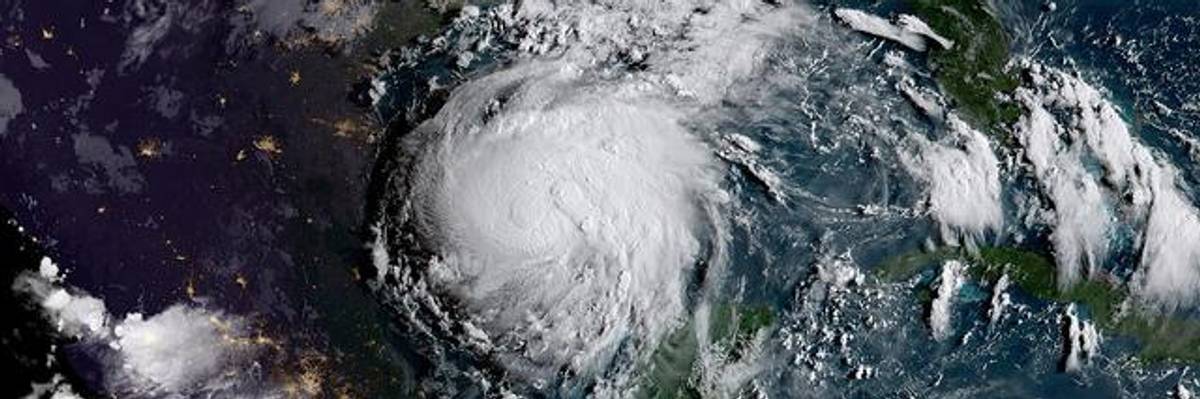
"The planet is getting warmer, ocean temperatures are rising, the polar ice caps are melting, and all of the incontrovertible science of climate change is that more extreme-weather events are an inevitable consequence."(Photo: Flikr/NOAA/NASA GOES Project)
I've covered the news in Houston for 3 1/2 years and have already seen two devastating floods and now what is being described as a one-in-800-years flood brought on by Hurricane Harvey.
I've covered the news in Houston for 3 1/2 years and have already seen two devastating floods and now what is being described as a one-in-800-years flood brought on by Hurricane Harvey.
That suggests to me that something is happening here that's way bigger than the largely made-up tiff between Texas Gov. Greg Abbott (R) and Houston Mayor Sylvester Turner (D) about whether Houston should have been evacuated before Harvey dumped trillions of gallons of rain on the nation's fourth-largest city.
There's no denying Texas is politically polarized, with all its major cities liberal and Democratic, and the rest of the state, and all its statewide elected officials, conservative and Republican. So there's no end of discord and rancor if one wants to find reasons for blame and finger-pointing.
Houston, meanwhile, can be its own worst enemy when it comes to flood control. A big part of its freewheeling, entrepreneurial identity is its lack of zoning, which has produced more than 600 square miles of subdivisions, strip malls and concrete prairie. It's not hard to wonder whether this vast expanse of what was once coastal plain was really the best place to build a major city.
But anyone who has lived through four straight days of torrential rain that may surpass 50 inches knows perfectly well that no zoning code, infrastructure improvements or flood control regulations could have done anything to deal with this much water inundating a major metropolitan area this quickly.
And it is an unbelievable amount of water. Not wanting to risk my car on Sunday morning, I started toward our newsroom on foot and found myself waist-deep two blocks from my home.
On Monday I ventured a mile north to Buffalo Bayou, a bucolic urban park remade thanks to $25 million from a leading local philanthropist who once worked for Enron. The park was gone, its meandering bayou now a roiling, fast-moving river that had engulfed parkways on both sides, flooded a television station and badly damaged much of the city's theater district.
On a stretch of Kirby Drive in River Oaks, Houston's toniest neighborhood, the water was chest-deep, lapping up onto mansion lawns.
Sometimes, even in our political and governmental bureaucracies, people say exactly what they mean. Not known for hyperbole, the National Weather Service tweeted after the first devastating day of rainfall, during which some parts of Houston got more than 25 inches: "All impacts are unknown & beyond anything experienced."
"It's catastrophic, unprecedented, epic," said Patrick Blood, a National Weather Service meteorologist. "Whatever adjective you want to use."
Brock Long, administrator of the Federal Emergency Management Agency, went even further: "This is a storm the United States has not seen yet."
What they're talking about, whether they know it or not, or care to acknowledge it or not, is global warming. The planet is getting warmer, ocean temperatures are rising, the polar ice caps are melting, and all of the incontrovertible science of climate change is that more extreme-weather events are an inevitable consequence.
Tom Friedman in his new book calls climate change a "black elephant" -- a combination of the unforeseen "black swan" event with enormous consequences and the "elephant in the room" no one can see.
There's really no other way to make sense of what's happening in Houston. The black elephant is here in America, just as it's in Africa and the Middle East and Antarctica, whether we want to see it or not.
Just acknowledging that will help Houston recover once the rain finally stops, making the political blame game even more futile than it has already become in American politics.
For now, Abbott and Turner are working tirelessly and cooperatively to help the thousands and thousands of people trapped by the worst floods in Houston's history.
And whenever it's over, Houston should use Harvey to jump-start its transition from the country's epicenter for oil and gas to a world capital of alternative energies. If the city can turn this devastating tragedy into an existential moment of reinvention after the storm, then a decade from now we may argue that it was worth it.
As for the nation, Americans need to understand what leading scientists have concluded even if many of our political leaders pretend it's not true -- we've just about blown through the Holocene epoch, when Earth emerged from the last ice age and became more comfortable for human life. Some climatologists have started to call our current age the Anthropocene, in which conditions on the planet have been dramatically altered by man. We have to take responsibility for what we've done, and take charge of our future.
It's clearly too late to stop the Category 4 hurricane that led to the millennial flooding in Houston. But it may not be too late to save the planet if we heed Harvey's hard lesson here in Texas, a proud state that doesn't like to be messed with. It could be the perfect place to start.
Dear Common Dreams reader, It’s been nearly 30 years since I co-founded Common Dreams with my late wife, Lina Newhouser. We had the radical notion that journalism should serve the public good, not corporate profits. It was clear to us from the outset what it would take to build such a project. No paid advertisements. No corporate sponsors. No millionaire publisher telling us what to think or do. Many people said we wouldn't last a year, but we proved those doubters wrong. Together with a tremendous team of journalists and dedicated staff, we built an independent media outlet free from the constraints of profits and corporate control. Our mission has always been simple: To inform. To inspire. To ignite change for the common good. Building Common Dreams was not easy. Our survival was never guaranteed. When you take on the most powerful forces—Wall Street greed, fossil fuel industry destruction, Big Tech lobbyists, and uber-rich oligarchs who have spent billions upon billions rigging the economy and democracy in their favor—the only bulwark you have is supporters who believe in your work. But here’s the urgent message from me today. It's never been this bad out there. And it's never been this hard to keep us going. At the very moment Common Dreams is most needed, the threats we face are intensifying. We need your support now more than ever. We don't accept corporate advertising and never will. We don't have a paywall because we don't think people should be blocked from critical news based on their ability to pay. Everything we do is funded by the donations of readers like you. When everyone does the little they can afford, we are strong. But if that support retreats or dries up, so do we. Will you donate now to make sure Common Dreams not only survives but thrives? —Craig Brown, Co-founder |
I've covered the news in Houston for 3 1/2 years and have already seen two devastating floods and now what is being described as a one-in-800-years flood brought on by Hurricane Harvey.
That suggests to me that something is happening here that's way bigger than the largely made-up tiff between Texas Gov. Greg Abbott (R) and Houston Mayor Sylvester Turner (D) about whether Houston should have been evacuated before Harvey dumped trillions of gallons of rain on the nation's fourth-largest city.
There's no denying Texas is politically polarized, with all its major cities liberal and Democratic, and the rest of the state, and all its statewide elected officials, conservative and Republican. So there's no end of discord and rancor if one wants to find reasons for blame and finger-pointing.
Houston, meanwhile, can be its own worst enemy when it comes to flood control. A big part of its freewheeling, entrepreneurial identity is its lack of zoning, which has produced more than 600 square miles of subdivisions, strip malls and concrete prairie. It's not hard to wonder whether this vast expanse of what was once coastal plain was really the best place to build a major city.
But anyone who has lived through four straight days of torrential rain that may surpass 50 inches knows perfectly well that no zoning code, infrastructure improvements or flood control regulations could have done anything to deal with this much water inundating a major metropolitan area this quickly.
And it is an unbelievable amount of water. Not wanting to risk my car on Sunday morning, I started toward our newsroom on foot and found myself waist-deep two blocks from my home.
On Monday I ventured a mile north to Buffalo Bayou, a bucolic urban park remade thanks to $25 million from a leading local philanthropist who once worked for Enron. The park was gone, its meandering bayou now a roiling, fast-moving river that had engulfed parkways on both sides, flooded a television station and badly damaged much of the city's theater district.
On a stretch of Kirby Drive in River Oaks, Houston's toniest neighborhood, the water was chest-deep, lapping up onto mansion lawns.
Sometimes, even in our political and governmental bureaucracies, people say exactly what they mean. Not known for hyperbole, the National Weather Service tweeted after the first devastating day of rainfall, during which some parts of Houston got more than 25 inches: "All impacts are unknown & beyond anything experienced."
"It's catastrophic, unprecedented, epic," said Patrick Blood, a National Weather Service meteorologist. "Whatever adjective you want to use."
Brock Long, administrator of the Federal Emergency Management Agency, went even further: "This is a storm the United States has not seen yet."
What they're talking about, whether they know it or not, or care to acknowledge it or not, is global warming. The planet is getting warmer, ocean temperatures are rising, the polar ice caps are melting, and all of the incontrovertible science of climate change is that more extreme-weather events are an inevitable consequence.
Tom Friedman in his new book calls climate change a "black elephant" -- a combination of the unforeseen "black swan" event with enormous consequences and the "elephant in the room" no one can see.
There's really no other way to make sense of what's happening in Houston. The black elephant is here in America, just as it's in Africa and the Middle East and Antarctica, whether we want to see it or not.
Just acknowledging that will help Houston recover once the rain finally stops, making the political blame game even more futile than it has already become in American politics.
For now, Abbott and Turner are working tirelessly and cooperatively to help the thousands and thousands of people trapped by the worst floods in Houston's history.
And whenever it's over, Houston should use Harvey to jump-start its transition from the country's epicenter for oil and gas to a world capital of alternative energies. If the city can turn this devastating tragedy into an existential moment of reinvention after the storm, then a decade from now we may argue that it was worth it.
As for the nation, Americans need to understand what leading scientists have concluded even if many of our political leaders pretend it's not true -- we've just about blown through the Holocene epoch, when Earth emerged from the last ice age and became more comfortable for human life. Some climatologists have started to call our current age the Anthropocene, in which conditions on the planet have been dramatically altered by man. We have to take responsibility for what we've done, and take charge of our future.
It's clearly too late to stop the Category 4 hurricane that led to the millennial flooding in Houston. But it may not be too late to save the planet if we heed Harvey's hard lesson here in Texas, a proud state that doesn't like to be messed with. It could be the perfect place to start.
I've covered the news in Houston for 3 1/2 years and have already seen two devastating floods and now what is being described as a one-in-800-years flood brought on by Hurricane Harvey.
That suggests to me that something is happening here that's way bigger than the largely made-up tiff between Texas Gov. Greg Abbott (R) and Houston Mayor Sylvester Turner (D) about whether Houston should have been evacuated before Harvey dumped trillions of gallons of rain on the nation's fourth-largest city.
There's no denying Texas is politically polarized, with all its major cities liberal and Democratic, and the rest of the state, and all its statewide elected officials, conservative and Republican. So there's no end of discord and rancor if one wants to find reasons for blame and finger-pointing.
Houston, meanwhile, can be its own worst enemy when it comes to flood control. A big part of its freewheeling, entrepreneurial identity is its lack of zoning, which has produced more than 600 square miles of subdivisions, strip malls and concrete prairie. It's not hard to wonder whether this vast expanse of what was once coastal plain was really the best place to build a major city.
But anyone who has lived through four straight days of torrential rain that may surpass 50 inches knows perfectly well that no zoning code, infrastructure improvements or flood control regulations could have done anything to deal with this much water inundating a major metropolitan area this quickly.
And it is an unbelievable amount of water. Not wanting to risk my car on Sunday morning, I started toward our newsroom on foot and found myself waist-deep two blocks from my home.
On Monday I ventured a mile north to Buffalo Bayou, a bucolic urban park remade thanks to $25 million from a leading local philanthropist who once worked for Enron. The park was gone, its meandering bayou now a roiling, fast-moving river that had engulfed parkways on both sides, flooded a television station and badly damaged much of the city's theater district.
On a stretch of Kirby Drive in River Oaks, Houston's toniest neighborhood, the water was chest-deep, lapping up onto mansion lawns.
Sometimes, even in our political and governmental bureaucracies, people say exactly what they mean. Not known for hyperbole, the National Weather Service tweeted after the first devastating day of rainfall, during which some parts of Houston got more than 25 inches: "All impacts are unknown & beyond anything experienced."
"It's catastrophic, unprecedented, epic," said Patrick Blood, a National Weather Service meteorologist. "Whatever adjective you want to use."
Brock Long, administrator of the Federal Emergency Management Agency, went even further: "This is a storm the United States has not seen yet."
What they're talking about, whether they know it or not, or care to acknowledge it or not, is global warming. The planet is getting warmer, ocean temperatures are rising, the polar ice caps are melting, and all of the incontrovertible science of climate change is that more extreme-weather events are an inevitable consequence.
Tom Friedman in his new book calls climate change a "black elephant" -- a combination of the unforeseen "black swan" event with enormous consequences and the "elephant in the room" no one can see.
There's really no other way to make sense of what's happening in Houston. The black elephant is here in America, just as it's in Africa and the Middle East and Antarctica, whether we want to see it or not.
Just acknowledging that will help Houston recover once the rain finally stops, making the political blame game even more futile than it has already become in American politics.
For now, Abbott and Turner are working tirelessly and cooperatively to help the thousands and thousands of people trapped by the worst floods in Houston's history.
And whenever it's over, Houston should use Harvey to jump-start its transition from the country's epicenter for oil and gas to a world capital of alternative energies. If the city can turn this devastating tragedy into an existential moment of reinvention after the storm, then a decade from now we may argue that it was worth it.
As for the nation, Americans need to understand what leading scientists have concluded even if many of our political leaders pretend it's not true -- we've just about blown through the Holocene epoch, when Earth emerged from the last ice age and became more comfortable for human life. Some climatologists have started to call our current age the Anthropocene, in which conditions on the planet have been dramatically altered by man. We have to take responsibility for what we've done, and take charge of our future.
It's clearly too late to stop the Category 4 hurricane that led to the millennial flooding in Houston. But it may not be too late to save the planet if we heed Harvey's hard lesson here in Texas, a proud state that doesn't like to be messed with. It could be the perfect place to start.