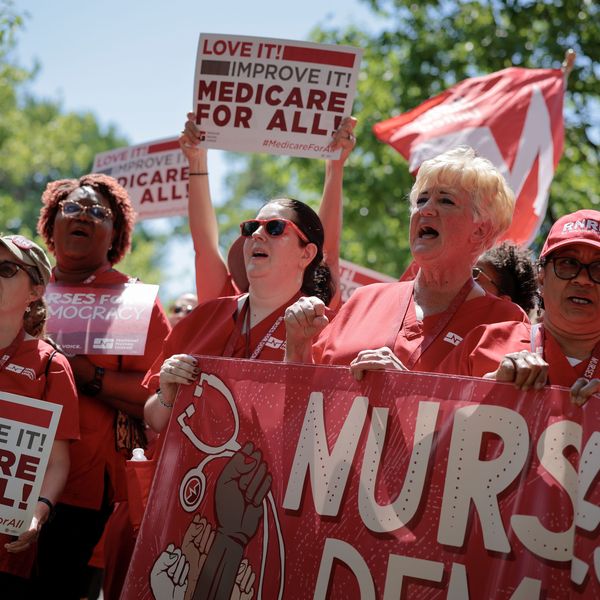
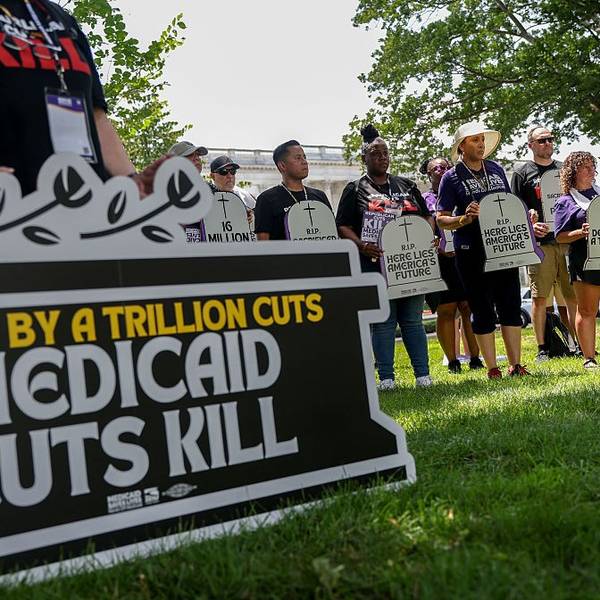
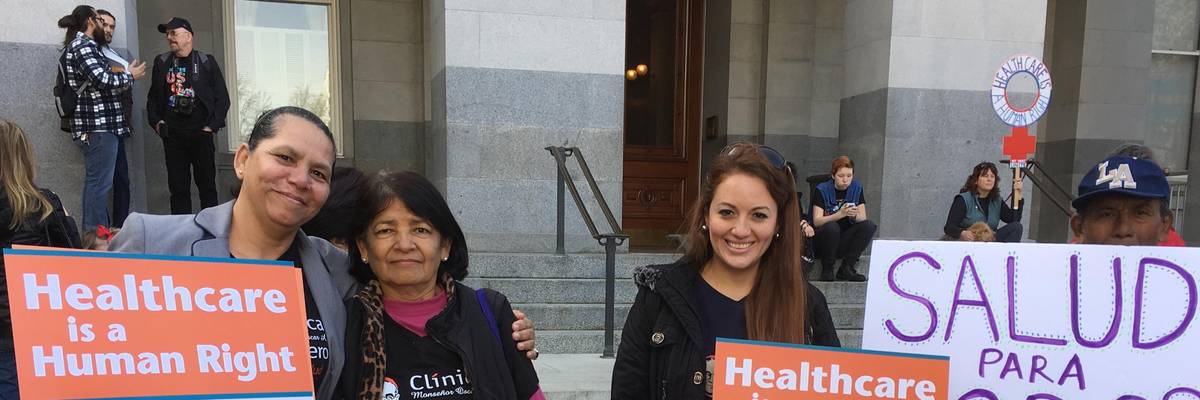
"Let's not forget that the huge holes in Obamacare on access and out of pocket costs in particular have left tens of millions of people without care or hammered by the high cost." (Photo: Courtesy of Author)
We Still Have A Lot of Work To Do On Healthcare
With liberals across the land breathing a huge sigh of relief after the abrupt collapse of the Senate scheme to repeal and somewhat replace the Affordable Care Act, all is good again with healthcare in America. Right?
Well, there have been a few troubling signs if you can dig past all the news about Donald Trump's latest tweets.
"The Medicare for all movement is growing, climb on board."
With liberals across the land breathing a huge sigh of relief after the abrupt collapse of the Senate scheme to repeal and somewhat replace the Affordable Care Act, all is good again with healthcare in America. Right?
Well, there have been a few troubling signs if you can dig past all the news about Donald Trump's latest tweets.
"The Medicare for all movement is growing, climb on board."
Americans are dying younger. A Bloomberg news report found that in 2015 the death rate rose slightly for the first time in 2015 since 1999 (though that has brought some cheer, said Bloomberg, into some corporate boardrooms, who can revise down how much they'll have to pay out in pension payments to retirees).
- Colon cancer mortality rates for white Americans under age 55 are climbing, as detailed in a study the Journal of the American Medical Association.
- More than four in ten adults with health insurance struggle with the high cost of deductibles, according to a Kaiser Family Foundation survey. Nearly 30 percent had trouble paying medical bills, with 73 percent of those cutting back on spending on food, clothing or other basic items. Significant numbers skipped dental care, going to the doctor, getting a recommended medical test or treatment, or filling a prescription.
- Blue Cross and Blue Shield of Georgia informed enrollees that if they go to the emergency room with a health problem that insurance bean counters later decide was not an "emergency" the insurer will not pay their care, reported Michael Hiltzik of the Los Angeles Times. That's right, patients will get stuck with the bill, after all how much could an ER visit cost?
- About 114 million Americans have no insurance coverage for dental care. Gum disease, the New York Times reported, increases the risk of heart disease, diabetes and lower baby birth weights. Dental emergencies in California alone rose by 50 percent from 2005 to 2011.
But the news is not all bad. It's a great time to be a healthcare chief executive. CEOs of the 70 largest U.S. health care companies have taken home a cumulative $9.8 billion since the enactment of the ACA. John Martin, former CEO of Gilead Sciences collected $863 million just by himself.
If the name Gilead sounds vaguely familiar, here's a refresher. They're the people behind Sovaldi, the hepatitis C drug for which Gilead charges $1,000 a pill or $84,000 for a 12-week treatment course, an amount that is threatening to bankrupt public programs which now commonly ration the drug.
It's also a banner time for creative new companies that profit off contracting health care services, like emergency care. The New York Times reports that more than 20 percent of ER visits result in much higher costs for patients who unexpectedly get a massive bill because their care was provided by doctors who are not part of their insurance "network."
Yes, but haven't all the policy wonks assured us we have the best healthcare system in the world?
Not if you're counting "amenable mortality," which the Washington Post defines as deaths that "could have been avoided by timely and effective medical care." By that score, according to University of Washington researchers, the U.S. ranked just 35th among 195 countries.
Of course, that's an unfair comparison. All those other countries ahead of us actually prioritize healthcare as a public good, a societal benefit not to be mortgaged off to corporations that exploit their peoples' health for profit.
What they all have is rational, coordinated national healthcare systems. Even if they have a role for private insurers, the government is still setting the rates and health benefits, and everyone, bar none, is guaranteed care.
We could, of course, have such a system too; you just have to be 65 or older to get access to it. It's called Medicare, and it remains one of the most popular reforms in U.S. history, far more beloved than those not so charming insurance companies whose principal mission is to collect your premiums and avoid paying anything out for your care.
We can, and should, all celebrate the defeat, for now, of call it McConnellcare or Ryancare or Trumpcare. But let's not forget that the huge holes in Obamacare on access and out of pocket costs in particular have left tens of millions of people without care or hammered by the high cost.
There's a reason 60 percent of Americans believe it is the government's obligation to ensure health coverage for all.
And, there's a straightforward way to accomplish that, building on 52 years of our successful Medicare experience - improve, strengthen Medicare, and lower the eligibility age to zero.
The Medicare for all movement is growing, climb on board.
An Urgent Message From Our Co-Founder
Dear Common Dreams reader, It’s been nearly 30 years since I co-founded Common Dreams with my late wife, Lina Newhouser. We had the radical notion that journalism should serve the public good, not corporate profits. It was clear to us from the outset what it would take to build such a project. No paid advertisements. No corporate sponsors. No millionaire publisher telling us what to think or do. Many people said we wouldn't last a year, but we proved those doubters wrong. Together with a tremendous team of journalists and dedicated staff, we built an independent media outlet free from the constraints of profits and corporate control. Our mission has always been simple: To inform. To inspire. To ignite change for the common good. Building Common Dreams was not easy. Our survival was never guaranteed. When you take on the most powerful forces—Wall Street greed, fossil fuel industry destruction, Big Tech lobbyists, and uber-rich oligarchs who have spent billions upon billions rigging the economy and democracy in their favor—the only bulwark you have is supporters who believe in your work. But here’s the urgent message from me today. It's never been this bad out there. And it's never been this hard to keep us going. At the very moment Common Dreams is most needed, the threats we face are intensifying. We need your support now more than ever. We don't accept corporate advertising and never will. We don't have a paywall because we don't think people should be blocked from critical news based on their ability to pay. Everything we do is funded by the donations of readers like you. When everyone does the little they can afford, we are strong. But if that support retreats or dries up, so do we. Will you donate now to make sure Common Dreams not only survives but thrives? —Craig Brown, Co-founder |
With liberals across the land breathing a huge sigh of relief after the abrupt collapse of the Senate scheme to repeal and somewhat replace the Affordable Care Act, all is good again with healthcare in America. Right?
Well, there have been a few troubling signs if you can dig past all the news about Donald Trump's latest tweets.
"The Medicare for all movement is growing, climb on board."
Americans are dying younger. A Bloomberg news report found that in 2015 the death rate rose slightly for the first time in 2015 since 1999 (though that has brought some cheer, said Bloomberg, into some corporate boardrooms, who can revise down how much they'll have to pay out in pension payments to retirees).
- Colon cancer mortality rates for white Americans under age 55 are climbing, as detailed in a study the Journal of the American Medical Association.
- More than four in ten adults with health insurance struggle with the high cost of deductibles, according to a Kaiser Family Foundation survey. Nearly 30 percent had trouble paying medical bills, with 73 percent of those cutting back on spending on food, clothing or other basic items. Significant numbers skipped dental care, going to the doctor, getting a recommended medical test or treatment, or filling a prescription.
- Blue Cross and Blue Shield of Georgia informed enrollees that if they go to the emergency room with a health problem that insurance bean counters later decide was not an "emergency" the insurer will not pay their care, reported Michael Hiltzik of the Los Angeles Times. That's right, patients will get stuck with the bill, after all how much could an ER visit cost?
- About 114 million Americans have no insurance coverage for dental care. Gum disease, the New York Times reported, increases the risk of heart disease, diabetes and lower baby birth weights. Dental emergencies in California alone rose by 50 percent from 2005 to 2011.
But the news is not all bad. It's a great time to be a healthcare chief executive. CEOs of the 70 largest U.S. health care companies have taken home a cumulative $9.8 billion since the enactment of the ACA. John Martin, former CEO of Gilead Sciences collected $863 million just by himself.
If the name Gilead sounds vaguely familiar, here's a refresher. They're the people behind Sovaldi, the hepatitis C drug for which Gilead charges $1,000 a pill or $84,000 for a 12-week treatment course, an amount that is threatening to bankrupt public programs which now commonly ration the drug.
It's also a banner time for creative new companies that profit off contracting health care services, like emergency care. The New York Times reports that more than 20 percent of ER visits result in much higher costs for patients who unexpectedly get a massive bill because their care was provided by doctors who are not part of their insurance "network."
Yes, but haven't all the policy wonks assured us we have the best healthcare system in the world?
Not if you're counting "amenable mortality," which the Washington Post defines as deaths that "could have been avoided by timely and effective medical care." By that score, according to University of Washington researchers, the U.S. ranked just 35th among 195 countries.
Of course, that's an unfair comparison. All those other countries ahead of us actually prioritize healthcare as a public good, a societal benefit not to be mortgaged off to corporations that exploit their peoples' health for profit.
What they all have is rational, coordinated national healthcare systems. Even if they have a role for private insurers, the government is still setting the rates and health benefits, and everyone, bar none, is guaranteed care.
We could, of course, have such a system too; you just have to be 65 or older to get access to it. It's called Medicare, and it remains one of the most popular reforms in U.S. history, far more beloved than those not so charming insurance companies whose principal mission is to collect your premiums and avoid paying anything out for your care.
We can, and should, all celebrate the defeat, for now, of call it McConnellcare or Ryancare or Trumpcare. But let's not forget that the huge holes in Obamacare on access and out of pocket costs in particular have left tens of millions of people without care or hammered by the high cost.
There's a reason 60 percent of Americans believe it is the government's obligation to ensure health coverage for all.
And, there's a straightforward way to accomplish that, building on 52 years of our successful Medicare experience - improve, strengthen Medicare, and lower the eligibility age to zero.
The Medicare for all movement is growing, climb on board.
With liberals across the land breathing a huge sigh of relief after the abrupt collapse of the Senate scheme to repeal and somewhat replace the Affordable Care Act, all is good again with healthcare in America. Right?
Well, there have been a few troubling signs if you can dig past all the news about Donald Trump's latest tweets.
"The Medicare for all movement is growing, climb on board."
Americans are dying younger. A Bloomberg news report found that in 2015 the death rate rose slightly for the first time in 2015 since 1999 (though that has brought some cheer, said Bloomberg, into some corporate boardrooms, who can revise down how much they'll have to pay out in pension payments to retirees).
- Colon cancer mortality rates for white Americans under age 55 are climbing, as detailed in a study the Journal of the American Medical Association.
- More than four in ten adults with health insurance struggle with the high cost of deductibles, according to a Kaiser Family Foundation survey. Nearly 30 percent had trouble paying medical bills, with 73 percent of those cutting back on spending on food, clothing or other basic items. Significant numbers skipped dental care, going to the doctor, getting a recommended medical test or treatment, or filling a prescription.
- Blue Cross and Blue Shield of Georgia informed enrollees that if they go to the emergency room with a health problem that insurance bean counters later decide was not an "emergency" the insurer will not pay their care, reported Michael Hiltzik of the Los Angeles Times. That's right, patients will get stuck with the bill, after all how much could an ER visit cost?
- About 114 million Americans have no insurance coverage for dental care. Gum disease, the New York Times reported, increases the risk of heart disease, diabetes and lower baby birth weights. Dental emergencies in California alone rose by 50 percent from 2005 to 2011.
But the news is not all bad. It's a great time to be a healthcare chief executive. CEOs of the 70 largest U.S. health care companies have taken home a cumulative $9.8 billion since the enactment of the ACA. John Martin, former CEO of Gilead Sciences collected $863 million just by himself.
If the name Gilead sounds vaguely familiar, here's a refresher. They're the people behind Sovaldi, the hepatitis C drug for which Gilead charges $1,000 a pill or $84,000 for a 12-week treatment course, an amount that is threatening to bankrupt public programs which now commonly ration the drug.
It's also a banner time for creative new companies that profit off contracting health care services, like emergency care. The New York Times reports that more than 20 percent of ER visits result in much higher costs for patients who unexpectedly get a massive bill because their care was provided by doctors who are not part of their insurance "network."
Yes, but haven't all the policy wonks assured us we have the best healthcare system in the world?
Not if you're counting "amenable mortality," which the Washington Post defines as deaths that "could have been avoided by timely and effective medical care." By that score, according to University of Washington researchers, the U.S. ranked just 35th among 195 countries.
Of course, that's an unfair comparison. All those other countries ahead of us actually prioritize healthcare as a public good, a societal benefit not to be mortgaged off to corporations that exploit their peoples' health for profit.
What they all have is rational, coordinated national healthcare systems. Even if they have a role for private insurers, the government is still setting the rates and health benefits, and everyone, bar none, is guaranteed care.
We could, of course, have such a system too; you just have to be 65 or older to get access to it. It's called Medicare, and it remains one of the most popular reforms in U.S. history, far more beloved than those not so charming insurance companies whose principal mission is to collect your premiums and avoid paying anything out for your care.
We can, and should, all celebrate the defeat, for now, of call it McConnellcare or Ryancare or Trumpcare. But let's not forget that the huge holes in Obamacare on access and out of pocket costs in particular have left tens of millions of people without care or hammered by the high cost.
There's a reason 60 percent of Americans believe it is the government's obligation to ensure health coverage for all.
And, there's a straightforward way to accomplish that, building on 52 years of our successful Medicare experience - improve, strengthen Medicare, and lower the eligibility age to zero.
The Medicare for all movement is growing, climb on board.