SUBSCRIBE TO OUR FREE NEWSLETTER
Daily news & progressive opinion—funded by the people, not the corporations—delivered straight to your inbox.
5
#000000
#FFFFFF
To donate by check, phone, or other method, see our More Ways to Give page.
Daily news & progressive opinion—funded by the people, not the corporations—delivered straight to your inbox.
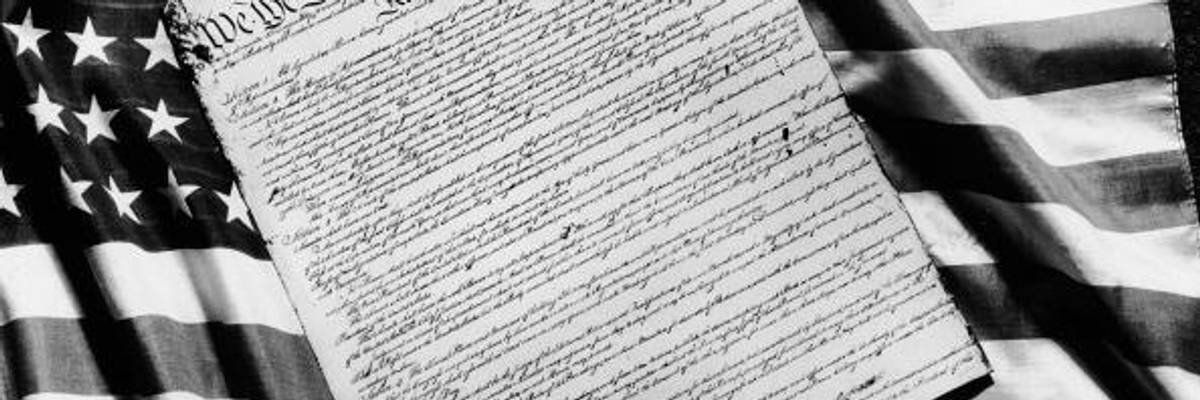
"Now that GOP state legislators have control over 32 state legislatures (both chambers), thanks in large part to partisan gerrymandering, some extremists are preparing to use their clout to gerrymander the U.S. Senate." (Photo by Lambert/Getty Images)
Now that GOP state legislators have control over 32 state legislatures (both chambers), thanks in large part to partisan gerrymandering, some extremists are preparing to use their clout to gerrymander the U.S. Senate.
This week in Denver, July 19-21, the American Legislative Exchange Council (ALEC) will welcome Republican state legislators and its corporate funders, including Koch Industries, ExxonMobil, K12 Inc., Peabody Energy, and PhRMA, to vote on corporate legislative priorities and create cookie cutter "model" bills in task force meetings that are still closed to the press.
ALEC will welcome U.S. Education Secretary Betsy DeVos, Labor Secretary Alexander Acosta, Secretary of the Interior Ryan Zinke, Newt Gingrich and other Trump loyalists to the meeting.
On the agenda for debate and discussion? A model bill to repeal the 17th Amendment, which established the popular election of United States Senators in 1913.
Previously, U.S. Senators were selected by state legislatures and political party bosses beholden to powerful industries. The corruption scandals erupting from the wheeling and dealing fueled some of the great muckraking investigative journalism of the early 20th Century. In 1912, progressive Republican U.S. Senator Robert "Fighting Bob" La Follette campaigned for the popular election of U.S. Senators as a means of cracking down on political corruption and corporate control of the democracy. Reformers introduced direct primary elections, ballot initiatives, and recall votes, in the same time period.
Now right-wing extremists want to roll back the clock to enable Republican state houses and Republican governors to hijack at least 10 U.S. Senate Seats held by Democrats in Republican trifecta states, and force an ever more extreme agenda through Congress.
The "Draft Resolution Recommending Constitutional Amendment Restoring Election Of U.S. Senators To The Legislatures Of The Sovereign States" is scheduled to be debated by ALEC's Federalism and International Relations Task Force in Denver.
The resolution reads in part:
Section 1. The seventeenth article of amendment to the Constitution of the United States is hereby repealed.
Section 2. Senators shall be elected exclusively by the State legislature, upon a majority vote of legislators present and voting in a joint session. If a vacancy shall exist for more than one hundred-eighty days, then the Governor shall appoint the Senator to serve the remainder of the vacant term. This procedure may not be modified by state initiative or referendum.
One only needs to examine the electoral map to understand why ALEC is pushing for a repeal of the 17th Amendment now.
With the majority of states under GOP control, Republicans could snatch some 17 U.S. Senate seats from Democrats if the state legislatures are given the right to pick Senators.
ALEC politicians know that their extreme agenda of rolling back renewables, busting unions, and privatizing schools is not popular with the American public and doesn't fly at the ballot box. No state, for instance, has approved school vouchers via the ballot box, education expert Diane Ravitch tell us.
It is not easy to pass a Constitutional Amendment or repeal one. Only Utah has passed a resolution urging the repeal of the 17th Amendment. But a repeal would give the GOP a supermajority in the U.S. Senate and a greatly enhanced ability to advance extremist policies.
This bill should be seen as the latest in a long line of ALEC bills to rig the system and rein in popular democracy. ALEC had a model resolution supporting the electoral college; ALEC wanted to limit ballot initiatives and referendums put on the ballot by voters; ALEC stood behind the U.S. Supreme Court's Citizen's United decision, and ALEC wanted to stomp on traditionally Democratic voters with voter ID requirements and more.
In 2012, the Center for Media and Democracy revealed that ALEC was involved in the Red Map redistricting effort, based on emails obtained through open records requests to Wisconsin Senate Majority Leader Scott Fitzgerald. ALEC had pushed redistricting approaches spearheaded by the former lawyer for the national Republican Party, Mark Braden, and hosted a special conference call with that partisan lawyer to advise ALEC legislators on redistricting. The result? Wisconsin's maps were so egregiously gerrymandered to lock down GOP control of seats that a landmark case challenging the hyper-partisan effort is now pending before the U.S. Supreme Court.
ALEC has debated the repeal of the 17th Amendment before at the 2013 States and Nation Policy Summit. In the "Equal State's Enfranchisement Act (ESEA)," ALEC required State Legislatures to choose a candidate for U.S. Senator that will be placed on the ballot alongside other candidates for the general public to vote on. The Act did not call for a repeal of the 17th Amendment, but gave a leg up to a favored candidate. That draft did not become a model bill.
This latest iteration, is a virtual copy of a bill on the site of a group called the Equal Justice Coalition, a small 501(c)3 nonprofit based out of Long Beach, California run by a retired real estate developer: J. Jay Feinberg. IRS filings for the group show that it was founded in 2015 and did not report revenue until 2016 when it stated receiving $46,000.
Feinberg held a workshop on EJC's repeal of the 17th Amendment that included John C. Eastman, Founding Director of the Claremont Institute's Center for Constitutional Jurisprudence and Trent England, Executive VP of the Oklahoma Council of Public Affairs at ALEC's States and Nation Policy Meeting in Washington, D.C in November 2016. Earlier, the trio held a "telepanel" on the subject hosted on the Claremont Institute's site. (View the slideshow here.)
In the Claremont panel and the ALEC workshop, Feinberg, Eastman, and England argue that the power and sovereignty of the states has been eroded by direct election of the Senate and that the costs of U.S. Senate elections have spun out of control.
Although the trio appears to quote a MapLight analysis stating that it now costs $10.5 million to win a U.S. Senate seat on average, they fail to note that MapLight President Daniel Newman attributes the high cost to the 2010 U.S. Supreme Court decision Citizens United v. FEC, which opened the door to an unlimited flow of corporate money into campaigns and elections.
Perhaps the Equal Justice Coalition should be promoting a Constitutional Amendment to roll back Citizens United instead.
Stay tuned and follow @ALECexposed for updates on ALEC.
Dear Common Dreams reader, It’s been nearly 30 years since I co-founded Common Dreams with my late wife, Lina Newhouser. We had the radical notion that journalism should serve the public good, not corporate profits. It was clear to us from the outset what it would take to build such a project. No paid advertisements. No corporate sponsors. No millionaire publisher telling us what to think or do. Many people said we wouldn't last a year, but we proved those doubters wrong. Together with a tremendous team of journalists and dedicated staff, we built an independent media outlet free from the constraints of profits and corporate control. Our mission has always been simple: To inform. To inspire. To ignite change for the common good. Building Common Dreams was not easy. Our survival was never guaranteed. When you take on the most powerful forces—Wall Street greed, fossil fuel industry destruction, Big Tech lobbyists, and uber-rich oligarchs who have spent billions upon billions rigging the economy and democracy in their favor—the only bulwark you have is supporters who believe in your work. But here’s the urgent message from me today. It's never been this bad out there. And it's never been this hard to keep us going. At the very moment Common Dreams is most needed, the threats we face are intensifying. We need your support now more than ever. We don't accept corporate advertising and never will. We don't have a paywall because we don't think people should be blocked from critical news based on their ability to pay. Everything we do is funded by the donations of readers like you. When everyone does the little they can afford, we are strong. But if that support retreats or dries up, so do we. Will you donate now to make sure Common Dreams not only survives but thrives? —Craig Brown, Co-founder |
Now that GOP state legislators have control over 32 state legislatures (both chambers), thanks in large part to partisan gerrymandering, some extremists are preparing to use their clout to gerrymander the U.S. Senate.
This week in Denver, July 19-21, the American Legislative Exchange Council (ALEC) will welcome Republican state legislators and its corporate funders, including Koch Industries, ExxonMobil, K12 Inc., Peabody Energy, and PhRMA, to vote on corporate legislative priorities and create cookie cutter "model" bills in task force meetings that are still closed to the press.
ALEC will welcome U.S. Education Secretary Betsy DeVos, Labor Secretary Alexander Acosta, Secretary of the Interior Ryan Zinke, Newt Gingrich and other Trump loyalists to the meeting.
On the agenda for debate and discussion? A model bill to repeal the 17th Amendment, which established the popular election of United States Senators in 1913.
Previously, U.S. Senators were selected by state legislatures and political party bosses beholden to powerful industries. The corruption scandals erupting from the wheeling and dealing fueled some of the great muckraking investigative journalism of the early 20th Century. In 1912, progressive Republican U.S. Senator Robert "Fighting Bob" La Follette campaigned for the popular election of U.S. Senators as a means of cracking down on political corruption and corporate control of the democracy. Reformers introduced direct primary elections, ballot initiatives, and recall votes, in the same time period.
Now right-wing extremists want to roll back the clock to enable Republican state houses and Republican governors to hijack at least 10 U.S. Senate Seats held by Democrats in Republican trifecta states, and force an ever more extreme agenda through Congress.
The "Draft Resolution Recommending Constitutional Amendment Restoring Election Of U.S. Senators To The Legislatures Of The Sovereign States" is scheduled to be debated by ALEC's Federalism and International Relations Task Force in Denver.
The resolution reads in part:
Section 1. The seventeenth article of amendment to the Constitution of the United States is hereby repealed.
Section 2. Senators shall be elected exclusively by the State legislature, upon a majority vote of legislators present and voting in a joint session. If a vacancy shall exist for more than one hundred-eighty days, then the Governor shall appoint the Senator to serve the remainder of the vacant term. This procedure may not be modified by state initiative or referendum.
One only needs to examine the electoral map to understand why ALEC is pushing for a repeal of the 17th Amendment now.
With the majority of states under GOP control, Republicans could snatch some 17 U.S. Senate seats from Democrats if the state legislatures are given the right to pick Senators.
ALEC politicians know that their extreme agenda of rolling back renewables, busting unions, and privatizing schools is not popular with the American public and doesn't fly at the ballot box. No state, for instance, has approved school vouchers via the ballot box, education expert Diane Ravitch tell us.
It is not easy to pass a Constitutional Amendment or repeal one. Only Utah has passed a resolution urging the repeal of the 17th Amendment. But a repeal would give the GOP a supermajority in the U.S. Senate and a greatly enhanced ability to advance extremist policies.
This bill should be seen as the latest in a long line of ALEC bills to rig the system and rein in popular democracy. ALEC had a model resolution supporting the electoral college; ALEC wanted to limit ballot initiatives and referendums put on the ballot by voters; ALEC stood behind the U.S. Supreme Court's Citizen's United decision, and ALEC wanted to stomp on traditionally Democratic voters with voter ID requirements and more.
In 2012, the Center for Media and Democracy revealed that ALEC was involved in the Red Map redistricting effort, based on emails obtained through open records requests to Wisconsin Senate Majority Leader Scott Fitzgerald. ALEC had pushed redistricting approaches spearheaded by the former lawyer for the national Republican Party, Mark Braden, and hosted a special conference call with that partisan lawyer to advise ALEC legislators on redistricting. The result? Wisconsin's maps were so egregiously gerrymandered to lock down GOP control of seats that a landmark case challenging the hyper-partisan effort is now pending before the U.S. Supreme Court.
ALEC has debated the repeal of the 17th Amendment before at the 2013 States and Nation Policy Summit. In the "Equal State's Enfranchisement Act (ESEA)," ALEC required State Legislatures to choose a candidate for U.S. Senator that will be placed on the ballot alongside other candidates for the general public to vote on. The Act did not call for a repeal of the 17th Amendment, but gave a leg up to a favored candidate. That draft did not become a model bill.
This latest iteration, is a virtual copy of a bill on the site of a group called the Equal Justice Coalition, a small 501(c)3 nonprofit based out of Long Beach, California run by a retired real estate developer: J. Jay Feinberg. IRS filings for the group show that it was founded in 2015 and did not report revenue until 2016 when it stated receiving $46,000.
Feinberg held a workshop on EJC's repeal of the 17th Amendment that included John C. Eastman, Founding Director of the Claremont Institute's Center for Constitutional Jurisprudence and Trent England, Executive VP of the Oklahoma Council of Public Affairs at ALEC's States and Nation Policy Meeting in Washington, D.C in November 2016. Earlier, the trio held a "telepanel" on the subject hosted on the Claremont Institute's site. (View the slideshow here.)
In the Claremont panel and the ALEC workshop, Feinberg, Eastman, and England argue that the power and sovereignty of the states has been eroded by direct election of the Senate and that the costs of U.S. Senate elections have spun out of control.
Although the trio appears to quote a MapLight analysis stating that it now costs $10.5 million to win a U.S. Senate seat on average, they fail to note that MapLight President Daniel Newman attributes the high cost to the 2010 U.S. Supreme Court decision Citizens United v. FEC, which opened the door to an unlimited flow of corporate money into campaigns and elections.
Perhaps the Equal Justice Coalition should be promoting a Constitutional Amendment to roll back Citizens United instead.
Stay tuned and follow @ALECexposed for updates on ALEC.
Now that GOP state legislators have control over 32 state legislatures (both chambers), thanks in large part to partisan gerrymandering, some extremists are preparing to use their clout to gerrymander the U.S. Senate.
This week in Denver, July 19-21, the American Legislative Exchange Council (ALEC) will welcome Republican state legislators and its corporate funders, including Koch Industries, ExxonMobil, K12 Inc., Peabody Energy, and PhRMA, to vote on corporate legislative priorities and create cookie cutter "model" bills in task force meetings that are still closed to the press.
ALEC will welcome U.S. Education Secretary Betsy DeVos, Labor Secretary Alexander Acosta, Secretary of the Interior Ryan Zinke, Newt Gingrich and other Trump loyalists to the meeting.
On the agenda for debate and discussion? A model bill to repeal the 17th Amendment, which established the popular election of United States Senators in 1913.
Previously, U.S. Senators were selected by state legislatures and political party bosses beholden to powerful industries. The corruption scandals erupting from the wheeling and dealing fueled some of the great muckraking investigative journalism of the early 20th Century. In 1912, progressive Republican U.S. Senator Robert "Fighting Bob" La Follette campaigned for the popular election of U.S. Senators as a means of cracking down on political corruption and corporate control of the democracy. Reformers introduced direct primary elections, ballot initiatives, and recall votes, in the same time period.
Now right-wing extremists want to roll back the clock to enable Republican state houses and Republican governors to hijack at least 10 U.S. Senate Seats held by Democrats in Republican trifecta states, and force an ever more extreme agenda through Congress.
The "Draft Resolution Recommending Constitutional Amendment Restoring Election Of U.S. Senators To The Legislatures Of The Sovereign States" is scheduled to be debated by ALEC's Federalism and International Relations Task Force in Denver.
The resolution reads in part:
Section 1. The seventeenth article of amendment to the Constitution of the United States is hereby repealed.
Section 2. Senators shall be elected exclusively by the State legislature, upon a majority vote of legislators present and voting in a joint session. If a vacancy shall exist for more than one hundred-eighty days, then the Governor shall appoint the Senator to serve the remainder of the vacant term. This procedure may not be modified by state initiative or referendum.
One only needs to examine the electoral map to understand why ALEC is pushing for a repeal of the 17th Amendment now.
With the majority of states under GOP control, Republicans could snatch some 17 U.S. Senate seats from Democrats if the state legislatures are given the right to pick Senators.
ALEC politicians know that their extreme agenda of rolling back renewables, busting unions, and privatizing schools is not popular with the American public and doesn't fly at the ballot box. No state, for instance, has approved school vouchers via the ballot box, education expert Diane Ravitch tell us.
It is not easy to pass a Constitutional Amendment or repeal one. Only Utah has passed a resolution urging the repeal of the 17th Amendment. But a repeal would give the GOP a supermajority in the U.S. Senate and a greatly enhanced ability to advance extremist policies.
This bill should be seen as the latest in a long line of ALEC bills to rig the system and rein in popular democracy. ALEC had a model resolution supporting the electoral college; ALEC wanted to limit ballot initiatives and referendums put on the ballot by voters; ALEC stood behind the U.S. Supreme Court's Citizen's United decision, and ALEC wanted to stomp on traditionally Democratic voters with voter ID requirements and more.
In 2012, the Center for Media and Democracy revealed that ALEC was involved in the Red Map redistricting effort, based on emails obtained through open records requests to Wisconsin Senate Majority Leader Scott Fitzgerald. ALEC had pushed redistricting approaches spearheaded by the former lawyer for the national Republican Party, Mark Braden, and hosted a special conference call with that partisan lawyer to advise ALEC legislators on redistricting. The result? Wisconsin's maps were so egregiously gerrymandered to lock down GOP control of seats that a landmark case challenging the hyper-partisan effort is now pending before the U.S. Supreme Court.
ALEC has debated the repeal of the 17th Amendment before at the 2013 States and Nation Policy Summit. In the "Equal State's Enfranchisement Act (ESEA)," ALEC required State Legislatures to choose a candidate for U.S. Senator that will be placed on the ballot alongside other candidates for the general public to vote on. The Act did not call for a repeal of the 17th Amendment, but gave a leg up to a favored candidate. That draft did not become a model bill.
This latest iteration, is a virtual copy of a bill on the site of a group called the Equal Justice Coalition, a small 501(c)3 nonprofit based out of Long Beach, California run by a retired real estate developer: J. Jay Feinberg. IRS filings for the group show that it was founded in 2015 and did not report revenue until 2016 when it stated receiving $46,000.
Feinberg held a workshop on EJC's repeal of the 17th Amendment that included John C. Eastman, Founding Director of the Claremont Institute's Center for Constitutional Jurisprudence and Trent England, Executive VP of the Oklahoma Council of Public Affairs at ALEC's States and Nation Policy Meeting in Washington, D.C in November 2016. Earlier, the trio held a "telepanel" on the subject hosted on the Claremont Institute's site. (View the slideshow here.)
In the Claremont panel and the ALEC workshop, Feinberg, Eastman, and England argue that the power and sovereignty of the states has been eroded by direct election of the Senate and that the costs of U.S. Senate elections have spun out of control.
Although the trio appears to quote a MapLight analysis stating that it now costs $10.5 million to win a U.S. Senate seat on average, they fail to note that MapLight President Daniel Newman attributes the high cost to the 2010 U.S. Supreme Court decision Citizens United v. FEC, which opened the door to an unlimited flow of corporate money into campaigns and elections.
Perhaps the Equal Justice Coalition should be promoting a Constitutional Amendment to roll back Citizens United instead.
Stay tuned and follow @ALECexposed for updates on ALEC.