SUBSCRIBE TO OUR FREE NEWSLETTER
Daily news & progressive opinion—funded by the people, not the corporations—delivered straight to your inbox.
5
#000000
#FFFFFF
To donate by check, phone, or other method, see our More Ways to Give page.
Daily news & progressive opinion—funded by the people, not the corporations—delivered straight to your inbox.
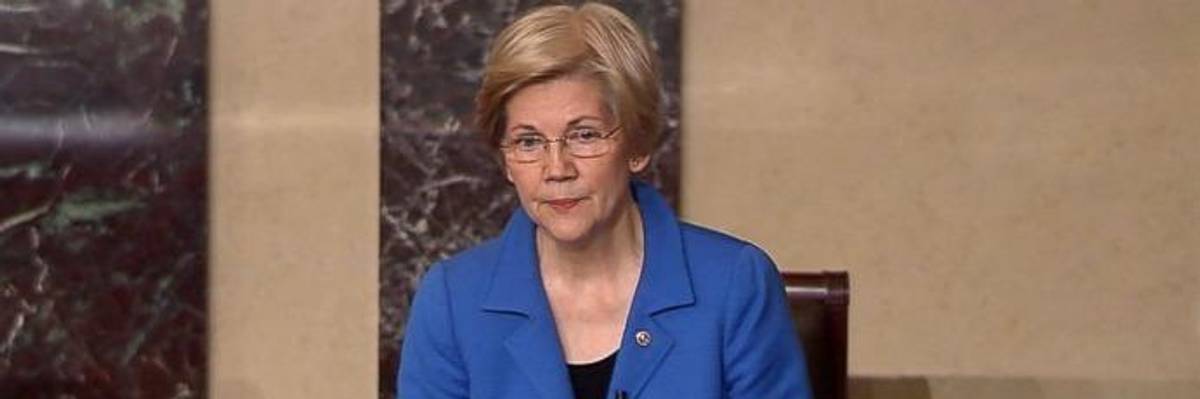
For us biographers, the electrifying moment when Senator Mitch McConnell silenced Elizabeth Warren recalled another proud moment in women's history, the day in 1838 when Angelina Grimke took the podium at the Massachusetts Legislature. (Photo: AP)
As scholars of women's history, we are aware of times in our past when advocates for women's rights and advocates for black rights competed against one another. But not this time. We need look no further than Elizabeth Warren's historic silencing on the floor of the Senate last week.
As scholars of women's history, we are aware of times in our past when advocates for women's rights and advocates for black rights competed against one another. But not this time. We need look no further than Elizabeth Warren's historic silencing on the floor of the Senate last week. A white woman rose to read the words of Coretta Scott King, words that reminded us of the racist history of the new attorney general, Senator Jeff Sessions, who, as US attorney in Alabama, "used the awesome power of his office" according to King, "in a shabby attempt to intimidate and frighten elderly black voters."
For us biographers, the electrifying moment when Senator Mitch McConnell silenced Elizabeth Warren recalled another proud moment in women's history, the day in 1838 when Angelina Grimke took the podium at the Massachusetts Legislature and became the first woman in US history to address an American legislative body. The subject then, as in the case of Elizabeth Warren, was the rights of African-Americans -- in that case, specifically, "the great and solemn subject of American slavery."
"I feel that I owe it to the suffering slave," Grimke told the Assembly, "and to the deluded master, to my country and the world, to do all that I can to overturn a system of complicated crimes, built up upon the broken hearts and prostrate bodies of my countrymen in chains, and cemented by the blood and sweat and tears of my sisters in bonds." Grimke, on that occasion, was treated a little better than Elizabeth Warren 150-odd years later. Though interrupted three times by hissing, she was eventually allowed to take the Speaker's desk and finish her eloquent plea.
Of course, it was easier to allow the brave Angelina Grimke a platform. Unlike Senator Elizabeth Warren, Angelina Grimke could only present a petition, signed by 20,000 women. She had the right neither to vote nor to hold office. Senator Warren has both, and the Internet besides. For that we must be grateful. Women do have a voice now, and they are using it. Even among Republicans, who have been consistently spineless, two women, Susan Collins of Maine and Lisa Murkowski of Alaska, voted against the shockingly unqualified Betsy DeVos to become secretary of education.
Trump's relentless efforts to divide us by race, by religion, by ethnicity, by differences of every kind, have unleashed a fury of protest, with a rich mix of women leading the way. The pink pussy hats, which overflowed the broad avenues of Washington and filled city squares around America and across the world the day after his inauguration, sent a defiant message to Trump and all others who demean women. It was a march about reproductive rights, but it was also a march about shielding vulnerable immigrants and protecting endangered black lives. Men were there too, joining in a call and response: "My life, my choice," chanted the women. "Her life, her choice," answered the men. This is an inclusive movement. "No hate, no bigotry, no Muslim registry," Alicia Keyes called out at the Washington march, "everyone with a bellybutton must agree."
For us, as for many other women, there is a lingering anger simmering beneath our protests -- an anger about the manner in which Hillary Clinton was defeated. Even before we learned that the Russians were targeting her campaign, even before James Comey raised that late and false e-mail alarm, we witnessed the misogyny that has always plagued strong women. Her voice, her laugh, her clothes, her earnestness -- all were fair game. The fact that she knew what she was talking about should have been reassuring. Instead, it made many Americans uneasy. Now we're left with the disastrous result: Donald Trump.
The danger of Donald Trump's position of power in the White House is sinking in around the world. The cover of Germany's Der Spiegel, perhaps the most important of Europe's news magazines, depicts Trump holding up the severed head of the Statue of Liberty. The snuffed-out torch of the Statue is on the cover of the current New Yorker. But Lady Liberty is not dead yet. She's just gotten a big jolt of adrenaline from the women who took to the streets on Jan. 21. And an additional jolt from Elizabeth Warren, who rose on the Senate floor last week to speak up for our one, indivisible, nation.
Dear Common Dreams reader, It’s been nearly 30 years since I co-founded Common Dreams with my late wife, Lina Newhouser. We had the radical notion that journalism should serve the public good, not corporate profits. It was clear to us from the outset what it would take to build such a project. No paid advertisements. No corporate sponsors. No millionaire publisher telling us what to think or do. Many people said we wouldn't last a year, but we proved those doubters wrong. Together with a tremendous team of journalists and dedicated staff, we built an independent media outlet free from the constraints of profits and corporate control. Our mission has always been simple: To inform. To inspire. To ignite change for the common good. Building Common Dreams was not easy. Our survival was never guaranteed. When you take on the most powerful forces—Wall Street greed, fossil fuel industry destruction, Big Tech lobbyists, and uber-rich oligarchs who have spent billions upon billions rigging the economy and democracy in their favor—the only bulwark you have is supporters who believe in your work. But here’s the urgent message from me today. It's never been this bad out there. And it's never been this hard to keep us going. At the very moment Common Dreams is most needed, the threats we face are intensifying. We need your support now more than ever. We don't accept corporate advertising and never will. We don't have a paywall because we don't think people should be blocked from critical news based on their ability to pay. Everything we do is funded by the donations of readers like you. When everyone does the little they can afford, we are strong. But if that support retreats or dries up, so do we. Will you donate now to make sure Common Dreams not only survives but thrives? —Craig Brown, Co-founder |
As scholars of women's history, we are aware of times in our past when advocates for women's rights and advocates for black rights competed against one another. But not this time. We need look no further than Elizabeth Warren's historic silencing on the floor of the Senate last week. A white woman rose to read the words of Coretta Scott King, words that reminded us of the racist history of the new attorney general, Senator Jeff Sessions, who, as US attorney in Alabama, "used the awesome power of his office" according to King, "in a shabby attempt to intimidate and frighten elderly black voters."
For us biographers, the electrifying moment when Senator Mitch McConnell silenced Elizabeth Warren recalled another proud moment in women's history, the day in 1838 when Angelina Grimke took the podium at the Massachusetts Legislature and became the first woman in US history to address an American legislative body. The subject then, as in the case of Elizabeth Warren, was the rights of African-Americans -- in that case, specifically, "the great and solemn subject of American slavery."
"I feel that I owe it to the suffering slave," Grimke told the Assembly, "and to the deluded master, to my country and the world, to do all that I can to overturn a system of complicated crimes, built up upon the broken hearts and prostrate bodies of my countrymen in chains, and cemented by the blood and sweat and tears of my sisters in bonds." Grimke, on that occasion, was treated a little better than Elizabeth Warren 150-odd years later. Though interrupted three times by hissing, she was eventually allowed to take the Speaker's desk and finish her eloquent plea.
Of course, it was easier to allow the brave Angelina Grimke a platform. Unlike Senator Elizabeth Warren, Angelina Grimke could only present a petition, signed by 20,000 women. She had the right neither to vote nor to hold office. Senator Warren has both, and the Internet besides. For that we must be grateful. Women do have a voice now, and they are using it. Even among Republicans, who have been consistently spineless, two women, Susan Collins of Maine and Lisa Murkowski of Alaska, voted against the shockingly unqualified Betsy DeVos to become secretary of education.
Trump's relentless efforts to divide us by race, by religion, by ethnicity, by differences of every kind, have unleashed a fury of protest, with a rich mix of women leading the way. The pink pussy hats, which overflowed the broad avenues of Washington and filled city squares around America and across the world the day after his inauguration, sent a defiant message to Trump and all others who demean women. It was a march about reproductive rights, but it was also a march about shielding vulnerable immigrants and protecting endangered black lives. Men were there too, joining in a call and response: "My life, my choice," chanted the women. "Her life, her choice," answered the men. This is an inclusive movement. "No hate, no bigotry, no Muslim registry," Alicia Keyes called out at the Washington march, "everyone with a bellybutton must agree."
For us, as for many other women, there is a lingering anger simmering beneath our protests -- an anger about the manner in which Hillary Clinton was defeated. Even before we learned that the Russians were targeting her campaign, even before James Comey raised that late and false e-mail alarm, we witnessed the misogyny that has always plagued strong women. Her voice, her laugh, her clothes, her earnestness -- all were fair game. The fact that she knew what she was talking about should have been reassuring. Instead, it made many Americans uneasy. Now we're left with the disastrous result: Donald Trump.
The danger of Donald Trump's position of power in the White House is sinking in around the world. The cover of Germany's Der Spiegel, perhaps the most important of Europe's news magazines, depicts Trump holding up the severed head of the Statue of Liberty. The snuffed-out torch of the Statue is on the cover of the current New Yorker. But Lady Liberty is not dead yet. She's just gotten a big jolt of adrenaline from the women who took to the streets on Jan. 21. And an additional jolt from Elizabeth Warren, who rose on the Senate floor last week to speak up for our one, indivisible, nation.
As scholars of women's history, we are aware of times in our past when advocates for women's rights and advocates for black rights competed against one another. But not this time. We need look no further than Elizabeth Warren's historic silencing on the floor of the Senate last week. A white woman rose to read the words of Coretta Scott King, words that reminded us of the racist history of the new attorney general, Senator Jeff Sessions, who, as US attorney in Alabama, "used the awesome power of his office" according to King, "in a shabby attempt to intimidate and frighten elderly black voters."
For us biographers, the electrifying moment when Senator Mitch McConnell silenced Elizabeth Warren recalled another proud moment in women's history, the day in 1838 when Angelina Grimke took the podium at the Massachusetts Legislature and became the first woman in US history to address an American legislative body. The subject then, as in the case of Elizabeth Warren, was the rights of African-Americans -- in that case, specifically, "the great and solemn subject of American slavery."
"I feel that I owe it to the suffering slave," Grimke told the Assembly, "and to the deluded master, to my country and the world, to do all that I can to overturn a system of complicated crimes, built up upon the broken hearts and prostrate bodies of my countrymen in chains, and cemented by the blood and sweat and tears of my sisters in bonds." Grimke, on that occasion, was treated a little better than Elizabeth Warren 150-odd years later. Though interrupted three times by hissing, she was eventually allowed to take the Speaker's desk and finish her eloquent plea.
Of course, it was easier to allow the brave Angelina Grimke a platform. Unlike Senator Elizabeth Warren, Angelina Grimke could only present a petition, signed by 20,000 women. She had the right neither to vote nor to hold office. Senator Warren has both, and the Internet besides. For that we must be grateful. Women do have a voice now, and they are using it. Even among Republicans, who have been consistently spineless, two women, Susan Collins of Maine and Lisa Murkowski of Alaska, voted against the shockingly unqualified Betsy DeVos to become secretary of education.
Trump's relentless efforts to divide us by race, by religion, by ethnicity, by differences of every kind, have unleashed a fury of protest, with a rich mix of women leading the way. The pink pussy hats, which overflowed the broad avenues of Washington and filled city squares around America and across the world the day after his inauguration, sent a defiant message to Trump and all others who demean women. It was a march about reproductive rights, but it was also a march about shielding vulnerable immigrants and protecting endangered black lives. Men were there too, joining in a call and response: "My life, my choice," chanted the women. "Her life, her choice," answered the men. This is an inclusive movement. "No hate, no bigotry, no Muslim registry," Alicia Keyes called out at the Washington march, "everyone with a bellybutton must agree."
For us, as for many other women, there is a lingering anger simmering beneath our protests -- an anger about the manner in which Hillary Clinton was defeated. Even before we learned that the Russians were targeting her campaign, even before James Comey raised that late and false e-mail alarm, we witnessed the misogyny that has always plagued strong women. Her voice, her laugh, her clothes, her earnestness -- all were fair game. The fact that she knew what she was talking about should have been reassuring. Instead, it made many Americans uneasy. Now we're left with the disastrous result: Donald Trump.
The danger of Donald Trump's position of power in the White House is sinking in around the world. The cover of Germany's Der Spiegel, perhaps the most important of Europe's news magazines, depicts Trump holding up the severed head of the Statue of Liberty. The snuffed-out torch of the Statue is on the cover of the current New Yorker. But Lady Liberty is not dead yet. She's just gotten a big jolt of adrenaline from the women who took to the streets on Jan. 21. And an additional jolt from Elizabeth Warren, who rose on the Senate floor last week to speak up for our one, indivisible, nation.