SUBSCRIBE TO OUR FREE NEWSLETTER
Daily news & progressive opinion—funded by the people, not the corporations—delivered straight to your inbox.
5
#000000
#FFFFFF
To donate by check, phone, or other method, see our More Ways to Give page.
If you're getting paid to advocate for the destruction of the world as we know it, shouldn't you at least let people know?
The Washington Post apparently doesn't think so.
The Post regularly publishes columns by Ed Rogers, a veteran of the Reagan/Bush administration turned lobbyist. His most recent column (4/20/15) is an attack on President Barack Obama for thinking that global warming is important:
Incredibly, in Sunday's weekly video address, President Obama said, "Today, there is no greater threat to our planet than climate change." I say "incredibly" because that just isn't true--and if President Obama really believes it is, then it is time to panic. Given the state of the world and the urgent problems facing us that directly affect our prospects for peace and prosperity, global warming shouldn't even be in the top five on the list of problems our president should be worrying about.
What are the many things more important than climate change? Um, the Ukraine crisis. Concern that "the United States is retreating from global leadership." And "at home, economic growth is anemic and job creation has stalled." There are other threats greater than global warming, too--at least two more, apparently--but Rogers doesn't specify them.
His case for climate change not being a significant problem is, if anything, less detailed:
So why would our president say global warming is our biggest threat? Probably because it suits his ideology and his management style. The truth is, if you accept at face value everything he says about climate change, there is nothing he can do in the 20 months he has left in office that will appreciably affect the climate.
That's pretty much it, before Rogers concludes, "Let's hope somewhere there are advisers telling him that urgent matters need his focus and global warming is simply not the priority that he wants it to be." There's nothing about sea level rise, crop failures, disease expansion, ocean acidification, etc.
So why would you ignore all the negative consequences of rapidly changing the Earth's climate, and insist that instead of doing anything about it, we ought to meet a vague list of other problems with an even vaguer gesture toward supposed solutions (e.g., "There is also a lot he could do to take the reins and provide American leadership around the world")? Well, maybe you're paid to do just that.
The Post's bio for Rogers notes that he "is the chairman of the lobbying and communications firm BGR Group," but it doesn't give any clue who his clients are. Luckily, lobbyists are required by law to disclose their clients, a fact the media critic known as @crushingbort made good use of:
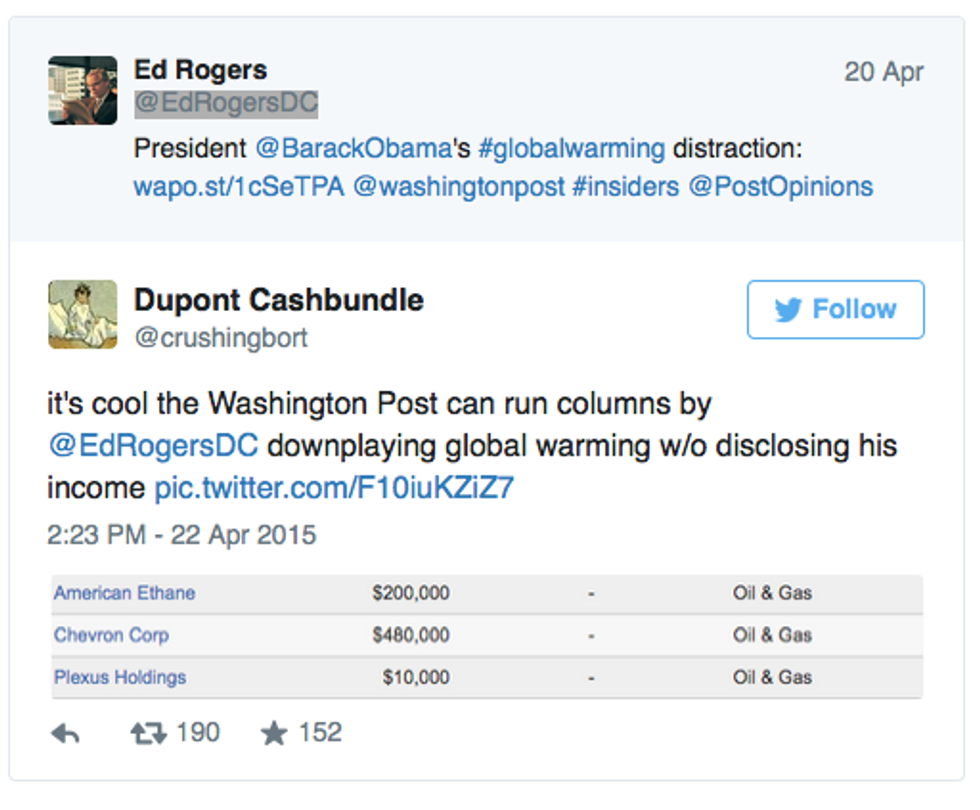
And that's just last year; in 2013, BGR got another $590,000 from Chevron, and $450,000 in 2012. In 2011, they got a million dollars form Gas Natural SDG, a Spanish methane-burning utility. And on and on.
What do you get when you give BGR that kind of money? Among other things, you get an employee who has a regular platform in the Washington Post, and has no qualms about advancing opinions that boost his clients' profits. Don't think that isn't mentioned when the agency is soliciting business.
It's not clear how Post readers benefit from regular exposure to a lobbyist promoting his clients' interests, but at the very least they should be informed that there is a connection between the views Rogers is espousing and the checks he is cashing.
Recently, Newsweek published an op-ed (4/11/15) attacking subsidies for wind power--and later put a note on it acknowledging that it was lacking in the disclosure department.
Editor's note: The author of this piece, Randy Simmons, is the Charles G. Koch professor of political economy at Utah State University. He's also a senior fellow at the Koch- and ExxonMobil-funded Property and Environment Research Center. These ties to the oil industry weren't originally disclosed in this piece.
Newsweek (4/21/15) also published a rebuttal to the piece, providing an alternative view of wind power that wasn't funded by the fossil fuel industry.
For many years, Newsweek and the Washington Post were owned by the same company. Will the Post follow its former corporate sibling's example and let its readers know that its columnist was expressing the views that he's paid to promote?
If you're getting paid to advocate for the destruction of the world as we know it, shouldn't you at least let people know?
The Washington Post apparently doesn't think so.
The Post regularly publishes columns by Ed Rogers, a veteran of the Reagan/Bush administration turned lobbyist. His most recent column (4/20/15) is an attack on President Barack Obama for thinking that global warming is important:
Incredibly, in Sunday's weekly video address, President Obama said, "Today, there is no greater threat to our planet than climate change." I say "incredibly" because that just isn't true--and if President Obama really believes it is, then it is time to panic. Given the state of the world and the urgent problems facing us that directly affect our prospects for peace and prosperity, global warming shouldn't even be in the top five on the list of problems our president should be worrying about.
What are the many things more important than climate change? Um, the Ukraine crisis. Concern that "the United States is retreating from global leadership." And "at home, economic growth is anemic and job creation has stalled." There are other threats greater than global warming, too--at least two more, apparently--but Rogers doesn't specify them.
His case for climate change not being a significant problem is, if anything, less detailed:
So why would our president say global warming is our biggest threat? Probably because it suits his ideology and his management style. The truth is, if you accept at face value everything he says about climate change, there is nothing he can do in the 20 months he has left in office that will appreciably affect the climate.
That's pretty much it, before Rogers concludes, "Let's hope somewhere there are advisers telling him that urgent matters need his focus and global warming is simply not the priority that he wants it to be." There's nothing about sea level rise, crop failures, disease expansion, ocean acidification, etc.
So why would you ignore all the negative consequences of rapidly changing the Earth's climate, and insist that instead of doing anything about it, we ought to meet a vague list of other problems with an even vaguer gesture toward supposed solutions (e.g., "There is also a lot he could do to take the reins and provide American leadership around the world")? Well, maybe you're paid to do just that.
The Post's bio for Rogers notes that he "is the chairman of the lobbying and communications firm BGR Group," but it doesn't give any clue who his clients are. Luckily, lobbyists are required by law to disclose their clients, a fact the media critic known as @crushingbort made good use of:
And that's just last year; in 2013, BGR got another $590,000 from Chevron, and $450,000 in 2012. In 2011, they got a million dollars form Gas Natural SDG, a Spanish methane-burning utility. And on and on.
What do you get when you give BGR that kind of money? Among other things, you get an employee who has a regular platform in the Washington Post, and has no qualms about advancing opinions that boost his clients' profits. Don't think that isn't mentioned when the agency is soliciting business.
It's not clear how Post readers benefit from regular exposure to a lobbyist promoting his clients' interests, but at the very least they should be informed that there is a connection between the views Rogers is espousing and the checks he is cashing.
Recently, Newsweek published an op-ed (4/11/15) attacking subsidies for wind power--and later put a note on it acknowledging that it was lacking in the disclosure department.
Editor's note: The author of this piece, Randy Simmons, is the Charles G. Koch professor of political economy at Utah State University. He's also a senior fellow at the Koch- and ExxonMobil-funded Property and Environment Research Center. These ties to the oil industry weren't originally disclosed in this piece.
Newsweek (4/21/15) also published a rebuttal to the piece, providing an alternative view of wind power that wasn't funded by the fossil fuel industry.
For many years, Newsweek and the Washington Post were owned by the same company. Will the Post follow its former corporate sibling's example and let its readers know that its columnist was expressing the views that he's paid to promote?
If you're getting paid to advocate for the destruction of the world as we know it, shouldn't you at least let people know?
The Washington Post apparently doesn't think so.
The Post regularly publishes columns by Ed Rogers, a veteran of the Reagan/Bush administration turned lobbyist. His most recent column (4/20/15) is an attack on President Barack Obama for thinking that global warming is important:
Incredibly, in Sunday's weekly video address, President Obama said, "Today, there is no greater threat to our planet than climate change." I say "incredibly" because that just isn't true--and if President Obama really believes it is, then it is time to panic. Given the state of the world and the urgent problems facing us that directly affect our prospects for peace and prosperity, global warming shouldn't even be in the top five on the list of problems our president should be worrying about.
What are the many things more important than climate change? Um, the Ukraine crisis. Concern that "the United States is retreating from global leadership." And "at home, economic growth is anemic and job creation has stalled." There are other threats greater than global warming, too--at least two more, apparently--but Rogers doesn't specify them.
His case for climate change not being a significant problem is, if anything, less detailed:
So why would our president say global warming is our biggest threat? Probably because it suits his ideology and his management style. The truth is, if you accept at face value everything he says about climate change, there is nothing he can do in the 20 months he has left in office that will appreciably affect the climate.
That's pretty much it, before Rogers concludes, "Let's hope somewhere there are advisers telling him that urgent matters need his focus and global warming is simply not the priority that he wants it to be." There's nothing about sea level rise, crop failures, disease expansion, ocean acidification, etc.
So why would you ignore all the negative consequences of rapidly changing the Earth's climate, and insist that instead of doing anything about it, we ought to meet a vague list of other problems with an even vaguer gesture toward supposed solutions (e.g., "There is also a lot he could do to take the reins and provide American leadership around the world")? Well, maybe you're paid to do just that.
The Post's bio for Rogers notes that he "is the chairman of the lobbying and communications firm BGR Group," but it doesn't give any clue who his clients are. Luckily, lobbyists are required by law to disclose their clients, a fact the media critic known as @crushingbort made good use of:
And that's just last year; in 2013, BGR got another $590,000 from Chevron, and $450,000 in 2012. In 2011, they got a million dollars form Gas Natural SDG, a Spanish methane-burning utility. And on and on.
What do you get when you give BGR that kind of money? Among other things, you get an employee who has a regular platform in the Washington Post, and has no qualms about advancing opinions that boost his clients' profits. Don't think that isn't mentioned when the agency is soliciting business.
It's not clear how Post readers benefit from regular exposure to a lobbyist promoting his clients' interests, but at the very least they should be informed that there is a connection between the views Rogers is espousing and the checks he is cashing.
Recently, Newsweek published an op-ed (4/11/15) attacking subsidies for wind power--and later put a note on it acknowledging that it was lacking in the disclosure department.
Editor's note: The author of this piece, Randy Simmons, is the Charles G. Koch professor of political economy at Utah State University. He's also a senior fellow at the Koch- and ExxonMobil-funded Property and Environment Research Center. These ties to the oil industry weren't originally disclosed in this piece.
Newsweek (4/21/15) also published a rebuttal to the piece, providing an alternative view of wind power that wasn't funded by the fossil fuel industry.
For many years, Newsweek and the Washington Post were owned by the same company. Will the Post follow its former corporate sibling's example and let its readers know that its columnist was expressing the views that he's paid to promote?