SUBSCRIBE TO OUR FREE NEWSLETTER
Daily news & progressive opinion—funded by the people, not the corporations—delivered straight to your inbox.
5
#000000
#FFFFFF
To donate by check, phone, or other method, see our More Ways to Give page.
Poison gas is not only a "moral obscenity" -- one the United States stockpiled for decades after its use was banned in warfare -- but a metaphor for human recklessness and wasted science.
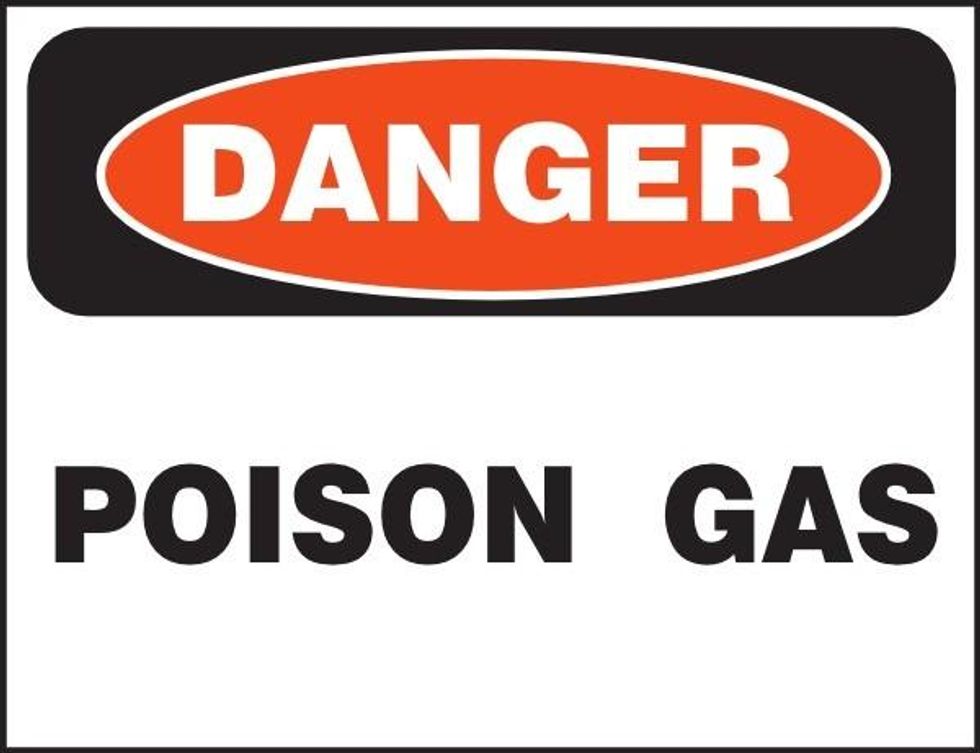
Like it or not, we're forced to think about it these days, since it's still an enticing pretext for war. And the more I think about it, the more I marvel at the persistent insanity of its existence. The "red line" that the so-called civilized world crossed over a century ago was not in the use of poison gas but in its creation, because it's lethal whether it's used or not. Attempting to get rid of it -- by burying it, burning it, dumping it -- has consequences almost as deadly as firing it off in battle.
The enormous toxic mess that encircles the globe needs serious and sustained attention, something present-day governments are, seemingly, incapable of. The fact that this mess of our own making exists at all ought to inspire not missiles and self-righteousness but the deepest questions we know how to ask. And the first question is this: How in God's name do we untangle ourselves from this mess collectively?
The 1925 Geneva Protocol, in response to the horrors of World War I, banned the use of asphyxiating and poisonous gases in war, but not, incredibly, their development or manufacture. It took the civilized world, the one John Kerry referenced in his condemnation of Bashar al-Assad, another seven decades to do that. In the meantime, there was plenty of manufacturing, developing and stockpiling of poison gas weaponry going on, including in the United States, up to and well beyond World War II.
"The fact that the initial U.S. response to the Syrian government's alleged use of poison gas was to bomb the country simply indicates the reckless irresponsibility of thinking in terms of military solutions to anything."
One factual tidbit I find fascinating is that Otto Ambros, a Nazi scientist and co-inventor of Sarin, convicted of crimes against humanity at Nuremberg, came to the United States in 1951, after serving half his term, and began advising the U.S. Army on its own chemical weapons program in the '50s. Could the reality of geopolitics be exposed in starker relief? For all the moral pretenses of war and militarism, the game has no moral boundaries whatsoever.
The fact that the initial U.S. response to the Syrian government's alleged use of poison gas was to bomb the country simply indicates the reckless irresponsibility of thinking in terms of military solutions to anything. Of course the moral issue was just a pretext to go to war, but even on its own terms, this was a preposterous "solution": Bombing storage facilities could easily release the toxic substances being stored. This is the essence of short-term, non-holistic thinking -- the last thing the planet's inhabitants need, but it's apparently what we're cursed with.
Poison gas, as I say, is lethal whether it's used or not. Consider the U.S. stockpile of around 30,000 tons of it, stored or buried, hastily and temporarily, in sites all over the country. The 1997 Chemical Weapons Convention treaty banned its manufacture and stockpiling and gave signing nations a decade to get rid of their stockpiles. We're not even close, primarily because doing so in a way that at least feints toward environmental responsibility is enormously complex and expensive.
"As a rule, chemical weapons are easier to make than to destroy," the New York Times reported recently, in a story that managed to avoid any reflection on the larger implications of this absurd arsenal we're stuck with.
"Everybody forgets that none of these weapons were designed to be peacefully disassembled," the Times quotes an Army spokesman as saying. "It was always assumed that they'd be used."
Why is that not a surprise? This kind of cynicism is all we ask of military planners, quick as they are to invoke moral rectitude as a pretext for using their lethal toys. And remember, most of our stockpiled weapons were manufactured in the wake of the 1925 Geneva Convention banning their use. Much as we imagine that our nation has a cornerstone of moral values, I fear it's an illusion.
And of course we're reaping the consequences of that illusion. Consider that, for many decades prior to the onset of environmental consciousness, the U.S. military, tasked with getting rid of what it no longer needed, simply buried it, burned it or dumped it in the ocean, long-term consequences be damned.
Eight years ago, John M. R. Bull wrote an extraordinary investigative piece for the Daily Press of Hampton Roads, Va., detailing the extent of the Army's jettisoning of obsolete poison gas canisters and other toxic trash. Summing up his findings afterward, I wrote:
"Turns out, according to Army documents the paper obtained, from the end of World War II until 1970, the Army jettisoned 64 million pounds of nerve and mustard agents, 400,000 chemical-filled bombs, land mines and rockets and more than 500 tons of radioactive waste into the coastal waters off 11 states that virtually ring the country; has only a vague idea where these dump sites are; has made only haphazard stabs at monitoring a few of the sites even though leakage and container breakdown are inevitable; and has not bothered to inform the affected states or other agencies about the dumping."
Add to all this our nuclear stockpiling and ongoing development, our use of white phosphorous and depleted uranium, our complicity in Iraq's use of poison gas against Iran and Iraqi Kurds back in the '80s, and I'm wondering how we can ever atone for what we've done, let alone clean up the leftovers.
Poison gas is not only a "moral obscenity" -- one the United States stockpiled for decades after its use was banned in warfare -- but a metaphor for human recklessness and wasted science.
Like it or not, we're forced to think about it these days, since it's still an enticing pretext for war. And the more I think about it, the more I marvel at the persistent insanity of its existence. The "red line" that the so-called civilized world crossed over a century ago was not in the use of poison gas but in its creation, because it's lethal whether it's used or not. Attempting to get rid of it -- by burying it, burning it, dumping it -- has consequences almost as deadly as firing it off in battle.
The enormous toxic mess that encircles the globe needs serious and sustained attention, something present-day governments are, seemingly, incapable of. The fact that this mess of our own making exists at all ought to inspire not missiles and self-righteousness but the deepest questions we know how to ask. And the first question is this: How in God's name do we untangle ourselves from this mess collectively?
The 1925 Geneva Protocol, in response to the horrors of World War I, banned the use of asphyxiating and poisonous gases in war, but not, incredibly, their development or manufacture. It took the civilized world, the one John Kerry referenced in his condemnation of Bashar al-Assad, another seven decades to do that. In the meantime, there was plenty of manufacturing, developing and stockpiling of poison gas weaponry going on, including in the United States, up to and well beyond World War II.
"The fact that the initial U.S. response to the Syrian government's alleged use of poison gas was to bomb the country simply indicates the reckless irresponsibility of thinking in terms of military solutions to anything."
One factual tidbit I find fascinating is that Otto Ambros, a Nazi scientist and co-inventor of Sarin, convicted of crimes against humanity at Nuremberg, came to the United States in 1951, after serving half his term, and began advising the U.S. Army on its own chemical weapons program in the '50s. Could the reality of geopolitics be exposed in starker relief? For all the moral pretenses of war and militarism, the game has no moral boundaries whatsoever.
The fact that the initial U.S. response to the Syrian government's alleged use of poison gas was to bomb the country simply indicates the reckless irresponsibility of thinking in terms of military solutions to anything. Of course the moral issue was just a pretext to go to war, but even on its own terms, this was a preposterous "solution": Bombing storage facilities could easily release the toxic substances being stored. This is the essence of short-term, non-holistic thinking -- the last thing the planet's inhabitants need, but it's apparently what we're cursed with.
Poison gas, as I say, is lethal whether it's used or not. Consider the U.S. stockpile of around 30,000 tons of it, stored or buried, hastily and temporarily, in sites all over the country. The 1997 Chemical Weapons Convention treaty banned its manufacture and stockpiling and gave signing nations a decade to get rid of their stockpiles. We're not even close, primarily because doing so in a way that at least feints toward environmental responsibility is enormously complex and expensive.
"As a rule, chemical weapons are easier to make than to destroy," the New York Times reported recently, in a story that managed to avoid any reflection on the larger implications of this absurd arsenal we're stuck with.
"Everybody forgets that none of these weapons were designed to be peacefully disassembled," the Times quotes an Army spokesman as saying. "It was always assumed that they'd be used."
Why is that not a surprise? This kind of cynicism is all we ask of military planners, quick as they are to invoke moral rectitude as a pretext for using their lethal toys. And remember, most of our stockpiled weapons were manufactured in the wake of the 1925 Geneva Convention banning their use. Much as we imagine that our nation has a cornerstone of moral values, I fear it's an illusion.
And of course we're reaping the consequences of that illusion. Consider that, for many decades prior to the onset of environmental consciousness, the U.S. military, tasked with getting rid of what it no longer needed, simply buried it, burned it or dumped it in the ocean, long-term consequences be damned.
Eight years ago, John M. R. Bull wrote an extraordinary investigative piece for the Daily Press of Hampton Roads, Va., detailing the extent of the Army's jettisoning of obsolete poison gas canisters and other toxic trash. Summing up his findings afterward, I wrote:
"Turns out, according to Army documents the paper obtained, from the end of World War II until 1970, the Army jettisoned 64 million pounds of nerve and mustard agents, 400,000 chemical-filled bombs, land mines and rockets and more than 500 tons of radioactive waste into the coastal waters off 11 states that virtually ring the country; has only a vague idea where these dump sites are; has made only haphazard stabs at monitoring a few of the sites even though leakage and container breakdown are inevitable; and has not bothered to inform the affected states or other agencies about the dumping."
Add to all this our nuclear stockpiling and ongoing development, our use of white phosphorous and depleted uranium, our complicity in Iraq's use of poison gas against Iran and Iraqi Kurds back in the '80s, and I'm wondering how we can ever atone for what we've done, let alone clean up the leftovers.
Poison gas is not only a "moral obscenity" -- one the United States stockpiled for decades after its use was banned in warfare -- but a metaphor for human recklessness and wasted science.
Like it or not, we're forced to think about it these days, since it's still an enticing pretext for war. And the more I think about it, the more I marvel at the persistent insanity of its existence. The "red line" that the so-called civilized world crossed over a century ago was not in the use of poison gas but in its creation, because it's lethal whether it's used or not. Attempting to get rid of it -- by burying it, burning it, dumping it -- has consequences almost as deadly as firing it off in battle.
The enormous toxic mess that encircles the globe needs serious and sustained attention, something present-day governments are, seemingly, incapable of. The fact that this mess of our own making exists at all ought to inspire not missiles and self-righteousness but the deepest questions we know how to ask. And the first question is this: How in God's name do we untangle ourselves from this mess collectively?
The 1925 Geneva Protocol, in response to the horrors of World War I, banned the use of asphyxiating and poisonous gases in war, but not, incredibly, their development or manufacture. It took the civilized world, the one John Kerry referenced in his condemnation of Bashar al-Assad, another seven decades to do that. In the meantime, there was plenty of manufacturing, developing and stockpiling of poison gas weaponry going on, including in the United States, up to and well beyond World War II.
"The fact that the initial U.S. response to the Syrian government's alleged use of poison gas was to bomb the country simply indicates the reckless irresponsibility of thinking in terms of military solutions to anything."
One factual tidbit I find fascinating is that Otto Ambros, a Nazi scientist and co-inventor of Sarin, convicted of crimes against humanity at Nuremberg, came to the United States in 1951, after serving half his term, and began advising the U.S. Army on its own chemical weapons program in the '50s. Could the reality of geopolitics be exposed in starker relief? For all the moral pretenses of war and militarism, the game has no moral boundaries whatsoever.
The fact that the initial U.S. response to the Syrian government's alleged use of poison gas was to bomb the country simply indicates the reckless irresponsibility of thinking in terms of military solutions to anything. Of course the moral issue was just a pretext to go to war, but even on its own terms, this was a preposterous "solution": Bombing storage facilities could easily release the toxic substances being stored. This is the essence of short-term, non-holistic thinking -- the last thing the planet's inhabitants need, but it's apparently what we're cursed with.
Poison gas, as I say, is lethal whether it's used or not. Consider the U.S. stockpile of around 30,000 tons of it, stored or buried, hastily and temporarily, in sites all over the country. The 1997 Chemical Weapons Convention treaty banned its manufacture and stockpiling and gave signing nations a decade to get rid of their stockpiles. We're not even close, primarily because doing so in a way that at least feints toward environmental responsibility is enormously complex and expensive.
"As a rule, chemical weapons are easier to make than to destroy," the New York Times reported recently, in a story that managed to avoid any reflection on the larger implications of this absurd arsenal we're stuck with.
"Everybody forgets that none of these weapons were designed to be peacefully disassembled," the Times quotes an Army spokesman as saying. "It was always assumed that they'd be used."
Why is that not a surprise? This kind of cynicism is all we ask of military planners, quick as they are to invoke moral rectitude as a pretext for using their lethal toys. And remember, most of our stockpiled weapons were manufactured in the wake of the 1925 Geneva Convention banning their use. Much as we imagine that our nation has a cornerstone of moral values, I fear it's an illusion.
And of course we're reaping the consequences of that illusion. Consider that, for many decades prior to the onset of environmental consciousness, the U.S. military, tasked with getting rid of what it no longer needed, simply buried it, burned it or dumped it in the ocean, long-term consequences be damned.
Eight years ago, John M. R. Bull wrote an extraordinary investigative piece for the Daily Press of Hampton Roads, Va., detailing the extent of the Army's jettisoning of obsolete poison gas canisters and other toxic trash. Summing up his findings afterward, I wrote:
"Turns out, according to Army documents the paper obtained, from the end of World War II until 1970, the Army jettisoned 64 million pounds of nerve and mustard agents, 400,000 chemical-filled bombs, land mines and rockets and more than 500 tons of radioactive waste into the coastal waters off 11 states that virtually ring the country; has only a vague idea where these dump sites are; has made only haphazard stabs at monitoring a few of the sites even though leakage and container breakdown are inevitable; and has not bothered to inform the affected states or other agencies about the dumping."
Add to all this our nuclear stockpiling and ongoing development, our use of white phosphorous and depleted uranium, our complicity in Iraq's use of poison gas against Iran and Iraqi Kurds back in the '80s, and I'm wondering how we can ever atone for what we've done, let alone clean up the leftovers.