SUBSCRIBE TO OUR FREE NEWSLETTER
Daily news & progressive opinion—funded by the people, not the corporations—delivered straight to your inbox.
5
#000000
#FFFFFF
To donate by check, phone, or other method, see our More Ways to Give page.
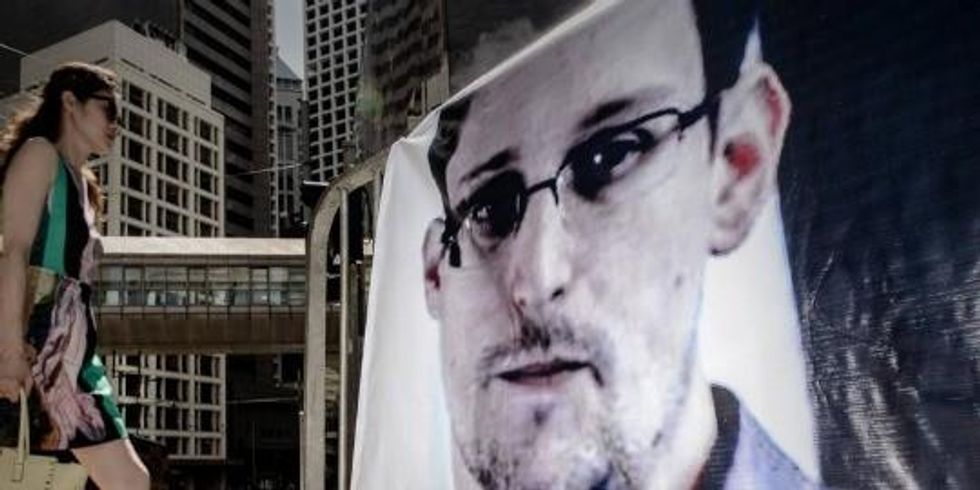
Snowden's work has revealed that even what we thought is the most democratic invention in human history can be used successfully against people of the world by few devious minds.
Eminent Russia scholar George Kennan passed away in 2005. Today, Anne Applebaum is as qualified as anyone in the US to write on Russia. She won the Pulitzer Prize for her magisterial book, Gulag: A History (2004). Yesterday, in TheWashington Post she opened her op-ed on Edward Snowden in Russia with the following words:
For those who think that Edward Snowden deserves arrest or worse, cheer yourselves with the thought that Sheremetyevo International Airport ;might possibly be the most soul-destroying, most angst-inducing transport hub in the world. Low ceilings and dim lighting create a sense of impending doom, while overpriced wristwatches glitter in the murk. Sullen salesgirls peddle stale sandwiches; men in bad suits drink silently at the bars. A vague scent of diesel fuel fills the air, and a thin layer of grime covers the backless benches and sticky floor. It's not a place you'd want to spend two hours, let alone 48.
The rhetorical device that Applebaum used to situate her readers--in the environment where Edward Snowden presumably is residing--is a strategy that nature writers have used for more than two centuries now. In his widely acclaimed book, Ecology Without Nature: Rethinking Environmental Aesthetics, philosopher Timothy Morton called this rhetorical device--ecomimesis. "Strong ecomimesis purports to evoke the here and now of writing. ... The reader glimpses the environment rather than the person," Morton wrote. Strictly speaking though, "I" the writer is essential in Morton's definition of "ecomimesis," but I'd take liberty to also include "you" the reader that Applebaum is referring to.
With just those words, Applebaum's op-ed, it seems to me suggests that Edward Snowden is currently in such a hell-hole that even the prisoners of Guantanamo wouldn't want to go there. As you read further, you get this: "It is perfectly possible that, as in Cold War days, Russian authorities will seek to trade Snowden for something or someone else they want, whether a spy or a criminal." There is no mention (not a word or line) about the global significance of Snowden's courageous whistle blowing. Quickly it becomes clear that--if only Russia would co-operate with the US, Snowden could be transferred to the paradise--we call Guantanamo in America. She couches it with a euphemism though--home. An op-ed filled with carefully worded nationalistic diatribe, ends with the following words:
[Russia] won't send him home as a gesture of goodwill or a matter of principle, as Kerry seems to hope. We can expect that only from some of our allies, and Russia isn't one at all.
When the animated debate--"Is Edward Snowden a hero or a traitor?" started, I wrote a piece urging to consider him not as a "hero" or "traitor" but "simply as a teacher--who provided knowledge to expose yet another aspect of the inverted totalitarianism in the United States." After everything that has been revealed since, there has been no public outrage against the government, in the US. The apathy that the people of the US are currently exhibiting is astounding--a classic attribute of "inverted totalitarianism" that political philosopher Sheldon Wolin coined in his book, Democracy Inc.: Managed Democracy and the Specter of Inverted Totalitarianism.
Instead of vigorous debate about fascism in the US government that Edward Snowden's work has revealed, the dialogue might soon shift toward what the influential left-wing liberal writer Anne Applebaum is suggesting: "the Cold War is back."
Rest assured though that "Cold War is back" will not be the only topic of debates to come. Throughout history, whenever there have been injustices, humans have debated it vigorously. In 2005, the Seattle Art Museum presented a two-day reading performances based on the anthology, Voices of the People's History of the United States, edited by Howard Zinn and Anthony Arnove. I read two pieces from the book: "The Devastation of the Indies: A Brief Account" (1542) by Bartolome de Las Casas and "The Problem Is Civil Obedience" (November 1970) byHoward Zinn. In the famous Valladolid debate (1550-1551), as a defender of the people of the Americas, Las Casas had vigorously debated Juan Gines de Sepulveda, who had promoted the idea that the Indians should be punished and reduced to slavery.
We need all our voices of conscience to rise in unison so that Edward's Snowden's courageous and immensely important revelations don't get side stepped by the government, the corporate media, and by the right- and left-wing pundits.
Beyond all the important things that Snowden's leaks have revealed, there is something profound it has brought to light also--the folly of the human mind.
Every now and then, with its ingenuity, the human mind gives us a solid kick-in-the-ass--and we keep running. But as soon as we gain speed, with its deviousness, it gives us a solid kick-in-the-crotch--and we fall flat on our back. This has been the story of human progress. Human mind is like a boomerang.
Long ago, we put coal inside a steam engine, and that inside a train--we started to go fast, collectively. Some time later, we put oil inside cars--we started to go fast, individually. We got the Internet--we started to communicate so fast that a tweet goes out before I can complete a fart. Going faster and faster, and some more--has been the story of human progress.
Edward Snowden's work has revealed that even what we thought is the most democratic invention in human history can be used successfully against people of the world by few devious minds.
Perhaps the biggest lesson we can take away from Snowden's revelations is this: Is it possible to slow down a bit?
Snowden's work has revealed that even what we thought is the most democratic invention in human history can be used successfully against people of the world by few devious minds.
Eminent Russia scholar George Kennan passed away in 2005. Today, Anne Applebaum is as qualified as anyone in the US to write on Russia. She won the Pulitzer Prize for her magisterial book, Gulag: A History (2004). Yesterday, in TheWashington Post she opened her op-ed on Edward Snowden in Russia with the following words:
For those who think that Edward Snowden deserves arrest or worse, cheer yourselves with the thought that Sheremetyevo International Airport ;might possibly be the most soul-destroying, most angst-inducing transport hub in the world. Low ceilings and dim lighting create a sense of impending doom, while overpriced wristwatches glitter in the murk. Sullen salesgirls peddle stale sandwiches; men in bad suits drink silently at the bars. A vague scent of diesel fuel fills the air, and a thin layer of grime covers the backless benches and sticky floor. It's not a place you'd want to spend two hours, let alone 48.
The rhetorical device that Applebaum used to situate her readers--in the environment where Edward Snowden presumably is residing--is a strategy that nature writers have used for more than two centuries now. In his widely acclaimed book, Ecology Without Nature: Rethinking Environmental Aesthetics, philosopher Timothy Morton called this rhetorical device--ecomimesis. "Strong ecomimesis purports to evoke the here and now of writing. ... The reader glimpses the environment rather than the person," Morton wrote. Strictly speaking though, "I" the writer is essential in Morton's definition of "ecomimesis," but I'd take liberty to also include "you" the reader that Applebaum is referring to.
With just those words, Applebaum's op-ed, it seems to me suggests that Edward Snowden is currently in such a hell-hole that even the prisoners of Guantanamo wouldn't want to go there. As you read further, you get this: "It is perfectly possible that, as in Cold War days, Russian authorities will seek to trade Snowden for something or someone else they want, whether a spy or a criminal." There is no mention (not a word or line) about the global significance of Snowden's courageous whistle blowing. Quickly it becomes clear that--if only Russia would co-operate with the US, Snowden could be transferred to the paradise--we call Guantanamo in America. She couches it with a euphemism though--home. An op-ed filled with carefully worded nationalistic diatribe, ends with the following words:
[Russia] won't send him home as a gesture of goodwill or a matter of principle, as Kerry seems to hope. We can expect that only from some of our allies, and Russia isn't one at all.
When the animated debate--"Is Edward Snowden a hero or a traitor?" started, I wrote a piece urging to consider him not as a "hero" or "traitor" but "simply as a teacher--who provided knowledge to expose yet another aspect of the inverted totalitarianism in the United States." After everything that has been revealed since, there has been no public outrage against the government, in the US. The apathy that the people of the US are currently exhibiting is astounding--a classic attribute of "inverted totalitarianism" that political philosopher Sheldon Wolin coined in his book, Democracy Inc.: Managed Democracy and the Specter of Inverted Totalitarianism.
Instead of vigorous debate about fascism in the US government that Edward Snowden's work has revealed, the dialogue might soon shift toward what the influential left-wing liberal writer Anne Applebaum is suggesting: "the Cold War is back."
Rest assured though that "Cold War is back" will not be the only topic of debates to come. Throughout history, whenever there have been injustices, humans have debated it vigorously. In 2005, the Seattle Art Museum presented a two-day reading performances based on the anthology, Voices of the People's History of the United States, edited by Howard Zinn and Anthony Arnove. I read two pieces from the book: "The Devastation of the Indies: A Brief Account" (1542) by Bartolome de Las Casas and "The Problem Is Civil Obedience" (November 1970) byHoward Zinn. In the famous Valladolid debate (1550-1551), as a defender of the people of the Americas, Las Casas had vigorously debated Juan Gines de Sepulveda, who had promoted the idea that the Indians should be punished and reduced to slavery.
We need all our voices of conscience to rise in unison so that Edward's Snowden's courageous and immensely important revelations don't get side stepped by the government, the corporate media, and by the right- and left-wing pundits.
Beyond all the important things that Snowden's leaks have revealed, there is something profound it has brought to light also--the folly of the human mind.
Every now and then, with its ingenuity, the human mind gives us a solid kick-in-the-ass--and we keep running. But as soon as we gain speed, with its deviousness, it gives us a solid kick-in-the-crotch--and we fall flat on our back. This has been the story of human progress. Human mind is like a boomerang.
Long ago, we put coal inside a steam engine, and that inside a train--we started to go fast, collectively. Some time later, we put oil inside cars--we started to go fast, individually. We got the Internet--we started to communicate so fast that a tweet goes out before I can complete a fart. Going faster and faster, and some more--has been the story of human progress.
Edward Snowden's work has revealed that even what we thought is the most democratic invention in human history can be used successfully against people of the world by few devious minds.
Perhaps the biggest lesson we can take away from Snowden's revelations is this: Is it possible to slow down a bit?
Snowden's work has revealed that even what we thought is the most democratic invention in human history can be used successfully against people of the world by few devious minds.
Eminent Russia scholar George Kennan passed away in 2005. Today, Anne Applebaum is as qualified as anyone in the US to write on Russia. She won the Pulitzer Prize for her magisterial book, Gulag: A History (2004). Yesterday, in TheWashington Post she opened her op-ed on Edward Snowden in Russia with the following words:
For those who think that Edward Snowden deserves arrest or worse, cheer yourselves with the thought that Sheremetyevo International Airport ;might possibly be the most soul-destroying, most angst-inducing transport hub in the world. Low ceilings and dim lighting create a sense of impending doom, while overpriced wristwatches glitter in the murk. Sullen salesgirls peddle stale sandwiches; men in bad suits drink silently at the bars. A vague scent of diesel fuel fills the air, and a thin layer of grime covers the backless benches and sticky floor. It's not a place you'd want to spend two hours, let alone 48.
The rhetorical device that Applebaum used to situate her readers--in the environment where Edward Snowden presumably is residing--is a strategy that nature writers have used for more than two centuries now. In his widely acclaimed book, Ecology Without Nature: Rethinking Environmental Aesthetics, philosopher Timothy Morton called this rhetorical device--ecomimesis. "Strong ecomimesis purports to evoke the here and now of writing. ... The reader glimpses the environment rather than the person," Morton wrote. Strictly speaking though, "I" the writer is essential in Morton's definition of "ecomimesis," but I'd take liberty to also include "you" the reader that Applebaum is referring to.
With just those words, Applebaum's op-ed, it seems to me suggests that Edward Snowden is currently in such a hell-hole that even the prisoners of Guantanamo wouldn't want to go there. As you read further, you get this: "It is perfectly possible that, as in Cold War days, Russian authorities will seek to trade Snowden for something or someone else they want, whether a spy or a criminal." There is no mention (not a word or line) about the global significance of Snowden's courageous whistle blowing. Quickly it becomes clear that--if only Russia would co-operate with the US, Snowden could be transferred to the paradise--we call Guantanamo in America. She couches it with a euphemism though--home. An op-ed filled with carefully worded nationalistic diatribe, ends with the following words:
[Russia] won't send him home as a gesture of goodwill or a matter of principle, as Kerry seems to hope. We can expect that only from some of our allies, and Russia isn't one at all.
When the animated debate--"Is Edward Snowden a hero or a traitor?" started, I wrote a piece urging to consider him not as a "hero" or "traitor" but "simply as a teacher--who provided knowledge to expose yet another aspect of the inverted totalitarianism in the United States." After everything that has been revealed since, there has been no public outrage against the government, in the US. The apathy that the people of the US are currently exhibiting is astounding--a classic attribute of "inverted totalitarianism" that political philosopher Sheldon Wolin coined in his book, Democracy Inc.: Managed Democracy and the Specter of Inverted Totalitarianism.
Instead of vigorous debate about fascism in the US government that Edward Snowden's work has revealed, the dialogue might soon shift toward what the influential left-wing liberal writer Anne Applebaum is suggesting: "the Cold War is back."
Rest assured though that "Cold War is back" will not be the only topic of debates to come. Throughout history, whenever there have been injustices, humans have debated it vigorously. In 2005, the Seattle Art Museum presented a two-day reading performances based on the anthology, Voices of the People's History of the United States, edited by Howard Zinn and Anthony Arnove. I read two pieces from the book: "The Devastation of the Indies: A Brief Account" (1542) by Bartolome de Las Casas and "The Problem Is Civil Obedience" (November 1970) byHoward Zinn. In the famous Valladolid debate (1550-1551), as a defender of the people of the Americas, Las Casas had vigorously debated Juan Gines de Sepulveda, who had promoted the idea that the Indians should be punished and reduced to slavery.
We need all our voices of conscience to rise in unison so that Edward's Snowden's courageous and immensely important revelations don't get side stepped by the government, the corporate media, and by the right- and left-wing pundits.
Beyond all the important things that Snowden's leaks have revealed, there is something profound it has brought to light also--the folly of the human mind.
Every now and then, with its ingenuity, the human mind gives us a solid kick-in-the-ass--and we keep running. But as soon as we gain speed, with its deviousness, it gives us a solid kick-in-the-crotch--and we fall flat on our back. This has been the story of human progress. Human mind is like a boomerang.
Long ago, we put coal inside a steam engine, and that inside a train--we started to go fast, collectively. Some time later, we put oil inside cars--we started to go fast, individually. We got the Internet--we started to communicate so fast that a tweet goes out before I can complete a fart. Going faster and faster, and some more--has been the story of human progress.
Edward Snowden's work has revealed that even what we thought is the most democratic invention in human history can be used successfully against people of the world by few devious minds.
Perhaps the biggest lesson we can take away from Snowden's revelations is this: Is it possible to slow down a bit?