

SUBSCRIBE TO OUR FREE NEWSLETTER
Daily news & progressive opinion—funded by the people, not the corporations—delivered straight to your inbox.
5
#000000
#FFFFFF
To donate by check, phone, or other method, see our More Ways to Give page.
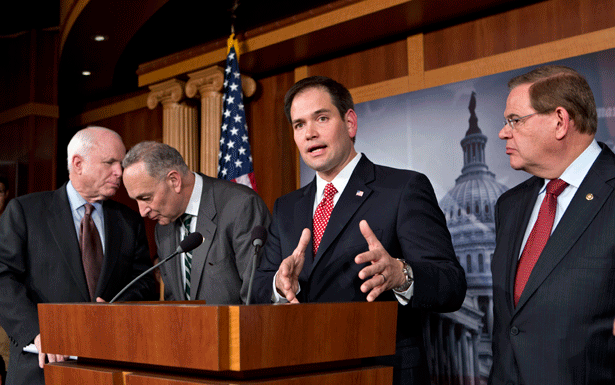
The 844-page bill is a lot to get through. Prerna Lal has outlined some valuable points on the bill's good, bad and ugly provisions for undocumented immigrants. Of note, she refers to "RPI," the new Registered Provision Immigrant status defined in the bill--a sort of second-class non-citizens status.
Most undocumented immigrants that can demonstrate their presence in the US before December 31, 2011, will qualify for RPI if they can also demonstrate a clean criminal record and pay a $500 fine and back taxes. That alone can sound an alarm for essential, low-wage workers who may find it difficult to come up with such funds. Those immigrants able to do so will then be authorized to live and work in the US, and even travel outside the country. An additional $500 fine will apply after six years. After ten years, RPI status immigrants will finally be able to apply for legal permanent residency--but only if they can speak English and pay an additional $1,000 fine. That residency status can eventually be turned into citizenship after three years.
In sum, the pathway to citizenship for many undocumented immigrant is, at minimum, a $2,000, thirteen-year process--although it's accelerated for students and agricultural workers. As Seth Freed Wessler points out at Colorlines.com, the bill also expands criminalization and shuts out LGBT couples, but will allow for reunification for those families who have been torn apart by deportation. All in all, there's a growing consensus that this is a very mixed bill.
But what's most troubling about it is that RPI status is contingent on border security triggers. As we've illustrated in the past, net migration on the southern border is at zero. Yet the bill would establish a new Southern Border Security Commission, and RPI applications will not be considered until the implantation of what's called the Southern Border Security Strategy and the Southern Border Fencing Strategy. The border security strategy will greatly expand surveillance on the US-Mexico border, especially through the use of drones, which will patrol the border "24 hours per day and 7 days per week." Legal permanent residency and eventual citizenship would be conditional on these expanded border security triggers--which are complex and difficult to measure.
As it stands now, the bill reads more like massive border security measures than anything else--because before anyone's status is examined for adjustment, the federal government will begin to pour in billions of dollars for drones, reinforced border patrols and extended fencing at the southern border. These measures are being pushed at time when net migration is at zero, and after Obama has created legacy of mass deportations. As Congress hammers through the bill, it's not unlikely that border security measures will gain even more ground.
The 844-page bill is a lot to get through. Prerna Lal has outlined some valuable points on the bill's good, bad and ugly provisions for undocumented immigrants. Of note, she refers to "RPI," the new Registered Provision Immigrant status defined in the bill--a sort of second-class non-citizens status.
Most undocumented immigrants that can demonstrate their presence in the US before December 31, 2011, will qualify for RPI if they can also demonstrate a clean criminal record and pay a $500 fine and back taxes. That alone can sound an alarm for essential, low-wage workers who may find it difficult to come up with such funds. Those immigrants able to do so will then be authorized to live and work in the US, and even travel outside the country. An additional $500 fine will apply after six years. After ten years, RPI status immigrants will finally be able to apply for legal permanent residency--but only if they can speak English and pay an additional $1,000 fine. That residency status can eventually be turned into citizenship after three years.
In sum, the pathway to citizenship for many undocumented immigrant is, at minimum, a $2,000, thirteen-year process--although it's accelerated for students and agricultural workers. As Seth Freed Wessler points out at Colorlines.com, the bill also expands criminalization and shuts out LGBT couples, but will allow for reunification for those families who have been torn apart by deportation. All in all, there's a growing consensus that this is a very mixed bill.
But what's most troubling about it is that RPI status is contingent on border security triggers. As we've illustrated in the past, net migration on the southern border is at zero. Yet the bill would establish a new Southern Border Security Commission, and RPI applications will not be considered until the implantation of what's called the Southern Border Security Strategy and the Southern Border Fencing Strategy. The border security strategy will greatly expand surveillance on the US-Mexico border, especially through the use of drones, which will patrol the border "24 hours per day and 7 days per week." Legal permanent residency and eventual citizenship would be conditional on these expanded border security triggers--which are complex and difficult to measure.
As it stands now, the bill reads more like massive border security measures than anything else--because before anyone's status is examined for adjustment, the federal government will begin to pour in billions of dollars for drones, reinforced border patrols and extended fencing at the southern border. These measures are being pushed at time when net migration is at zero, and after Obama has created legacy of mass deportations. As Congress hammers through the bill, it's not unlikely that border security measures will gain even more ground.
The 844-page bill is a lot to get through. Prerna Lal has outlined some valuable points on the bill's good, bad and ugly provisions for undocumented immigrants. Of note, she refers to "RPI," the new Registered Provision Immigrant status defined in the bill--a sort of second-class non-citizens status.
Most undocumented immigrants that can demonstrate their presence in the US before December 31, 2011, will qualify for RPI if they can also demonstrate a clean criminal record and pay a $500 fine and back taxes. That alone can sound an alarm for essential, low-wage workers who may find it difficult to come up with such funds. Those immigrants able to do so will then be authorized to live and work in the US, and even travel outside the country. An additional $500 fine will apply after six years. After ten years, RPI status immigrants will finally be able to apply for legal permanent residency--but only if they can speak English and pay an additional $1,000 fine. That residency status can eventually be turned into citizenship after three years.
In sum, the pathway to citizenship for many undocumented immigrant is, at minimum, a $2,000, thirteen-year process--although it's accelerated for students and agricultural workers. As Seth Freed Wessler points out at Colorlines.com, the bill also expands criminalization and shuts out LGBT couples, but will allow for reunification for those families who have been torn apart by deportation. All in all, there's a growing consensus that this is a very mixed bill.
But what's most troubling about it is that RPI status is contingent on border security triggers. As we've illustrated in the past, net migration on the southern border is at zero. Yet the bill would establish a new Southern Border Security Commission, and RPI applications will not be considered until the implantation of what's called the Southern Border Security Strategy and the Southern Border Fencing Strategy. The border security strategy will greatly expand surveillance on the US-Mexico border, especially through the use of drones, which will patrol the border "24 hours per day and 7 days per week." Legal permanent residency and eventual citizenship would be conditional on these expanded border security triggers--which are complex and difficult to measure.
As it stands now, the bill reads more like massive border security measures than anything else--because before anyone's status is examined for adjustment, the federal government will begin to pour in billions of dollars for drones, reinforced border patrols and extended fencing at the southern border. These measures are being pushed at time when net migration is at zero, and after Obama has created legacy of mass deportations. As Congress hammers through the bill, it's not unlikely that border security measures will gain even more ground.

