SUBSCRIBE TO OUR FREE NEWSLETTER
Daily news & progressive opinion—funded by the people, not the corporations—delivered straight to your inbox.
5
#000000
#FFFFFF
To donate by check, phone, or other method, see our More Ways to Give page.
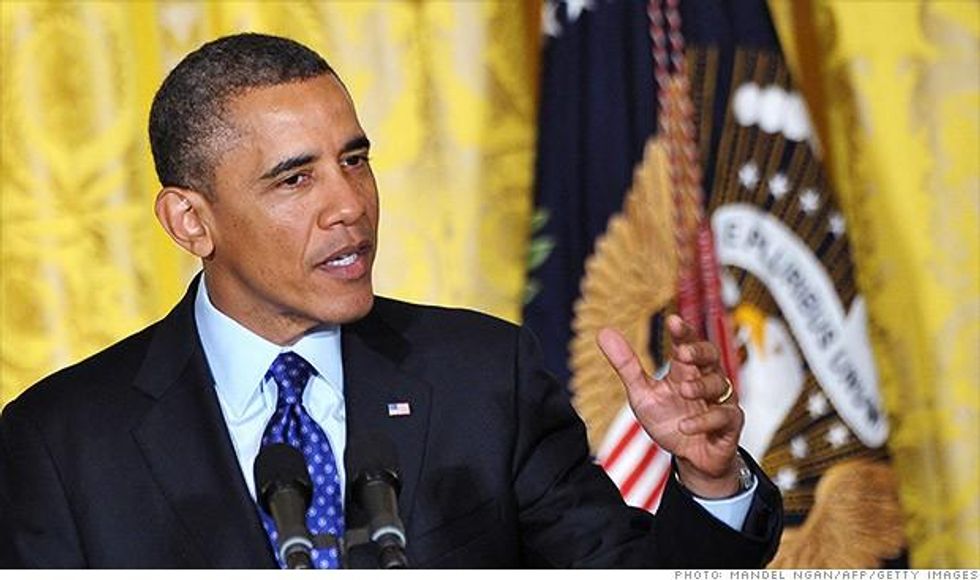
Today, the president releases his budget for fiscal year 2014, the year that begins this October. Commentators and advocates will pour over its disparate parts, although the White House has already leaked its major contours.
This document is less a budget for government than a purpose statement of the administration. In this divided government, it is already "dead on arrival." That's particularly true this year since the Senate and House have each passed its own budget outline. For all of its volumes and detail, the president's budget is at best a statement of his priorities. And there it is distinctively disappointing.
The president's major purpose is not to address mass unemployment, not to build a new foundation for the economy, not to revive the middle class or redress Gilded Age inequality. The president's overriding priority is to cut a deal - and a deal that continues to impose austerity on an already faltering recovery.
"We need a transformational president who will rouse Americans to address the challenges we face, not a transactional mediator who offers preemptive concessions to get a deal that ignores those challenges. Deficits are not our problem."
So he releases a budget that the White House admits is "not ideal." It is framed around preemptive concessions to get a deal - or to show that the president is not at fault if one is not forthcoming. The budget would replace the mindless sequester spending cuts, while cutting as much in spending - about $1.2 trillion over 10 years - in less randomly destructive ways. It offers Republicans what they have tried to extort - structural cuts in Social Security benefits (by lowering the inflation adjustment) and savings from Medicare. It embraces the Republican position on corporate tax reform - lowering rates and closing loopholes without gaining any new revenue, asking the corporations that are enjoying record profits to offer exactly nothing to deficit reduction. In exchange, it seeks a modest $580 billion in new revenue over 10 years, largely by closing loopholes for the wealthy.
That's the "grand bargain" the president seeks (although he's willing to negotiate with Republicans beyond what he has conceded in negotiations with himself).
Not surprisingly, the president's position is far less destructive than the budget passed by the Republican House. The president would get savings from both the military and domestic programs, while Republican budget enforces the sequester cuts only on domestic services. The president would preserve Obamacare and protect Medicaid, while the Republican budget would strip health care coverage for an estimated 35 million people. The president calls for the wealthy to contribute to deficit reduction with more taxes, while the Republican budget once more asks not a penny more from the affluent, inflicting the pain on middle- and low-income families.
And the president's budget makes gestures at a different course. It would provide token funding ($10 billion) for an infrastructure bank to begin rebuilding our decrepit roads, trains and sewers. It would provide incentives for states to offer preschool programs for kids, paid for by raising sin taxes on cigarettes.
It also calls for a gaggle of progressive tax reforms: the Buffett rule to ensure that the millionaires don't pay lower taxes than their secretaries; ending the egregious hedge fund "carried interest" tax dodge; putting a lid of $3 million on 401(k) funds, curbing what might be called the Mitt Romney gambit that enabled him to amass a $100 million tax-free retirement account. It would enforce a minimum tax on profits that multinationals report abroad.
But these nods to the president's campaign promises and his electoral base are not the focus of the president's message. This is a budget framed around getting a deal. It assumes the growth we have is adequate. It miseducates Americans that the most important goal is to reduce projected deficits in a "balanced" way. And it shows that a Democratic president is even willing to cut Social Security benefits - the pledge we make one to another - in order to get that deal.
Don't get distracted by the various proposals. Few, if any, will survive in this divided government. And Republican abhorrence of asking the corporations and wealthy to contribute anything more may even save us from the grand bargain.
What's troublesome is the budget reveals a misguided presidential purpose. This country needs fundamental reform to make this economy work for working people. Over 20 million people in need of full-time work is not acceptable. Record numbers in poverty is not acceptable. Failing to provide the next generation with a high quality education from pre-K to affordable college is a national calamity. Gilded Age inequality and the collapse of the broad middle class that made America exceptional cannot go unchallenged. Catastrophic climate change needs more than a passing nod.
We need a transformational president who will rouse Americans to address the challenges we face, not a transactional mediator who offers preemptive concessions to get a deal that ignores those challenges. Deficits are not our problem. The deficit is already falling faster than at any time since the demobilization after World War II and crippling the recovery. The only way to get our books in order over the long term is to create sustainable growth with rewards widely shared. (And to take on the insurance and drug companies and hospital complexes that drive up our ridiculous health care costs).
Barack Obama won re-election only after he left the last "grand bargain" debacle in the summer of 2011, put out a clear jobs program, embraced the populist spirit of Occupy at Osawatomie, Kan., and framed his campaign around reviving the middle class. In this budget, he reverts to the president more comfortable with splitting the difference rather than setting the direction. Neither the country nor his presidency will be well served by this.
Today, the president releases his budget for fiscal year 2014, the year that begins this October. Commentators and advocates will pour over its disparate parts, although the White House has already leaked its major contours.
This document is less a budget for government than a purpose statement of the administration. In this divided government, it is already "dead on arrival." That's particularly true this year since the Senate and House have each passed its own budget outline. For all of its volumes and detail, the president's budget is at best a statement of his priorities. And there it is distinctively disappointing.
The president's major purpose is not to address mass unemployment, not to build a new foundation for the economy, not to revive the middle class or redress Gilded Age inequality. The president's overriding priority is to cut a deal - and a deal that continues to impose austerity on an already faltering recovery.
"We need a transformational president who will rouse Americans to address the challenges we face, not a transactional mediator who offers preemptive concessions to get a deal that ignores those challenges. Deficits are not our problem."
So he releases a budget that the White House admits is "not ideal." It is framed around preemptive concessions to get a deal - or to show that the president is not at fault if one is not forthcoming. The budget would replace the mindless sequester spending cuts, while cutting as much in spending - about $1.2 trillion over 10 years - in less randomly destructive ways. It offers Republicans what they have tried to extort - structural cuts in Social Security benefits (by lowering the inflation adjustment) and savings from Medicare. It embraces the Republican position on corporate tax reform - lowering rates and closing loopholes without gaining any new revenue, asking the corporations that are enjoying record profits to offer exactly nothing to deficit reduction. In exchange, it seeks a modest $580 billion in new revenue over 10 years, largely by closing loopholes for the wealthy.
That's the "grand bargain" the president seeks (although he's willing to negotiate with Republicans beyond what he has conceded in negotiations with himself).
Not surprisingly, the president's position is far less destructive than the budget passed by the Republican House. The president would get savings from both the military and domestic programs, while Republican budget enforces the sequester cuts only on domestic services. The president would preserve Obamacare and protect Medicaid, while the Republican budget would strip health care coverage for an estimated 35 million people. The president calls for the wealthy to contribute to deficit reduction with more taxes, while the Republican budget once more asks not a penny more from the affluent, inflicting the pain on middle- and low-income families.
And the president's budget makes gestures at a different course. It would provide token funding ($10 billion) for an infrastructure bank to begin rebuilding our decrepit roads, trains and sewers. It would provide incentives for states to offer preschool programs for kids, paid for by raising sin taxes on cigarettes.
It also calls for a gaggle of progressive tax reforms: the Buffett rule to ensure that the millionaires don't pay lower taxes than their secretaries; ending the egregious hedge fund "carried interest" tax dodge; putting a lid of $3 million on 401(k) funds, curbing what might be called the Mitt Romney gambit that enabled him to amass a $100 million tax-free retirement account. It would enforce a minimum tax on profits that multinationals report abroad.
But these nods to the president's campaign promises and his electoral base are not the focus of the president's message. This is a budget framed around getting a deal. It assumes the growth we have is adequate. It miseducates Americans that the most important goal is to reduce projected deficits in a "balanced" way. And it shows that a Democratic president is even willing to cut Social Security benefits - the pledge we make one to another - in order to get that deal.
Don't get distracted by the various proposals. Few, if any, will survive in this divided government. And Republican abhorrence of asking the corporations and wealthy to contribute anything more may even save us from the grand bargain.
What's troublesome is the budget reveals a misguided presidential purpose. This country needs fundamental reform to make this economy work for working people. Over 20 million people in need of full-time work is not acceptable. Record numbers in poverty is not acceptable. Failing to provide the next generation with a high quality education from pre-K to affordable college is a national calamity. Gilded Age inequality and the collapse of the broad middle class that made America exceptional cannot go unchallenged. Catastrophic climate change needs more than a passing nod.
We need a transformational president who will rouse Americans to address the challenges we face, not a transactional mediator who offers preemptive concessions to get a deal that ignores those challenges. Deficits are not our problem. The deficit is already falling faster than at any time since the demobilization after World War II and crippling the recovery. The only way to get our books in order over the long term is to create sustainable growth with rewards widely shared. (And to take on the insurance and drug companies and hospital complexes that drive up our ridiculous health care costs).
Barack Obama won re-election only after he left the last "grand bargain" debacle in the summer of 2011, put out a clear jobs program, embraced the populist spirit of Occupy at Osawatomie, Kan., and framed his campaign around reviving the middle class. In this budget, he reverts to the president more comfortable with splitting the difference rather than setting the direction. Neither the country nor his presidency will be well served by this.
Today, the president releases his budget for fiscal year 2014, the year that begins this October. Commentators and advocates will pour over its disparate parts, although the White House has already leaked its major contours.
This document is less a budget for government than a purpose statement of the administration. In this divided government, it is already "dead on arrival." That's particularly true this year since the Senate and House have each passed its own budget outline. For all of its volumes and detail, the president's budget is at best a statement of his priorities. And there it is distinctively disappointing.
The president's major purpose is not to address mass unemployment, not to build a new foundation for the economy, not to revive the middle class or redress Gilded Age inequality. The president's overriding priority is to cut a deal - and a deal that continues to impose austerity on an already faltering recovery.
"We need a transformational president who will rouse Americans to address the challenges we face, not a transactional mediator who offers preemptive concessions to get a deal that ignores those challenges. Deficits are not our problem."
So he releases a budget that the White House admits is "not ideal." It is framed around preemptive concessions to get a deal - or to show that the president is not at fault if one is not forthcoming. The budget would replace the mindless sequester spending cuts, while cutting as much in spending - about $1.2 trillion over 10 years - in less randomly destructive ways. It offers Republicans what they have tried to extort - structural cuts in Social Security benefits (by lowering the inflation adjustment) and savings from Medicare. It embraces the Republican position on corporate tax reform - lowering rates and closing loopholes without gaining any new revenue, asking the corporations that are enjoying record profits to offer exactly nothing to deficit reduction. In exchange, it seeks a modest $580 billion in new revenue over 10 years, largely by closing loopholes for the wealthy.
That's the "grand bargain" the president seeks (although he's willing to negotiate with Republicans beyond what he has conceded in negotiations with himself).
Not surprisingly, the president's position is far less destructive than the budget passed by the Republican House. The president would get savings from both the military and domestic programs, while Republican budget enforces the sequester cuts only on domestic services. The president would preserve Obamacare and protect Medicaid, while the Republican budget would strip health care coverage for an estimated 35 million people. The president calls for the wealthy to contribute to deficit reduction with more taxes, while the Republican budget once more asks not a penny more from the affluent, inflicting the pain on middle- and low-income families.
And the president's budget makes gestures at a different course. It would provide token funding ($10 billion) for an infrastructure bank to begin rebuilding our decrepit roads, trains and sewers. It would provide incentives for states to offer preschool programs for kids, paid for by raising sin taxes on cigarettes.
It also calls for a gaggle of progressive tax reforms: the Buffett rule to ensure that the millionaires don't pay lower taxes than their secretaries; ending the egregious hedge fund "carried interest" tax dodge; putting a lid of $3 million on 401(k) funds, curbing what might be called the Mitt Romney gambit that enabled him to amass a $100 million tax-free retirement account. It would enforce a minimum tax on profits that multinationals report abroad.
But these nods to the president's campaign promises and his electoral base are not the focus of the president's message. This is a budget framed around getting a deal. It assumes the growth we have is adequate. It miseducates Americans that the most important goal is to reduce projected deficits in a "balanced" way. And it shows that a Democratic president is even willing to cut Social Security benefits - the pledge we make one to another - in order to get that deal.
Don't get distracted by the various proposals. Few, if any, will survive in this divided government. And Republican abhorrence of asking the corporations and wealthy to contribute anything more may even save us from the grand bargain.
What's troublesome is the budget reveals a misguided presidential purpose. This country needs fundamental reform to make this economy work for working people. Over 20 million people in need of full-time work is not acceptable. Record numbers in poverty is not acceptable. Failing to provide the next generation with a high quality education from pre-K to affordable college is a national calamity. Gilded Age inequality and the collapse of the broad middle class that made America exceptional cannot go unchallenged. Catastrophic climate change needs more than a passing nod.
We need a transformational president who will rouse Americans to address the challenges we face, not a transactional mediator who offers preemptive concessions to get a deal that ignores those challenges. Deficits are not our problem. The deficit is already falling faster than at any time since the demobilization after World War II and crippling the recovery. The only way to get our books in order over the long term is to create sustainable growth with rewards widely shared. (And to take on the insurance and drug companies and hospital complexes that drive up our ridiculous health care costs).
Barack Obama won re-election only after he left the last "grand bargain" debacle in the summer of 2011, put out a clear jobs program, embraced the populist spirit of Occupy at Osawatomie, Kan., and framed his campaign around reviving the middle class. In this budget, he reverts to the president more comfortable with splitting the difference rather than setting the direction. Neither the country nor his presidency will be well served by this.