SUBSCRIBE TO OUR FREE NEWSLETTER
Daily news & progressive opinion—funded by the people, not the corporations—delivered straight to your inbox.
5
#000000
#FFFFFF
To donate by check, phone, or other method, see our More Ways to Give page.
The Academy Awards ceremony will make history this year with the first-ever nomination of a feature documentary made by a Palestinian. "5 Broken Cameras" was filmed and directed by Emad Burnat, a resident of the occupied Palestinian West Bank town of Bil'in, along with his Israeli filmmaking partner Guy Davidi. What does a Palestinian farmer wear on the red carpet in Hollywood? We were almost prevented from knowing, as Burnat, his wife and 8-year-old son were detained at Los Angeles International Airport and threatened with deportation. Despite his formal invitation from the Academy of Motion Picture Arts and Sciences as an Oscar-nominated filmmaker, it took the intervention of Oscar-winning documentarian Michael Moore, who now sits on the Academy Board of Governors, followed by Academy attorneys, for Burnat and his family to gain entry into the country.
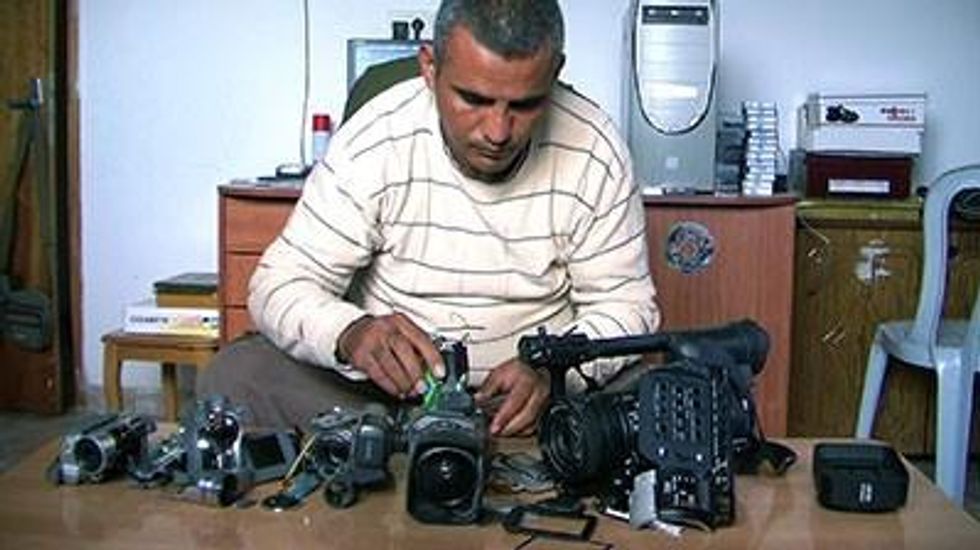
"5 Broken Cameras" is in competition at the Oscars with an Israeli documentary, "The Gatekeepers," a film that features interviews with the six surviving former directors of Israel's Shin Bet, the country's secret internal security service, which functions as sort of hybrid of the U.S. FBI and CIA. In the film, all six condemn the current practices of Israeli occupation and settlement expansion.
In a remarkable case of life imitating art, as celebrities gather for the entertainment industry's biggest gala of the year, the Israel/Palestine conflict is being played out on the streets of Tinseltown.
Hours after regaining his freedom, Burnat issued a statement that read: "Last night, on my way from Turkey to Los Angeles, CA, my family and I were held at US immigration for about an hour and questioned about the purpose of my visit to the United States. Immigration officials asked for proof that I was nominated for an Academy Award for the documentary '5 Broken Cameras' and they told me that if I couldn't prove the reason for my visit, my wife Soraya, my son Gibreel and I would be sent back to Turkey on the same day."
He went on: "After 40 minutes of questions and answers, Gibreel asked me why we were still waiting in that small room. I simply told him the truth: 'Maybe we'll have to go back.' I could see his heart sink." Gibreel's birth in 2005 was the motivation for the film. Emad Burnat got his first camera then, to record his fourth son growing up. At that time, the government of Israel began building the separation wall through Bil'in, provoking a campaign of nonviolent resistance from the Palestinian residents and their supporters. As Burnat recorded the protests, his cameras were smashed or shot, one by one, destroyed by the violent response from the Israeli army and the armed Israeli settlers.
Dror Moreh is the Israeli director of "The Gatekeepers." Moreh told me: "The settlements are the biggest obstacle to peace. If there is something that will prevent peace, it's the settlements and the settlers. I think this is the largest and most influential and most powerful group in Israeli politics. They're basically dictating the policy of Israel in the last years. I think that definitely for the Palestinians, the settlements are the worst enemy in their way to the homeland. When they see everywhere, in Judea and Samaria now, the settlements that are built like mushrooms after rain, they see how their country is shrinking."
Both "5 Broken Cameras" and "The Gatekeepers" are up for the Oscar against other very compelling nominees: "How to Survive a Plague," about the AIDS epidemic; "The Invisible War," about rampant, unprosecuted rape in the U.S. military; and "Searching for Sugar Man," about renewal for a musician long thought dead.
Burnat finished his statement on his detention at Los Angeles International Airport: "Although this was an unpleasant experience, this is a daily occurrence for Palestinians, every single day, throughout the West Bank. There are more than 500 Israeli checkpoints, roadblocks, and other barriers to movement across our land, and not a single one of us has been spared the experience that my family and I experienced yesterday. Ours was a very minor example of what my people face every day."
Regardless of which documentary wins, the 2013 Oscars mark a historic shift in the public dialogue on Israel/Palestine, a long-overdue shift to which 40 million television viewers will be exposed.
Denis Moynihan contributed research to this column.
The Academy Awards ceremony will make history this year with the first-ever nomination of a feature documentary made by a Palestinian. "5 Broken Cameras" was filmed and directed by Emad Burnat, a resident of the occupied Palestinian West Bank town of Bil'in, along with his Israeli filmmaking partner Guy Davidi. What does a Palestinian farmer wear on the red carpet in Hollywood? We were almost prevented from knowing, as Burnat, his wife and 8-year-old son were detained at Los Angeles International Airport and threatened with deportation. Despite his formal invitation from the Academy of Motion Picture Arts and Sciences as an Oscar-nominated filmmaker, it took the intervention of Oscar-winning documentarian Michael Moore, who now sits on the Academy Board of Governors, followed by Academy attorneys, for Burnat and his family to gain entry into the country.
"5 Broken Cameras" is in competition at the Oscars with an Israeli documentary, "The Gatekeepers," a film that features interviews with the six surviving former directors of Israel's Shin Bet, the country's secret internal security service, which functions as sort of hybrid of the U.S. FBI and CIA. In the film, all six condemn the current practices of Israeli occupation and settlement expansion.
In a remarkable case of life imitating art, as celebrities gather for the entertainment industry's biggest gala of the year, the Israel/Palestine conflict is being played out on the streets of Tinseltown.
Hours after regaining his freedom, Burnat issued a statement that read: "Last night, on my way from Turkey to Los Angeles, CA, my family and I were held at US immigration for about an hour and questioned about the purpose of my visit to the United States. Immigration officials asked for proof that I was nominated for an Academy Award for the documentary '5 Broken Cameras' and they told me that if I couldn't prove the reason for my visit, my wife Soraya, my son Gibreel and I would be sent back to Turkey on the same day."
He went on: "After 40 minutes of questions and answers, Gibreel asked me why we were still waiting in that small room. I simply told him the truth: 'Maybe we'll have to go back.' I could see his heart sink." Gibreel's birth in 2005 was the motivation for the film. Emad Burnat got his first camera then, to record his fourth son growing up. At that time, the government of Israel began building the separation wall through Bil'in, provoking a campaign of nonviolent resistance from the Palestinian residents and their supporters. As Burnat recorded the protests, his cameras were smashed or shot, one by one, destroyed by the violent response from the Israeli army and the armed Israeli settlers.
Dror Moreh is the Israeli director of "The Gatekeepers." Moreh told me: "The settlements are the biggest obstacle to peace. If there is something that will prevent peace, it's the settlements and the settlers. I think this is the largest and most influential and most powerful group in Israeli politics. They're basically dictating the policy of Israel in the last years. I think that definitely for the Palestinians, the settlements are the worst enemy in their way to the homeland. When they see everywhere, in Judea and Samaria now, the settlements that are built like mushrooms after rain, they see how their country is shrinking."
Both "5 Broken Cameras" and "The Gatekeepers" are up for the Oscar against other very compelling nominees: "How to Survive a Plague," about the AIDS epidemic; "The Invisible War," about rampant, unprosecuted rape in the U.S. military; and "Searching for Sugar Man," about renewal for a musician long thought dead.
Burnat finished his statement on his detention at Los Angeles International Airport: "Although this was an unpleasant experience, this is a daily occurrence for Palestinians, every single day, throughout the West Bank. There are more than 500 Israeli checkpoints, roadblocks, and other barriers to movement across our land, and not a single one of us has been spared the experience that my family and I experienced yesterday. Ours was a very minor example of what my people face every day."
Regardless of which documentary wins, the 2013 Oscars mark a historic shift in the public dialogue on Israel/Palestine, a long-overdue shift to which 40 million television viewers will be exposed.
Denis Moynihan contributed research to this column.
The Academy Awards ceremony will make history this year with the first-ever nomination of a feature documentary made by a Palestinian. "5 Broken Cameras" was filmed and directed by Emad Burnat, a resident of the occupied Palestinian West Bank town of Bil'in, along with his Israeli filmmaking partner Guy Davidi. What does a Palestinian farmer wear on the red carpet in Hollywood? We were almost prevented from knowing, as Burnat, his wife and 8-year-old son were detained at Los Angeles International Airport and threatened with deportation. Despite his formal invitation from the Academy of Motion Picture Arts and Sciences as an Oscar-nominated filmmaker, it took the intervention of Oscar-winning documentarian Michael Moore, who now sits on the Academy Board of Governors, followed by Academy attorneys, for Burnat and his family to gain entry into the country.
"5 Broken Cameras" is in competition at the Oscars with an Israeli documentary, "The Gatekeepers," a film that features interviews with the six surviving former directors of Israel's Shin Bet, the country's secret internal security service, which functions as sort of hybrid of the U.S. FBI and CIA. In the film, all six condemn the current practices of Israeli occupation and settlement expansion.
In a remarkable case of life imitating art, as celebrities gather for the entertainment industry's biggest gala of the year, the Israel/Palestine conflict is being played out on the streets of Tinseltown.
Hours after regaining his freedom, Burnat issued a statement that read: "Last night, on my way from Turkey to Los Angeles, CA, my family and I were held at US immigration for about an hour and questioned about the purpose of my visit to the United States. Immigration officials asked for proof that I was nominated for an Academy Award for the documentary '5 Broken Cameras' and they told me that if I couldn't prove the reason for my visit, my wife Soraya, my son Gibreel and I would be sent back to Turkey on the same day."
He went on: "After 40 minutes of questions and answers, Gibreel asked me why we were still waiting in that small room. I simply told him the truth: 'Maybe we'll have to go back.' I could see his heart sink." Gibreel's birth in 2005 was the motivation for the film. Emad Burnat got his first camera then, to record his fourth son growing up. At that time, the government of Israel began building the separation wall through Bil'in, provoking a campaign of nonviolent resistance from the Palestinian residents and their supporters. As Burnat recorded the protests, his cameras were smashed or shot, one by one, destroyed by the violent response from the Israeli army and the armed Israeli settlers.
Dror Moreh is the Israeli director of "The Gatekeepers." Moreh told me: "The settlements are the biggest obstacle to peace. If there is something that will prevent peace, it's the settlements and the settlers. I think this is the largest and most influential and most powerful group in Israeli politics. They're basically dictating the policy of Israel in the last years. I think that definitely for the Palestinians, the settlements are the worst enemy in their way to the homeland. When they see everywhere, in Judea and Samaria now, the settlements that are built like mushrooms after rain, they see how their country is shrinking."
Both "5 Broken Cameras" and "The Gatekeepers" are up for the Oscar against other very compelling nominees: "How to Survive a Plague," about the AIDS epidemic; "The Invisible War," about rampant, unprosecuted rape in the U.S. military; and "Searching for Sugar Man," about renewal for a musician long thought dead.
Burnat finished his statement on his detention at Los Angeles International Airport: "Although this was an unpleasant experience, this is a daily occurrence for Palestinians, every single day, throughout the West Bank. There are more than 500 Israeli checkpoints, roadblocks, and other barriers to movement across our land, and not a single one of us has been spared the experience that my family and I experienced yesterday. Ours was a very minor example of what my people face every day."
Regardless of which documentary wins, the 2013 Oscars mark a historic shift in the public dialogue on Israel/Palestine, a long-overdue shift to which 40 million television viewers will be exposed.
Denis Moynihan contributed research to this column.