SUBSCRIBE TO OUR FREE NEWSLETTER
Daily news & progressive opinion—funded by the people, not the corporations—delivered straight to your inbox.
5
#000000
#FFFFFF
To donate by check, phone, or other method, see our More Ways to Give page.
Thanks in part to the consumer backlash against wasteful, unnecessary bottled water Nestle's sales figures are declining in the United States, Europe and Australia. The company has recently resorted to unorthodox, nay, illegal measures to maintain its stranglehold over the earth's vital food and water resources. Even before the company's share of the bottled water business fell by two percent in the west in 2011, Nestle ripped a page from a James Bond villain's playbook, turning to good old-fashioned espionage to protect its corporate interests.
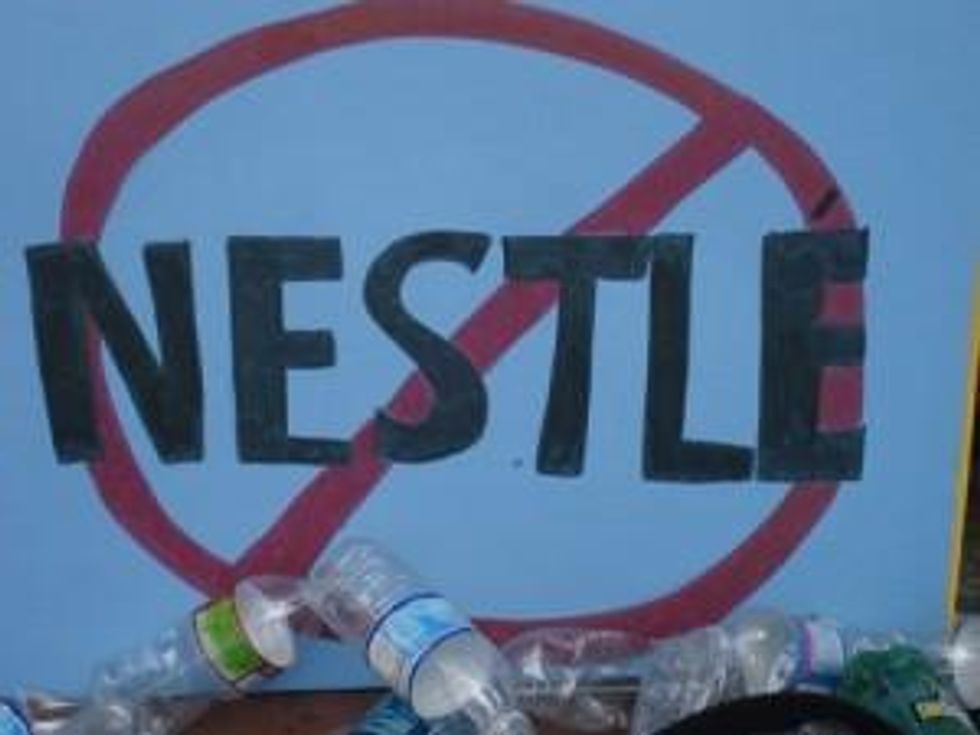
Last week, the Civil Tribunal of Lausanne, Switzerland, found Nestle guilty of hiring a private security firm to spy on the activities of the Swiss activist group ATTAC, in what has aptly come to be known as "Nestlegate." The tribunal charged the company with "unlawful violation of the rights of the person" after the company hired Sara Meylan to infiltrate and gather information on the anti-globalization group.
This is not the first time a corporation has adopted these tactics, nor, sadly is it likely to be the last. Several years ago, Mother Jones reported that corporations had hired a private security firm run by former U.S. Secret Service agents to spy on environmental groups, and in 2011, Greenpeace sued Dow Chemical Company and Sasol North America for seeking to undermine campaigns against genetically engineered foods and chemical pollution.
While inexcusable and unscrupulous, these actions underscore the effectiveness of activist movements. After all, corporations wouldn't pour untold amounts of money into covert ops if they didn't think their market share was at risk from consumer backlash against their products and practices.
Nestle has long dug into its deep pockets to bend public policy to its will, but its battle against ATTAC reeks of desperation. There's a very fine line between selling out natural resources and tramping upon individual civil liberties, and Nestle appears perfectly comfortable with both.
Luckily, there is something you can do about this. Use your wallet to take a stand against Nestle's shady practices by choosing tap water over bottled, whenever you can. Our Take Back the Tap resources will show you how.
Thanks in part to the consumer backlash against wasteful, unnecessary bottled water Nestle's sales figures are declining in the United States, Europe and Australia. The company has recently resorted to unorthodox, nay, illegal measures to maintain its stranglehold over the earth's vital food and water resources. Even before the company's share of the bottled water business fell by two percent in the west in 2011, Nestle ripped a page from a James Bond villain's playbook, turning to good old-fashioned espionage to protect its corporate interests.
Last week, the Civil Tribunal of Lausanne, Switzerland, found Nestle guilty of hiring a private security firm to spy on the activities of the Swiss activist group ATTAC, in what has aptly come to be known as "Nestlegate." The tribunal charged the company with "unlawful violation of the rights of the person" after the company hired Sara Meylan to infiltrate and gather information on the anti-globalization group.
This is not the first time a corporation has adopted these tactics, nor, sadly is it likely to be the last. Several years ago, Mother Jones reported that corporations had hired a private security firm run by former U.S. Secret Service agents to spy on environmental groups, and in 2011, Greenpeace sued Dow Chemical Company and Sasol North America for seeking to undermine campaigns against genetically engineered foods and chemical pollution.
While inexcusable and unscrupulous, these actions underscore the effectiveness of activist movements. After all, corporations wouldn't pour untold amounts of money into covert ops if they didn't think their market share was at risk from consumer backlash against their products and practices.
Nestle has long dug into its deep pockets to bend public policy to its will, but its battle against ATTAC reeks of desperation. There's a very fine line between selling out natural resources and tramping upon individual civil liberties, and Nestle appears perfectly comfortable with both.
Luckily, there is something you can do about this. Use your wallet to take a stand against Nestle's shady practices by choosing tap water over bottled, whenever you can. Our Take Back the Tap resources will show you how.
Thanks in part to the consumer backlash against wasteful, unnecessary bottled water Nestle's sales figures are declining in the United States, Europe and Australia. The company has recently resorted to unorthodox, nay, illegal measures to maintain its stranglehold over the earth's vital food and water resources. Even before the company's share of the bottled water business fell by two percent in the west in 2011, Nestle ripped a page from a James Bond villain's playbook, turning to good old-fashioned espionage to protect its corporate interests.
Last week, the Civil Tribunal of Lausanne, Switzerland, found Nestle guilty of hiring a private security firm to spy on the activities of the Swiss activist group ATTAC, in what has aptly come to be known as "Nestlegate." The tribunal charged the company with "unlawful violation of the rights of the person" after the company hired Sara Meylan to infiltrate and gather information on the anti-globalization group.
This is not the first time a corporation has adopted these tactics, nor, sadly is it likely to be the last. Several years ago, Mother Jones reported that corporations had hired a private security firm run by former U.S. Secret Service agents to spy on environmental groups, and in 2011, Greenpeace sued Dow Chemical Company and Sasol North America for seeking to undermine campaigns against genetically engineered foods and chemical pollution.
While inexcusable and unscrupulous, these actions underscore the effectiveness of activist movements. After all, corporations wouldn't pour untold amounts of money into covert ops if they didn't think their market share was at risk from consumer backlash against their products and practices.
Nestle has long dug into its deep pockets to bend public policy to its will, but its battle against ATTAC reeks of desperation. There's a very fine line between selling out natural resources and tramping upon individual civil liberties, and Nestle appears perfectly comfortable with both.
Luckily, there is something you can do about this. Use your wallet to take a stand against Nestle's shady practices by choosing tap water over bottled, whenever you can. Our Take Back the Tap resources will show you how.