SUBSCRIBE TO OUR FREE NEWSLETTER
Daily news & progressive opinion—funded by the people, not the corporations—delivered straight to your inbox.
5
#000000
#FFFFFF
To donate by check, phone, or other method, see our More Ways to Give page.
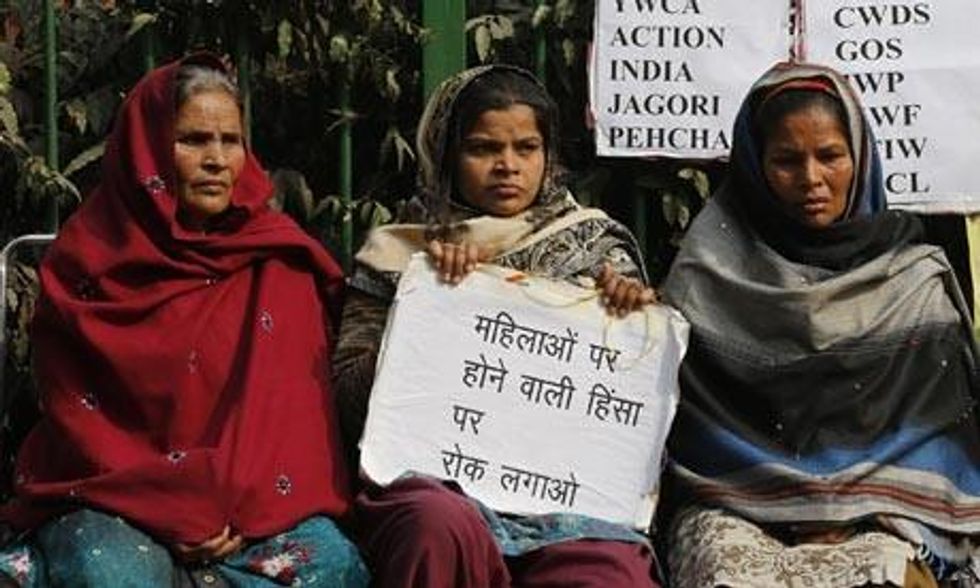
One in three women around the world are subject to violence at some point in their life, a statistic that prompted Ensler, who wrote the Monologues in 1996, to set up One Billion Rising. With such violence encompassing domestic abuse, gang rape, female genital mutilation and war, it is perhaps unsurprising that the campaign has taken on a different hue in each of the 190 countries where events to mark 14 February are planned.
"It is something that has gone across class, social group and religion. It's like a huge feminist tsunami," she said on a stopover in Paris.
Local protests range from the first ever flashmob in Mogadishu, Somalia, to the town square in Rothesay on the Isle of Bute and encompass Maori women in New Zealand and an estimated 25m protesters in Bangladesh. Ensler's idea for One Billion Rising came from her work in the Congo, where she set up the City of Joy to help female victims of violence and where she plans to be on 14 February itself, a day chosen partly to take back the idea of love from the soppy commercialism of Valentine's Day. Her last stop before Congo will be London, with a sold-out event at the Cafe de Paris including Thandie Newton and other campaigners.
Ensler says a combination of social media and the world's grassroots feminist movements have driven the way the campaign has taken off globally. In south Asia for three weeks over Christmas, she was struck by how much the horror over the gang rape of the 23-year-old medical student Jyoti Singh in Delhi had given impetus to the campaign. "In India, One Billion Rising is at the centre of the biggest breakthrough in sexual violence ever seen," she says.
Kamla Bhasin, a feminist campaigner in the continent for more than 30 years, says each country is taking a different approach - from the astonishing mass movement in Bangladesh, organised by Brac, one of the world's largest NGOs, to Afghanistan, where "there will be no dancing and no singing but people still want to say, 'Enough is enough'".
The idea of dancing to stop violence has understandably attracted naysayers, even among committed supporters, but two videos, among hundreds, sum up how Ensler's idea inspires campaigners. The first is the one that launched the new anthem written and produced by Grammy-award-winning Tena Clark, Break the Chain , with a video choreographed by Debbie Allen, who went on to make her own accompanying "how to" dance video. The second is one produced by campaigners in Norwich. Without the involvement of the sort of Hollywood A-listers - Robert Redford, Jane Fonda - usually associated with Ensler, it's still hugely effective. Local organisers were keen to show that the campaign is supported by men and boys as well as women.
Much of the effort in the UK has been concentrated on changing sex education in schools to embrace relationships and violence. A cross-party group including Labour MP Stella Creasy and Conservative MP Amber Rudd is hoping for parliamentary time on 14 February to vote on making "personal, social and health education a requirement in schools, including a zero tolerance approach to violence and abuse in relationships".
Efforts to get the government to recognise the campaign itself have so far failed to gain much ground. In the latest parliamentary debate, foreign office minister Hugo Swire restricted himself to pointing out that the government took such violence seriously and warned women to be careful when going abroad.
In the US, veteran campaigner Pat Reuss is also hoping to use support for OBR in every state to resuscitate the Violence Against Women Act that provides protection for victims, yet which Congress failed to reauthorise last year.
When asked which country she has been most amazed by, Ensler rattles off a list of action - from those protesting against sex trafficking in Mexico to mass activity in the Philippines. She adds that the 50 cities preparing events in Italy took her by surprise. "That was a real turning point for me," she says. "Fifty cities in Italy!"
Campaigners are already wondering what will happen after V-day. "The dancing will be amazing but more important is what's happening to move violence against women to the forefront of the agenda," says Ensler. "It will never be a marginalised issue again ... At this point it really feels like a wave with a life of its own."
One in three women around the world are subject to violence at some point in their life, a statistic that prompted Ensler, who wrote the Monologues in 1996, to set up One Billion Rising. With such violence encompassing domestic abuse, gang rape, female genital mutilation and war, it is perhaps unsurprising that the campaign has taken on a different hue in each of the 190 countries where events to mark 14 February are planned.
"It is something that has gone across class, social group and religion. It's like a huge feminist tsunami," she said on a stopover in Paris.
Local protests range from the first ever flashmob in Mogadishu, Somalia, to the town square in Rothesay on the Isle of Bute and encompass Maori women in New Zealand and an estimated 25m protesters in Bangladesh. Ensler's idea for One Billion Rising came from her work in the Congo, where she set up the City of Joy to help female victims of violence and where she plans to be on 14 February itself, a day chosen partly to take back the idea of love from the soppy commercialism of Valentine's Day. Her last stop before Congo will be London, with a sold-out event at the Cafe de Paris including Thandie Newton and other campaigners.
Ensler says a combination of social media and the world's grassroots feminist movements have driven the way the campaign has taken off globally. In south Asia for three weeks over Christmas, she was struck by how much the horror over the gang rape of the 23-year-old medical student Jyoti Singh in Delhi had given impetus to the campaign. "In India, One Billion Rising is at the centre of the biggest breakthrough in sexual violence ever seen," she says.
Kamla Bhasin, a feminist campaigner in the continent for more than 30 years, says each country is taking a different approach - from the astonishing mass movement in Bangladesh, organised by Brac, one of the world's largest NGOs, to Afghanistan, where "there will be no dancing and no singing but people still want to say, 'Enough is enough'".
The idea of dancing to stop violence has understandably attracted naysayers, even among committed supporters, but two videos, among hundreds, sum up how Ensler's idea inspires campaigners. The first is the one that launched the new anthem written and produced by Grammy-award-winning Tena Clark, Break the Chain , with a video choreographed by Debbie Allen, who went on to make her own accompanying "how to" dance video. The second is one produced by campaigners in Norwich. Without the involvement of the sort of Hollywood A-listers - Robert Redford, Jane Fonda - usually associated with Ensler, it's still hugely effective. Local organisers were keen to show that the campaign is supported by men and boys as well as women.
Much of the effort in the UK has been concentrated on changing sex education in schools to embrace relationships and violence. A cross-party group including Labour MP Stella Creasy and Conservative MP Amber Rudd is hoping for parliamentary time on 14 February to vote on making "personal, social and health education a requirement in schools, including a zero tolerance approach to violence and abuse in relationships".
Efforts to get the government to recognise the campaign itself have so far failed to gain much ground. In the latest parliamentary debate, foreign office minister Hugo Swire restricted himself to pointing out that the government took such violence seriously and warned women to be careful when going abroad.
In the US, veteran campaigner Pat Reuss is also hoping to use support for OBR in every state to resuscitate the Violence Against Women Act that provides protection for victims, yet which Congress failed to reauthorise last year.
When asked which country she has been most amazed by, Ensler rattles off a list of action - from those protesting against sex trafficking in Mexico to mass activity in the Philippines. She adds that the 50 cities preparing events in Italy took her by surprise. "That was a real turning point for me," she says. "Fifty cities in Italy!"
Campaigners are already wondering what will happen after V-day. "The dancing will be amazing but more important is what's happening to move violence against women to the forefront of the agenda," says Ensler. "It will never be a marginalised issue again ... At this point it really feels like a wave with a life of its own."
One in three women around the world are subject to violence at some point in their life, a statistic that prompted Ensler, who wrote the Monologues in 1996, to set up One Billion Rising. With such violence encompassing domestic abuse, gang rape, female genital mutilation and war, it is perhaps unsurprising that the campaign has taken on a different hue in each of the 190 countries where events to mark 14 February are planned.
"It is something that has gone across class, social group and religion. It's like a huge feminist tsunami," she said on a stopover in Paris.
Local protests range from the first ever flashmob in Mogadishu, Somalia, to the town square in Rothesay on the Isle of Bute and encompass Maori women in New Zealand and an estimated 25m protesters in Bangladesh. Ensler's idea for One Billion Rising came from her work in the Congo, where she set up the City of Joy to help female victims of violence and where she plans to be on 14 February itself, a day chosen partly to take back the idea of love from the soppy commercialism of Valentine's Day. Her last stop before Congo will be London, with a sold-out event at the Cafe de Paris including Thandie Newton and other campaigners.
Ensler says a combination of social media and the world's grassroots feminist movements have driven the way the campaign has taken off globally. In south Asia for three weeks over Christmas, she was struck by how much the horror over the gang rape of the 23-year-old medical student Jyoti Singh in Delhi had given impetus to the campaign. "In India, One Billion Rising is at the centre of the biggest breakthrough in sexual violence ever seen," she says.
Kamla Bhasin, a feminist campaigner in the continent for more than 30 years, says each country is taking a different approach - from the astonishing mass movement in Bangladesh, organised by Brac, one of the world's largest NGOs, to Afghanistan, where "there will be no dancing and no singing but people still want to say, 'Enough is enough'".
The idea of dancing to stop violence has understandably attracted naysayers, even among committed supporters, but two videos, among hundreds, sum up how Ensler's idea inspires campaigners. The first is the one that launched the new anthem written and produced by Grammy-award-winning Tena Clark, Break the Chain , with a video choreographed by Debbie Allen, who went on to make her own accompanying "how to" dance video. The second is one produced by campaigners in Norwich. Without the involvement of the sort of Hollywood A-listers - Robert Redford, Jane Fonda - usually associated with Ensler, it's still hugely effective. Local organisers were keen to show that the campaign is supported by men and boys as well as women.
Much of the effort in the UK has been concentrated on changing sex education in schools to embrace relationships and violence. A cross-party group including Labour MP Stella Creasy and Conservative MP Amber Rudd is hoping for parliamentary time on 14 February to vote on making "personal, social and health education a requirement in schools, including a zero tolerance approach to violence and abuse in relationships".
Efforts to get the government to recognise the campaign itself have so far failed to gain much ground. In the latest parliamentary debate, foreign office minister Hugo Swire restricted himself to pointing out that the government took such violence seriously and warned women to be careful when going abroad.
In the US, veteran campaigner Pat Reuss is also hoping to use support for OBR in every state to resuscitate the Violence Against Women Act that provides protection for victims, yet which Congress failed to reauthorise last year.
When asked which country she has been most amazed by, Ensler rattles off a list of action - from those protesting against sex trafficking in Mexico to mass activity in the Philippines. She adds that the 50 cities preparing events in Italy took her by surprise. "That was a real turning point for me," she says. "Fifty cities in Italy!"
Campaigners are already wondering what will happen after V-day. "The dancing will be amazing but more important is what's happening to move violence against women to the forefront of the agenda," says Ensler. "It will never be a marginalised issue again ... At this point it really feels like a wave with a life of its own."