SUBSCRIBE TO OUR FREE NEWSLETTER
Daily news & progressive opinion—funded by the people, not the corporations—delivered straight to your inbox.
5
#000000
#FFFFFF
To donate by check, phone, or other method, see our More Ways to Give page.
One of the many fierce debates at the United Nations Framework Convention on Climate Change Conference of Parties (CoP), which opened this year on November 26 in Doha, Qatar is about climate finance. How should the reduction of greenhouse gases (GHGs) and the adaptation to climate change's effects, both slow-onset, such as drought, and suddenly catastrophic, such as Hurricane Sandy, be most effectively financed?
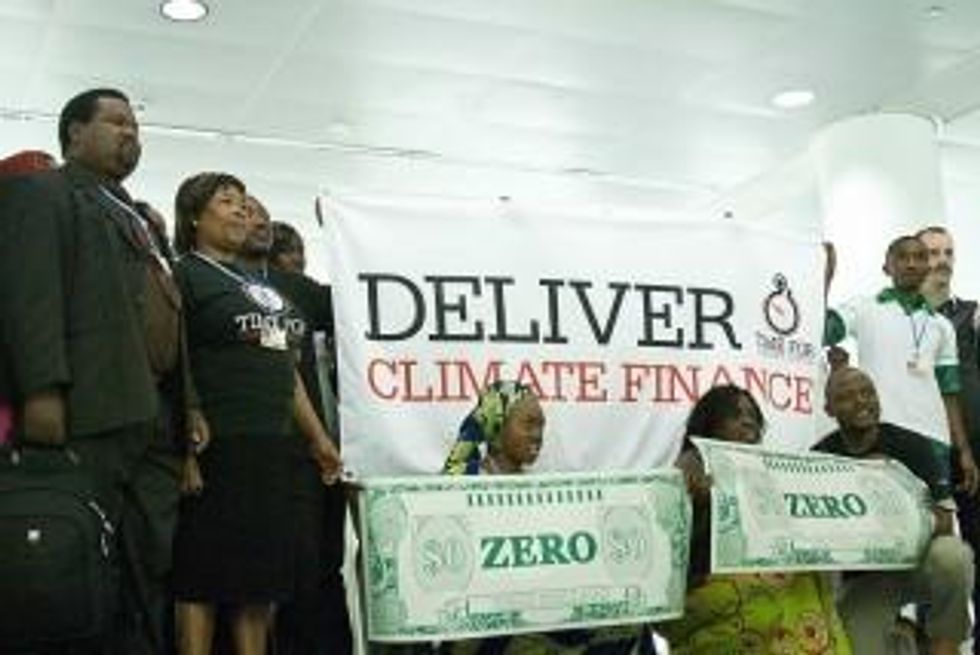
Among the many contentious issues to be debated at the CoP, perhaps none is less likely to be resolved than the issue of how to pay to adapt to climate change and to reduce GHGs. This debate goes beyond the question of whether payment should come from the industrialized countries that bear the historical responsibility for the majority of GHG production, or whether payment also should come from those developing countries that will, in the words of U.S. negotiator Jonathan Pershing, bear "future responsibility" as major GHG emitters. The question is not even how much of a share each should pay, but whether any significant funds will be committed at all.
One indicator that no big climate finance commitments are to be expected in Doha is the Group of 20 climate finance report discussed by finance ministers, November 4-5 in Mexico City. The Group of 20 includes both the largest historical emitter of GHGs, the United States, and largest current emitter, China. The report simply summarized other reports and made few solid proposals. For example, they referenced the Climate Policy Initiative's 2011 report that noted the near absence of private sector financing for adaptation, but made no proposals even for how to get the private sector to assume the costs of paying for the loss and damage to its facilities and supply chains and for "climate-proofing" them.
The Doha CoP will no doubt thank donors for the $30 billion in "fast-track" finance pledged (but not yet given in full) by developed countries at the 2009 CoP in Copenhagen, largely targeted to GHG reduction projects from 2010 to 2012. However, as an August editorial in Point Carbon glumly noted, "the fast start funding, for what most people agree is "one of the biggest challenges of our time", is equivalent to 15 percent of the value of Greece's most recent bailout ($200 billion) and just 4 percent of the value of the amount originally pledged to the US TARP [Troubled Asset Relief Program] scheme ($700 billion)."
At the opening CoP session of the Ad Hoc Working Group on Long-Term Cooperation (LCA), the Group of 77 and China restated their long-standing preference for public funding of climate finance. According to reporting by Third World Network, they proposed that developed countries contribute $30 billion to the Green Climate Fund (GCF) for developing country climate projects from 2012-2015. But how the GCF will operate and be governed is still being debated. In the GCF negotiations in October 17-20 in South Korea, some developed country delegates did not want the GCF Board to take guidance and be reviewed by the CoP. Rather they want the GCF Board, whose creation is authorized by the CoP, to determine whether, when and to what extent it will be guided by and report to the CoP.
At the 2011 CoP in Durban, South Africa, the United States did not want the GCF to be capitalized until developing countries had agreed to assume binding emissions commitments and other donor demands under the Durban Platform that is to succeed the LCA. Developed countries and South Korea, the newly selected GCF secretariat host country, have contributed $7 million in administrative expenses towards the planning to begin GCF operations in 2014.
With public sources of climate finance slow to materialize to adapt to climate change, there are in Doha more side event discussions of the policy certainty and public finance guarantees that the private sector and donors to multilateral organizations say are needed to "catalyze" private sector investment. For example, at a side event with the World Bank's private sector facility, the International Finance Corporation, the UN Development Program presented a report on its experience of using scarce public funds to attract private finance for renewable energy projects.
More controversially, carbon emissions markets continue to be promoted as both an important source of climate finance and an important mechanism for incentivizing major GHG emitters to make long term investments to reduce their carbon footprint. The International Emissions Trading Association will host 18 side events in Doha, plus private meetings with negotiators.
A British consultancy, boasting the health of London carbon exchanges, reported that the global value of carbon emissions credit transactions had increased to $176 billion in 2011. However, the vast majority of these transactions are recirculating the value of carbon credits given for free by the European Commission to power plants and heavy energy users in the European Union. According to a June Carbon Trade Watch report, these free credits have amounted to an average annual seven billion euro windfall profit for European polluters since 2005. At a November auction of European Union Emissions Trading Scheme credits, which begins the 2013-2020 phase of the ETS, the price had fallen to 6.7 euros a metric ton of GHGs from about 20 euros in 2009. However, just one percent of the transactions on the soon to be defunct Blue Next carbon exchange in Paris are "spot" transactions used by non-financial firms to meet their emissions limits. The remaining transactions are financial derivative contracts based on the value of carbon credits. Returns and fees on derivatives may enrich carbon traders and exchanges, but they do not "leverage" revenue for adaptation or mitigation projects.
Because of the falling price of ETS credits, the European Commission has spent the past year debating how to fix the $148 billion market to increase the carbon price sufficiently to prompt emitters to reduce their emissions. In November, according to Point Carbon (subscription required), Barclays Bank issued a report calling the EC efforts a "regulatory omnishambles," meaning a shambles in every aspect. Of more than 3,000 carbon market respondents to a 2012 Point Carbon survey, just 47 percent thought that the ETS was the "most cost-efficient way to reduce emissions in the EU."
While delegates in Doha debated who should control climate finance, scientists in Doha reported a relentless acceleration of global warming and its effects, including a summary of extreme weather events at least as devastating, if not as widely reported, as Hurricane Sandy. The World Meteorological Organization issued a preliminary statement that began, "The last ten years (2001-2011) were among the top warmest years on record, and the first ten months of 2012 indicate that this year will not be an exception."
In a press release, WMO Secretary General Michel Jarraud, commenting on the unprecedented extent of melting Arctic sea ice, stated, "Climate change is taking place before our eyes and will continue to do so as a result of the concentrations of greenhouse gases in the atmosphere, which have risen constantly and again reached new records."
Tragically, as some governments engage in Great Power tactics reminiscent of the 19th century to ensure their economic hegemony, climate finance remains an "omnishambles" directed largely to subsidizing major polluters and the financial derivatives markets.
One of the many fierce debates at the United Nations Framework Convention on Climate Change Conference of Parties (CoP), which opened this year on November 26 in Doha, Qatar is about climate finance. How should the reduction of greenhouse gases (GHGs) and the adaptation to climate change's effects, both slow-onset, such as drought, and suddenly catastrophic, such as Hurricane Sandy, be most effectively financed?
Among the many contentious issues to be debated at the CoP, perhaps none is less likely to be resolved than the issue of how to pay to adapt to climate change and to reduce GHGs. This debate goes beyond the question of whether payment should come from the industrialized countries that bear the historical responsibility for the majority of GHG production, or whether payment also should come from those developing countries that will, in the words of U.S. negotiator Jonathan Pershing, bear "future responsibility" as major GHG emitters. The question is not even how much of a share each should pay, but whether any significant funds will be committed at all.
One indicator that no big climate finance commitments are to be expected in Doha is the Group of 20 climate finance report discussed by finance ministers, November 4-5 in Mexico City. The Group of 20 includes both the largest historical emitter of GHGs, the United States, and largest current emitter, China. The report simply summarized other reports and made few solid proposals. For example, they referenced the Climate Policy Initiative's 2011 report that noted the near absence of private sector financing for adaptation, but made no proposals even for how to get the private sector to assume the costs of paying for the loss and damage to its facilities and supply chains and for "climate-proofing" them.
The Doha CoP will no doubt thank donors for the $30 billion in "fast-track" finance pledged (but not yet given in full) by developed countries at the 2009 CoP in Copenhagen, largely targeted to GHG reduction projects from 2010 to 2012. However, as an August editorial in Point Carbon glumly noted, "the fast start funding, for what most people agree is "one of the biggest challenges of our time", is equivalent to 15 percent of the value of Greece's most recent bailout ($200 billion) and just 4 percent of the value of the amount originally pledged to the US TARP [Troubled Asset Relief Program] scheme ($700 billion)."
At the opening CoP session of the Ad Hoc Working Group on Long-Term Cooperation (LCA), the Group of 77 and China restated their long-standing preference for public funding of climate finance. According to reporting by Third World Network, they proposed that developed countries contribute $30 billion to the Green Climate Fund (GCF) for developing country climate projects from 2012-2015. But how the GCF will operate and be governed is still being debated. In the GCF negotiations in October 17-20 in South Korea, some developed country delegates did not want the GCF Board to take guidance and be reviewed by the CoP. Rather they want the GCF Board, whose creation is authorized by the CoP, to determine whether, when and to what extent it will be guided by and report to the CoP.
At the 2011 CoP in Durban, South Africa, the United States did not want the GCF to be capitalized until developing countries had agreed to assume binding emissions commitments and other donor demands under the Durban Platform that is to succeed the LCA. Developed countries and South Korea, the newly selected GCF secretariat host country, have contributed $7 million in administrative expenses towards the planning to begin GCF operations in 2014.
With public sources of climate finance slow to materialize to adapt to climate change, there are in Doha more side event discussions of the policy certainty and public finance guarantees that the private sector and donors to multilateral organizations say are needed to "catalyze" private sector investment. For example, at a side event with the World Bank's private sector facility, the International Finance Corporation, the UN Development Program presented a report on its experience of using scarce public funds to attract private finance for renewable energy projects.
More controversially, carbon emissions markets continue to be promoted as both an important source of climate finance and an important mechanism for incentivizing major GHG emitters to make long term investments to reduce their carbon footprint. The International Emissions Trading Association will host 18 side events in Doha, plus private meetings with negotiators.
A British consultancy, boasting the health of London carbon exchanges, reported that the global value of carbon emissions credit transactions had increased to $176 billion in 2011. However, the vast majority of these transactions are recirculating the value of carbon credits given for free by the European Commission to power plants and heavy energy users in the European Union. According to a June Carbon Trade Watch report, these free credits have amounted to an average annual seven billion euro windfall profit for European polluters since 2005. At a November auction of European Union Emissions Trading Scheme credits, which begins the 2013-2020 phase of the ETS, the price had fallen to 6.7 euros a metric ton of GHGs from about 20 euros in 2009. However, just one percent of the transactions on the soon to be defunct Blue Next carbon exchange in Paris are "spot" transactions used by non-financial firms to meet their emissions limits. The remaining transactions are financial derivative contracts based on the value of carbon credits. Returns and fees on derivatives may enrich carbon traders and exchanges, but they do not "leverage" revenue for adaptation or mitigation projects.
Because of the falling price of ETS credits, the European Commission has spent the past year debating how to fix the $148 billion market to increase the carbon price sufficiently to prompt emitters to reduce their emissions. In November, according to Point Carbon (subscription required), Barclays Bank issued a report calling the EC efforts a "regulatory omnishambles," meaning a shambles in every aspect. Of more than 3,000 carbon market respondents to a 2012 Point Carbon survey, just 47 percent thought that the ETS was the "most cost-efficient way to reduce emissions in the EU."
While delegates in Doha debated who should control climate finance, scientists in Doha reported a relentless acceleration of global warming and its effects, including a summary of extreme weather events at least as devastating, if not as widely reported, as Hurricane Sandy. The World Meteorological Organization issued a preliminary statement that began, "The last ten years (2001-2011) were among the top warmest years on record, and the first ten months of 2012 indicate that this year will not be an exception."
In a press release, WMO Secretary General Michel Jarraud, commenting on the unprecedented extent of melting Arctic sea ice, stated, "Climate change is taking place before our eyes and will continue to do so as a result of the concentrations of greenhouse gases in the atmosphere, which have risen constantly and again reached new records."
Tragically, as some governments engage in Great Power tactics reminiscent of the 19th century to ensure their economic hegemony, climate finance remains an "omnishambles" directed largely to subsidizing major polluters and the financial derivatives markets.
One of the many fierce debates at the United Nations Framework Convention on Climate Change Conference of Parties (CoP), which opened this year on November 26 in Doha, Qatar is about climate finance. How should the reduction of greenhouse gases (GHGs) and the adaptation to climate change's effects, both slow-onset, such as drought, and suddenly catastrophic, such as Hurricane Sandy, be most effectively financed?
Among the many contentious issues to be debated at the CoP, perhaps none is less likely to be resolved than the issue of how to pay to adapt to climate change and to reduce GHGs. This debate goes beyond the question of whether payment should come from the industrialized countries that bear the historical responsibility for the majority of GHG production, or whether payment also should come from those developing countries that will, in the words of U.S. negotiator Jonathan Pershing, bear "future responsibility" as major GHG emitters. The question is not even how much of a share each should pay, but whether any significant funds will be committed at all.
One indicator that no big climate finance commitments are to be expected in Doha is the Group of 20 climate finance report discussed by finance ministers, November 4-5 in Mexico City. The Group of 20 includes both the largest historical emitter of GHGs, the United States, and largest current emitter, China. The report simply summarized other reports and made few solid proposals. For example, they referenced the Climate Policy Initiative's 2011 report that noted the near absence of private sector financing for adaptation, but made no proposals even for how to get the private sector to assume the costs of paying for the loss and damage to its facilities and supply chains and for "climate-proofing" them.
The Doha CoP will no doubt thank donors for the $30 billion in "fast-track" finance pledged (but not yet given in full) by developed countries at the 2009 CoP in Copenhagen, largely targeted to GHG reduction projects from 2010 to 2012. However, as an August editorial in Point Carbon glumly noted, "the fast start funding, for what most people agree is "one of the biggest challenges of our time", is equivalent to 15 percent of the value of Greece's most recent bailout ($200 billion) and just 4 percent of the value of the amount originally pledged to the US TARP [Troubled Asset Relief Program] scheme ($700 billion)."
At the opening CoP session of the Ad Hoc Working Group on Long-Term Cooperation (LCA), the Group of 77 and China restated their long-standing preference for public funding of climate finance. According to reporting by Third World Network, they proposed that developed countries contribute $30 billion to the Green Climate Fund (GCF) for developing country climate projects from 2012-2015. But how the GCF will operate and be governed is still being debated. In the GCF negotiations in October 17-20 in South Korea, some developed country delegates did not want the GCF Board to take guidance and be reviewed by the CoP. Rather they want the GCF Board, whose creation is authorized by the CoP, to determine whether, when and to what extent it will be guided by and report to the CoP.
At the 2011 CoP in Durban, South Africa, the United States did not want the GCF to be capitalized until developing countries had agreed to assume binding emissions commitments and other donor demands under the Durban Platform that is to succeed the LCA. Developed countries and South Korea, the newly selected GCF secretariat host country, have contributed $7 million in administrative expenses towards the planning to begin GCF operations in 2014.
With public sources of climate finance slow to materialize to adapt to climate change, there are in Doha more side event discussions of the policy certainty and public finance guarantees that the private sector and donors to multilateral organizations say are needed to "catalyze" private sector investment. For example, at a side event with the World Bank's private sector facility, the International Finance Corporation, the UN Development Program presented a report on its experience of using scarce public funds to attract private finance for renewable energy projects.
More controversially, carbon emissions markets continue to be promoted as both an important source of climate finance and an important mechanism for incentivizing major GHG emitters to make long term investments to reduce their carbon footprint. The International Emissions Trading Association will host 18 side events in Doha, plus private meetings with negotiators.
A British consultancy, boasting the health of London carbon exchanges, reported that the global value of carbon emissions credit transactions had increased to $176 billion in 2011. However, the vast majority of these transactions are recirculating the value of carbon credits given for free by the European Commission to power plants and heavy energy users in the European Union. According to a June Carbon Trade Watch report, these free credits have amounted to an average annual seven billion euro windfall profit for European polluters since 2005. At a November auction of European Union Emissions Trading Scheme credits, which begins the 2013-2020 phase of the ETS, the price had fallen to 6.7 euros a metric ton of GHGs from about 20 euros in 2009. However, just one percent of the transactions on the soon to be defunct Blue Next carbon exchange in Paris are "spot" transactions used by non-financial firms to meet their emissions limits. The remaining transactions are financial derivative contracts based on the value of carbon credits. Returns and fees on derivatives may enrich carbon traders and exchanges, but they do not "leverage" revenue for adaptation or mitigation projects.
Because of the falling price of ETS credits, the European Commission has spent the past year debating how to fix the $148 billion market to increase the carbon price sufficiently to prompt emitters to reduce their emissions. In November, according to Point Carbon (subscription required), Barclays Bank issued a report calling the EC efforts a "regulatory omnishambles," meaning a shambles in every aspect. Of more than 3,000 carbon market respondents to a 2012 Point Carbon survey, just 47 percent thought that the ETS was the "most cost-efficient way to reduce emissions in the EU."
While delegates in Doha debated who should control climate finance, scientists in Doha reported a relentless acceleration of global warming and its effects, including a summary of extreme weather events at least as devastating, if not as widely reported, as Hurricane Sandy. The World Meteorological Organization issued a preliminary statement that began, "The last ten years (2001-2011) were among the top warmest years on record, and the first ten months of 2012 indicate that this year will not be an exception."
In a press release, WMO Secretary General Michel Jarraud, commenting on the unprecedented extent of melting Arctic sea ice, stated, "Climate change is taking place before our eyes and will continue to do so as a result of the concentrations of greenhouse gases in the atmosphere, which have risen constantly and again reached new records."
Tragically, as some governments engage in Great Power tactics reminiscent of the 19th century to ensure their economic hegemony, climate finance remains an "omnishambles" directed largely to subsidizing major polluters and the financial derivatives markets.