

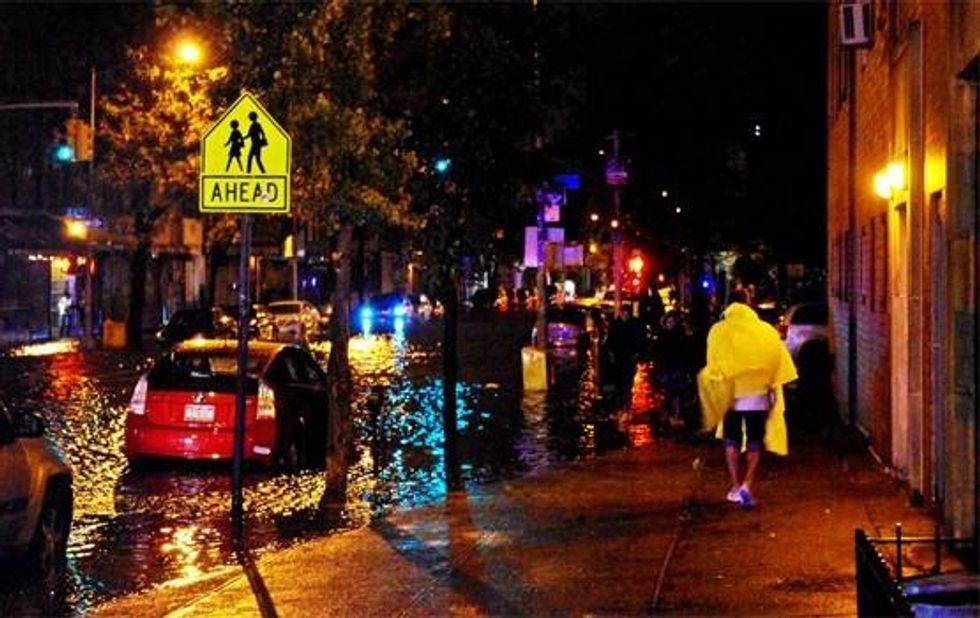
But there's another issue that Sandy raises. Climate models suggest we'll be facing similar disasters with increasing frequency. So will we, as neighbors and as a nation, come to the aid of those who lose their home, business, or farm because of flood, drought, fire, or other climate-related disaster? Are we a country that comes together in hard times, or do we come apart? In other words, when things get tough, do we turn to each other? Or do we turn on each other? The answer to these questions will define much about how we live together as we face increasing climate weirdness in coming decades.
First signs out of the hardest-hit areas are positive. As so often happens in disasters, ordinary people acted heroically when they saw a way to help. Belle Harbor residents grabbed surfboards to rescue themselves and neighbors from storm surges and a fire that flattened sections of their community. In lower Manhattan, a real estate broker kept his office open during the storm, with a generator and hot coffee so neighbors could charge their cell phones and first responders could get out of the wind and rain. A local pizza place served up free slices to cold and hungry customers the day after the storm. And families in Hoboken who still had electricity set out tables for neighbors , with coffee pots and power strips for cell phone charging.
Activists, too, are pitching in to help with recovery; the Occupy Wall Street movement is teaming up with activists from 350.org to link volunteers to places where help is needed.
But a storm of this scope requires a response far beyond what neighbors can do and even what state and local governments can handle. The areas hit the hardest needed, and received, help from the federal government, which worked collaboratively with local officials even before the storm hit. FEMA and the Army Corps of Engineers had stationed supplies where they would likely be needed ahead of the storm. The National Guard mobilized troops to help with rescue and recovery. Warnings to residents of vulnerable areas went out early and often, informed by excellent hurricane forecasting, so many people evacuated and others were prepared to wait out the storm in relative safety.
Former FEMA director, Michael Brown, made famous for bungling the response to Hurricane Katrina, criticized the president for being over-prepared. But instead of seeing families stranded on rooftops, left to struggle on their own for days after the storm, as happened in New Orleans under Brown's watch, we're seeing effective and timely action throughout a wide swath of the eastern seaboard.
This is a side of our national character that makes us justifiably proud. Ordinary people, even complete strangers, step up to help one another. And our government, when well run, can marshal extraordinary capabilities at all levels to rescue people from storm surges, to offer help to farmers whose crops fail because of drought, and to train and deploy firefighters to contain wildfires. Partisan issues are set aside to get things done, as President Obama and New Jersey Governor Chris Christie are demonstrating.
Will we be able to maintain this ethic of mutual support in the years to come? Or will incessant attacks on government undermine the capacity of government to respond and result in a return to the failed FEMA model that prevailed under George W. Bush?
Perhaps Sandy will tip the balance towards a vision that is, at its essence, patriotic--built on our love for our country, and all the regions and people that make it up.
Big disasters help us recognize our interdependence. Any of us could find ourselves stranded by a storm or fire, in need of help from others. We are each part of a family, neighborhood, community, nation--a part of the human species, which, like all species, lives and dies depending on the resilience of a much larger whole.
This is how countries achieve greatness. When one area is in trouble, other areas pitch in. In an age when once-in-a-lifetime disasters are starting to happen once a year, it's more important than ever that farmers, small business owners, families, and all of us, aren't left to fend for ourselves. When the country as a whole stands together, all are strengthened.
But there's another issue that Sandy raises. Climate models suggest we'll be facing similar disasters with increasing frequency. So will we, as neighbors and as a nation, come to the aid of those who lose their home, business, or farm because of flood, drought, fire, or other climate-related disaster? Are we a country that comes together in hard times, or do we come apart? In other words, when things get tough, do we turn to each other? Or do we turn on each other? The answer to these questions will define much about how we live together as we face increasing climate weirdness in coming decades.
First signs out of the hardest-hit areas are positive. As so often happens in disasters, ordinary people acted heroically when they saw a way to help. Belle Harbor residents grabbed surfboards to rescue themselves and neighbors from storm surges and a fire that flattened sections of their community. In lower Manhattan, a real estate broker kept his office open during the storm, with a generator and hot coffee so neighbors could charge their cell phones and first responders could get out of the wind and rain. A local pizza place served up free slices to cold and hungry customers the day after the storm. And families in Hoboken who still had electricity set out tables for neighbors , with coffee pots and power strips for cell phone charging.
Activists, too, are pitching in to help with recovery; the Occupy Wall Street movement is teaming up with activists from 350.org to link volunteers to places where help is needed.
But a storm of this scope requires a response far beyond what neighbors can do and even what state and local governments can handle. The areas hit the hardest needed, and received, help from the federal government, which worked collaboratively with local officials even before the storm hit. FEMA and the Army Corps of Engineers had stationed supplies where they would likely be needed ahead of the storm. The National Guard mobilized troops to help with rescue and recovery. Warnings to residents of vulnerable areas went out early and often, informed by excellent hurricane forecasting, so many people evacuated and others were prepared to wait out the storm in relative safety.
Former FEMA director, Michael Brown, made famous for bungling the response to Hurricane Katrina, criticized the president for being over-prepared. But instead of seeing families stranded on rooftops, left to struggle on their own for days after the storm, as happened in New Orleans under Brown's watch, we're seeing effective and timely action throughout a wide swath of the eastern seaboard.
This is a side of our national character that makes us justifiably proud. Ordinary people, even complete strangers, step up to help one another. And our government, when well run, can marshal extraordinary capabilities at all levels to rescue people from storm surges, to offer help to farmers whose crops fail because of drought, and to train and deploy firefighters to contain wildfires. Partisan issues are set aside to get things done, as President Obama and New Jersey Governor Chris Christie are demonstrating.
Will we be able to maintain this ethic of mutual support in the years to come? Or will incessant attacks on government undermine the capacity of government to respond and result in a return to the failed FEMA model that prevailed under George W. Bush?
Perhaps Sandy will tip the balance towards a vision that is, at its essence, patriotic--built on our love for our country, and all the regions and people that make it up.
Big disasters help us recognize our interdependence. Any of us could find ourselves stranded by a storm or fire, in need of help from others. We are each part of a family, neighborhood, community, nation--a part of the human species, which, like all species, lives and dies depending on the resilience of a much larger whole.
This is how countries achieve greatness. When one area is in trouble, other areas pitch in. In an age when once-in-a-lifetime disasters are starting to happen once a year, it's more important than ever that farmers, small business owners, families, and all of us, aren't left to fend for ourselves. When the country as a whole stands together, all are strengthened.
But there's another issue that Sandy raises. Climate models suggest we'll be facing similar disasters with increasing frequency. So will we, as neighbors and as a nation, come to the aid of those who lose their home, business, or farm because of flood, drought, fire, or other climate-related disaster? Are we a country that comes together in hard times, or do we come apart? In other words, when things get tough, do we turn to each other? Or do we turn on each other? The answer to these questions will define much about how we live together as we face increasing climate weirdness in coming decades.
First signs out of the hardest-hit areas are positive. As so often happens in disasters, ordinary people acted heroically when they saw a way to help. Belle Harbor residents grabbed surfboards to rescue themselves and neighbors from storm surges and a fire that flattened sections of their community. In lower Manhattan, a real estate broker kept his office open during the storm, with a generator and hot coffee so neighbors could charge their cell phones and first responders could get out of the wind and rain. A local pizza place served up free slices to cold and hungry customers the day after the storm. And families in Hoboken who still had electricity set out tables for neighbors , with coffee pots and power strips for cell phone charging.
Activists, too, are pitching in to help with recovery; the Occupy Wall Street movement is teaming up with activists from 350.org to link volunteers to places where help is needed.
But a storm of this scope requires a response far beyond what neighbors can do and even what state and local governments can handle. The areas hit the hardest needed, and received, help from the federal government, which worked collaboratively with local officials even before the storm hit. FEMA and the Army Corps of Engineers had stationed supplies where they would likely be needed ahead of the storm. The National Guard mobilized troops to help with rescue and recovery. Warnings to residents of vulnerable areas went out early and often, informed by excellent hurricane forecasting, so many people evacuated and others were prepared to wait out the storm in relative safety.
Former FEMA director, Michael Brown, made famous for bungling the response to Hurricane Katrina, criticized the president for being over-prepared. But instead of seeing families stranded on rooftops, left to struggle on their own for days after the storm, as happened in New Orleans under Brown's watch, we're seeing effective and timely action throughout a wide swath of the eastern seaboard.
This is a side of our national character that makes us justifiably proud. Ordinary people, even complete strangers, step up to help one another. And our government, when well run, can marshal extraordinary capabilities at all levels to rescue people from storm surges, to offer help to farmers whose crops fail because of drought, and to train and deploy firefighters to contain wildfires. Partisan issues are set aside to get things done, as President Obama and New Jersey Governor Chris Christie are demonstrating.
Will we be able to maintain this ethic of mutual support in the years to come? Or will incessant attacks on government undermine the capacity of government to respond and result in a return to the failed FEMA model that prevailed under George W. Bush?
Perhaps Sandy will tip the balance towards a vision that is, at its essence, patriotic--built on our love for our country, and all the regions and people that make it up.
Big disasters help us recognize our interdependence. Any of us could find ourselves stranded by a storm or fire, in need of help from others. We are each part of a family, neighborhood, community, nation--a part of the human species, which, like all species, lives and dies depending on the resilience of a much larger whole.
This is how countries achieve greatness. When one area is in trouble, other areas pitch in. In an age when once-in-a-lifetime disasters are starting to happen once a year, it's more important than ever that farmers, small business owners, families, and all of us, aren't left to fend for ourselves. When the country as a whole stands together, all are strengthened.