SUBSCRIBE TO OUR FREE NEWSLETTER
Daily news & progressive opinion—funded by the people, not the corporations—delivered straight to your inbox.
5
#000000
#FFFFFF
To donate by check, phone, or other method, see our More Ways to Give page.
Military spending combines the two certainties in life: death and taxes. U.S. taxpayers are paying more than anyone else on Earth to support an industry devoted to death.
Tuesday, Tax Day, Americans were treated to the news that our nation has increased its overall spending on the military. In 2011, the United States spent approximately $740 billion on the military, an increase of more than $40 billion from the previous year, and this doesn't include parts of the intelligence, Homeland Security and State Department budgets devoted to military activities.
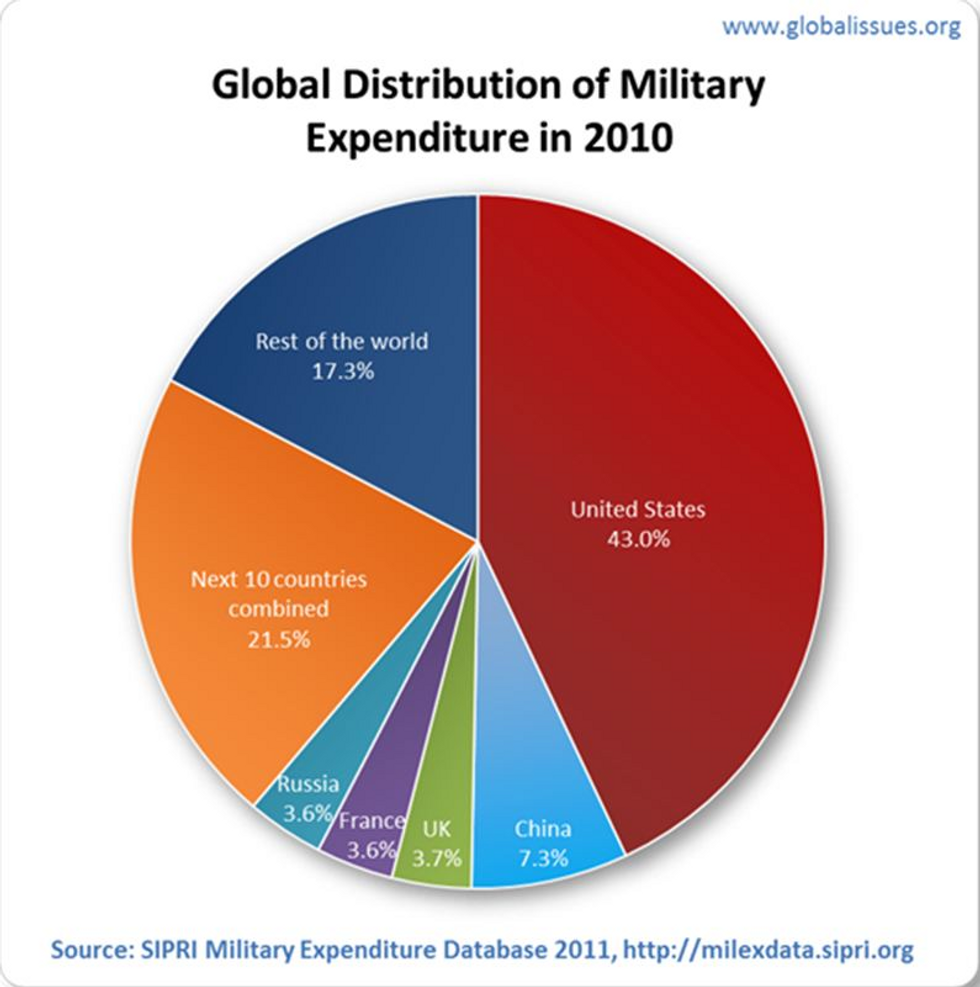
The United States accounts for approximately 43 percent of all global military expenditures. The world now spends, according to new data from the Stockholm International Peace Research Institute, more than $1.7 trillion on war and preparing to wage it. This total for 2011 marks a nearly $100 billion increase over 2010.
This news comes at a time of continued global economic uncertainty. Even more paradoxically, violence between states has become increasingly rare.
Some countries, of course, are bucking the trend. Military spending declined in Europe last year for the third year in a row. Europeans have quite sensibly applied their austerity measures to what matters least: militarism.
The rest of the world is being less sensible. Military spending is significantly rising in the Middle East and Africa and modestly growing in Latin America and Asia.
The United States stands at a historic crossroads. As the world's largest military spender, we can literally bite the bullet and follow through on the essential task of balancing the budget on the Pentagon's back. Toward this end, Sen. Tom Coburn - a conservative Oklahoma Republican - has proposed a $1 trillion cut in military spending over the next decade. There's bipartisan support for his plan.
Mitt Romney, by contrast, wants to increase military spending to 4 percent of the overall GDP. He'd like to add, among other things, 100,000 troops and 15 Navy warships. Over the next decade, his spending increases would amount to $2.5 trillion over the Pentagon's current projections. A nation could buy a lot of education and health care just with that projected increase.
At the moment, the Obama administration is seeking a middle path of reducing military spending largely by drawing down the war in Afghanistan and scrapping one or two obviously anachronistic weapons systems like the stealth F-22 Raptor, which costs $143 million a pop. Obama's approach, although less damaging than Romney's blueprint, doesn't go far enough to save our economy or our country. We need to reduce military spending at least as much as Eisenhower or Nixon did after the Korean and Vietnam wars. They trimmed the Pentagon's budget by 27 percent and 29 percent respectively.
The problem isn't just about the production of weapons and war machines. It's also about their sales. As they brace for some Pentagon cuts, U.S. military contractors hope to cover their losses by selling overseas, reinforcing the U.S. position as the world's No. 1 arms exporter. Just like Philip Morris, arms merchants are merchants of death. If they don't die in conflicts sustained by U.S. weapons, the victims die from inadequate health care, lack of food and potable water, unregulated environmental pollution, and all the other problems their governments should have been addressing instead of buying weapons.
On Tuesday, people in 40 countries and more than 100 cities around the world participated in the second annual Global Day of Action on Military Spending. One of the demands of the people who took part was to treat weapons just like cigarettes and tax them as a social ill. This new death tax could both reduce the arms trade and generate revenue for critical human needs.
After all these years of paying taxes to support war, it's time we used taxes to build peace. The stakes have never been higher. If we don't get global military spending under control, it will be the death of us all.
Military spending combines the two certainties in life: death and taxes. U.S. taxpayers are paying more than anyone else on Earth to support an industry devoted to death.
Tuesday, Tax Day, Americans were treated to the news that our nation has increased its overall spending on the military. In 2011, the United States spent approximately $740 billion on the military, an increase of more than $40 billion from the previous year, and this doesn't include parts of the intelligence, Homeland Security and State Department budgets devoted to military activities.
The United States accounts for approximately 43 percent of all global military expenditures. The world now spends, according to new data from the Stockholm International Peace Research Institute, more than $1.7 trillion on war and preparing to wage it. This total for 2011 marks a nearly $100 billion increase over 2010.
This news comes at a time of continued global economic uncertainty. Even more paradoxically, violence between states has become increasingly rare.
Some countries, of course, are bucking the trend. Military spending declined in Europe last year for the third year in a row. Europeans have quite sensibly applied their austerity measures to what matters least: militarism.
The rest of the world is being less sensible. Military spending is significantly rising in the Middle East and Africa and modestly growing in Latin America and Asia.
The United States stands at a historic crossroads. As the world's largest military spender, we can literally bite the bullet and follow through on the essential task of balancing the budget on the Pentagon's back. Toward this end, Sen. Tom Coburn - a conservative Oklahoma Republican - has proposed a $1 trillion cut in military spending over the next decade. There's bipartisan support for his plan.
Mitt Romney, by contrast, wants to increase military spending to 4 percent of the overall GDP. He'd like to add, among other things, 100,000 troops and 15 Navy warships. Over the next decade, his spending increases would amount to $2.5 trillion over the Pentagon's current projections. A nation could buy a lot of education and health care just with that projected increase.
At the moment, the Obama administration is seeking a middle path of reducing military spending largely by drawing down the war in Afghanistan and scrapping one or two obviously anachronistic weapons systems like the stealth F-22 Raptor, which costs $143 million a pop. Obama's approach, although less damaging than Romney's blueprint, doesn't go far enough to save our economy or our country. We need to reduce military spending at least as much as Eisenhower or Nixon did after the Korean and Vietnam wars. They trimmed the Pentagon's budget by 27 percent and 29 percent respectively.
The problem isn't just about the production of weapons and war machines. It's also about their sales. As they brace for some Pentagon cuts, U.S. military contractors hope to cover their losses by selling overseas, reinforcing the U.S. position as the world's No. 1 arms exporter. Just like Philip Morris, arms merchants are merchants of death. If they don't die in conflicts sustained by U.S. weapons, the victims die from inadequate health care, lack of food and potable water, unregulated environmental pollution, and all the other problems their governments should have been addressing instead of buying weapons.
On Tuesday, people in 40 countries and more than 100 cities around the world participated in the second annual Global Day of Action on Military Spending. One of the demands of the people who took part was to treat weapons just like cigarettes and tax them as a social ill. This new death tax could both reduce the arms trade and generate revenue for critical human needs.
After all these years of paying taxes to support war, it's time we used taxes to build peace. The stakes have never been higher. If we don't get global military spending under control, it will be the death of us all.
Military spending combines the two certainties in life: death and taxes. U.S. taxpayers are paying more than anyone else on Earth to support an industry devoted to death.
Tuesday, Tax Day, Americans were treated to the news that our nation has increased its overall spending on the military. In 2011, the United States spent approximately $740 billion on the military, an increase of more than $40 billion from the previous year, and this doesn't include parts of the intelligence, Homeland Security and State Department budgets devoted to military activities.
The United States accounts for approximately 43 percent of all global military expenditures. The world now spends, according to new data from the Stockholm International Peace Research Institute, more than $1.7 trillion on war and preparing to wage it. This total for 2011 marks a nearly $100 billion increase over 2010.
This news comes at a time of continued global economic uncertainty. Even more paradoxically, violence between states has become increasingly rare.
Some countries, of course, are bucking the trend. Military spending declined in Europe last year for the third year in a row. Europeans have quite sensibly applied their austerity measures to what matters least: militarism.
The rest of the world is being less sensible. Military spending is significantly rising in the Middle East and Africa and modestly growing in Latin America and Asia.
The United States stands at a historic crossroads. As the world's largest military spender, we can literally bite the bullet and follow through on the essential task of balancing the budget on the Pentagon's back. Toward this end, Sen. Tom Coburn - a conservative Oklahoma Republican - has proposed a $1 trillion cut in military spending over the next decade. There's bipartisan support for his plan.
Mitt Romney, by contrast, wants to increase military spending to 4 percent of the overall GDP. He'd like to add, among other things, 100,000 troops and 15 Navy warships. Over the next decade, his spending increases would amount to $2.5 trillion over the Pentagon's current projections. A nation could buy a lot of education and health care just with that projected increase.
At the moment, the Obama administration is seeking a middle path of reducing military spending largely by drawing down the war in Afghanistan and scrapping one or two obviously anachronistic weapons systems like the stealth F-22 Raptor, which costs $143 million a pop. Obama's approach, although less damaging than Romney's blueprint, doesn't go far enough to save our economy or our country. We need to reduce military spending at least as much as Eisenhower or Nixon did after the Korean and Vietnam wars. They trimmed the Pentagon's budget by 27 percent and 29 percent respectively.
The problem isn't just about the production of weapons and war machines. It's also about their sales. As they brace for some Pentagon cuts, U.S. military contractors hope to cover their losses by selling overseas, reinforcing the U.S. position as the world's No. 1 arms exporter. Just like Philip Morris, arms merchants are merchants of death. If they don't die in conflicts sustained by U.S. weapons, the victims die from inadequate health care, lack of food and potable water, unregulated environmental pollution, and all the other problems their governments should have been addressing instead of buying weapons.
On Tuesday, people in 40 countries and more than 100 cities around the world participated in the second annual Global Day of Action on Military Spending. One of the demands of the people who took part was to treat weapons just like cigarettes and tax them as a social ill. This new death tax could both reduce the arms trade and generate revenue for critical human needs.
After all these years of paying taxes to support war, it's time we used taxes to build peace. The stakes have never been higher. If we don't get global military spending under control, it will be the death of us all.