

The most important piece of news yesterday, this week, this month, and this year was a new set of statistics released yesterday by the Global Carbon Project. It showed that carbon emissions from our planet had increased 5.9 percent between 2009 and 2010. In fact, it was arguably among the most important pieces of data in the last, oh, three centuries, since according to the New York Times it represented "almost certainly the largest absolute jump in any year since the Industrial Revolution."
What it means, in climate terms, is that we've all but lost the battle to reduce the damage from global warming. The planet has already warmed about a degree Celsius; it's clearly going to go well past two degrees. It means, in political terms, that the fossil fuel industry has delayed effective action for the 12 years since the Kyoto treaty was signed. It means, in diplomatic terms, that the endless talks underway in Durban should be more important than ever--they should be the focus of a planetary population desperate to figure out how it's going to survive the century.
But instead, almost no one is paying attention to the proceedings, at least on this continent. One of our political parties has decided that global warming is a hoax--it's two leading candidates are busily apologizing for anything they said in the past that might possibly have been construed as backing, you know, science. President Obama hasn't yet spoken on the Durban talks, and informed international observers like Joss Garman are beginning to despair that he ever will.
Who are the 99%? In this country, they're those of us who aren't making any of these deadly decisions. In this world, they're the vast majority of people who didn't contribute to those soaring emissions. In this biosphere they're every other species now living on a disorienting earth.
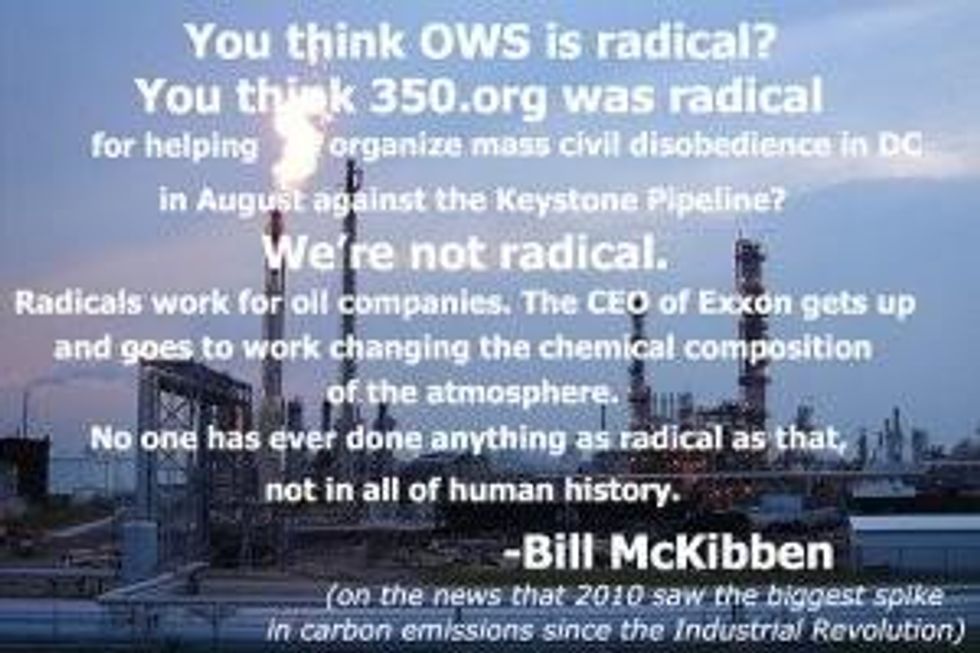
You think OWS is radical? You think 350.org was radical for helping organize mass civil disobedience in DC in August against the Keystone Pipeline? We're not radical. Radicals work for oil companies. The CEO of Exxon gets up every morning and goes to work changing the chemical composition of the atmosphere. No one has ever done anything as radical as that, not in all of human history. And he and his ilk spend heavily on campaigns to make sure no one stops them--the US Chamber of Commerce gave more money than the DNC and the RNC last cycle, and 94% of it went to climate deniers.
Corporate power has occupied the atmosphere. 2011 showed we could fight back. 2012 would be a good year to step up the pressure. Because this time next year the Global Carbon Project will release another number. And I'm betting it will be grim.
The most important piece of news yesterday, this week, this month, and this year was a new set of statistics released yesterday by the Global Carbon Project. It showed that carbon emissions from our planet had increased 5.9 percent between 2009 and 2010. In fact, it was arguably among the most important pieces of data in the last, oh, three centuries, since according to the New York Times it represented "almost certainly the largest absolute jump in any year since the Industrial Revolution."
What it means, in climate terms, is that we've all but lost the battle to reduce the damage from global warming. The planet has already warmed about a degree Celsius; it's clearly going to go well past two degrees. It means, in political terms, that the fossil fuel industry has delayed effective action for the 12 years since the Kyoto treaty was signed. It means, in diplomatic terms, that the endless talks underway in Durban should be more important than ever--they should be the focus of a planetary population desperate to figure out how it's going to survive the century.
But instead, almost no one is paying attention to the proceedings, at least on this continent. One of our political parties has decided that global warming is a hoax--it's two leading candidates are busily apologizing for anything they said in the past that might possibly have been construed as backing, you know, science. President Obama hasn't yet spoken on the Durban talks, and informed international observers like Joss Garman are beginning to despair that he ever will.
Who are the 99%? In this country, they're those of us who aren't making any of these deadly decisions. In this world, they're the vast majority of people who didn't contribute to those soaring emissions. In this biosphere they're every other species now living on a disorienting earth.
You think OWS is radical? You think 350.org was radical for helping organize mass civil disobedience in DC in August against the Keystone Pipeline? We're not radical. Radicals work for oil companies. The CEO of Exxon gets up every morning and goes to work changing the chemical composition of the atmosphere. No one has ever done anything as radical as that, not in all of human history. And he and his ilk spend heavily on campaigns to make sure no one stops them--the US Chamber of Commerce gave more money than the DNC and the RNC last cycle, and 94% of it went to climate deniers.
Corporate power has occupied the atmosphere. 2011 showed we could fight back. 2012 would be a good year to step up the pressure. Because this time next year the Global Carbon Project will release another number. And I'm betting it will be grim.
The most important piece of news yesterday, this week, this month, and this year was a new set of statistics released yesterday by the Global Carbon Project. It showed that carbon emissions from our planet had increased 5.9 percent between 2009 and 2010. In fact, it was arguably among the most important pieces of data in the last, oh, three centuries, since according to the New York Times it represented "almost certainly the largest absolute jump in any year since the Industrial Revolution."
What it means, in climate terms, is that we've all but lost the battle to reduce the damage from global warming. The planet has already warmed about a degree Celsius; it's clearly going to go well past two degrees. It means, in political terms, that the fossil fuel industry has delayed effective action for the 12 years since the Kyoto treaty was signed. It means, in diplomatic terms, that the endless talks underway in Durban should be more important than ever--they should be the focus of a planetary population desperate to figure out how it's going to survive the century.
But instead, almost no one is paying attention to the proceedings, at least on this continent. One of our political parties has decided that global warming is a hoax--it's two leading candidates are busily apologizing for anything they said in the past that might possibly have been construed as backing, you know, science. President Obama hasn't yet spoken on the Durban talks, and informed international observers like Joss Garman are beginning to despair that he ever will.
Who are the 99%? In this country, they're those of us who aren't making any of these deadly decisions. In this world, they're the vast majority of people who didn't contribute to those soaring emissions. In this biosphere they're every other species now living on a disorienting earth.
You think OWS is radical? You think 350.org was radical for helping organize mass civil disobedience in DC in August against the Keystone Pipeline? We're not radical. Radicals work for oil companies. The CEO of Exxon gets up every morning and goes to work changing the chemical composition of the atmosphere. No one has ever done anything as radical as that, not in all of human history. And he and his ilk spend heavily on campaigns to make sure no one stops them--the US Chamber of Commerce gave more money than the DNC and the RNC last cycle, and 94% of it went to climate deniers.
Corporate power has occupied the atmosphere. 2011 showed we could fight back. 2012 would be a good year to step up the pressure. Because this time next year the Global Carbon Project will release another number. And I'm betting it will be grim.