SUBSCRIBE TO OUR FREE NEWSLETTER
Daily news & progressive opinion—funded by the people, not the corporations—delivered straight to your inbox.
5
#000000
#FFFFFF
To donate by check, phone, or other method, see our More Ways to Give page.
Let's face it, a decade spent fighting a war in Iraq that had no cause - at least no just cause - and a war in Afghanistan that appears to have no end, made a lot of people think it inevitable that the U.S. would reconsider its interventionist approach to the rest of the world. The optimists among us considered these disasters so blatant that even the country's foreign policy-makers would have to learn something from them. And even pessimists figured that the current economic situation just wouldn't allow us to go on playing cops to the entire world. But no. Oh, there'll be change, all right: If you're tired of the War on Terror, they've got a new one lined up for you - President Obama has announced plans to station 2,500 U.S. Marines in Darwin, Australia.
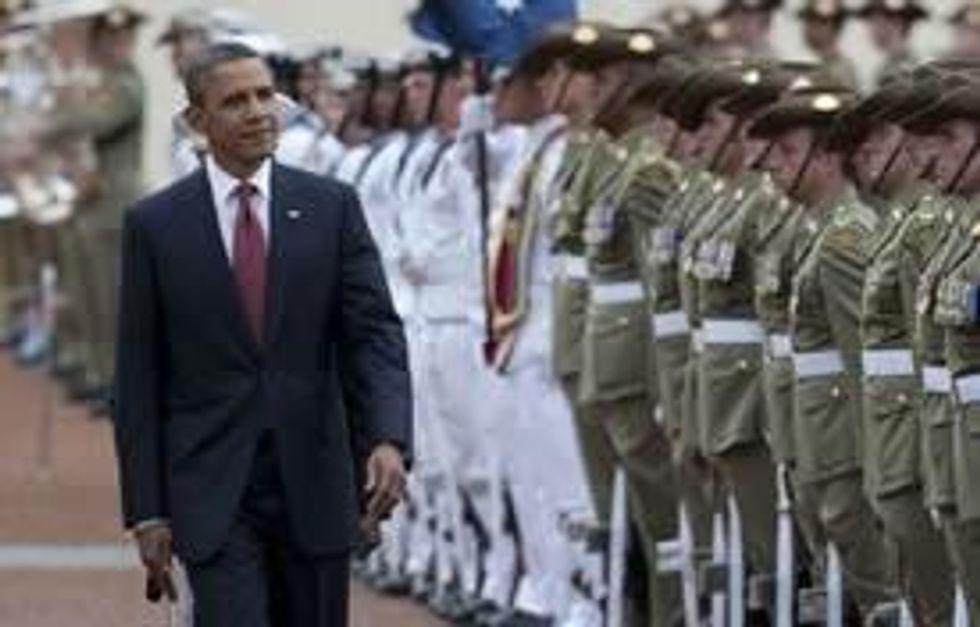
With his Republican challengers going on about not letting "China run all over us," Obama got himself right to the front of the parade, countering the Chinese invasion of American markets with cheap goods by deploying the largest number of American troops seen in Australia since General Douglas MacArthur bunked there during World War II. And if the meaning of this is not immediately obvious back home, it is elsewhere: the Irish national news service, RTE, wrote: "The move may be seen by Beijing as further evidence of Washington's attempt to encircle China, with US bases in Japan and Korea and now troops in Australia."
And then, besides the Republicans, there's the military. As the events that led to last year's dismissal of General Stanley McChrystal from his Afghanistan command again showed, a Democratic President always worries about having his legs cut out from under him by a Pentagon implying that he's "soft" on defense. But, now - well you just know that opening up a China front is the best Christmas present a Pentagon procurement agent could imagine. We're bound to need some snazzy new equipment to face the challenges of switching focus from the Middle East to the Pacific.
Yet while all of this passes for smart in the center ring of American politics, Obama appears to again run the risk of undermining his own base by giving them more of the same old same old. A Pew Research poll earlier this month asked citizens of the U.S., Germany, Spain, the United Kingdom and France whether they agreed with the statement "our people are not perfect, but our culture is superior." You may be happy to know that only a minority concurred in any of the five countries, although, at 49 percent, it was a close question in the U.S. And what's relevant here is the generation gap the poll uncovered in this country. In all five nations, it was respondents older than 50 who were most likely to see greatness in faces of their countrymen - 60 percent of the age group saw things that way in the U.S. But nowhere else did the difference between the oldsters and the 18-29 year-olds match the 23 point gap found in the U.S. It seems that something really is changing here.
Much of the American public tolerance for our continual military presence and armed actions around the globe has come from just the sort of presumption the poll measured, that is, a feeling that the U.S. must be right when it gets into it with another country - even if we don't understand exactly why - because in the end America is the envy of the world and we wouldn't be that if we weren't doing things right. But the Pew report is just the latest reminder that a President so famously dependent upon mobilizing a youth base beyond its usual activity level may be skating on thin ice in opting to soldier on with bellicose foreign policy moves. Like many a President before him, in going with the Pentagon flow he hopes to neutralize his opposition while calculating that his base has nowhere else to go. But he could ultimately find that on election day many of them go nowhere at all. They may give him credit for audacity in sending the Marines to Australia, but it may not be the kind of audacity they were hoping for.
In the end, though, the matter of whose political advantage this move plays out to is quite secondary. More importantly, it should remind us that no matter how absurd - or dangerous American foreign policy may get, it doesn't change without voices calling for it far more loudly than those we hear today.
Let's face it, a decade spent fighting a war in Iraq that had no cause - at least no just cause - and a war in Afghanistan that appears to have no end, made a lot of people think it inevitable that the U.S. would reconsider its interventionist approach to the rest of the world. The optimists among us considered these disasters so blatant that even the country's foreign policy-makers would have to learn something from them. And even pessimists figured that the current economic situation just wouldn't allow us to go on playing cops to the entire world. But no. Oh, there'll be change, all right: If you're tired of the War on Terror, they've got a new one lined up for you - President Obama has announced plans to station 2,500 U.S. Marines in Darwin, Australia.
With his Republican challengers going on about not letting "China run all over us," Obama got himself right to the front of the parade, countering the Chinese invasion of American markets with cheap goods by deploying the largest number of American troops seen in Australia since General Douglas MacArthur bunked there during World War II. And if the meaning of this is not immediately obvious back home, it is elsewhere: the Irish national news service, RTE, wrote: "The move may be seen by Beijing as further evidence of Washington's attempt to encircle China, with US bases in Japan and Korea and now troops in Australia."
And then, besides the Republicans, there's the military. As the events that led to last year's dismissal of General Stanley McChrystal from his Afghanistan command again showed, a Democratic President always worries about having his legs cut out from under him by a Pentagon implying that he's "soft" on defense. But, now - well you just know that opening up a China front is the best Christmas present a Pentagon procurement agent could imagine. We're bound to need some snazzy new equipment to face the challenges of switching focus from the Middle East to the Pacific.
Yet while all of this passes for smart in the center ring of American politics, Obama appears to again run the risk of undermining his own base by giving them more of the same old same old. A Pew Research poll earlier this month asked citizens of the U.S., Germany, Spain, the United Kingdom and France whether they agreed with the statement "our people are not perfect, but our culture is superior." You may be happy to know that only a minority concurred in any of the five countries, although, at 49 percent, it was a close question in the U.S. And what's relevant here is the generation gap the poll uncovered in this country. In all five nations, it was respondents older than 50 who were most likely to see greatness in faces of their countrymen - 60 percent of the age group saw things that way in the U.S. But nowhere else did the difference between the oldsters and the 18-29 year-olds match the 23 point gap found in the U.S. It seems that something really is changing here.
Much of the American public tolerance for our continual military presence and armed actions around the globe has come from just the sort of presumption the poll measured, that is, a feeling that the U.S. must be right when it gets into it with another country - even if we don't understand exactly why - because in the end America is the envy of the world and we wouldn't be that if we weren't doing things right. But the Pew report is just the latest reminder that a President so famously dependent upon mobilizing a youth base beyond its usual activity level may be skating on thin ice in opting to soldier on with bellicose foreign policy moves. Like many a President before him, in going with the Pentagon flow he hopes to neutralize his opposition while calculating that his base has nowhere else to go. But he could ultimately find that on election day many of them go nowhere at all. They may give him credit for audacity in sending the Marines to Australia, but it may not be the kind of audacity they were hoping for.
In the end, though, the matter of whose political advantage this move plays out to is quite secondary. More importantly, it should remind us that no matter how absurd - or dangerous American foreign policy may get, it doesn't change without voices calling for it far more loudly than those we hear today.
Let's face it, a decade spent fighting a war in Iraq that had no cause - at least no just cause - and a war in Afghanistan that appears to have no end, made a lot of people think it inevitable that the U.S. would reconsider its interventionist approach to the rest of the world. The optimists among us considered these disasters so blatant that even the country's foreign policy-makers would have to learn something from them. And even pessimists figured that the current economic situation just wouldn't allow us to go on playing cops to the entire world. But no. Oh, there'll be change, all right: If you're tired of the War on Terror, they've got a new one lined up for you - President Obama has announced plans to station 2,500 U.S. Marines in Darwin, Australia.
With his Republican challengers going on about not letting "China run all over us," Obama got himself right to the front of the parade, countering the Chinese invasion of American markets with cheap goods by deploying the largest number of American troops seen in Australia since General Douglas MacArthur bunked there during World War II. And if the meaning of this is not immediately obvious back home, it is elsewhere: the Irish national news service, RTE, wrote: "The move may be seen by Beijing as further evidence of Washington's attempt to encircle China, with US bases in Japan and Korea and now troops in Australia."
And then, besides the Republicans, there's the military. As the events that led to last year's dismissal of General Stanley McChrystal from his Afghanistan command again showed, a Democratic President always worries about having his legs cut out from under him by a Pentagon implying that he's "soft" on defense. But, now - well you just know that opening up a China front is the best Christmas present a Pentagon procurement agent could imagine. We're bound to need some snazzy new equipment to face the challenges of switching focus from the Middle East to the Pacific.
Yet while all of this passes for smart in the center ring of American politics, Obama appears to again run the risk of undermining his own base by giving them more of the same old same old. A Pew Research poll earlier this month asked citizens of the U.S., Germany, Spain, the United Kingdom and France whether they agreed with the statement "our people are not perfect, but our culture is superior." You may be happy to know that only a minority concurred in any of the five countries, although, at 49 percent, it was a close question in the U.S. And what's relevant here is the generation gap the poll uncovered in this country. In all five nations, it was respondents older than 50 who were most likely to see greatness in faces of their countrymen - 60 percent of the age group saw things that way in the U.S. But nowhere else did the difference between the oldsters and the 18-29 year-olds match the 23 point gap found in the U.S. It seems that something really is changing here.
Much of the American public tolerance for our continual military presence and armed actions around the globe has come from just the sort of presumption the poll measured, that is, a feeling that the U.S. must be right when it gets into it with another country - even if we don't understand exactly why - because in the end America is the envy of the world and we wouldn't be that if we weren't doing things right. But the Pew report is just the latest reminder that a President so famously dependent upon mobilizing a youth base beyond its usual activity level may be skating on thin ice in opting to soldier on with bellicose foreign policy moves. Like many a President before him, in going with the Pentagon flow he hopes to neutralize his opposition while calculating that his base has nowhere else to go. But he could ultimately find that on election day many of them go nowhere at all. They may give him credit for audacity in sending the Marines to Australia, but it may not be the kind of audacity they were hoping for.
In the end, though, the matter of whose political advantage this move plays out to is quite secondary. More importantly, it should remind us that no matter how absurd - or dangerous American foreign policy may get, it doesn't change without voices calling for it far more loudly than those we hear today.