
I'm not the only one unhappy with economic systems based on constant growth and endlessly increasing exploitation of finite resources -- systems that concentrate wealth in the hands of a few while so many people struggle.
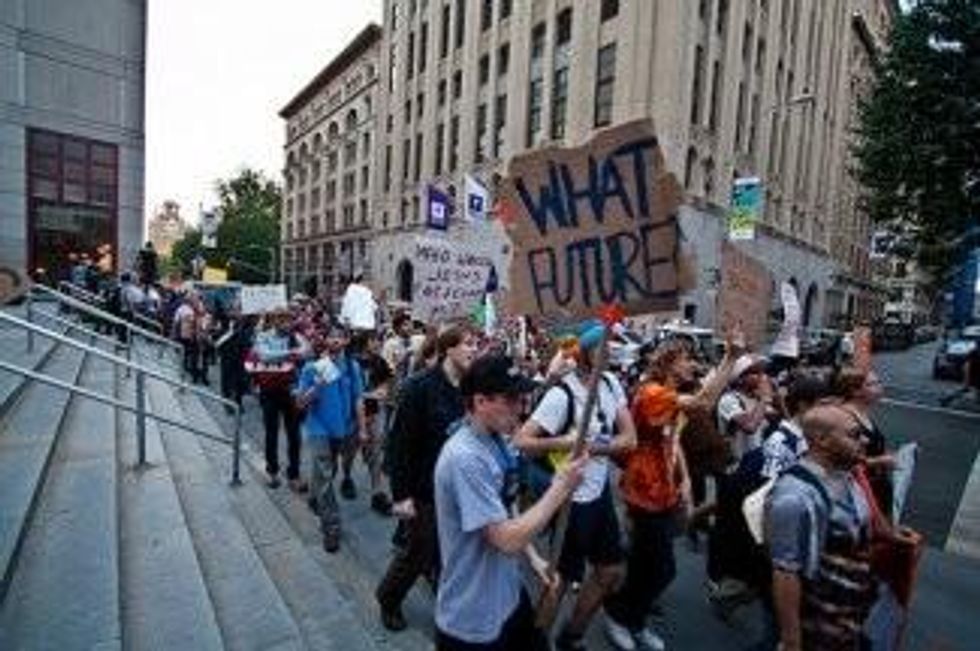
Since September 17, protests have spread from New York to a growing number of cities across the United States, Europe, and Canada, in a movement dubbed "Occupy Wall Street." The protesters' aims aren't always clear; in some case they seem downright incoherent or absurd -- such as calls for open border policies and increased trade tariffs at the same time.
It's interesting that those credited with spurring the movement did so with a single question: "What is our one demand?" The question was first posed in my hometown of Vancouver by Adbusters magazine. Editor Kalle Lasn said the campaign was launched as an invitation to act more than an attempt to get an answer. Focusing on a single demand may or may not be a useful exercise, but the conversation itself is necessary. Thanks to the attention these protests are generating, union leaders, students, workers, and others have a public forum to raise questions about our current economic systems.
Why have governments spent trillions of dollars in taxpayers' money to bail out financial institutions, many of which fought any notion of government regulation or social assistance, while doing nothing for people who had life savings wiped out or lost homes through foreclosure? And why have governments not at least demanded that the institutions demonstrate some ecological and social responsibility in return?
Why do developed nations still give tax breaks to the wealthiest few while children go hungry and working people and the unemployed see wages, benefits, and opportunities dwindle -- and while infrastructure crumbles and access to good health care and education diminishes?
Why are we rapidly exploiting finite resources and destroying precious natural systems for the sake of short-term profit and unsustainable economic growth? What will we do when oil runs out or becomes too difficult or expensive to extract if we haven't taken the time to reduce our demands for energy and shift to cleaner sources?
Why does our economic system place a higher value on disposable and often unnecessary goods and services than on the things we really need to survive and be healthy, like clean air, clean water, and productive soil? Sure, there's some contradiction in protesters carrying iPhones while railing against the consumer system. But this is not just about making personal changes and sacrifices; it's about questioning our place on this planet.
In less than a century, the human population has grown exponentially, from 1.5 to seven billion. That's been matched by rapid growth in technology and products, resource exploitation, and knowledge. The pace and manner of development have led to a reliance on fossil fuels, to the extent that much of our infrastructure supports products such as cars and their fuels to keep the cycle of profits and wealth concentration going. Our current economic systems are relatively new -- methods we've devised both to deal with the challenge of production and distribution for rapidly expanding populations and to exploit the opportunities.
It may seem like there's no hope for change, but we have to remember that most of these developments are recent, and that humans are capable of innovation, creativity, and foresight. Despite considerable opposition, most countries recognized at some point that abolishing slavery had goals that transcended economic considerations, such as enhancing human rights and dignity -- and it didn't destroy the economy in the end, as supporters of slavery feared.
I don't know if the Occupy Wall Street protests will lead to anything. Surely there will be backlash. And although I wouldn't compare these protests to those taking place in the Middle East, they all show that when people have had enough of inequality, of the negative and destructive consequences of decisions made by people in power, we have a responsibility to come together and speak out.
The course of human history is constantly changing. It's up to all of us to join the conversation to help steer it to a better path than the one we are on. Maybe our one demand should be of ourselves: Care enough to do something.
Written with contributions from Ian Hanington, David Suzuki Foundation editorial and communications specialist
I'm not the only one unhappy with economic systems based on constant growth and endlessly increasing exploitation of finite resources -- systems that concentrate wealth in the hands of a few while so many people struggle.
Since September 17, protests have spread from New York to a growing number of cities across the United States, Europe, and Canada, in a movement dubbed "Occupy Wall Street." The protesters' aims aren't always clear; in some case they seem downright incoherent or absurd -- such as calls for open border policies and increased trade tariffs at the same time.
It's interesting that those credited with spurring the movement did so with a single question: "What is our one demand?" The question was first posed in my hometown of Vancouver by Adbusters magazine. Editor Kalle Lasn said the campaign was launched as an invitation to act more than an attempt to get an answer. Focusing on a single demand may or may not be a useful exercise, but the conversation itself is necessary. Thanks to the attention these protests are generating, union leaders, students, workers, and others have a public forum to raise questions about our current economic systems.
Why have governments spent trillions of dollars in taxpayers' money to bail out financial institutions, many of which fought any notion of government regulation or social assistance, while doing nothing for people who had life savings wiped out or lost homes through foreclosure? And why have governments not at least demanded that the institutions demonstrate some ecological and social responsibility in return?
Why do developed nations still give tax breaks to the wealthiest few while children go hungry and working people and the unemployed see wages, benefits, and opportunities dwindle -- and while infrastructure crumbles and access to good health care and education diminishes?
Why are we rapidly exploiting finite resources and destroying precious natural systems for the sake of short-term profit and unsustainable economic growth? What will we do when oil runs out or becomes too difficult or expensive to extract if we haven't taken the time to reduce our demands for energy and shift to cleaner sources?
Why does our economic system place a higher value on disposable and often unnecessary goods and services than on the things we really need to survive and be healthy, like clean air, clean water, and productive soil? Sure, there's some contradiction in protesters carrying iPhones while railing against the consumer system. But this is not just about making personal changes and sacrifices; it's about questioning our place on this planet.
In less than a century, the human population has grown exponentially, from 1.5 to seven billion. That's been matched by rapid growth in technology and products, resource exploitation, and knowledge. The pace and manner of development have led to a reliance on fossil fuels, to the extent that much of our infrastructure supports products such as cars and their fuels to keep the cycle of profits and wealth concentration going. Our current economic systems are relatively new -- methods we've devised both to deal with the challenge of production and distribution for rapidly expanding populations and to exploit the opportunities.
It may seem like there's no hope for change, but we have to remember that most of these developments are recent, and that humans are capable of innovation, creativity, and foresight. Despite considerable opposition, most countries recognized at some point that abolishing slavery had goals that transcended economic considerations, such as enhancing human rights and dignity -- and it didn't destroy the economy in the end, as supporters of slavery feared.
I don't know if the Occupy Wall Street protests will lead to anything. Surely there will be backlash. And although I wouldn't compare these protests to those taking place in the Middle East, they all show that when people have had enough of inequality, of the negative and destructive consequences of decisions made by people in power, we have a responsibility to come together and speak out.
The course of human history is constantly changing. It's up to all of us to join the conversation to help steer it to a better path than the one we are on. Maybe our one demand should be of ourselves: Care enough to do something.
Written with contributions from Ian Hanington, David Suzuki Foundation editorial and communications specialist
I'm not the only one unhappy with economic systems based on constant growth and endlessly increasing exploitation of finite resources -- systems that concentrate wealth in the hands of a few while so many people struggle.
Since September 17, protests have spread from New York to a growing number of cities across the United States, Europe, and Canada, in a movement dubbed "Occupy Wall Street." The protesters' aims aren't always clear; in some case they seem downright incoherent or absurd -- such as calls for open border policies and increased trade tariffs at the same time.
It's interesting that those credited with spurring the movement did so with a single question: "What is our one demand?" The question was first posed in my hometown of Vancouver by Adbusters magazine. Editor Kalle Lasn said the campaign was launched as an invitation to act more than an attempt to get an answer. Focusing on a single demand may or may not be a useful exercise, but the conversation itself is necessary. Thanks to the attention these protests are generating, union leaders, students, workers, and others have a public forum to raise questions about our current economic systems.
Why have governments spent trillions of dollars in taxpayers' money to bail out financial institutions, many of which fought any notion of government regulation or social assistance, while doing nothing for people who had life savings wiped out or lost homes through foreclosure? And why have governments not at least demanded that the institutions demonstrate some ecological and social responsibility in return?
Why do developed nations still give tax breaks to the wealthiest few while children go hungry and working people and the unemployed see wages, benefits, and opportunities dwindle -- and while infrastructure crumbles and access to good health care and education diminishes?
Why are we rapidly exploiting finite resources and destroying precious natural systems for the sake of short-term profit and unsustainable economic growth? What will we do when oil runs out or becomes too difficult or expensive to extract if we haven't taken the time to reduce our demands for energy and shift to cleaner sources?
Why does our economic system place a higher value on disposable and often unnecessary goods and services than on the things we really need to survive and be healthy, like clean air, clean water, and productive soil? Sure, there's some contradiction in protesters carrying iPhones while railing against the consumer system. But this is not just about making personal changes and sacrifices; it's about questioning our place on this planet.
In less than a century, the human population has grown exponentially, from 1.5 to seven billion. That's been matched by rapid growth in technology and products, resource exploitation, and knowledge. The pace and manner of development have led to a reliance on fossil fuels, to the extent that much of our infrastructure supports products such as cars and their fuels to keep the cycle of profits and wealth concentration going. Our current economic systems are relatively new -- methods we've devised both to deal with the challenge of production and distribution for rapidly expanding populations and to exploit the opportunities.
It may seem like there's no hope for change, but we have to remember that most of these developments are recent, and that humans are capable of innovation, creativity, and foresight. Despite considerable opposition, most countries recognized at some point that abolishing slavery had goals that transcended economic considerations, such as enhancing human rights and dignity -- and it didn't destroy the economy in the end, as supporters of slavery feared.
I don't know if the Occupy Wall Street protests will lead to anything. Surely there will be backlash. And although I wouldn't compare these protests to those taking place in the Middle East, they all show that when people have had enough of inequality, of the negative and destructive consequences of decisions made by people in power, we have a responsibility to come together and speak out.
The course of human history is constantly changing. It's up to all of us to join the conversation to help steer it to a better path than the one we are on. Maybe our one demand should be of ourselves: Care enough to do something.
Written with contributions from Ian Hanington, David Suzuki Foundation editorial and communications specialist