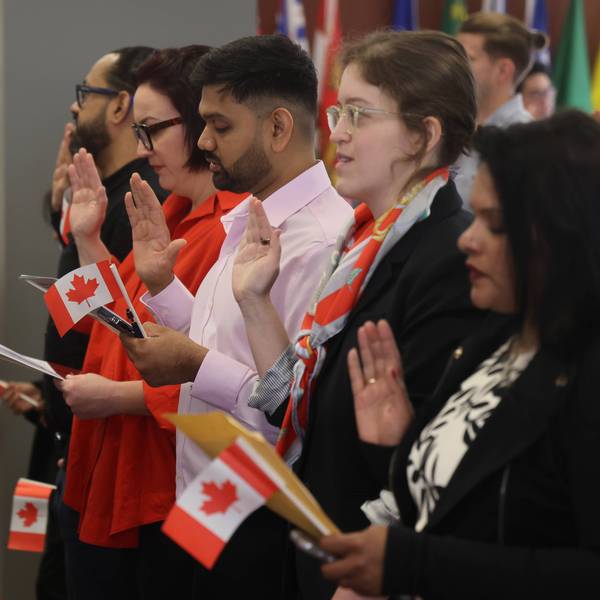

Journey of a Citizen
Too much awareness is a tough burden to carry. I got an email the other day from a reader who opened up the deep, confusing paradox of being a citizen of the American empire.
"I read that 51 percent of our Federal taxes go to feed the war machine. The fear of the IRS overwhelms the shame I feel, for paying those dollars that go to kill people. Mixing all of the emotions: hypocrisy, shame, guilt, fear, anger, all together equal for me a sense of futility and hopelessness.
Too much awareness is a tough burden to carry. I got an email the other day from a reader who opened up the deep, confusing paradox of being a citizen of the American empire.
"I read that 51 percent of our Federal taxes go to feed the war machine. The fear of the IRS overwhelms the shame I feel, for paying those dollars that go to kill people. Mixing all of the emotions: hypocrisy, shame, guilt, fear, anger, all together equal for me a sense of futility and hopelessness.
"I cannot even point the finger at the biggest killers, when I know that I am part of the problem and am too scared to do anything about it. How can I judge them, when I have blood on my hands also?"
It just so happens this email arrived the same day I sat and talked for an hour with Paul Rogat Loeb, author of the recently updated and re-released Soul of a Citizen, the definitive book on social and political activism -- on stepping out of safety and beyond our fear and anger, indeed, beyond all the emotions listed above, and giving public meaning to one's life.
There's nothing simple or "guaranteed" about taking this step, or any of the steps thereafter, on the journey called Making a Difference.
Loeb's book tells innumerable stories of people who have taken courageous stands, who have worked, often with little recognition and even less hope of success, for extraordinary change . . . and have achieved it. But the point of the stories isn't to hoist anyone onto a pedestal. Every word of Soul is directed at you and me, or rather, at the soul of the citizen within each of us.
Loeb draws a link between the "celebrity activists" of days past, the ones whose names have entered history -- Gandhi, Mandela, Tutu, King, the Dalai Lama, Rosa Parks -- and Everyman and Everywoman: shy (perhaps), despairing, quietly outraged, uncertain, sitting on the sidelines. He does so by demythologizing the history makers. Profound change doesn't flow from Greatness; it inches forward incrementally, resulting from the humble efforts of ordinary people.
"The book's core message puts responsibility back on our shoulders," Loeb said.
For instance, the actual Rosa Parks story, with which he leads off the book, is compelling in that regard. Parks is usually described, simply, as a woman whose feet were tired, who in a moment of divine anger and courage refused to give up her seat on a Montgomery bus and in so doing became the mother of the civil rights movement. In point of fact, by the time Parks took her stand -- by remaining seated -- in December 1955, she'd already been involved with her local NAACP chapter for a dozen years, and had recently spent 10 days at a civil rights and labor training session at the Highlander School in Tennessee. When she refused to give up her seat on the bus, she knew exactly what she was doing, and she knew the time for doing it was ripe.
"In short," Loeb writes, "Parks' decision didn't come out of nowhere. Nor did she single-handedly give birth to the civil rights movement. Rather, she was part of a longstanding effort to create change, when success was far from certain and setbacks were routine."
He adds that "Parks' first step toward involvement -- attending a local NAACP meeting -- was as critical to altering history as her famed stand on the bus."
The point being: Take the small step! Move, however clumsily it may seem, in a direction that speaks to your awareness. Something will happen. The deeper point Loeb is making is that the journey that begins with that first step into public life, that first tentative fusion of private awareness and collective effort, is an end in itself. Hope is realized not merely in some ultimate, headline-grabbing victory, but in each small step along the way.
"Hope," Loeb said, quoting Sojourners founder Jim Wallis, "is believing in spite of the evidence -- and watching the evidence change."
Activism is about building the future. Consider, Loeb asks us, the artisans who built the great medieval cathedrals of Europe, "working generation after generation on projects whose completion few would live to see."
I'd say it's like that, but more complex: building peace, building environmental sustainability, building justice and fairness. These "cathedrals" are far too big, and they have no royal architect, let alone a royal blessing. But we must start, or continue, despite what we know: that the work is daunting, and will never quite be finished.
The joy is in the journey. This is what it means to be a citizen.
An Urgent Message From Our Co-Founder
Dear Common Dreams reader, It’s been nearly 30 years since I co-founded Common Dreams with my late wife, Lina Newhouser. We had the radical notion that journalism should serve the public good, not corporate profits. It was clear to us from the outset what it would take to build such a project. No paid advertisements. No corporate sponsors. No millionaire publisher telling us what to think or do. Many people said we wouldn't last a year, but we proved those doubters wrong. Together with a tremendous team of journalists and dedicated staff, we built an independent media outlet free from the constraints of profits and corporate control. Our mission has always been simple: To inform. To inspire. To ignite change for the common good. Building Common Dreams was not easy. Our survival was never guaranteed. When you take on the most powerful forces—Wall Street greed, fossil fuel industry destruction, Big Tech lobbyists, and uber-rich oligarchs who have spent billions upon billions rigging the economy and democracy in their favor—the only bulwark you have is supporters who believe in your work. But here’s the urgent message from me today. It's never been this bad out there. And it's never been this hard to keep us going. At the very moment Common Dreams is most needed, the threats we face are intensifying. We need your support now more than ever. We don't accept corporate advertising and never will. We don't have a paywall because we don't think people should be blocked from critical news based on their ability to pay. Everything we do is funded by the donations of readers like you. When everyone does the little they can afford, we are strong. But if that support retreats or dries up, so do we. Will you donate now to make sure Common Dreams not only survives but thrives? —Craig Brown, Co-founder |
Too much awareness is a tough burden to carry. I got an email the other day from a reader who opened up the deep, confusing paradox of being a citizen of the American empire.
"I read that 51 percent of our Federal taxes go to feed the war machine. The fear of the IRS overwhelms the shame I feel, for paying those dollars that go to kill people. Mixing all of the emotions: hypocrisy, shame, guilt, fear, anger, all together equal for me a sense of futility and hopelessness.
"I cannot even point the finger at the biggest killers, when I know that I am part of the problem and am too scared to do anything about it. How can I judge them, when I have blood on my hands also?"
It just so happens this email arrived the same day I sat and talked for an hour with Paul Rogat Loeb, author of the recently updated and re-released Soul of a Citizen, the definitive book on social and political activism -- on stepping out of safety and beyond our fear and anger, indeed, beyond all the emotions listed above, and giving public meaning to one's life.
There's nothing simple or "guaranteed" about taking this step, or any of the steps thereafter, on the journey called Making a Difference.
Loeb's book tells innumerable stories of people who have taken courageous stands, who have worked, often with little recognition and even less hope of success, for extraordinary change . . . and have achieved it. But the point of the stories isn't to hoist anyone onto a pedestal. Every word of Soul is directed at you and me, or rather, at the soul of the citizen within each of us.
Loeb draws a link between the "celebrity activists" of days past, the ones whose names have entered history -- Gandhi, Mandela, Tutu, King, the Dalai Lama, Rosa Parks -- and Everyman and Everywoman: shy (perhaps), despairing, quietly outraged, uncertain, sitting on the sidelines. He does so by demythologizing the history makers. Profound change doesn't flow from Greatness; it inches forward incrementally, resulting from the humble efforts of ordinary people.
"The book's core message puts responsibility back on our shoulders," Loeb said.
For instance, the actual Rosa Parks story, with which he leads off the book, is compelling in that regard. Parks is usually described, simply, as a woman whose feet were tired, who in a moment of divine anger and courage refused to give up her seat on a Montgomery bus and in so doing became the mother of the civil rights movement. In point of fact, by the time Parks took her stand -- by remaining seated -- in December 1955, she'd already been involved with her local NAACP chapter for a dozen years, and had recently spent 10 days at a civil rights and labor training session at the Highlander School in Tennessee. When she refused to give up her seat on the bus, she knew exactly what she was doing, and she knew the time for doing it was ripe.
"In short," Loeb writes, "Parks' decision didn't come out of nowhere. Nor did she single-handedly give birth to the civil rights movement. Rather, she was part of a longstanding effort to create change, when success was far from certain and setbacks were routine."
He adds that "Parks' first step toward involvement -- attending a local NAACP meeting -- was as critical to altering history as her famed stand on the bus."
The point being: Take the small step! Move, however clumsily it may seem, in a direction that speaks to your awareness. Something will happen. The deeper point Loeb is making is that the journey that begins with that first step into public life, that first tentative fusion of private awareness and collective effort, is an end in itself. Hope is realized not merely in some ultimate, headline-grabbing victory, but in each small step along the way.
"Hope," Loeb said, quoting Sojourners founder Jim Wallis, "is believing in spite of the evidence -- and watching the evidence change."
Activism is about building the future. Consider, Loeb asks us, the artisans who built the great medieval cathedrals of Europe, "working generation after generation on projects whose completion few would live to see."
I'd say it's like that, but more complex: building peace, building environmental sustainability, building justice and fairness. These "cathedrals" are far too big, and they have no royal architect, let alone a royal blessing. But we must start, or continue, despite what we know: that the work is daunting, and will never quite be finished.
The joy is in the journey. This is what it means to be a citizen.
Too much awareness is a tough burden to carry. I got an email the other day from a reader who opened up the deep, confusing paradox of being a citizen of the American empire.
"I read that 51 percent of our Federal taxes go to feed the war machine. The fear of the IRS overwhelms the shame I feel, for paying those dollars that go to kill people. Mixing all of the emotions: hypocrisy, shame, guilt, fear, anger, all together equal for me a sense of futility and hopelessness.
"I cannot even point the finger at the biggest killers, when I know that I am part of the problem and am too scared to do anything about it. How can I judge them, when I have blood on my hands also?"
It just so happens this email arrived the same day I sat and talked for an hour with Paul Rogat Loeb, author of the recently updated and re-released Soul of a Citizen, the definitive book on social and political activism -- on stepping out of safety and beyond our fear and anger, indeed, beyond all the emotions listed above, and giving public meaning to one's life.
There's nothing simple or "guaranteed" about taking this step, or any of the steps thereafter, on the journey called Making a Difference.
Loeb's book tells innumerable stories of people who have taken courageous stands, who have worked, often with little recognition and even less hope of success, for extraordinary change . . . and have achieved it. But the point of the stories isn't to hoist anyone onto a pedestal. Every word of Soul is directed at you and me, or rather, at the soul of the citizen within each of us.
Loeb draws a link between the "celebrity activists" of days past, the ones whose names have entered history -- Gandhi, Mandela, Tutu, King, the Dalai Lama, Rosa Parks -- and Everyman and Everywoman: shy (perhaps), despairing, quietly outraged, uncertain, sitting on the sidelines. He does so by demythologizing the history makers. Profound change doesn't flow from Greatness; it inches forward incrementally, resulting from the humble efforts of ordinary people.
"The book's core message puts responsibility back on our shoulders," Loeb said.
For instance, the actual Rosa Parks story, with which he leads off the book, is compelling in that regard. Parks is usually described, simply, as a woman whose feet were tired, who in a moment of divine anger and courage refused to give up her seat on a Montgomery bus and in so doing became the mother of the civil rights movement. In point of fact, by the time Parks took her stand -- by remaining seated -- in December 1955, she'd already been involved with her local NAACP chapter for a dozen years, and had recently spent 10 days at a civil rights and labor training session at the Highlander School in Tennessee. When she refused to give up her seat on the bus, she knew exactly what she was doing, and she knew the time for doing it was ripe.
"In short," Loeb writes, "Parks' decision didn't come out of nowhere. Nor did she single-handedly give birth to the civil rights movement. Rather, she was part of a longstanding effort to create change, when success was far from certain and setbacks were routine."
He adds that "Parks' first step toward involvement -- attending a local NAACP meeting -- was as critical to altering history as her famed stand on the bus."
The point being: Take the small step! Move, however clumsily it may seem, in a direction that speaks to your awareness. Something will happen. The deeper point Loeb is making is that the journey that begins with that first step into public life, that first tentative fusion of private awareness and collective effort, is an end in itself. Hope is realized not merely in some ultimate, headline-grabbing victory, but in each small step along the way.
"Hope," Loeb said, quoting Sojourners founder Jim Wallis, "is believing in spite of the evidence -- and watching the evidence change."
Activism is about building the future. Consider, Loeb asks us, the artisans who built the great medieval cathedrals of Europe, "working generation after generation on projects whose completion few would live to see."
I'd say it's like that, but more complex: building peace, building environmental sustainability, building justice and fairness. These "cathedrals" are far too big, and they have no royal architect, let alone a royal blessing. But we must start, or continue, despite what we know: that the work is daunting, and will never quite be finished.
The joy is in the journey. This is what it means to be a citizen.