

SUBSCRIBE TO OUR FREE NEWSLETTER
Daily news & progressive opinion—funded by the people, not the corporations—delivered straight to your inbox.
5
#000000
#FFFFFF
To donate by check, phone, or other method, see our More Ways to Give page.
Daily news & progressive opinion—funded by the people, not the corporations—delivered straight to your inbox.
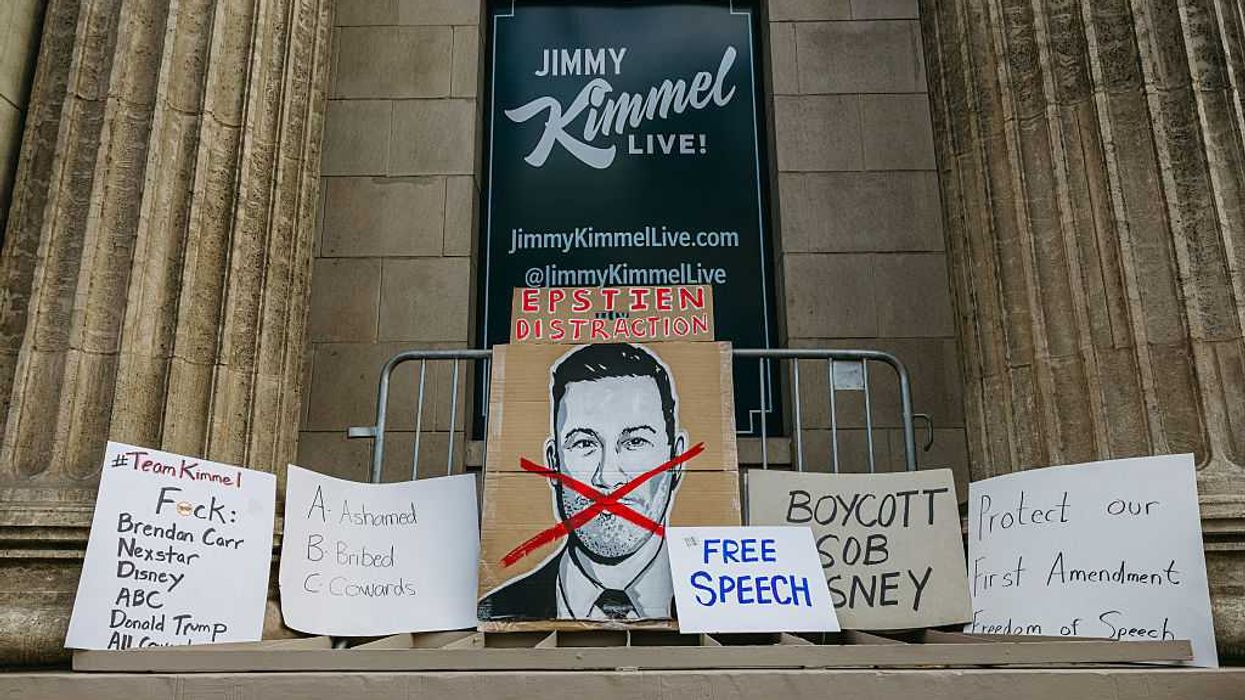
Kimmel isn’t the only voice that’s been targeted for failing to toe the line in the wake of Kirk’s murder, but Kimmel’s firing is the one that’s outraged millions of Americans who aren’t political junkies, so it's the one that offers the best chance to act.
How can we effectively push back on the Jimmy Kimmel suspension, and its larger threats to free speech? After Charlie Kirk’s shooting, Kimmel posted, “Can we just for one day agree that it is horrible and monstrous to shoot another human?” And sent his family’s “love to the Kirks and to all the children, parents, and innocents who fall victim to senseless gun violence.” But that didn’t seem to matter, because Kimmel also dared to point out that the Trump administration was using the assassination to score political points.
US President Donald Trump had already warned in July that Kimmel should be the next to be fired after Stephen Colbert. After Kimmel spoke out following the assassination, Trump Federal Communications Commission head Brendan Carr threatened to revoke the licenses of stations carrying Kimmel’s show. Nexstar and Sinclair then jumped in saying they wouldn’t air Kimmel’s episodes. And ABC-Disney caved. Vladimir Putin and his oligarchs would be proud.
Hearteningly, Americans are responding with appropriate outrage. The cancellation site of Disney+ streaming service has reportedly crashed from people ending their subscriptions. Conservative-leaning comedians have spoken out. Common Cause has launched a Turn Off Disney campaign and FreePress.Net has started a call-in campaign. Even Republican Sen. Ted Cruz (R-Texas) called it “unbelievably dangerous for government to put itself in the position of saying we’re going to decide what speech we like and what we don’t, and we’re going to threaten to take you off air if we don’t like what you’re saying.”
The question is how to sustain the pushback, which means building the broadest possible coalition of fellow citizens who are outraged, whether or not they love Kimmel’s jokes and stands. And how to coordinate as many organizations as possible working together to promote approaches like:
Successful boycotts and corporate campaigns need coalitions that act together and persist. I’m hoping other groups will now coordinate with Freepress.net and Common Cause to do this, and coordinate on common platforms to direct people. For instance, someone launched a boycottdisneyabc.com site with toolkits, templates, and an event page. But it’s not clear which, if any, groups are behind it or are using it. Pushback takes organization, as well as individual people acting.
Kimmel isn’t the only voice that’s been targeted for failing to toe the line in the wake of Kirk’s murder. MSNBC fired Matthew Dowd and the Washington Post fired columnist Karen Attiah. But Kimmel’s firing is the one that’s outraged millions of Americans who aren’t political junkies, so it's the one that offers the best chance to act. Kimmel’s suspension presents both a challenge to democracy, and an opportunity to keep this country one where governments can’t just shut down people who disagree with them.
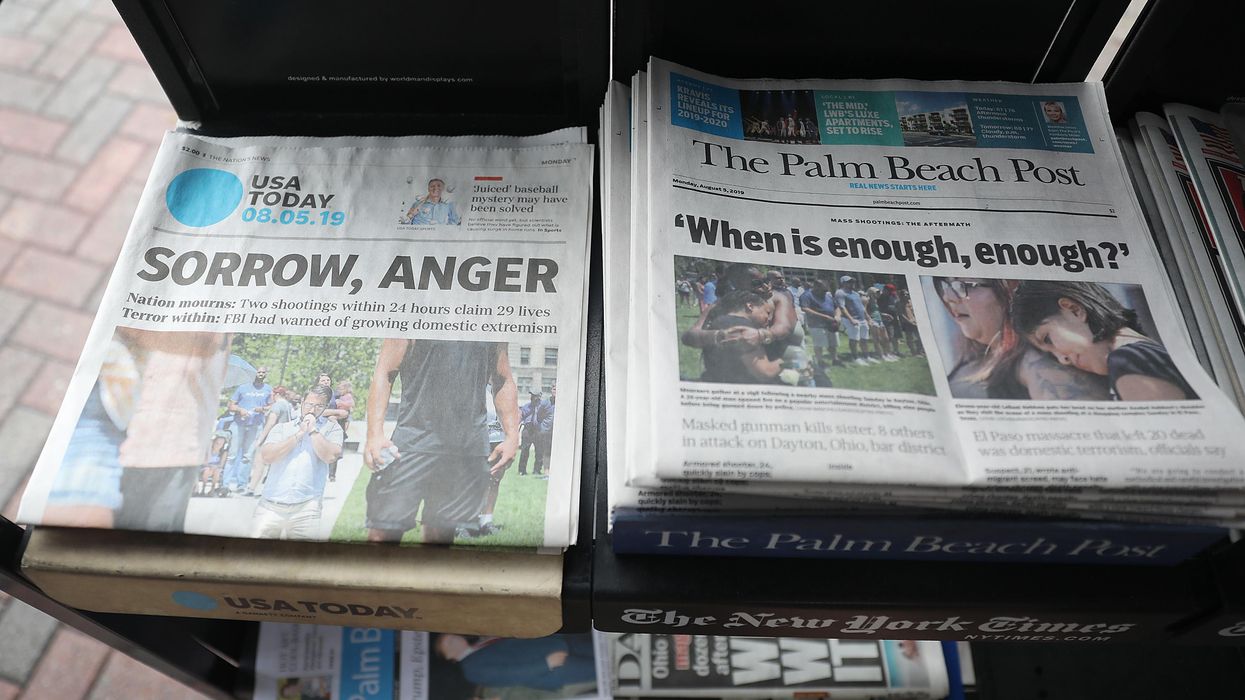
Editors owe a duty to the public to avoid hyperbolic opinion writing and “doom looping” that advance the interests of a privileged few.
On September 21, 1970, The New York Times ran its first “op-ed” page. Short for “opposite the editorial,” this new feature provided space for writers with no relationship to the newspaper’s editorial board to express their views. Before long, other newspapers followed suit. More than 50 years later, in order to compete with electronic media news, traditional newspapers have come to utilize opinion pages as a means to attract and keep readers.
Newspaper editors understood the power of opinion pieces as early as 1921 when editor Herbert Bayard Swope of the Pulitzer Prize-winning New York World said: “Nothing is more interesting than opinion when opinion is interesting, so I devised a method of cleaning off the page opposite the editorial… and thereon I decided to print opinions, ignoring facts.”
The pioneering opinion pieces Swope published were written by newspaper staff; and, while he may have ignored some facts in the opinions he published, contemporary newspapers claim to aspire to journalistic integrity. In its op-ed guidelines, The Washington Post, for example, notes that all op-eds are fact-checked. Post guidelines explain that authors with “important titles,” like “senators, business leaders, heads of state,” are held “to a particularly high standard when considering whether to publish them in the Post.”
Too often, however, the aims of consolidated, corporatized media, owned and operated by megarich individuals, supersede Fourth Estate journalistic ethics and democratic duties.
As competition for the public’s attention stiffens in a social media and online communications-saturated environment, it’s perhaps not surprising that conflicts of interest arise in the op-ed pages. In 2011, more than 50 journalists and academics urged greater transparency about conflicts of interest among New York Times op-ed page contributors. In an October 6, 2011 letter to Arthur Brisbane, the Times’s public editor, they criticized the practice of “special interests surreptitiously funding ‘experts’ to push industry talking points in the nation’s major media outlets,” absent reporting of those writers’ vested interests.
In their letter to the Times, the signatories called out the unreported bias of Manhattan Institute senior fellow Robert Bryce. The Institute received millions of dollars in funding from the fossil fuel industry. Bryce’s promotion of fossil fuels rather than renewable energy, they wrote, flew in the face of his “masquerading as an unbiased expert.”
Corporate media consolidation has strategically limited the diversity of perspectives and the quality of journalism and unduly influenced audience opinion. With a handful of large corporations controlling a majority of media outlets, content homogenization and profit prioritization often replace journalistic integrity. For instance, the acquisition of hundreds of weekly and daily newspapers by conglomerates like Gannett has led to a reduction in independent voices, an increase in editorial uniformity, biased editorials and op-eds, and news deserts.
The Sinclair Broadcast Group’s ownership of approximately 200 television stations has been criticized for mandating the airing of politically slanted content, including editorials and op-eds, across its network. This centralized control over broadcasting allows for the dissemination of partisan perspectives, undermining public access to balanced, impartial news coverage. Instead, viewers are fed one-sided opinions aligned with corporate agendas, rather than presented with a diverse array of viewpoints.
Editorials and op-eds can and often do have a greater influence on public consciousness than news articles. In best-case scenarios, they express a broad spectrum of opinions, provide in-depth analysis, advocate for specific viewpoints, and connect with audiences through emotion and ethos. Publications adhering to journalistic ethics feature opinions written in the public’s best interest and offer a range of well-reasoned perspectives that enhance good-faith debate.
Because the importance of an issue is often equated with the type and amount of media coverage it gets, high-profile publishers bear a greater responsibility in curating opinion pieces. When premier newspapers publish op-eds that are irresponsibly written—whether echoing government propaganda and political biases or corporate interests, lacking fundamental facts or historical context, or wielding accusatory or derogatory language and sensationalized headlines—they “signal boost” for a particular viewpoint or agenda.
This type of writing is irresponsible and counter-democratic for several reasons. Many news consumers skim headlines, only reading articles with gripping titles and subtitles. Reckless opining is equally irresponsible because many Americans have difficulty distinguishing fact from opinion. News consumers do not always make the necessary distinction between what’s published in the “news” section versus “opinion,” according to Marist College journalism professor Kevin M. Lerner.
When established reporters and purported experts voice their views as authoritative, their opinions are often perceived as news rather than opinion. Readers give them greater weight because of their credentials. Editors thus bear a greater responsibility to ensure that their opinion pieces adhere to the highest standards of journalistic ethics. Failure to do so can amount to a form of reader manipulation. Such lapses not only compromise journalistic credibility but do a disservice to the public and the democratic process.
Daniel Macy, senior associate in the Office of the Public Editor at PBS, wrote a defense of news editorial decisions. Too often, he complained, news audiences incorrectly believe that the media shape the news agenda. Macy claimed that the news media merely mirror the agenda. If audiences believe there’s bias, he continued, that’s due to the ever-present prioritizing system that each news consumer keeps in their head. At the end of the day, he affirmed, the editor decides what makes the news. “That sounds a little bit agenda-setting, but it’s not.”
Macy’s denial notwithstanding, establishment media has an agenda-setting function, and editorial decisions factor into the formation of public opinion and individuals’ voting decisions. Although the media cannot necessarily tell audiences what to think, they certainly have the power to inform what and who audiences think about. Take the 2024 report by Fairness and Accuracy in Reporting (FAIR) that investigated biased articles on economic topics, such as inflation, recession, and government debt and spending.
Searches of the 2023 New York Times and Washington Post archives revealed excessive prognosticating about a recession that never materialized and simultaneously correlated this to companies’ unjustifiably inflating prices. This sort of signal-boosting whipped up “fears of recession, a fantasy problem,” and directed attention away from the facts. In March 2024, writing on the strength of the U.S. economy, Louis Jacobson explored why so many Americans believe otherwise. The “self-reinforcing doom loops of media coverage and partisan biases” are at least partly, if not wholly, to blame, he wrote.
Opinion pieces that serve corporate or political agendas exemplify irresponsible editorializing. Editors owe a duty to the public to avoid hyperbolic opinion writing and “doom looping” that advance the interests of a privileged few. Too often, however, the aims of consolidated, corporatized media, owned and operated by megarich individuals, supersede Fourth Estate journalistic ethics and democratic duties. Manufacturing Consent (1988), the seminal work of Edward Herman and Noam Chomsky, shattered the illusion that the establishment media serve as a reliable check on power. Rather, media empires prop up the status quo and repeatedly display an unwillingness to challenge the power structures from which they profit.
A brief survey of opinion pieces related to 2023 headline news stories illustrates how unenforced editorial standards turned op-eds into forms of political propaganda. In the case of Israel’s genocidal acts against Palestinians in 2023 to 2024, editorials and op-eds in U.S. newspapers largely portrayed Israel as a victim, despite overwhelming evidence to support South Africa’s charge in the International Court of Justice that Israel is committing genocide in Gaza.
The Intercept published an analysis of media coverage during the first six weeks of the Israeli assault on Gaza, which helps to quantify the misuse of op-eds. The open-source inquiry into more than 1,000 articles revealed coverage that regularly favored the Israeli narrative. Consistent bias against Palestinians in The New York Times, Washington Post, and Los Angeles Times disproportionately described Israeli losses in emotional, humanizing language.
By contrast, Palestinian deaths were downplayed, as were the devastating impacts of the unprecedented bombing campaign in the Gaza Strip. The killing of journalists and children was similarly minimized. Harking back to Manufacturing Consent, Herman and Chomsky demonstrated the notion of “worthy and unworthy victims.” Victims of enemies of the United States and its client states are “worthy victims.” Correspondingly, in MintPress News (February 27, 2024) Alan Macleod wrote that deaths will only be covered extensively and compassionately in the establishment press if there’s political and economic capital to be gained.
Time and again, Western establishment news media showcase Israeli government and military officials and “authoritative voices” sympathetic to Israeli and U.S. policies to comment on the conflict.
The Intercept’s analysis detailed asymmetrical reporting on acts of antisemitism versus anti-Arab and anti-Muslim actions, and concluded that “[a]nalysis of both print media and cable news make[s] clear that, if any cohort of media consumers is getting a slanted picture, it’s those who get their news from established mass media in the U.S.”
In February 2024, Fairness and Accuracy in Reporting released the results of its analysis of opinion pieces in The New York Times and Washington Post that mentioned Israel or Gaza, as published from October 7 to December 6, 2023. FAIR determined that, although both papers included a few strong pro-Palestinian voices, opinions weighed heavily toward Israeli interests.
That was largely due to reliance on regular columnists sympathetic to Israel. Guest opinion editorials in both papers primarily featured the same old government officials (domestic and foreign, past and present) and attendant think tank experts uncritical of Israel.
To give an example of “op-ed abuse” that advantages U.S. pro-war policies, a study by the Quincy Institute found that the majority of think tank experts featured in the establishment press supportive of Ukraine were paid by the U.S. Department of Defense. Conflating national and international security issues with a feigned need for expert opinion is nothing new—newspapers of record have a track record of employing op-eds to justify war.
Caitlin Johnstone has written that “a jarring number of media executives and influential journalists” belong to the Council on Foreign Relations. The Washington Post’s former managing editor, Richard Harwood, reportedly commented that media involvement in the council aids the United States in formulating and promoting its policies and positions.
Indeed, who does the reporting and opining is as instrumental to a story as its subject and how a story is told, as media analyst Sana Saeed of Al-Jazeera+ has analyzed. Time and again, Western establishment news media showcase Israeli government and military officials and “authoritative voices” sympathetic to Israeli and U.S. policies to comment on the conflict. To state the obvious, stenography—that is, uncritically quoting think tank executives and government bureaucrats—is not journalism. Nor does it carry weight in constructive opinion writing unless, perhaps, it’s contextualized to validate an argument.
Traditional media have long served as sources for citizens to learn about their political leaders, policies, and government. Citizens should be able to trust their nation’s premier newspapers to maintain professed standards of professional ethics and to offer a plurality of newsworthy viewpoints.
Biased reporting is a breach of journalistic ethics. The preamble to the Society for Professional Journalists’ Code of Ethics, widely considered the gold standard of ethical journalism, states the belief “that public enlightenment is the forerunner of justice and the foundation of democracy,” and appeals to the integrity of every journalist, beginning with guidelines for seeking and reporting truth. A breach of ethics interferes with the public’s right to, and need for, accurate information.
Biased and propagandized publications may be thought of as a human rights issue too. According to Article 19 of the United Nations Universal Declaration of Human Rights, “Everyone has the right to freedom of opinion and expression, which includes the freedom to hold opinions without interference, and to seek and receive… information… through any media regardless of frontiers.” Thinking in those terms, reporting that’s biased, lacks transparency, or presents decontextualized information impedes Article 19’s contention that information seekers have the right to obtain facts and bias-free information.
Even in the digital age, America’s legacy media bear a consequential responsibility to the public. At a time when democracy is under strain, opinion pieces in our premier newspapers run the risk of abusing their status to steer public debate against the public welfare—especially when written by influential individuals with vested conflicts of interest.
Considering the blurred lines between legacy media and social media and between news and opinion, editorial decisions do more than undermine the role and reputation of journalism in a democracy; they jeopardize democracy itself.
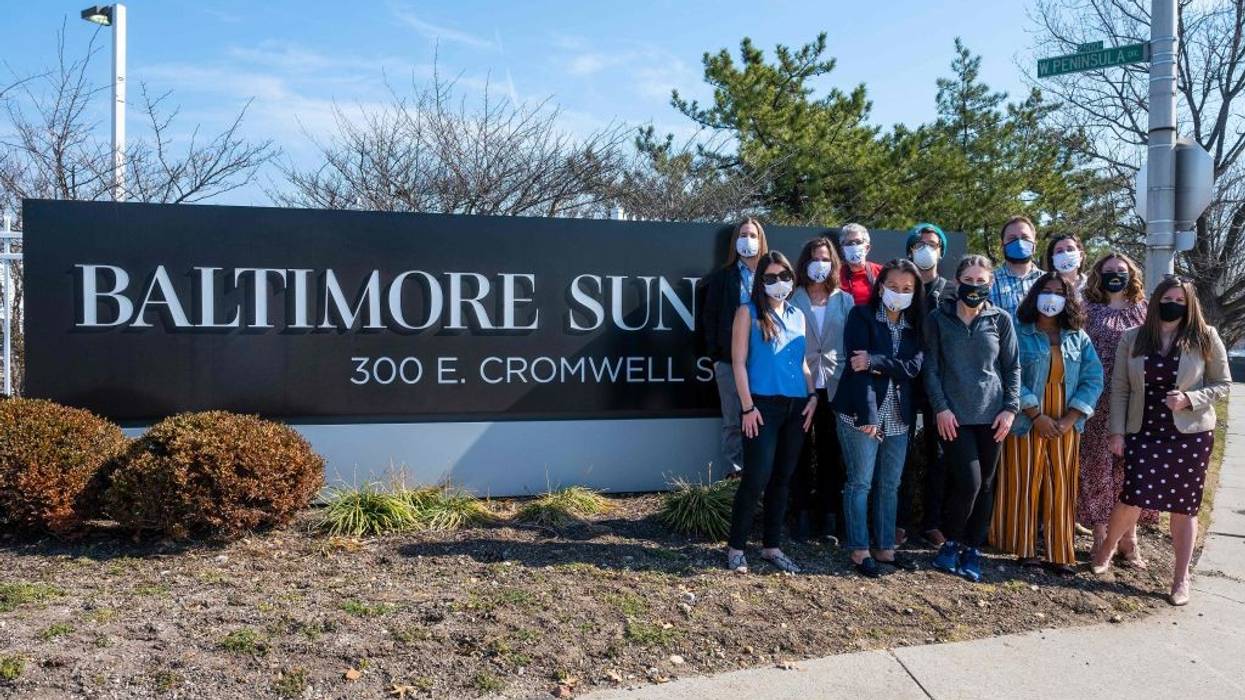
The unchecked control of the media by corporate interests is the deeper issues, but let the billionaire owners be a warning to us all.
David D. Smith, leading stockholder of Sinclair, Inc., announced on January 15 that he was purchasing what is left of the Baltimore Sun, once regarded as the crown jewel of the Maryland city’s media (AP, 1/15/24).
Sinclair is a multi-billion dollar Fortune 500 company and one of the largest owners of television stations in the country. The company has been criticized for its conservative and not always accurate TV news coverage (Salon, 7/21/17; New Yorker, 10/15/18). In 2018, the company compelled local TV news anchors around the country to read on air the same copy parroting President Donald Trump’s claims about “fake news” (Deadspin, 3/31/18).
The decline of the Sun has been happening for years before Smith’s purchase. The outlet was purchased in 2021 by Alden Capital Group, a hedge fund, which cut newsroom capacity and output. The Sun’s previous owner, Tribune (formerly Tronc), had already been furloughing staff and cutting pay before Alden’s takeover.
Sinclair is a national media giant, owning 294 stations across the country, but it is also headquartered just outside of Baltimore. Smith said he purchased the Sun with his own funding, independent of Sinclair. The Sun (1/15/24) advertised the purchase as “the first time in nearly four decades that the Sun will be in the hands of a local owner.”
Numerous media outlets around the country have expressed concern about Smith’s purchase, with a focus on his right-wing political leanings and his outspoken disdain for print media (e.g., New Republic, 1/17/24; New York Times, 1/20/24).
“A local buyer taking over a struggling newspaper in the 21st century is normally cause for some celebration,” the AP (1/16/24) commented. “But the Baltimore Sun’s newly announced owner has a very specific political background, and some are concerned about what the 187-year-old publication could become.”
Yet the groundwork for Smith’s takeover of the Sun was laid by many of the same news outlets expressing concern about it. Media have created an environment that not only enables takeovers of newspapers by billionaires, but frequently celebrates such acquisitions as important for democracy.
Much of the concern around Smith’s purchase of the Baltimore Sun has to do with his family’s legacy of influencing the news in the region. Over the last 20 years, Smith and his family have become increasingly powerful in Baltimore’s political, corporate and media landscape, and they have used their local media holdings to promote their agendas (Baltimore Sun, 1/18/24). The Sun has a history of reporting critically on Sinclair (9/1/22, 6/27/23, 8/2/23), a threat that has likely been neutralized by this purchase.
Observers are right to be skeptical of Smith’s promise that he is buying the Baltimore Sun out of an “absolute responsibility to serve the public interest” (AP, 1/16/24). But many of the same news outlets concerned about Smith’s influence over a longstanding daily newspaper have shown little concern about the influence of billionaire news owners in general—or they have shown selective concern.
When Amazon founder Jeff Bezos bought the Washington Post in 2013 (Extra!, 3/14), he assured the public that he was only interested in its potential profitability and that the Post would continue to operate as an independent entity. There wasn’t widespread panic.
Some of the Post’s coverage has seemed to go out of its way to protect the explicit interests of Bezos and the billionaire class (CJR, 9/27/22). As FAIR (10/11/18, 11/21/18) reported, the Post’s coverage of the 2018 Maryland gubernatorial campaign was shockingly biased in favor of Republican Larry Hogan and against Democrat Ben Jealous, a Bernie Sanders supporter. Hogan was negotiating to bring an Amazon headquarters to Maryland, and Jealous had raised questions about the deal.
With some exceptions, like Elon Musk’s takeover of Twitter (New York Times, 10/5/22; Newsweek, 10/28/22; MSNBC, 11/21/22), corporate media have covered billionaire takeovers of media outlets in a mostly neutral or positive light, at times portraying the wealthy owners as if they are saving a dying but essential industry out of the goodness of their hearts. That was the dominant tone of the coverage of Marc Benioff’s purchase of Time magazine (CNN, 12/30/19) and John H. Henry’s purchase of the Boston Globe (Reuters, 8/3/13), among others.
When billionaire Patrick Soon-Shiong purchased the LA Times, the New York Times (2/7/18) described him as rescuing the outlet from corporate media hell and offering a “welcome alternative” to Tronc. Its article began with a staffer “popp[ing] a bottle of champagne.” Soon-Shiong had previously been Tronc’s vice chair.
The New York Times (1/18/24) recently reported that the media outlets bought by billionaires have been largely failing financially—that the billionaires have failed to “save the news industry,” as if that were truly their goal. The Times didn’t consider that billionaires earn other dividends from controlling public discourse, for one.
The national media did exhibit more concern when billionaire Sheldon Adelson, a major casino owner (now deceased), bought the Las Vegas Review-Journal in 2015. News stories highlighted his ties to the Republican Party, and some speculated that he would use the purchase to influence the 2016 presidential election (Guardian, 12/17/15; NPR, 12/17/15; Atlantic, 12/17/15).
There was far less concern over what it means, in general, for a casino magnate to own the news in Las Vegas (Common Dreams, 12/22/15). Would Adelson have faced as much pushback if he weren’t a Republican?
It seems that “liberal” establishment media are concerned about some wealthy corporate owners—the faceless hedge funds and those with far-right leanings—but not the problem of billionaire or corporate ownership in general and its corrosive effects on a free press. But it is the very unchecked environment of corporate news ownership that has enabled the wealthy far-right takeover of so much of it.
None of the billionaires buying up newspapers have offered clear policies and practices ensuring that they won’t be able to influence coverage, only tepid assurances. FCC or other regulations that might ensure news media are free from such conflicts of interest would require sustained public attention–and that would entail corporate media challenging the interests of their own owners.
Concerns about the Baltimore Sun becoming a blatant tool of the far right are warranted. Within Baltimore, WBFF-Fox 45’s racist and politicized coverage is notorious. Regular coverage fosters fear around Baltimore youth, progressive causes and public schools (e.g., 7/24/22, 1/25/24). In 2014, Fox 45 was caught doctoring footage of noted local activist Tawanda Jones to make it seem like she was saying “kill a cop” during a protest, when she was chanting about “killer cops” (Afro, 12/23/14).
Fox 45 has shown clear favoritism to local politicians. For years, it supported a scandal-ridden candidate, Thiru Vignarajah, in his repeated failed bids for state’s attorney and mayor. Smith family members were prominent donors to his campaigns, and Fox 45 has hosted him in the studio far more than other candidates.
This year, the Smith family has shifted its financial support and airtime to candidate Sheila Dixon, who was previously Baltimore’s mayor but resigned in 2010 after pleading guilty to perjury and embezzlement. Smith’s partner in his deal to buy the Sun, conservative Sinclair commentator Armstrong Williams, hosted a one-hour, flattering interview with Dixon last June.
The Smith family also has a notorious reputation locally for the practices of its restaurant company, Atlas Restaurant Group, which has been aggressively buying up struggling restaurants and other properties. The company has faced controversy for policies that restrict service based on racist and arbitrarily enforced dress codes.
Smith has been less shy than his counterparts in other cities about his plans to influence the Baltimore Sun’s coverage. Sun employees shared anonymous accounts with outside reporters (Baltimore Banner, 1/16/24) of a closed door meeting in which Smith reportedly admitted to wanting to remake the Sun to be more like his local TV station, including featuring unscientific polls on the front page.
As part of catastrophizing Smith’s purchase of the Baltimore Sun, media have promoted the newspaper’s legacy as if it were unquestionably vaunted, setting up a good/evil binary. In reality, there has long been substantial local criticism of the Sun, including its coziness with powerful interests, its legacy of problematic hero-reporters, and its negative characterizations of Baltimore’s Black and other marginalized communities.
The Baltimore Banner (1/16/24) brought up the the Sun’s credentials in challenging Smith’s characterization of the newspaper:
Asked Tuesday during the meeting whether he stood by [negative] comments [about newspapers] now that he owns one of the most storied titles in American journalism, Smith said yes. Asked if he felt that way about the contents of his newspaper, Smith said “in many ways, yes,” according to people at the meeting.
The Baltimore Sun won the 2020 Pulitzer Prize for local reporting.
The Banner article was written by three reporters, all of whom previously worked for the Sun.
The Pulitzer Prize was invoked again by the Washington Post (1/17/24) as prima facie evidence of the Sun’s intrinsic goodness. The Post recounted an exchange in which Smith suggested to his new employees that the officers involved in Freddie Gray’s death in 2015 were innocent. A staffer challenged him on the point.
“You may believe that they killed somebody,” Smith said. “I’m not here to tell you they did or didn’t.”
The Sun was a Pulitzer finalist for its coverage of Gray’s death.
I previously wrote for FAIR (9/22/23) about how the Sun’s coverage of Freddie Gray’s death leaned almost entirely on the statements of police and promoted police officers as heroes, while marginalizing or ignoring the statements of witnesses, who were the Black residents of Gray’s former neighborhood. The Sun has refused to share new evidence that has emerged in Gray’s death since 2015, failing to correct the record on its mistakes, despite the case being one of the biggest stories in Baltimore’s history.
Likewise, the Sun’s coverage of the riots in Baltimore after Freddie Gray’s death was barely distinguishable from how Fox 45 reports on Baltimore’s youth. As FAIR (4/29/15) reported at the time, Sun reporters (4/28/15) repeated a false police story that teenagers had been planning to “purge” that day and attacked police, “pelting officers with water bottles and rocks,” as if unprovoked. The Sun missed the real story of how police fomented a riot by locking down teenagers after school and not letting them return home (Mother Jones, 4/28/15), among other provocative actions.
The Sun has continued to portray Baltimore’s Black youth as de facto criminals in many stories (e.g., 9/15/20), often hiding the racism behind a sheen of “both sides” reporting.
Conversely, although Fox 45 has been an easy target for liberal reporters and politicians, not all of its coverage has been as supportive of powerful interests as the Sun’s reporting. Fox 45 (3/19/21) was aggressive in its effort to expose corruption by Nick Mosby, the current City Council president, and former state’s attorney Marilyn Mosby—a Baltimore power couple who recently divorced. (She filed an FCC complaint against the station, accusing it of racist coverage.) Marilyn Mosby was ultimately indicted and convicted by the federal government for perjury and mortgage fraud.
By contrast, the Baltimore Sun published several editorials in support of the Mosbys and minimizing their scandals, including one (3/23/21) arguing that the federal investigation into their possible crimes was “not good for Baltimore.” (One member of the three-person editorial team at the time, Andrea K. McDaniels, is married to a long-time vocal Mosby supporter, Zach McDaniels, who helped Mosby on the Freddie Gray case. Andrea McDaniels is now managing editor of the Baltimore Banner.)
As for the Banner, the Sun’s chief competitor, it has adopted a superior tone in its coverage of the Smith takeover (1/16/24, 2/5/24), but it has its own ties to the Smith family. The Banner has held events in partnership with Atlas restaurants, which are owned by the Smith family, and published article after article that cover Atlas, a Banner advertiser, in a favorable light (e.g., 7/11/23, 10/2/23, 10/18/23).
The Banner has also escaped any scrutiny of its own ownership model. As I previously wrote about for FAIR (12/21/23), the Banner is nominally a nonprofit organization—an “independent” outlet, according to Nieman Lab (1/22/24)—but it is owned by Stewart Bainum, Jr., the very wealthy CEO of Choice Hotels and a nursing home chain, as well as a one-time state politician. He established the Banner after failing to purchase the Sun.
A Democrat, Bainum was described by the national press as the “savior” of Baltimore media (Washington Post, 2/17/21), but the Banner’s board and staff are almost entirely made up of people from the corporate world, its content is buried behind paywalls, and it has platformed right-wing sentiments, including transphobia (9/20/22). Also, like the Sun, it has a habit of parroting what police say (8/27/22) and not offering retractions when those stories turn out to be false (8/30/22).
Smith obviously poses a real threat to the possibility of fair and accurate Baltimore news. At the same time, he serves as a convenient scapegoat for a much deeper and broader problem: the unchecked control of the media by corporate interests, sometimes in the form of what seem like wealthy benefactors.

"The Sinclair TV owner bought The Baltimore Sun for the same reason Elon Musk bought Twitter," opined one critic. "Power."
New Baltimore Sun owner and right-wing media executive David D. Smith raised eyebrows and ire in media circles and beyond following a Tuesday meeting at which he reportedly insulted journalists at his new acquisition and told them to focus on profit.
Smith, the multimillionaire head of the Sinclair Broadcasts Group—a network notorious for its fealty to former U.S. President Donald Trump—purchased the Sun, along with a bevy of other Maryland papers, last week for what The New Republic described as an "unspecified, nine-figure" amount from Alden Global Capital, an investment firm known for its cost-cutting ways.
Sinclair started out in Baltimore and the Sun reported that it's the first time in nearly four decades that the paper will be locally owned. However, NPR media correspondent David Folkenflik atold "All Things Considered" host Juana Summers that Sun staffers left the meeting with Smith "fairly on edge."
Smith "said he's only read [the Sun] about four times, which is kind of astonishing for a guy whose family has been there for more than a half-century," Folkenflik said, adding that the new owner also argued that the paper "just isn't offering people news that is holding local government actors accountable."
"This," Folkenflik added, "for a newspaper that, you know, revealed corruption by the then-mayor of Baltimore that led to the Sun winning a Pulitzer just a few short years ago."
The once-venerable Sun has, in fact, won 16 Pulitzer Prizes over its storied history.
Folkenflik, who once worked for the Sun, noted:
It has a really proud heritage going back to 1837. The story of the Sun, nonetheless, is kind of the story of modern American newspapering. Alden is the latest in a string of big corporate owners that has, you know, time after time, decade after decade, whittled down or slashed its staffs and its ambitions. The paper has shrunk pretty sharply.
Media accountability advocates expressed alarm and concern over Smith's purchase of the Sun. Popular Information publisher Judd Legum noted that the paper's new owner is a donor to far-right groups including Project Veritas, Turning Point USA, and Moms for Liberty.
"Sinclair Broadcasting, which is controlled by the Smith family,
forces nearly 200 local TV affiliates to run right-wing pro-Trump political commentary," Legum said. "Sinclair affiliates have also promoted right-wing conspiracy theories, including claims that [Democratic National Committee] staffer Seth Rich was murdered by a hitman as payback for sharing sensitive emails to WikiLeaks."
Sinclair and Smith have been closely aligned with the Trump family. Trump son-in-law Jared Kushner has admitted that the former president and 2024 GOP front-runner's campaign
struck a deal with Sinclair in 2016 for access in exchange for more favorable coverage.
"We are here to deliver your message," Smith
told the Trump campaign. "Period."
Smith is also openly inimical toward the mainstream media—including the
Sun. According to The Baltimore Banner, he told New York Magazine in 2018 that he viewed print media to be "so left-wing as to be meaningless dribble."
Pressed during Tuesday's meeting whether he still believed this, Smith answered in the affirmative. Asked if that included the paper he just bought, he replied, "in many ways, yes."
Sun staffers present at Tuesday's meeting told Folkenflik that their new boss seemed especially focused on the paper's bottom line.
"Smith told his new staffers that, you know, the
Sun was profitable but that he meant to make it more profitable," Folkenflik told Summers.
According to the Banner, he told them to "go make me some money."

Across the world, dictators, authoritarians, and wannabee dictators are using Trump’s epithet “fake news” to attack journalists with a vengeance.
Last week’s holiday weekend gave Louise and me an opportunity to take a week off to visit a few friends and take a break from American politics. Instead, we got a splash of cold water in the face; it’s an amazing story.
We started our trip near Barcelona, Spain, where we spent the day and had a wonderful meal and fascinating, detail-rich conversation with Raw Story editor Roxanne Cooper and her husband, Earl.
You may recall that the Daily Take I wrote from Cardiz the next day, inspired in part by our discussion, was about how Spain had been fascist from the 1930s right up until Francisco Franco died in 1975 and how “normal” life can seem under a fascist regime — just so long as you’re not political or a member of the press.
The simple reality, known well to the Framers of our Constitution, is that a free, open, and independent press is essential to a functioning democracy.
From there we visited Morocco, the seventeenth-most-dangerous country in the world to practice journalism. A fellow we spent much of the day with absolutely refused to discuss politics and deflected every one of my efforts to raise issues of Moroccan governance or press freedom. He’s a survivor and plans to stay one.
We ended up in Portugal, at the home of an old friend who spent much of his career as a reporter and then senior-level media executive, a retired American who’s now a permanent resident of that country. With his permission I tell this story, although I’m not going to identify him for reasons that will become clear in a moment.
As he drove us to his home and we brought each other up to date on our lives and labors (we worked together in news for about a decade many years ago), he told Louise and me about the new project he’s working on with a loose group of people scattered across several EU countries.
It involves preparing for something that, I confess, hadn’t even been on my conscious radar: helping safely smuggle American reporters and opinion writers — and their families — out of the US in the event of a sudden fascist takeover and press crackdown by a figure openly hostile to reporting like Trump or DeSantis.
That people living in Europe would even consider such a thing as potentially necessary was, for me, a shocking wake-up call about how far America has already gone down the authoritarian road and how clear — from outside our country — this is to those living in nations that have experienced rapid authoritarian transitions in the past.
Just a year before Franco’s death ended formal fascism in Spain, Portugal’s rightwing dictatorship — the longest-lasting one in Europe during the 20th century — was overthrown in 1974 by a military-led leftist coup (the “Carnation Revolution”) which ended press and schoolbook censorship as a first step to guiding the country through a democratic transition.
Today, as a result, Portugal is one of the EU’s more progressive and open nations, particularly with regard to press freedom: they’re number 9 in the world, according to Reporters Without Borders.
There are multiple active networks around the world working to support reporters at risk in repressive regimes; most Americans have heard the stories of hundreds of Russian reporters who fled or were smuggled out of that country after, early last year, President Putin criminalized reporting on his terrorist war against the democracy and citizens of Ukraine.
The Committee to Protect Journalists, for example, has experts and correspondents around the world who support reporters exposing antidemocratic and criminal activity by repressive governments. As their website notes:
“[CPJ] provides comprehensive, life-saving support to journalists and media support staff working around the world through up-to-date safety and security information and rapid response assistance.”
They’re one of multiple organizations working around the world to promote press freedom; many are much smaller and some even operate with no public presence whatsoever, as is the group my friend is currently helping to organize.
The simple reality, known well to the Framers of our Constitution, is that a free, open, and independent press is essential to a functioning democracy. To ensure this in America, in addition to our First Amendment, we had for much of the last century specific laws and rules enhancing press independence, keeping news as news rather than infotainment, and ensuring a broad spectrum of perspectives and ideas were available to the public.
The Fairness Doctrine, for example, which Reagan suspended the enforcement of in 1987 and Barack Obama took off the books in 2011, mandated that when representatives of radio or TV station ownership or management presented opinions on controversial subjects there be equal time given to opposing views.
When I worked in the newsroom of WITL radio and at WJIM TV in Lansing, Michigan during the late 1960s, part of my job was to help find those “opposing voices” who’d record responses to on-air editorials by station management.
The Fairness Doctrine also required us to “program in the public interest,” which was interpreted as having news at the top and bottom of every hour on the radio along with a half-hour to one-hour news block leading into prime time on TV (this was also loosely covered by the “Prime Time Access Rule”).
Back then, news operations lost money; they were the cost of maintaining a radio or TV station license. Starting in 1987, however, they moved under the oversight of network entertainment programming and became profit centers, so nowadays “if it bleeds, it leads.” Clickbait is today more vital to many “news” organizations than information crucial to a functioning democracy, simply because it draws more eyeballs and thus more profit.
Additionally, the Fairness Doctrine required “equal time” be given to candidates for public office, a provision that would have prevented Trump from getting, according to The Street, an estimated “$5.6 billion [in free television coverage] throughout the entirety of his [2016] campaign, more than Hillary Clinton, Bernie Sanders, Ted Cruz, Paul Ryan and Marco Rubio combined.”
Finally, there were explicit limits on the monopolization of media outlets, known as “media ownership limits.” Some of these were blown up when Bill Clinton signed Newt Gingrich’s Telecommunications Act of 1996, which led to a massive consolidation of newspaper and radio station ownership over the next five years.
Ownership rules were further loosened in 2017 by the Trump administration in a 3-2 FCC vote, with the Republican majority prevailing. Public interest groups sued and it went to the Supreme Court where, in 2021, Brett Kavanaugh, with Clarence Thomas concurring, wrote the Court’s opinion saying:
“The [three Republicans on the] FCC considered the record evidence on competition, localism, viewpoint diversity, and minority and female ownership, and reasonably concluded that the three ownership rules no longer serve the public interest.”
As a result, a handful of right-leaning New York hedge funds and private equity firms now own more than half of all the local newspapers in the US, the CEO of a network with hundreds of stations broadcasting rightwing talk radio 24/7 told me and a US Senator to our faces that he’d never put anybody on any of his stations “who advocates raising my taxes,” and the single largest network of TV stations in the country is owned by the openly and proudly rightwing Sinclair Broadcasting.
There literally is no equivalent national media infrastructure on the left here in the United States. None.
All of this media consolidation that’s happened since the Reagan Revolution makes our overall media landscape much easier to seize, control, and manipulate should our government ever flip fully fascist, as my friend in Portugal fears could happen.
In my opinion, the “soft fascist” model pursued by Hungary’s Viktor Orbán is the most likely to prevail here in the US should a Republican win the White House: Orbán simply used his government’s influence to facilitate the takeover of virtually all the consequential media in that nation by a handful of friendly oligarchs, so every radio and TV station in that country now most closely resembles Fox “News” and praises Orbán’s every move, day after day.
One could argue we’re already more than halfway there. When my radio program was carried opposite Rush Limbaugh on Air America, we’d leased 54 radio stations from Clear Channel and broadcast into virtually every major metropolitan area in the US. We did well, had an audience of millions, and I frequently beat Limbaugh in the ratings in our daypart; some suggest without Air America Barack Obama may not have been elected president in 2008.
After Mitt Romney’s Bain Capital private equity firm took over Clear Channel, however, one-by-one we lost our stations as they were flipped to sports programming until Air America no longer had a large enough audience share to support an advertising revenue model and went bankrupt. Virtually every one of those radio “pods” now program rightwing talk radio and the last two to carry my show went rightwing in the past five years.
Thus — lacking a broad and nationally-penetrating progressive radio, TV, and newspaper infrastructure — should a Trump, DeSantis, or other Republican fascist become president and outlaw “fake news” altogether, I and my colleagues may be faced with the choices confronting journalists in other authoritarian nations: leave broadcasting or, for our own safety, even leave the country.
This is the path reporting has taken in Russia, Myanmar, Hong Kong, Brazil, India, Venezuela, Poland, Cuba, The Philippines, Turkey, parts of Mexico, China, Colombia, and Nigeria.
And it’s not like we’re doing well: news media in America is already in crisis.
Reporters Without Borders ranks America 45th in press freedom, far below every other advanced democracy in the world. Other countries with freer and more open news organizations and systems include Tonga, the Dominican Republic, Croatia, Montenegro, Andorra, Cabo Verde, Jamaica, Moldova, South Africa, Costa Rica, Namibia, Samoa, and pretty much every “western” European nation.
The media consolidation scenarios described above account for much of that low position.
Arguably, the transition from a free press to our infotainment/clickbait media today began with media strategies laid out by Reagan and Bush consultants Lee Atwater, Roger Stone, and Putin’s man Paul Manafort. During the 1992 election Rich Bond, then the chairman of the RNC, explained why Republicans had spent the previous twenty years claiming there was a “liberal bias” in the media when there was and is measurably no such thing.
“There is some strategy to it,” Eric Alterman quoted Bond as saying. “If you watch any great coach, what they try to do is ‘work the refs.’ Maybe the ref will cut you a little slack on the next one.”
Four decades of this constant harassment of our media by Republican politicians and their toadies has led to today’s both-sides-ism, where many reporters are afraid to even mention Republican crimes or perfidy unless they can come up with some equivalent — no matter how thin or weak — by Democrats.
Michael Abramowitz, president of Freedom House and a former editor and White House correspondent for The Washington Post, told Neiman Reports:
“There is no question we are living through a democracy recession. … We are in a very difficult situation and focusing on protecting journalists and their ability to do their jobs safely and helping to make journalism more economically viable is critical to restoring democracy. …
“I think we’re on a terribly dire course right now. All the threats to journalism today are honestly to me so much greater than when I was a journalist. … That’s what the murder of Jamal Khashoggi was all about.”
Across the world, dictators, authoritarians, and wannabee dictators are using Trump’s epithet “fake news” to attack journalists with a vengeance. Turkey recently cracked down on reporters, jailing several, having passed a law that explicitly uses the phrase “fake news.”
Two months ago, on the 30th anniversary of World Press Freedom Day, the United Nations held a conference about this issue of a free press and its necessity to functioning democracies.
UN Secretary-General António Guterres said the situation was dire:
“Freedom of the press is the foundation of democracy and justice. It gives all of us the facts we need to shape opinions and speak truth to power. But in every corner of the world, freedom of the press is under attack.”
His concerns were echoed by the Publisher of The New York Times, A.G. Sulzberger, who added:
“The Internet also unleashed the avalanche of misinformation, propaganda, punditry and clickbait that now overwhelms our information ecosystem, often drowning out credible journalism and accelerating the decline in societal trust.”
Republican calls for violence against reporters are also getting louder every day. Just this past month Kari Lake threatened our press, saying:
“I have a message tonight for Merrick Garland, and Jack Smith, and Joe Biden. And the guys back there in the fake news media, you should listen up as well, this one’s for you.
“If you want to get to President Trump, you’re going to have to go through me, and you’re going to have to go through 75 million Americans just like me.
“And I’m going to tell you, most of us are card-carrying members of the NRA. That’s not a threat, that’s a public service announcement.”
Clearly it was a threat, and a threat of violent death at the hands of gun owners.
Meanwhile, Trump and other Republicans have amped up their attacks on the media, including threats of imprisonment and worse directed at journalists, should Republicans seize power in the 2024 election.
From Russian troll farms pumping lies and propaganda directly into American homes via social media, to useful idiots in America who echo them for political gain, to Republican politicians openly calling for an end to a free press in this country, my friend in Portugal may well be onto something.

Some advocates of the bargaining code model seem focused on punishing Big Tech and "aren't really giving a great deal of thought to what the future of journalism requires," said Tim Karr of Free Press.
While Meta is under fire for planning to yank journalistic content off Facebook and Instagram in Canada over the Online News Act, some policy experts are criticizing Canadian lawmakers for passing the legislation, arguing that the backlash was predictable plus the law won't adequately address issues with Big Tech or the media industry.
Free Press senior director of strategy and communications Tim Karr on Friday warned of the "real world impacts" of Meta's plans for Canadian users, pointing out that "there are forest fires now raging across parts of Canada," so "having access to news and information could be a matter of life or death for a lot of people."
Karr is also critical of legislation like the new Canadian law, also known as Bill C-18. The optics are "very good for lawmakers," he told Common Dreams in an interview, "but the hard reality is that while it may look good in the papers for them... it does very little to actually get at the root of the problem of the crisis in journalism."
"There are things that Big Tech does that deserve to be punished, but the real goal here is not punishing Big Tech... It is helping save public interest news and information."
After Bill C-18 received royal assent on Thursday, Minister of Canadian Heritage Pablo Rodriguez said in a statement that "a free and independent press is fundamental to our democracy. Thanks to the Online News Act, newsrooms across the country will now be able to negotiate fairly for compensation when their work appears on the biggest digital platforms."
"It levels the playing field by putting the power of Big Tech in check and ensuring that even our smallest news business can benefit through this regime and receive fair compensation for their work," added Rodriguez, who leads the Department of Canadian Heritage—which must now draft regulations related to the law, a process that could take six months or longer.
The department's statement highlighted how the global journalism funding crisis has impacted Canada, noting that 474 outlets have closed in 335 Canadian communities since 2008, a third of industry jobs disappeared across the country from 2010-16, and overall revenue for broadcast television, radio, newspapers, and magazines fell by nearly $6 billion from 2008-20.
Building on a model enacted in Australia two years ago, Bill C-18 is designed to inject money into the news media sector through agreements under which dominant digital platforms—such as Alphabet-owned Google and Meta's Facebook and Instagram—compensate Canadian journalistic outlets for their content. Smaller news outlets will be able to collectively bargain for deals.
When Australia's News Media Bargaining Code took effect in early 2021, Facebook—which changed its parent company name to Meta later that year—initially blocked the content of Australian news outlets, which Amnesty International campaigner Tim O'Connor at the time called an "extremely concerning" decision that "demonstrates why allowing one company to exert such dominant power over our information ecosystem threatens human rights."
The tech giant reversed course within a week—and despite Wall Street Journal reporting last June that "Facebook is reexamining its commitment to paying for news," the voluntary agreements in Australia have so far held up. According to a December report from the Australian government, Meta and Google have inked more than 30 deals with the nation's news outlets.
"At least some of these agreements have enabled news businesses to, in particular, employ additional journalists and make other valuable investments to assist their operations," says the Australian report. "While views on the success or otherwise of the code will invariably differ, we consider it is reasonable to conclude that the code has been a success to date."
Whether such deals will materialize in Canada remains to be seen, but the technology companies have fiercely opposed Bill C-18. The Toronto Star noted that "earlier this year, Google quietly launched a test designed to filter out news content on its search engine for a small percentage of its Canadian users. Meta followed suit in June, conducting a test that is still ongoing and limits news sharing for some of its users."
Google spokesperson Jenn Crider said Thursday that "we're doing everything we can to avoid an outcome that no one wants. Every step of the way, we've proposed thoughtful and pragmatic solutions that would have improved the bill and cleared the path for us to increase our already significant investments in the Canadian news ecosystem. So far, none of our concerns have been addressed. Bill C-18 is about to become law and remains unworkable. We are continuing to urgently seek to work with the government on a path forward."
Meta, meanwhile, chose what Karr—a critic of both the bargaining code model and Big Tech—called the "nuclear option," and confirmed Thursday that "news availability will be ended on Facebook and Instagram for all users in Canada" before the law takes effect.
Rodriguez responded that "Facebook knows very well that they have no obligations under the act right now. Following royal assent of Bill C-18, the government will engage in a regulatory and implementation process. If the government can't stand up for Canadians against tech giants, who will?"
The American Economic Liberties Project tweeted Friday that "Meta's back on its blackmail routine, but Canadian lawmakers know better," echoing Erik Peinert, the group's research manager and editor, who had similarly praised the country's policymakers a day earlier.
"Canadian lawmakers stepped up today to save news outlets that are being eaten alive by Big Tech's business model of monetizing their content with no compensation," Peinert said in a Thursday statement. "Similar legislation has already restored Australia's news landscape, injecting millions into the industry to support a new generation of journalists and strengthen democracy."
Rather than applauding Canadian lawmakers, critics like Karr and professor Michael Geist, the Canada research chair in internet and e-commerce law at the University of Ottawa, suggested that they "have made an epic miscalculation."
Meta's move "was both predictable and entirely avoidable," considering that the company "never strayed from the position that the bill rendered Canadian news uneconomic on its platforms and that it would stop news sharing in response," according to Geist.
As he wrote Friday on Substack:
News is not a significant part of Facebook feeds (the company says about 3%) and it is highly substitutable (users spend the same amount of time on the platform whether presented with news links or photos of friends). But it is important to many news outlets, who told the Senate studying the bill that it provides between 17-30% of their traffic. This is particularly true for small, independent, and digital-first outlets that often rely on social media to develop readership and establish community. Losing those free referral links will have a damaging effect on those news outlets and undermine competition, leading to reduced traffic, less ad revenue, and fewer subscribers. Indeed, the publishers know the value of Facebook since they are the ones that post the majority of links to their own articles. Tough talk from Rodriguez will be cold comfort for those who have lost those links and lost revenues due to government policy.
"Had the government listened to anyone other than media lobbyists, it would have considered alternatives such as a fund model that would have avoided payments for links, concerns about press independence, as well as risks to trade and copyright obligations," Geist added. "But in a process that initially even tried to exclude Meta from appearing before committee, there was no room for dissenting views. And now there will be no room for Canadian news on the world's leading social media platform as part of the government's made-in-Canada internet."
This week's developments in Canada could inform debates about such bills elsewhere, including in the United States. Peinert on Thursday urged U.S. lawmakers considering the Journalism Competition and Preservation Act (JCPA), sponsored by Sen. Amy Klobuchar (D-Minn.), to "follow Australia and Canada's lead." Anti-monopoly campaigners have also welcomed a similar bill by California state lawmakers.
Karr has warned against measures like the JCPA and the new Canadian law. He noted Friday that "Free Press is no fan of big social media companies and we spend a good portion of our time advocating against a lot of the things that companies like Facebook, Twitter, and Google do."
"But it feels to me oftentimes that the impetus of the support for the bargaining code bills in Australia, Canada, and the United States is merely to punish Big Tech—and, of course, there are things that Big Tech does that deserve to be punished, but the real goal here is not punishing Big Tech," he stressed. "It is helping save public interest news and information... creating a model that subsidizes the type of news production, local news in particular, accountability journalism, that has gone missing as a result of the implosion of the news industry."
It is no longer "economically viable for local newspapers to operate on the model that they've been operating on for the last century," Karr told Common Dreams. "Unless we take a serious look at the shifting economics of news production and create legislation meant to address that, we're going to just be kind of bailing water out of a sinking ship." However, he argued, advocates of bargaining bills "aren't really giving a great deal of thought to what the future of journalism requires."
With the Australian code, "there isn't a lot of transparency" regarding negotiations, because it's not legally mandated, and "Google and Facebook initially struck deals with some of the consolidated outlets there," he explained. The approach pursued by Australia and Canada "favors large and often very profitable news organizations while disadvantaging smaller news organizations that might be serving minority communities or other niche populations."
It also creates "this kind of clickbait gold rush where you have outlets just trying to put items in social media that generate a lot of clicks and a lot of traffic so that they can go back to these platforms and ask for a lot of money," he warned.
Australia and Canada's laws advanced in part because "legacy media outlets have been very aggressive in lobbying... because they know it just lines their pockets," Karr said. "That's been our main complaint about the JCPA and other bargaining code bills, is that they're the wrong solution... to the crisis in journalism. In fact, they kind of ignore the crisis."
Passing such policies not only fails to address problems such as news deserts, "it actually sets us back because... lawmakers have limited bandwidth for all of the issues that they have to deal with," he argued. Because "there is a political desire to do something about these very powerful tech companies," these measures allow lawmakers "to check that box while at the same time saying that they're doing something to help save journalism."
One alternative is creating an independent fund for public interest journalism. For the United States specifically, "Free Press has proposed an ad tax that would be levied on online advertising revenues," Karr detailed Thursday at Tech Policy Press. "A 1% tax would generate around $2 billion annually—which would fund a public interest media endowment that would place a premium on funding civic engagement and accountability journalism over clickbait and disinformation."
"Unlike the JCPA, it wouldn't rely on a convoluted bargaining code that's built on a false understanding of the news business," he wrote. "Instead, this approach recognizes the actual economics of news, treats journalism as a public good, and creates a structure through which funds actually support the production and distribution of news and information that are needed most."
National and state-level efforts to “save local news” would reward chains like Sinclair that continue to neglect the information needs of communities they’re supposed to serve.
Sometimes lawmakers write legislation that would do the opposite of its stated goal. Nowhere is this more evident than in two recent bills—one introduced at the state level and another in the U.S. Congress—that are supposedly designed to “save local news.”
Both the California Journalism Preservation Act (CJPA) and the federal Journalism Competition and Preservation Act (JCPA) would allow news publishers—including broadcast companies—to extract payments from large social-media enterprises like Alphabet and Meta in exchange for linking to their content. This would apply to any content regardless of its accuracy or news value.
One of the bigger beneficiaries of California’s CJPA and the U.S. Senate’s JCPA is a conglomerate that seems determined to get rid of local news and replace it with right-wing spin produced at a “National Desk.”
One of the bigger beneficiaries of California’s CJPA and the U.S. Senate’s JCPA is a conglomerate that seems determined to get rid of local news and replace it with right-wing spin produced at a “National Desk” far from the communities this broadcast company is legally obligated to serve.
That conglomerate, Sinclair Broadcast Group, recently announced plans to eliminate entire local newsrooms at local-television stations in five broadcast areas. Sinclair is also drastically cutting newsroom staff at an additional five local stations, pushing all of these stations to fill the resulting news hole with National Desk boilerplate. That means zero local coverage—and lots of the cookie-cutter conservatism that Sinclair has pumped out via the public airwaves for decades.
Sinclair doesn’t care about the benefits that local news coverage brings to communities. The company owns and operates several stations that broadcast to regions of California, including KAEF in Eureka, KBAK in Bakersfield, KMPH in Fresno, KRCR in Redding, and KRXI around Lake Tahoe. Any of these newsrooms could be next on its chopping block. But lawmakers in Sacramento and Washington are ignoring Sinclair’s dismal track record and moving forward with legislation that would reward Sinclair as it undermines local news.
On Tuesday, the CJPA passed through California Assembly’s Judiciary Committee just a few days after the Committee on Privacy and Consumer Protection advanced it. And in Washington, Sen. Amy Klobuchar (D-Minn.) has reintroduced the JCPA, which failed to pass in the previous Congress after facing headwinds from a coalition of local-news advocates and media-democracy groups.
Both bills would create a convoluted mechanism for corporate handouts to highly profitable and consolidated media outlets—and both bills would allow these chains to continue to neglect the information needs of the communities they’re supposed to serve.
Both bills would create a convoluted mechanism for corporate handouts to highly profitable and consolidated media outlets—and both bills would allow these chains to continue to neglect the information needs of the communities they’re supposed to serve.
That these bills have any momentum is largely due to the powerful Big Media lobby pushing them. This includes lobbyists working on behalf of Sinclair as well as Gannett Co. and predatory hedge fund Alden Global Capital, which have also cut local newsrooms to the bone even as they’ve continued to buy back stocks, go deeper into debt to acquire more local outlets, and use other financial gimmicks to enrich their owners, executives, and shareholders.
These companies aren’t journalism’s saviors. In many places they’ve created news deserts after shuttering local operations. Lawmakers shouldn’t reward them for such slash-and-burn tactics. Instead, policymakers should pass bills that support local-accountability journalism by putting reporters back on local beats and expanding coverage in communities that companies like Sinclair have failed.
The Federal Communications Commission (FCC) has largely taken a pass on disciplining these companies for repeatedly misleading regulators about their constant misuse of the public airwaves.
An FCC mandate is to “protect and advance diversity, competition, and localism in the media marketplace.” The agency has instead allowed Sinclair to consolidate control over nearly 200 local stations. And in 2018, the conglomerate misled the FCC about the nature of its control over the many stations it already owned in a failed attempt to gobble up even more.
In exchange for exclusive access to so much of our public airwaves, Sinclair thumbs its nose at public-interest obligations, delivering the bare minimum required by the FCC.
The FCC needs to take a long-overdue look at its legacy of failure.
It created sham businesses and shell companies to evade FCC station-ownership limits. It forces these local-TV stations to air “must-run segments” filled with propaganda seemingly pulled straight from a MAGA rally. And it routinely cuts back on local-news staffing while its top executives get rich off the bumper crop of political campaign ads that come around every two years.
Whether it’s via state or federal legislation, or a federal agency that has too often bucked its obligation to serve the public interest, regulators seem intent on saving local news by ignoring—or even perpetuating—the problems that led to its collapse in the first place.
Once we recognize the miscues and market failures driving the journalism crisis, it becomes hard to justify simply handing money over to these same incumbents. This recognition requires we shift our focus away from bills like the CJPA and JCPA toward public policy that creates funding for local-accountability journalism, including noncommercial initiatives.
The FCC needs to take a long overdue look at its legacy of failure. Promoting competition, localism, and diversity means giving more locally owned outlets access to the public airwaves—outlets that will serve their communities in ways Sinclair has not.
In a strategic sleight of hand, the large news-media companies want us to conflate the public importance of local journalism with their own bottom lines. When companies like Sinclair lobby for these bad bills, they want us to forget their actual record of mistreating their own reporters. They want to pretend they’re not getting rich by maintaining this broken system that’s misusing our airwaves and poisoning our democracy.
The problem is that too many of our elected representatives and appointed media regulators are all too willing to give Sinclair a pass, and have opted to “save local news” by becoming accessories to its demise.
We're familiar with Fox, the TV propaganda arm of the Trump administration remaining a far right-wing outlet under Rupert Murdoch and his mission of using media to push an arch-conservative agenda.
And we're becoming aware of other radical right efforts to use media to indoctrinate people. There's the right-wing Sinclair Broadcast Group seeking to buy up more local TV stations to deceive and lie from, and One America News and Newsmax TV.
As the headline of a recent article in The New York Times declared: "Pro-Trump Media Keeps the Disinformation Flowing."
Much has to be done about this radical right drive to destroy the ideal of media being an independent monitor, a watchdog taking on power--not a partisan handmaiden.
Use of anti-trust regulations and implementation of Federal Communication Commission broadcast rules are on the top of the list.
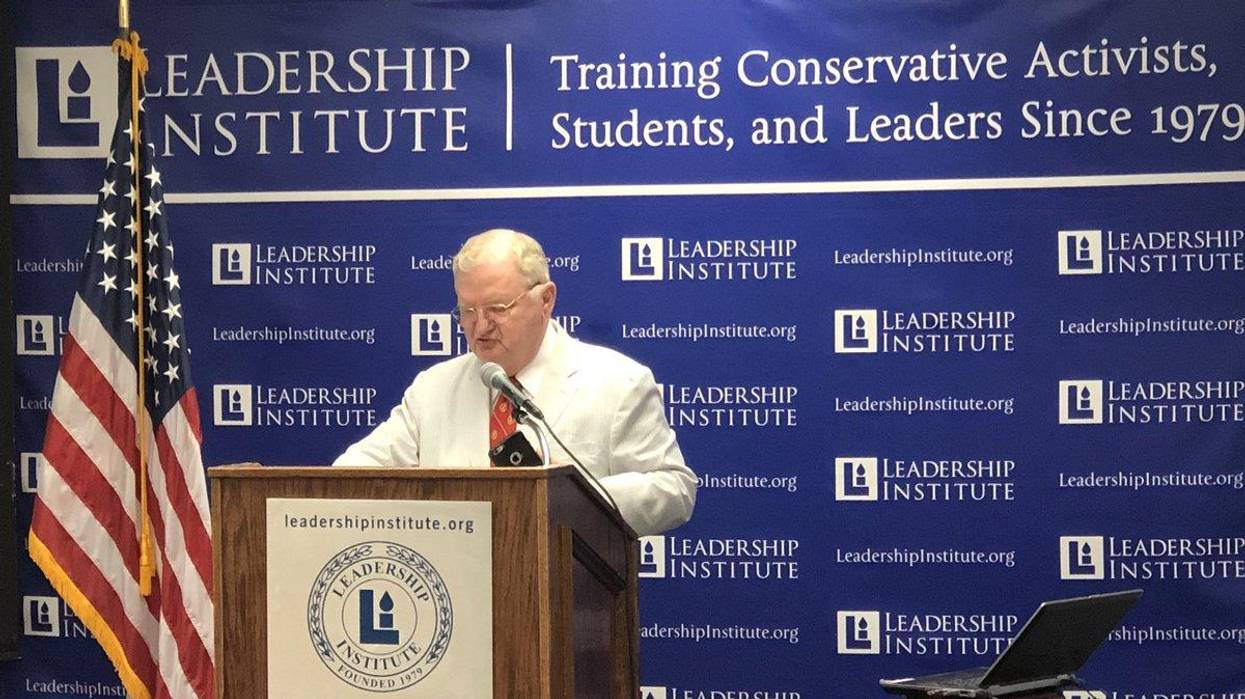
One proud graduate of The Leadership Institute is Mitch McConnell.
But largely flying under the radar has been the training operation for right-wingers to be taught how to work the media, infiltrate government and otherwise promote a right-wing agenda in the United States and in recent years extending itself through the world especially to Europe.
It's called The Leadership Institute and since it was set up in 1979 "has trained," according to its website, "more than 200,000 conservative activists, leaders and students."
One proud graduate of The Leadership Institute is Mitch McConnell, minority leader of the U.S. Senate, who on its website, below his photo, declares: "Thanks to you (Morton) and everyone who has served on your staff. There are countless conservatives making a difference in public policy across the country. As one of your earliest students, I know firsthand what a wonderful foundation the Leadership Institute's education provides for someone involved in public service."
The "Morton" he is referring to is Morton C. Blackwell, who founded The Leadership Institute, and remains its president and runs it.
Another graduate is now former U.S. Vice President Mike Pence.
As The Leadership Institute says on a page about its "Mission" on its website: "The Leadership Institute's mission is to increase the number and effectiveness of conservative activists and leaders in the public policy process."
"Institute programs prepare thousands of conservatives each year," it says. And from it, "Conservatives learn how to...Succeed in the competitive field of broadcast media, Run successfully for elected office...Communicate a conservative message using the media...Formulate policy as elected officials or key staff members. The Leadership Institute is the center of conservative activist training. No other organization provides more training to conservative activists each year."
Describing under "Headquarters" The Leadership Institute's "facility" in Arlington, Virginia, the website says it includes "a training center, professional multimedia studies, dormitories."
Blackwell's trajectory through the years has been allied with the most conservative streams in U.S. politics as detailed on The Leadership Institute's website.
"Mr. Blackwell was Barry Goldwater's youngest elected delegate to the 1964 Republican National Convention in San Francisco," it says. "He was a national convention Alternate Delegate for Ronald Reagan in 1968 and 1976, and a Ronald Reagan Delegate at the 1980 national convention. In 1980, he organized and oversaw the national youth effort for Ronald Reagan. He served as Special Assistant to the President on President Reagan's White House Staff 1981-1984. Mr. Blackwell is something of a specialist in matters relating to the rules of the Republican Party....He serves now on the RNC's Standing Committee on Rules and has attended every meeting of the Republican National Conventions' Rules Committees since 1972."
The biography also notes that The Leadership Institute's total revenue since 1974 is $274 million. It currently has revenue of over $16.9 million a year and a full-time staff of 70."
Despite its political purpose, The Leadership Institute has received 501(c)(3) non-profit status from the U.S. Internal Revenue Service.
In recent years, The Leadership Institute has extended its reach worldwide, especially to Europe.
The British-based organization openDemocracy (yes, the "o" is not capitalized and the words are combined) which seeks "to educate citizens to challenge power and encourage democratic debate across the world," conducted an investigation that resulted in a report it published in October of last year.
It was headlined: "Undercover with the US conservatives who trained Mike Pence. This is how the architects of America's culture wars are trying to export their tactics to Europe."
Its authors, Adam Ramsay and Joni Hess, write: "Our host via Zoom, the Leadership Institute, exists to 'place conservatives in the government, politics and media'- and it says its graduates include Trump's vice-president, Mike Pence. Like a multi-level marketing scheme, the workshop taught us to recruit students to right-wing activism, who would in turn recruit others. Blair stressed a growing marginalisation of conservative ideology on college campuses, and a 'moral obligation to save the US....Over several hours, we were taught to polarise discussions, to war game public debates, to reframe 'anti-worker' policies as 'right to work', to characterise pro-choice activists as 'hating babies'."
Under a subtitle, "The US culture wars go global," they continue: "This bare-knuckled politics is no longer confined to the US. The Leadership Institute has spent around $350,000 bringing its agenda to Europe since 2016, according to a new investigation by openDemocracy. There has been a marked increase in its European activities in recent years--and it spends more money in Europe than anywhere else in the world, outside the US. openDemocracy's research also reveals that the organisation has worked with controversial ultra-conservatives in Europe including a Lega politician in Italy, the Spanish far-right group CitizenGo, Croatia's anti-LGBT 'In the Name of the Family' coalition and the neo-feudalist Tradition, Family and Property movement's branches in Austria and France, as well as across Latin America."
"The Leadership Institute has also worked with a number of conservative groups and politicians in the UK--including Tim Evans, a former lobbyist for privatised healthcare; a former chair of the conservative Bow Group think-tank; and Matthew Elliott, chief executive of the Vote Leave campaign in the Brexit referendum campaign."
It continues: "Speaking to openDemocracy, the prominent UK LGBT rights activist Peter Tatchell accused the Leadership Institute of 'a form of cultural imperialism'. 'It is exporting culture wars to subvert our democracies and influence our politics. We [didn't] even know it is happening, until now,' he said."
The piece goes on: "Leadership Institute was founded by its current president Morton Blackwell in 1979. Since then, it says it has trained thousands of US conservatives, from high-school students to senior politicians, in skills from email marketing to how to get jobs on Capitol Hill. In our workshop, we were told that Blackwell thought 1964 Republican presidential candidate Barry Goldwater was ideologically correct, but saw that that didn't help him win. So he and other Goldwater supporters launched some key institutions of US conservatism: the anti-abortion and gun-rights movements, the Heritage Foundation think tank and the Leadership Institute, which works behind the scenes, recruiting, training, connecting--pushing allies onto the front lines of US politics. In the future, they swore, they'd win. And they have: their alumni, in addition to Pence, include George W. Bush's strategist Karl Rove and Republican senate majority leader Mitch McConnell."
Blackwell received the "Titan of Conservation Award" from the Heritage Foundation this past December. A Heritage Foundation press release said the entity's president, Kay C. James, "who calls Blackwell a personal mentor," asserted: "Morton Blackwell is a living legend of the conservative movement."
Trump is most thankfully gone. Trumpism, most unfortunately, is still with us--as is The Leadership Institute with its right-wing operation now extending globally.

Public interest groups celebrated Monday after the U.S. Court of Appeals for the Third Circuit quashed an effort by the Republican-led Federal Communications Commission to relax local media ownership rules.
"This decision is telling the Trump administration that it can't ignore us as it pushes regulations to enrich big companies and hurt our communities."
--Bryan Mercer, Media Mobilizing Project
"Today's ruling is a tremendous victory for the public," Free Press vice president of strategy and senior counsel Jessica J. Gonzalez said in a statement. "It admonishes the Trump FCC for its complete failure to consider the impact of its ownership policies on women and people of color."
In late 2017, the FCC voted along party lines to eliminate or weaken various rules, making it easier for companies to buy more televisions stations in the same market and killing a decades-old ban on a company owning both a newspaper and radio or TV station in the same market. As Common Dreams reported at the time, critics of media consolidation called it a "massive handout" to companies like the right-wing Sinclair Broadcast Group--which reportedly has ties to FCC Chairman Ajit Pai, who was appointed by President Donald Trump and spearheaded the overhaul.
The FCC's attempt to loosen its rules was challenged by Common Cause, the Communications Workers of America, Free Press, the Media Mobilizing Project, the Prometheus Radio Project, and the United Church of Christ Office of Communication as well as attorneys from the Georgetown Law Institute of Public Representation. In a 2-1 decision (pdf) Monday, the Philadelphia-based appeals court found that the FCC "has not shown yet that it adequately considered the effect its actions... will have on diversity in broadcast media ownership."
The decision is just the latest in a long series of rulings from the appeals court regarding the FCC's media ownership rules over the past 15 years. Gonzalez noted that "this marks the fourth time this court has rejected the relentless attempts from the FCC and the broadcast industry to weaken media-ownership limits regardless of the damage such drastic deregulation would cause local communities."
The court referenced the long legal battle in its ruling Monday, which reads in part: "To avoid sounding like a broken record, we recount only in brief the history of this case up through our most recent decision. The full account of the entire saga can be found in our earlier opinions." That tidbit was among a few parts of the decision that Free Press policy manager Dana Floberg highlighted in a series of tweets Monday:
Former FCC commissioner and Common Cause special adviser Michael Copps praised the appeals court for finding that with the 2017 overhaul, "the FCC used flawed data and woefully insubstantial analysis that does not even begin to consider the impact of its rule changes on diverse ownership."
"Our democracy suffers when just a few entities own the majority of our media, and the FCC's media ownership rules are intended to prevent that from happening."
--Michael Copps, Common Cause
"It's a great day for the public interest," declared Copps, who pointed out that "women and people of color own a dismally low number of broadcast stations in the nation," and "these communities have struggled to acquire broadcast stations in a highly consolidated industry."
"The court's decision should also put the brakes on big media consolidation," Copps said. "Since the FCC rolled back its rules, several media giants announced plans to merge seeking to take advantage of a wild west. Our democracy suffers when just a few entities own the majority of our media, and the FCC's media ownership rules are intended to prevent that from happening."
Gonzalez of Free Press said that "media consolidation leaves communities with far less of the local news and information people need to stay informed." She added:
Despite the growth in digital-media options, free over-the-air broadcasting remains a critical news source for people of color and low-income communities in particular. To meet the needs of these populations, the FCC must nurture ownership diversity, not let giant companies like Nexstar, Fox, and Sinclair devour even more local stations.
The FCC must now do the job it's long refused to do: properly weigh all of the evidence showing the impact of media consolidation on local communities. It's time we had real data on the agency's decades-long neglect of ownership diversity, and then policies designed to fix that problem for real. We're confident that the data will show that more media consolidation is the wrong path for creating a democratic and diverse media system.
Media Mobilizing Project executive director Bryan Mercer, who also welcomed Monday's ruling, said that "as we organize with Black, Brown, immigrant, and other communities in Philly, we see how the diversity of stories grounded in our communities builds our power."
"This decision is telling the Trump administration that it can't ignore us as it pushes regulations to enrich big companies and hurt our communities," he said. "We will build on this victory and support and expand diverse voices in our media here, and nationwide."
Alongside the public interest groups, the two Democratic FCC Commissioners also celebrated the court's decision. "This is big," Jessica Rosenworcel, who opposed the rule changes, wrote in a pair of tweets. "Now the FCC needs to go back to the drawing board and get it right."
FCC Commissioner Geoffrey Starks also took to Twitter Monday to praise the decision and share a statement in which he called for further federal research on diversity in media ownership.
"Today's opinion is clear: the FCC's approach to setting out media ownership rules needs a dramatic overhaul," said Starks. "We must recommit to our goals of promoting competition, localism, and diversity. We can no longer get by with the bad data and shoddy analysis--problems that have been highlighted far too often by courts and interested observers in recent years."
Pai, for his part, released a statement (pdf) on Monday accusing the majority of judges who have served on the appeals court the past 15 years of "blocking any attempt to modernize these regulations to match the obvious realities of the modern media marketplace." The chairman added that the FCC intends to seek further judicial review of the decision.
A new book by one of the nation's foremost civil liberties lawyers powerfully describes how America's constitutional checks and balances are being pushed to the brink by a president who is consciously following Adolf Hitler's extremist propaganda and policy template from the early 1930s--when the Nazis took power in Germany.
In When at Times the Mob Is Swayed: A Citizen's Guide to Defending Our Republic, Burt Neuborne mostly focuses on how America's constitutional foundation in 2019--an unrepresentative Congress, the Electoral College and a right-wing Supreme Court majority--is not positioned to withstand Trump's extreme polarization and GOP power grabs. However, its second chapter, "Why the Sudden Concern About Fixing the Brakes?," extensively details Trump's mimicry of Hitler's pre-war rhetoric and strategies.
Neuborne doesn't make this comparison lightly. His 55-year career began by challenging the constitutionality of the Vietnam War in the 1960s. He became the ACLU's national legal director in the 1980s under Ronald Reagan. He was founding legal director of the Brennan Center for Justice at New York University Law School in the 1990s. He has been part of more than 200 Supreme Court cases and Holocaust reparation litigation.
"Why does an ignorant, narcissistic buffoon like Trump trigger such anxiety? Why do so many Americans feel it existentially (not just politically) important to resist our forty-fifth president?" he writes. "Partly it's just aesthetics. Trump is such a coarse and appalling man that it's hard to stomach his presence in Abraham Lincoln's house. But that's not enough to explain the intensity of my dread. LBJ was coarse. Gerald Ford and George W. Bush were dumb as rocks. Richard Nixon was an anti-Semite. Bill Clinton's mistreatment of women dishonored his office. Ronald Reagan was a dangerous ideologue. I opposed each of them when they appeared to exceed their constitutional powers. But I never felt a sense of existential dread. I never sensed that the very existence of a tolerant democracy was in play."
A younger Trump, according to his first wife's divorce filings, kept and studied a book translating and annotating Adolf Hitler's pre-World War II speeches in a locked bedside cabinet, Neuborne noted. The English edition of My New Order, published in 1941, also had analyses of the speeches' impact on his era's press and politics. "Ugly and appalling as they are, those speeches are masterpieces of demagogic manipulation," Neuborne says.
"Watching Trump work his crowds, though, I see a dangerously manipulative narcissist unleashing the demagogic spells that he learned from studying Hitler's speeches--spells that he cannot control and that are capable of eroding the fabric of American democracy," Neuborne says. "You see, we've seen what these rhetorical techniques can do. Much of Trump's rhetoric--as a candidate and in office--mirrors the strategies, even the language, used by Adolf Hitler in the early 1930s to erode German democracy."
Many Americans may seize or condemn Neuborne's analysis, which has more than 20 major points of comparison. The author repeatedly says his goal is not "equating" the men--as "it trivializes Hitler's obscene crimes to compare them to Trump's often pathetic foibles."
Indeed, the book has a larger frame: whether federal checks and balances--Congress, the Supreme Court, the Electoral College--can contain the havoc that Trump thrives on and the Republican Party at large has embraced. But the Trump-Hitler compilation is a stunning warning, because, as many Holocaust survivors have said, few Germans or Europeans expected what unfolded in the years after Hitler amassed power.
Here's how Neuborne introduces this section. Many recent presidents have been awful, "But then there was Donald Trump, the only president in recent American history to openly despise the twin ideals--individual dignity and fundamental equality--upon which the contemporary United States is built. When you confront the reality of a president like Trump, the state of both sets of brakes--internal [constitutional] and external [public resistance]--become hugely important because Donald Trump's political train runs on the most potent and dangerous fuel of all: a steady diet of fear, greed, loathing, lies, and envy. It's a toxic mixture that has destroyed democracies before, and can do so again.
"Give Trump credit," he continues. "He did his homework well and became the twenty-first-century master of divisive rhetoric. We're used to thinking of Hitler's Third Reich as the incomparably evil tyranny that it undoubtedly was. But Hitler didn't take power by force. He used a set of rhetorical tropes codified in Trump's bedside reading that persuaded enough Germans to welcome Hitler as a populist leader. The Nazis did not overthrow the Weimar Republic. It fell into their hands as the fruit of Hitler's satanic ability to mesmerize enough Germans to trade their birthright for a pottage of scapegoating, short-term economic gain, xenophobia, and racism. It could happen here."
20 Common Themes, Rhetorical Tactics and Dangerous Policies
Here are 20 serious points of comparison between the early Hitler and Trump:
1. Neither was elected by a majority. Trump lost the popular vote by 2.9 million votes, receiving votes by 25.3 percent of all eligible American voters. "That's just a little less than the percentage of the German electorate that turned to the Nazi Party in 1932-33," Neuborne writes. "Unlike the low turnouts in the United States, turnout in Weimar Germany averaged just over 80 percent of eligible voters." He continues, "Once installed as a minority chancellor in January 1933, Hitler set about demonizing his political opponents, and no one--not the vaunted, intellectually brilliant German judiciary; not the respected, well-trained German police; not the revered, aristocratic German military; not the widely admired, efficient German government bureaucracy; not the wealthy, immensely powerful leaders of German industry; and not the powerful center-right political leaders of the Reichstag--mounted a serious effort to stop him."
2. Both found direct communication channels to their base. By 1936's Olympics, Nazi narratives dominated German cultural and political life. "How on earth did Hitler pull it off? What satanic magic did Trump find in Hitler's speeches?" Neuborne asks. He addresses Hitler's extreme rhetoric soon enough, but notes that Hitler found a direct communication pathway--the Nazi Party gave out radios with only one channel, tuned to Hitler's voice, bypassing Germany's news media. Trump has an online equivalent.
"Donald Trump's tweets, often delivered between midnight and dawn, are the twenty-first century's technological embodiment of Hitler's free plastic radios," Neuborne says. "Trump's Twitter account, like Hitler's radios, enables a charismatic leader to establish and maintain a personal, unfiltered line of communication with an adoring political base of about 30-40 percent of the population, many (but not all) of whom are only too willing, even anxious, to swallow Trump's witches' brew of falsehoods, half-truths, personal invective, threats, xenophobia, national security scares, religious bigotry, white racism, exploitation of economic insecurity, and a never ending-search for scapegoats."
3. Both blame others and divide on racial lines. As Neuborne notes, "Hitler used his single-frequency radios to wax hysterical to his adoring base about his pathological racial and religious fantasies glorifying Aryans and demonizing Jews, blaming Jews (among other racial and religious scapegoats) for German society's ills." That is comparable to "Trump's tweets and public statements, whether dealing with black-led demonstrations against police violence, white-led racist mob violence, threats posed by undocumented aliens, immigration policy generally, protests by black and white professional athletes, college admission policies, hate speech, even response to hurricane damage in Puerto Rico," he says. Again and again, Trump uses "racially tinged messages calculated to divide whites from people of color."
4. Both relentlessly demonize opponents. "Hitler's radio harangues demonized his domestic political opponents, calling them parasites, criminals, cockroaches, and various categories of leftist scum," Neuborne notes. "Trump's tweets and speeches similarly demonize his political opponents. Trump talks about the country being 'infested' with dangerous aliens of color. He fantasizes about jailing Hillary Clinton, calls Mexicans rapists, refers to 'shithole countries,' degrades anyone who disagrees with him, and dreams of uprooting thousands of allegedly disloyal bureaucrats in the State Department, the Environmental Protection Agency, the FBI, and the CIA, who he calls 'the deep state' and who, he claims, are sabotaging American greatness."
5. They unceasingly attack objective truth. "Both Trump and Hitler maintained a relentless assault on the very idea of objective truth," he continues. "Each began the assault by seeking to delegitimize the mainstream press. Hitler quickly coined the epithet Lugenpresse (literally 'lying press') to denigrate the mainstream press. Trump uses a paraphrase of Hitler's lying press epithet--'fake news'--cribbed, no doubt, from one of Hitler's speeches. For Trump, the mainstream press is a 'lying press' that publishes 'fake news.'" Hitler attacked his opponents as spreading false information to undermine his positions, Neuborne says, just as Trump has attacked "elites" for disseminating false news, "especially his possible links to the Kremlin."
6. They relentlessly attack mainstream media. Trump's assaults on the media echo Hitler's, Neuborne says, noting that he "repeatedly attacks the 'failing New York Times,' leads crowds in chanting 'CNN sucks,' [and] is personally hostile to most reporters." He cites the White House's refusal to fly the flag at half-mast after the murder of five journalists in Annapolis in June 2018, Trump's efforts to punish CNN by blocking a merger of its corporate parent, and trying to revoke federal Postal Service contracts held by Amazon, which was founded by Jeff Bezos, who also owns the Washington Post.
7. Their attacks on truth include science. Neuborne notes, "Both Trump and Hitler intensified their assault on objective truth by deriding scientific experts, especially academics who question Hitler's views on race or Trump's views on climate change, immigration, or economics. For both Trump and Hitler, the goal is (and was) to eviscerate the very idea of objective truth, turning everything into grist for a populist jury subject to manipulation by a master puppeteer. In both Trump's and Hitler's worlds, public opinion ultimately defines what is true and what is false."
8. Their lies blur reality--and supporters spread them. "Trump's pathological penchant for repeatedly lying about his behavior can only succeed in a world where his supporters feel free to embrace Trump's 'alternative facts' and treat his hyperbolic exaggerations as the gospel truth," Neuborne says. "Once Hitler had delegitimized the mainstream media by a series of systematic attacks on its integrity, he constructed a fawning alternative mass media designed to reinforce his direct radio messages and enhance his personal power. Trump is following the same path, simultaneously launching bitter attacks on the mainstream press while embracing the so-called alt-right media, co-opting both Sinclair Broadcasting and the Rupert Murdoch-owned Fox Broadcasting Company as, essentially, a Trump Broadcasting Network."
9. Both orchestrated mass rallies to show status. "Once Hitler had cemented his personal communications link with his base via free radios and a fawning media and had badly eroded the idea of objective truth, he reinforced his emotional bond with his base by holding a series of carefully orchestrated mass meetings dedicated to cementing his status as a charismatic leader, or Fuhrer," Neuborne writes. "The powerful personal bonds nurtured by Trump's tweets and Fox's fawning are also systematically reinforced by periodic, carefully orchestrated mass rallies (even going so far as to co-opt a Boy Scout Jamboree in 2017), reinforcing Trump's insatiable narcissism and his status as a charismatic leader."
10. They embrace extreme nationalism. "Hitler's strident appeals to the base invoked an extreme version of German nationalism, extolling a brilliant German past and promising to restore Germany to its rightful place as a preeminent nation," Neuborne says. "Trump echoes Hitler's jingoistic appeal to ultranationalist fervor, extolling American exceptionalism right down to the slogan 'Make America Great Again,' a paraphrase of Hitler's promise to restore German greatness."
11. Both made closing borders a centerpiece. "Hitler all but closed Germany's borders, freezing non-Aryan migration into the country and rendering it impossible for Germans to escape without official permission. Like Hitler, Trump has also made closed borders a centerpiece of his administration," Neuborne continues. "Hitler barred Jews. Trump bars Muslims and seekers of sanctuary from Central America. When the lower courts blocked Trump's Muslim travel ban, he unilaterally issued executive orders replacing it with a thinly disguised substitute that ultimately narrowly won Supreme Court approval under a theory of extreme deference to the president."
12. They embraced mass detention and deportations. "Hitler promised to make Germany free from Jews and Slavs. Trump promises to slow, stop, and even reverse the flow of non-white immigrants, substituting Muslims, Africans, Mexicans, and Central Americans of color for Jews and Slavs as scapegoats for the nation's ills. Trump's efforts to cast dragnets to arrest undocumented aliens where they work, live, and worship, followed by mass deportation... echo Hitler's promise to defend Germany's racial identity," he writes, also noting that Trump has "stooped to tearing children from their parents [as Nazis in World War II would do] to punish desperate efforts by migrants to find a better life."
13. Both used borders to protect selected industries. "Like Hitler, Trump seeks to use national borders to protect his favored national interests, threatening to ignite protectionist trade wars with Europe, China, and Japan similar to the trade wars that, in earlier incarnations, helped to ignite World War I and World War II," Neuborne writes. "Like Hitler, Trump aggressively uses our nation's political and economic power to favor selected American corporate interests at the expense of foreign competitors and the environment, even at the price of international conflict, massive inefficiency, and irreversible pollution [climate change]."
14. They cemented their rule by enriching elites. "Hitler's version of fascism shifted immense power--both political and financial--to the leaders of German industry. In fact, Hitler governed Germany largely through corporate executives," he continues. "Trump has also presided over a massive empowerment--and enrichment--of corporate America. Under Trump, large corporations exercise immense political power while receiving huge economic windfalls and freedom from regulations designed to protect consumers and the labor force.
"Hitler despised the German labor movement, eventually destroying it and imprisoning its leaders. Trump also detests strong unions, seeking to undermine any effort to interfere with the prerogatives of management."
15. Both rejected international norms. "Hitler's foreign policy rejected international cooperation in favor of military and economic coercion, culminating in the annexation of the Sudetenland, the phony Hitler-Stalin nonaggression pact, the invasion of Czechoslovakia, and the horrors of global war," Neuborne notes. "Like Hitler, Trump is deeply hostile to multinational cooperation, withdrawing from the Trans-Pacific Partnership, the Paris Agreement on climate change, and the nuclear agreement with Iran, threatening to withdraw from the North American Free Trade Agreement, abandoning our Kurdish allies in Syria, and even going so far as to question the value of NATO, our post-World War II military alliance with European democracies against Soviet expansionism."
16. They attack domestic democratic processes. "Hitler attacked the legitimacy of democracy itself, purging the voting rolls, challenging the integrity of the electoral process, and questioning the ability of democratic government to solve Germany's problems," Neuborne notes. "Trump has also attacked the democratic process, declining to agree to be bound by the outcome of the 2016 elections when he thought he might lose, supporting the massive purge of the voting rolls allegedly designed to avoid (nonexistent) fraud, championing measures that make it harder to vote, tolerating--if not fomenting--massive Russian interference in the 2016 presidential election, encouraging mob violence at rallies, darkly hinting at violence if Democrats hold power, and constantly casting doubt on the legitimacy of elections unless he wins."
17. Both attack the judiciary and rule of law. "Hitler politicized and eventually destroyed the vaunted German justice system. Trump also seeks to turn the American justice system into his personal playground," Neuborne writes. "Like Hitler, Trump threatens the judicially enforced rule of law, bitterly attacking American judges who rule against him, slyly praising Andrew Jackson for defying the Supreme Court, and abusing the pardon power by pardoning an Arizona sheriff found guilty of criminal contempt of court for disobeying federal court orders to cease violating the Constitution."
18. Both glorify the military and demand loyalty oaths. "Like Hitler, Trump glorifies the military, staffing his administration with layers of retired generals (who eventually were fired or resigned), relaxing control over the use of lethal force by the military and the police, and demanding a massive increase in military spending," Neuborne writes. Just as Hitler "imposed an oath of personal loyalty on all German judges" and demanded courts defer to him, "Trump's already gotten enough deference from five Republican [Supreme Court] justices to uphold a largely Muslim travel ban that is the epitome of racial and religious bigotry."
Trump has also demanded loyalty oaths. "He fired James Comey, a Republican appointed in 2013 as FBI director by President Obama, for refusing to swear an oath of personal loyalty to the president; excoriated and then sacked Jeff Sessions, his handpicked attorney general, for failing to suppress the criminal investigation into... Trump's possible collusion with Russia in influencing the 2016 elections; repeatedly threatened to dismiss Robert Mueller, the special counsel carrying out the investigation; and called again and again for the jailing of Hillary Clinton, his 2016 opponent, leading crowds in chants of 'lock her up.'" A new chant, "send her back," has since emerged at Trump rallies directed at non-white Democratic congresswomen.
19. They proclaim unchecked power. "Like Hitler, Trump has intensified a disturbing trend that predated his administration of governing unilaterally, largely through executive orders or proclamations," Neuborne says, citing the Muslim travel ban, trade tariffs, unraveling of health and environmental safety nets, ban on transgender military service, and efforts to end President Obama's protection for Dreamers. "Like Hitler, Trump claims the power to overrule Congress and govern all by himself. In 1933, Hitler used the pretext of the Reichstag fire to declare a national emergency and seize the power to govern unilaterally. The German judiciary did nothing to stop him. German democracy never recovered."
"When Congress refused to give Trump funds for his border wall even after he threw a tantrum and shut down the government, Trump, like Hitler, declared a phony national emergency and claimed the power to ignore Congress," Neuborne continues. "Don't count on the Supreme Court to stop him. Five justices gave the game away on the President's unilateral travel ban. They just might do the same thing on the border wall." It did in late July, ruling that Trump could divert congressionally appropriated funds from the Pentagon budget--undermining constitutional separation of powers.
20. Both relegate women to subordinate roles. "Finally," writes Neuborne, "Hitler propounded a misogynistic, stereotypical view of women, valuing them exclusively as wives and mothers while excluding them from full participation in German political and economic life. Trump may be the most openly misogynist figure ever to hold high public office in the United States, crassly treating women as sexual objects, using nondisclosure agreements and violating campaign finance laws to shield his sexual misbehavior from public knowledge, attacking women who come forward to accuse men of abusive behavior, undermining reproductive freedom, and opposing efforts by women to achieve economic equality."
Whither Constitutional Checks and Balances?
Most of Neuborne's book is not centered on Trump's fealty to Hitler's methods and early policies. He notes, as many commentators have, that Trump is following the well-known contours of authoritarian populists and dictators: "there's always a charismatic leader, a disaffected mass, an adroit use of communications media, economic insecurity, racial or religious fault lines, xenophobia, a turn to violence, and a search for scapegoats."
The bigger problem, and the subject of most of the book, is that the federal architecture intended to be a check and balance against tyrants, is not poised to act. Congressional representation is fundamentally anti-democratic. In the Senate, politicians representing 18 percent of the national population--epicenters of Trump's base--can cast 51 percent of the chamber's votes. A Republican majority from rural states, representing barely 40 percent of the population, controls the chamber. It repeatedly thwarts legislation reflecting multicultural America's values--and creates a brick wall for impeachment.
The House of Representatives is not much better. Until 2018, this decade's GOP-majority House, a product of 2011's extreme Republican gerrymanders, was also unrepresentative of the nation's demographics. That bias still exists in the Electoral College, as the size of a state's congressional delegation equals its allocation of votes. That formula is fair as far as House members go, but allocating votes based on two senators per state hurts urban America. Consider that California's population is 65 times larger than Wyoming's.
Meanwhile, the Supreme Court's majority remains in the hands of justices appointed by Republican presidents--and favors that party's agenda. Most Americans are unaware that the court's partisan majority has only changed twice since the Civil War--in 1937, when a Democratic-appointed majority took over, and in 1972, when a Republican-appointed majority took over. Senate Republican Majority Leader Mitch McConnell's blocking of President Obama's final nominee thwarted a twice-a-century change. Today's hijacked Supreme Court majority has only just begun deferring to Trump's agenda.
Neuborne wants to be optimistic that a wave of state-based resistance, call it progressive federalism, could blunt Trump's power grabs and help the country return to a system embracing, rather than demonizing, individual dignity and fundamental equality. But he predicts that many Americans who supported Trump in 2016 (largely, he suggests, because their plights have been overlooked for many years by federal power centers and by America's capitalist hubs) won't desert Trump--not while he's in power.
"When tyrants like Hitler are ultimately overthrown, their mass support vanishes retroactively--everyone turns out to have been in the resistance--but the mass support was undeniably there," he writes. "There will, of course, be American quislings who will enthusiastically support an American tyrant. There always are--everywhere."
Ultimately, Neuborne doesn't expect there will be a "constitutional mechanic in the sky ready to swoop down and save American democracy from Donald Trump at the head of a populist mob." Whatever Trump thinks he is or isn't doing, his rhetorical and strategic role model--the early Hitler--is what makes Trump and today's GOP so dangerous.
"Even if all that Trump is doing is marching to that populist drum, he is unleashing forces that imperil the fragile fabric of a multicultural democracy," Neuborne writes. "But I think there's more. The parallels--especially the links between Lugenpresse and 'fake news,' and promises to restore German greatness and 'Make America Great Again'--are just too close to be coincidental. I'm pretty sure that Trump's bedside study of Hitler's speeches--especially the use of personal invective, white racism, and xenophobia--has shaped the way Trump seeks to gain political power in our time. I don't for a moment believe that Trump admires what Hitler eventually did with his power [genocide], but he damn well admires--and is successfully copying--the way that Hitler got it."