

SUBSCRIBE TO OUR FREE NEWSLETTER
Daily news & progressive opinion—funded by the people, not the corporations—delivered straight to your inbox.
5
#000000
#FFFFFF
To donate by check, phone, or other method, see our More Ways to Give page.
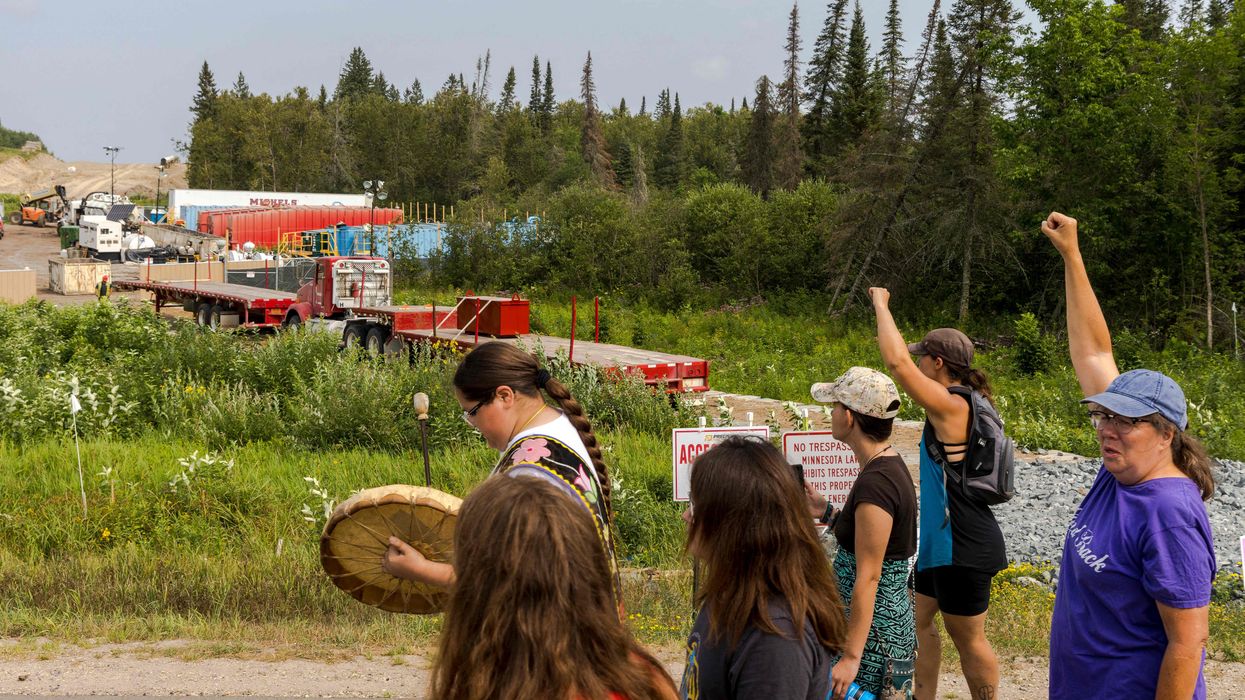
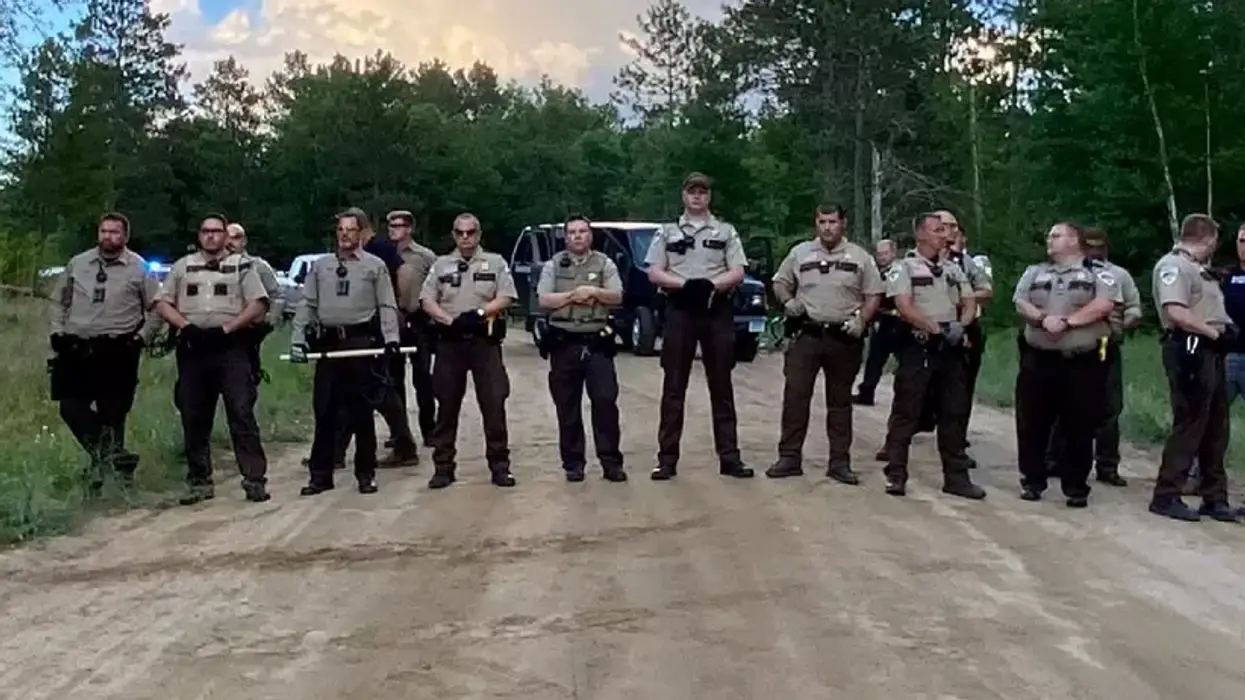
By the end of the day, 186 people had been detained in the largest mass-arrest of the opposition movement. Some officers stuck around to process arrests, while others stopped for snacks at a gas station or ordered Chinese takeout before crashing at a nearby motel.
These latter details might be considered irrelevant, except for the fact that the police and emergency workers’ takeout, motel rooms, riot gear, gas, wages, and trainings were paid for by one side of the dispute — Enbridge, which spent more than $79,000 on policing that day alone.
When the Minnesota Public Utilities Commission gave Enbridge permission in 2020 to replace its corroded Line 3 pipeline and double its capacity, it included an unusual condition in the permit: Enbridge would pay the police as they responded to the acts of civil disobedience that the project would surely spark. The pipeline company’s money would be funneled to law enforcement and other government agencies via a Public Safety Escrow Account managed by the state.
By the time construction finished in fall 2021, prosecutors had filed 967 criminal cases related to pipeline protests, and police had submitted hundreds of receipts and invoices to the Enbridge-funded escrow account, seeking reimbursement. Through a public records request, Grist and the Center for Media and Democracy have obtained and reviewed every one of those invoices, providing the most complete picture yet of the ways the pipeline company paid for the arrests of its opponents — and much more.
From pizza and “Pipeline Punch” energy drinks, to porta potties, riot suits, zip ties, and salaries, Enbridge poured a total of $8.6 million into 97 public agencies, from the northern Minnesota communities that the pipeline intersected to southern counties from which deputies traveled hours to help quell demonstrations.
By far the biggest set of expenses reimbursed from the Enbridge escrow account was over $5 million for wages, meals, lodging, mileage, and other contingencies as police and emergency workers responded to protests during construction. Over $1.3 million each went toward equipment and planning, including dozens of training sessions. Enbridge also reimbursed nearly a quarter million dollars for the cost of responding to pipeline-related human trafficking and sexual violence.

(Credit: Jessie Blaeser / Grist)
Reporters for Grist and the Center for Media and Democracy reviewed more than 350 records requested from the Minnesota Public Utilities Commission, pulling out totals described in invoices and receipts and dividing them into categories such as equipment, wages, and training. Each agency had its own method for tracking expenses, with varying levels of specificity. In cases where reporters were unable to cleanly disentangle different types of expenses, those expenses were categorized as “other/multiple.” Generally, totals should be considered conservative estimates for each category.
The $79,000 that Enbridge paid for the single day of arrests on June 7, which doesn’t include all of the Enbridge-funded equipment and training many officers relied on, displays the wide range of activities and agencies Enbridge’s money touched. The county attorney’s office of Hubbard County, where the protest took place, even attempted to get Enbridge to reimburse $27,000 in prosecution expenses. In other words, the area’s top arbiter of justice assumed that Enbridge would be covering the cost of pursuing charges against hundreds of water protectors. (The state-appointed escrow account manager denied the request.)
Some of the most surprising Enbridge invoices were from institutions and officials associated with protecting Minnesota’s environmental resources and preserving a balance between industry and the public interest. No agency received more escrow account money than the Minnesota Department of Natural Resources, or DNR, which is also one of the primary agencies monitoring Line 3 for environmental harms. Of the $2.1 million that the DNR received, the funds were mainly used to respond to protests and train state enforcement officers about how to manage protesters, in some cases before construction had even begun. Conservation officers joined police on the front lines of protests, on the pipeline company’s dime.
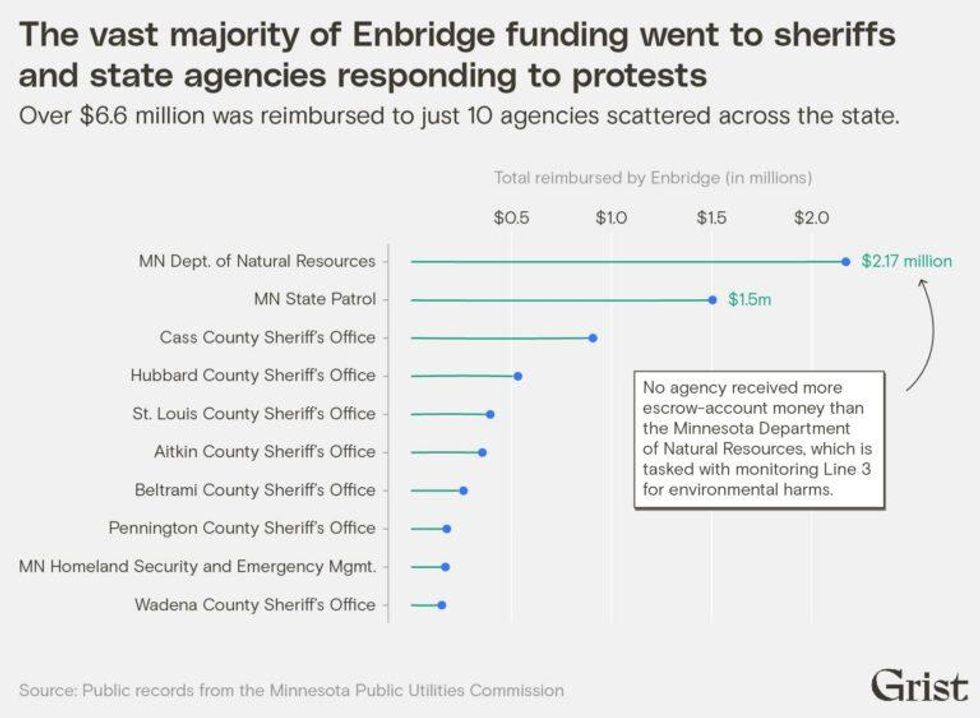
(Credit: Jessie Blaeser / Grist)
The Aitkin County-run Long Lake Conservation Center, one of the oldest environmental education centers in the U.S., provided facilities to police to the tune of over $40,000, which the sheriff’s office paid using Enbridge funds. And a public safety liaison hired to coordinate among Enbridge, the Public Utilities Commission, and local officials was paid $120,000 in salary and benefits by the pipeline company over a year and a half.
The invoices also document, in unusual detail, the connection between fossil fuel megaproject construction and violence against women: Enbridge reimbursed a nonprofit organization for the cost of hotel rooms for women who had been assaulted by Line 3 workers, according to an invoice submitted by the nonprofit. The pipeline company also helped pay for two sex trafficking stings conducted by the Minnesota Human Trafficking Investigative Task Force, leading to the arrest of at least four Line 3 pipeline workers.
The state of Minnesota also considered police public relations to be expenses eligible for Enbridge funding. John Elder, at the time spokesperson for the Minneapolis Police Department, put out police press releases and responded to journalist queries on behalf of the Northern Lights Task Force, which was set up to coordinate emergency response agencies throughout the protests. Enbridge ultimately reimbursed the St. Louis County Sheriff’s Office for 331 hours of his work at a wage of $80 per hour. (St. Louis County Sheriff Gordon Ramsay said he was not in office during pipeline construction and could not comment on Line-3-related work, and Elder did not respond to requests for comment.)
A year earlier, Elder had handled Minneapolis police PR when one of the city’s officers killed George Floyd, sparking an unprecedented wave of nationwide protests. Elder was behind the notorious press release stating that Floyd had “physically resisted officers” and died after he “appeared to be suffering medical distress.” Hours later, a bystander video went viral, showing that the medical distress followed an officer pressing his knee on Floyd’s neck for for more than nine minutes. Fallout from the press release did not stop law enforcement agencies from choosing Elder to lead officials’ public relations surrounding the Line 3 protests.
Water protectors contend that the state of Minnesota’s arrangement with Enbridge trampled their constitutional rights. With 97 criminal cases unresolved across the state, five defendants in Aitkin County are pursuing motions arguing that the escrow account created an unconstitutional police and prosecutor bias that violated their rights to due process and equal protection under the law. They want the charges dismissed. Attorneys with the Partnership for Civil Justice Fund’s Center for Protest Law and Litigation previously used the defense against charges filed by Hubbard County that were ultimately dismissed. They’re now preparing a separate civil lawsuit challenging the use of the escrow account on constitutional grounds.
Winona LaDuke, an Anishinaabe activist and founder of the Indigenous environmental nonprofit Honor the Earth, is among those arguing in court that charges should be thrown out. Aitkin County, the jurisdiction behind the allegations she’s fighting, was reimbursed $6,007.70 for wages and benefits on just one of the days she was arrested. LaDuke believes the money amped up the police response.
“They were far more aggressive with us, far more intent on finding any possible reason to stop somebody,” she said. “Law enforcement is supposed to protect and serve the people. They work for Enbridge.”
LaDuke added that she believes the DNR’s Enbridge money represents a “conflict of interest.” In addition to its role in monitoring the pipeline’s full Minnesota route, the agency is directly responsible for the ecological health of 35 miles of state lands and 66 waterways that Line 3 crosses — and where Anishinaabe people have distinct treaty rights to hunt, gather, and travel. To date, the DNR and the Minnesota Pollution Control Agency have charged Enbridge over $11 million in penalties for violations that include dozens of drilling fluid spills and three aquifer breaches that occurred during construction. LaDuke and others have criticized the agency’s response to the incidents, noting that it took months to publicly disclose the first of the aquifer breaches.
Juli Kellner, an Enbridge spokesperson, emphasized that the escrow account was operated by an independent manager who reported to the Public Utilities Commission, not the oil company. Kellner said the account was created to relieve communities from the increased financial burden that public safety agencies accrued when responding to protests.
“Enbridge provided funding but had no decision-making authority on reimbursement requests,” she said.
Ryan Barlow, the Public Utilities Commission’s general counsel, said the commission had no comment about the appropriateness of specific expenses: “If expenses met the conditions of the permit they were approved; if they did not, they were not approved.”
In a statement, the DNR said that receiving reimbursement from Enbridge does not constitute a conflict of interest: “At no time were state law enforcement personnel under the control or direction of Enbridge, and at no time did the opportunity for reimbursement for our public safety work in any way influence our regulatory decisions.”
When asked why its officers were trained how to use chemical weapons ahead of the protests, the DNR said their peace officers’ overall mission is “protecting Minnesota’s natural resources and the people who use them” and that such equipment, while occasionally necessary, “is not used as part of conservation officers’ routine work.”
Hubbard County Sheriff Cory Aukes said his agency’s response was dictated by the protestors and water protectors. “If they want to block roads, threaten workers, and cause $100,000 worth of damage to Enbridge equipment, well, we have a job to do, and we did it,” Aukes said, adding that Enbridge is a taxpayer that officers have a duty to protect. “Enbridge is a big taxpayer in Hubbard county and we would be doing an injustice if we didn’t support them as well.”
“We were in the middle,” added Aitkin County Sheriff Dan Guida. “There were probably times when it seems like we dealt with water protectors in a more criminal way, but they were the ones breaking the law.” He added that officers had no knowledge of the reimbursement plan and that the funds spared taxpayers the cost of policing the pipeline.
Long Lake Conservation Center manager Dave McMillan, on the other hand, said he knew the money the Aitkin County Sheriff’s Office paid his organization for police officer lodging would come from Enbridge. “My concern was not wanting to become a pawn or a player in this political battle. In the same token, we said if any of the organizations that were protesting said they wanted to come here and use our facilities, we would have said yes,” he said. Enbridge’s connection to the facility runs even deeper: The company’s director of tribal engagement sits on the board of the Long Lake Conservation Foundation, which helps fund the county-run facility.
With energy infrastructure fights brewing over liquid natural gas terminals in the Southeast, lithium mining in the West, and the Enbridge-operated Line 5 pipeline in Wisconsin and Michigan, the ongoing legal cases that have ensnared the water protectors will help decide whether or not the public safety escrow account will be replicated elsewhere.
“Our concern is that this now will become the model for deployment nationwide against any community that is rising up against corporate abuse,” said Mara Verheyden-Hilliard, the director of the Center for Protest Law and Litigation, who is representing some of the water protectors. “It becomes very easy to sell this to the public as a savings for taxpayers, when instead what they’re doing is selling their police department to serve the pecuniary interests of a corporation.”
Long before Line 3 construction began, Anishinaabe-led water defenders promised they would rise up if the expanded pipeline was permitted. Members of the Minnesota Public Utilities Commission warily looked west to North Dakota, where in 2016 and 2017 public agencies spent $38 million policing massive protests led by members of the Standing Rock Sioux Tribe against construction of the Dakota Access Pipeline. With global concerns about climate change and biodiversity reaching a fever pitch, building an oil pipeline now came with a hefty civil disobedience bill, and the commissioners did not want taxpayers to foot it.
According to the pipeline permit, finalized in 2020, whenever a Minnesota public safety agency spent money on almost anything related to Line 3, they could submit an invoice, and Enbridge would pay it. Nonprofits responding to drug and human trafficking were also eligible for grants from the account. To create a layer of separation between police and the Enbridge money, the state hired an account manager to decide which invoices would be fulfilled.
Minnesota wasn’t the only state considering this kind of account. In 2019, South Dakota Governor Kristi Noem passed a law designed to establish “the next generation model of funding pipeline construction.” The law created a fund for law enforcement and emergency managers responding to pipeline protests, paid partly by new rioting penalties, but also with as much as $20 million from the company behind the pipeline. Noem’s office collaborated on the legislation with TransCanada, now known as TC Energy, which was preparing to build the controversial Keystone XL tar sands oil pipeline. But with Keystone XL defunct after President Joe Biden pulled a key permit in 2021, only Minnesota would have the opportunity to fully test the new model.
Even before Line 3 received its final permit on November 30, 2020, more than $1 million in reimbursement-eligible expenses had been spent. Sheriffs’ offices were already buying riot gear and conducting crowd control trainings in 2016 and 2017, in anticipation of the protests.
Key to coordinating it all was the Northern Lights Task Force, established in September 2018 and consisting of law enforcement and other public officials from 16 counties along the pipeline route or otherwise hosting Enbridge infrastructure, as well as representatives from nearby reservations and state agencies. Task force members met at least a dozen times before construction began, the invoices show, and at times Enbridge representatives joined. It didn’t necessarily matter, however, whether Enbridge was physically in the room, because the company’s money was always there: For the law enforcement agencies that requested it, the corporation paid wages and overtime for each Northern Lights Task Force meeting attended.
David Olmstead, a retired Bloomington police commander appointed by the Minnesota Department of Homeland Security and Emergency Management to fulfill the duties of the Line 3 public safety liaison, coordinated between Enbridge and public officials. Enbridge reimbursed the homeland security agency Olmstead’s salary and benefits as well as more than $20,000 in lodging expenses that Olmstead charged to a credit card, which included a room at Duluth’s Fairfield Inn that was rented for two straight months at the height of protests in June and July 2021, for a nightly rate of $165.
Indeed, for some, pipeline work became a full-time job funded by the multinational company. In October 2019, the Minnesota State Patrol assigned Captain Joe Dwyer to the role of commander for demonstration preparedness, a position he held for the next two years. “I attended various planning meetings and tabletop exercises,” Dwyer wrote in a letter submitted to the Enbridge account manager. “I also facilitated conversations, provided training and conducted extensive research related to response plans along the construction route with the various stakeholders associated with the project.” Dwyer got a dollar-per-hour pay bump and earned $50.82 hourly working in his new role. Enbridge covered tens of thousands of dollars of Dwyer’s wages.
Howie Padilla, a spokesperson for the Minnesota Department of Public Safety, which oversees both the Minnesota State Patrol and Department of Homeland Security and Emergency Management, underlined in a statement, “At no time were state law enforcement resources under the control or direction of Enbridge.”
Olmstead and Dwyer, who did not respond to requests for comment, helped set up a network of emergency operations centers to be activated when protests kicked off. In St. Louis County, the sheriff’s office contracted Paramount Planning, a company that counts Enbridge among its clients, to help run the Northeast Emergency Operations Center. Paramount agreed to coordinate the various law enforcement agencies, create a staffing schedule, and attend meetings, including intelligence-sharing meetings. Enbridge reimbursed the sheriff’s office just under $50,000 for Paramount’s work.
Paramount’s president and owner, Blain Johnson, said he was unaware that Enbridge had paid for his company’s St. Louis County contract. He said that an Enbridge representative attended the emergency operations center’s morning meetings, but that Paramount did not otherwise communicate with the corporation about its work for the St. Louis County Sheriff. Johnson acknowledged, however, that Paramount staff did work for Enbridge on consulting with tribes about the Line 3 pipeline. “Realistically, you could look at it as kind of a conflict of interest, but that part of the company was completely separated from what we were working on with the sheriff’s office,” Johnson said.
Law enforcement leaders also worked with task force members as they arranged dozens of training sessions. Although a large proportion focused on crowd control tactics, others covered techniques for dismantling lock-downs, responding to weapons of mass destruction, policing sex trafficking, upholding the constitution, understanding Native American culture, and using lessons learned from policing the Dakota Access Pipeline. Public officials spent over $950,000 of Enbridge’s money on training expenses, including meals, lodging, mileage, training fees, and wages.
Three quarters of the Enbridge training money went to the Department of Natural Resources. The agency’s enforcement division is not only responsible for upholding environmental laws and ticketing deviant poachers and recreational vehicle drivers, but it also has full police powers on state lands. While riot control may not be in the typical job description of a Minnesota conservation officer, previously known as a game warden, dozens of them trained to control crowds and use less-lethal chemical weapons.
The Enbridge fund wasn’t supposed to be primarily for stuff. To limit purchases, Public Utilities Commission members added language in the permit stipulating that public agencies could only use it to buy personal protective equipment, or PPE.
Over half of PPE funds went toward riot gear valued at more than $700,000, which was purchased from police equipment vendors like Streicher’s and Galls. For 13 county and city police forces, that meant more than $5,000 in riot suits, shields, and gas masks. The Beltrami County Sheriff’s Office took over $70,000 for riot gear, and the Polk County Sheriff’s Office more than $50,000. (Neither office responded to requests for comment.) However it was state agencies that received more than half of the Enbridge reimbursements for crowd control equipment: more than $200,000 for the Minnesota State Patrol, and over $170,000 for the Department of Natural Resources.

(Credit: Jessie Blaeser / Grist)
Enbridge also covered more than $325,000 in clothing — mostly cold weather apparel — as well as over $55,000 for hand, foot, and body warmers. Even the identification patches worn on many deputies’ lapels were paid for by Enbridge — totaling more than $7,000. Another $2,000 went toward porta potty rentals, and over $12,000 more toward gear to protect police as they detached protesters who had locked themselves to equipment, including face shields and flame-proof blankets to guard against flying sparks.
Enbridge paid not only for the time the Sheriff’s deputies took to arrest water protectors and bind their hands behind their backs, but also for the handcuffs themselves, which were dubbed PPE and paid for by the pipeline company. The state of Minnesota approved more than $12,500 in Enbridge funds for zip ties and handcuffs.
“Less lethal” weapons did not count as personal protective equipment, the account manager decided, to the frustration of some law enforcement leaders. The Beltrami County Sheriff’s Office attempted to claim over $10,000 worth of less lethal weaponry from Enbridge, including 250 bean bag rounds, two projectile launchers, 24 distraction devices, 61 batons, and various chemical weapons and ammunition such as pepper spray, 46 tear gas grenades, and 25 tear gas projectiles. And the Wright County Sheriff’s Office asked for Enbridge funds to cover $1,700 worth of pepper spray, sponge rounds, and other less than lethal weapons. All were denied.
Winona County Sheriff Ron Ganrude said sheriffs in southeastern Minnesota had compiled a list of equipment, including batons, that they expected deputies would need as they traveled north to assist on Line 3. Both the Winona County Sheriff’s Office and the city of Park Rapids attempted to use the escrow funds to pay for batons but were denied.
However, even though Enbridge couldn’t buy these weapons, the company did cover trainings on how to use them. Several trainings were provided by the tear gas manufacturer Safariland, costing thousands of dollars. Enbridge also reimbursed over $260,000 worth of gas masks and attachments, including filters for tear gas, presumably to protect law enforcement from the chemicals they themselves would be deploying.
It wasn’t necessarily the counties with the heaviest protest activity that purchased the most equipment using Enbridge money. Among the top five local law enforcement equipment buyers was the Otter Tail County Sheriff’s Office, located south of the pipeline route, which purchased more than $37,000 in riot gear using Enbridge money. Also among the top spenders was the Freeborn County Sheriff’s Office, located in one of Minnesota’s southernmost counties. The agency’s only Enbridge-related expense besides equipment was for three officers to spend a two- to three-day deployment assisting other agencies along the pipeline route in the northern part of the state. (The office did not respond to requests for comment.)
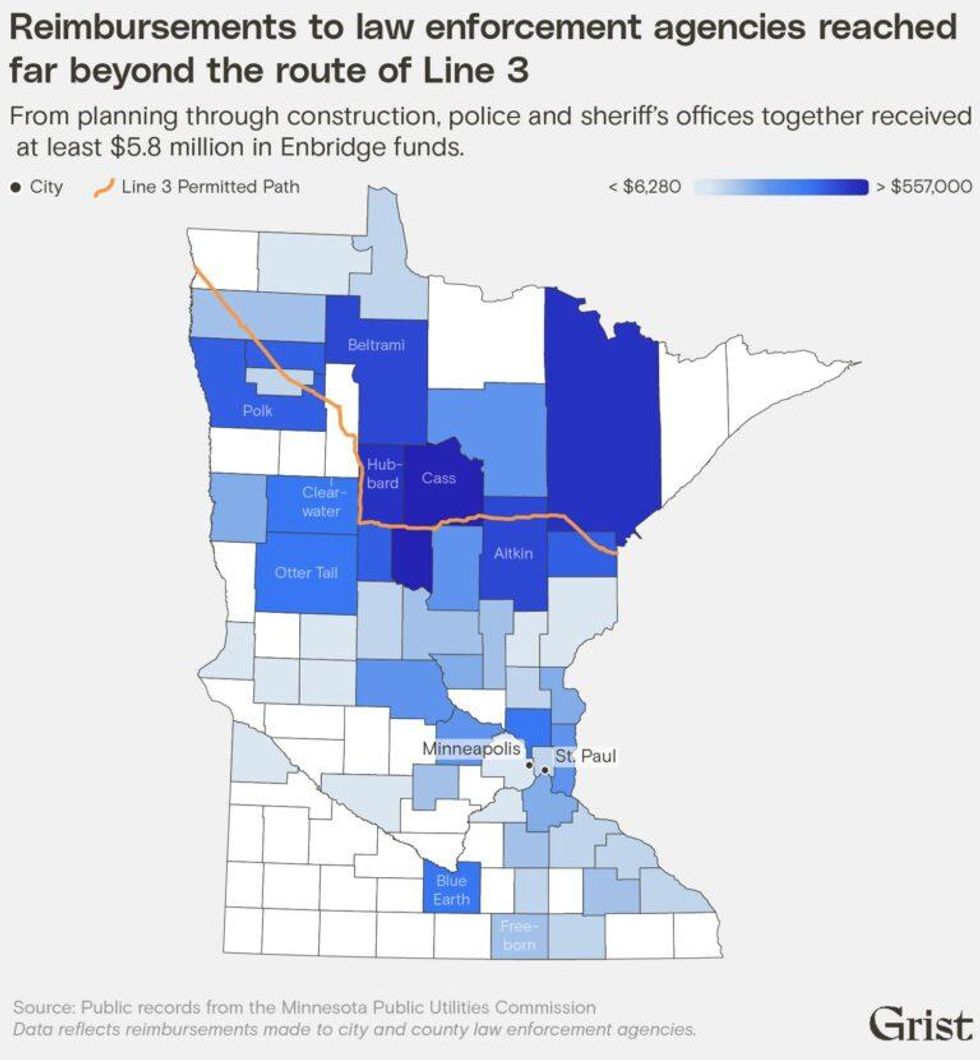
(Credit: Jessie Blaeser / Grist)
Otter Tail County Sheriff Barry Fitzgibbons told Grist that his agency still owns and maintains its equipment. “This in no way has impacted our ability to remain fair and impartial,” he said in a written statement.
2021 was a year of unprecedented protest among Northern Minnesota’s pristine lakes and wetlands. Enbridge and law enforcement faced a drumbeat of road blockades, lockdowns to pipeline equipment, marches through remote prairie, and layered demonstrations combining Anishinaabe ceremony with direct action tactics refined by generations of environmental and Indigenous social movements.
The biggest Enbridge escrow account expense was more than $4.5 million in wages, benefits, and overtime for officials responding to perceived security threats during construction. More than just police and sheriff’s offices were involved: The Department of Natural Resources’ largest Enbridge-funded expense was $870,000 in personnel costs during construction.
And it wasn’t just calls for service that Enbridge paid for. Dozens of invoices mentioned “patrols,” where law enforcement would drive up and down the pipeline route or surveil places occupied by pipeline opponents.
The Cass County Sheriff’s Office’s “proactive” safety patrol, described in an invoice, may help explain why that agency expensed far more money for response costs to the escrow account — over $900,000 — than any other county or city, despite facing fewer mass demonstrations than other areas.
Like Cass, Hubbard County at times instituted patrols. They also established mandatory overtime shifts. Line 3 meant that police officers across Minnesota received paychecks padded with Enbridge-funded overtime pay. One officer from the Clay County Sheriff’s Office, for example, earned $778.46 per day in wages and benefits for four 18-hour shifts in July and August 2021 – a total that included hourly pay for his four-hour 150-mile round-trip drive to the closest emergency operations center.
The invoices confirm that Enbridge-funded sheriff’s deputies in Hubbard County surveilled the Namewag camp, which was located on private land and used both as a space for Anishinaabe land-based practices and as a jumping off point for direct action protests. “On 3/6 and 3/7, Hubbard County Deputies observed roughly 30 previously unidentified vehicles arriving and periodically leaving the Hinds Lake Camp (Ginew [sic] Collective Camp) in Straight River Township, Hubbard County,” one invoice states.
It goes on to describe intelligence shared by an Enbridge employee, detailing the movements of various groups of pipeline resistors. “Migizi camp [another anti-Line 3 encampment] is empty at this time and intelligence suggests Migizi and Portland XR [short for Extinction Rebellion] are camping at a public campground,” the message from Enbridge stated.
Enbridge also paid for gas that fueled officers’ cars, hotels they stayed in when assisting other jurisdictions, and food they ate during shifts. During both planning stages and periods of law enforcement action, Enbridge covered at least $150,000 in meals, snacks, and drinks. The oil company bought bagels, Domino’s pizza, McNuggets, Subway sandwich platters, a Dairy Queen strawberry sundae, summer sausage, cheese curds, deep fried pickles, Fritos, Gatorade, and energy drinks, including one called Pipeline Punch.
From planning through construction, police and sheriff’s offices together received at least $5.8 million in Enbridge funds. For state agencies, the Enbridge funds represented a tiny proportion of massive budgets. However, for the Cass County Sheriff’s Office, the Enbridge money added up to the equivalent of more than 10 percent of the office’s 2021 budget. (The office did not respond to requests for comment.) Five other sheriff’s offices received reimbursements equivalent to over 5 percent of their annual budgets.
The biggest Enbridge payouts did not always correspond to the counties with the most protest activity. Only 17 of the 47 counties that received reimbursements were actually intersected by Enbridge infrastructure or saw any arrests.
The range of choices law enforcement agencies made regarding what to invoice makes clear the discretionary nature of the Line 3 response. Clearwater County is home to one of two places where Line 3 crosses the Mississippi River and the site of a number of protests. Although 20 other law enforcement agencies billed Enbridge for assisting the local sheriff, Clearwater County billed nothing to the pipeline company.
The invoices also offer insight into the way the influx of pipeline workers translated into incidents of human trafficking and assault. “Since the Line 3 Replacement project has come to our area, we have experienced an increase in calls and need for services,” reads a grant application from the nonprofit Violence Intervention Project, or VIP, based in Thief River Falls, Minnesota, a community through which the pipeline passes, just outside the Red Lake Reservation. “We have provided services to several victims that have been assaulted by employees working on the Enbridge line 3 project.”
Enbridge reimbursed the organization for two hotel rooms for assault survivors, since VIP’s shelter was full at the time. The company also paid $42,000 worth of hazard pay for shelter workers during the 2021 winter, due to the Covid-19 pandemic.
Enbridge’s biggest human trafficking grant recipient was Support Within Reach, a northern Minnesota organization that works with survivors of sexual violence, which used the money to pay for extra personnel costs during pipeline construction and to buy emergency cell phones for advocates.
Additional funds also went to public agencies: Enbridge reimbursed $43,551.96 to local law enforcement agencies working with the Minnesota Human Trafficking Investigative Task Force. The documents describe at least two multi-agency operations in Grand Rapids and Bemidji, and news reports from the time confirm that they led to the arrest of four Line 3 workers.
Kellner, the Enbridge spokesperson, said that any employee caught and arrested for human trafficking would be fired by the company. She added that the four workers who were arrested were subcontractors, not direct employees of the oil company, and were fired by the contractor Enbridge worked with.
The Link, a nonprofit based in North Minneapolis, received $36,870 from Enbridge and used it in part to assist the task force with sting operations and support survivors who were found. Beth Holger, the organization’s chief executive officer, said she did not feel conflicted about taking Enbridge’s money, because it was going to victims: “Yes we took money from a corporation that has caused harm, and we’re giving it to people to help with that harm.”
The $8.6 million in expenses covered by Enbridge by no means accounts for the full public cost of responding to opposition to the Line 3 pipeline.
Several sheriffs’ offices anticipated thousands more Enbridge dollars than they received. The sheriffs’ offices in Cass, Beltrami, and Polk counties each attempted to expense around $25,000 of equipment that was ultimately denied reimbursement.
The state rejected Cass County’s request for an $18,000 fingerprinting system, and Polk County was denied Enbridge money for approximately $9,000 worth of TV sets for its emergency operations center as well as thousands more for tools like saws and chisels used to cut chains, cement, pvc pipes, and other materials used by protesters to lock down to Enbridge equipment and block construction.
Hubbard County Sheriff Cory Aukes said that it was unfortunate that the Hubbard county attorney’s request for prosecutorial funds was denied by the account manager, as Aukes sees the influx of charges and protestors as an undue burden on the attorney’s office as well as the sheriff’s office. He said that his agency had plenty of other expenses that weren’t covered.
He added that he believes it would be fiscally irresponsible to decline Enbridge’s funds. “Shouldn’t they have to fund that? Shouldn’t they be responsible to reimburse these additional costs?” Aukes asked.
To water protectors, however, the greatest costs of the pipeline are its consequences for the climate, water, and the Canadian forest ecosystem decimated by tar sands oil production. The nonprofit LaDuke co-founded, Honor the Earth, issued its own invoice to Enbridge before the creation of the escrow account, estimating that Line 3 would cost $266 billion annually in environmental losses and social damages.
So far, she hasn’t received a response.
This story was originally co-published in partnership with Grist and the Center for Media & Democracy and appears at Common Dreams with permission.
On Monday, Petroperu officials confirmed to Reuters that 3,000 barrels of oil had been poured into two critical Amazon River tributaries, the Chiriaco and Morona rivers, which eight Achuar tribes depended on for water.
Critics charge that the spills continued to spread and caused far worse damage after the responsible company, Petroperu, failed to act to contain the oil released by the pipeline breakages.
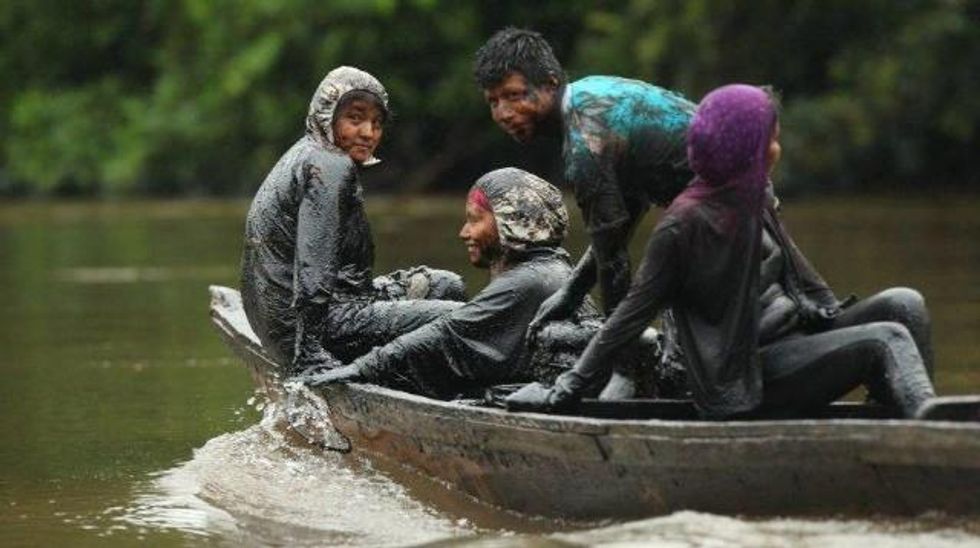
A third pipeline rupture was rumored on February 19, reports Amazon Watch, but the state-owned petroleum company took to Twitter to deny those reports.
The devastating spills occurred mere months after Indigenous activists staged massive protests against Peru's oil industry in September.
Over the weekend, local activist Marco Arana Zegarra posted horrific images of the oil's spread in the Chiriaco tributary:
"Those responsible? Where are they?" Zegarra appealed.
Waterways flow with black sludge and trees and flowers are rendered nearly unrecognizable by a thick coating of oil in video footage of the spills:
"At least this time," observed Zegarra, "Petroperu has given Indigenous populations suits to wear for cleaning up oil."
Petroperu president German Velasquez "denied reports the company paid children to clean up the oil," reports the Guardian, but then he went on, perhaps damningly, to say that "he was evaluating firing four officials, including one who may have allowed children to collect the crude."
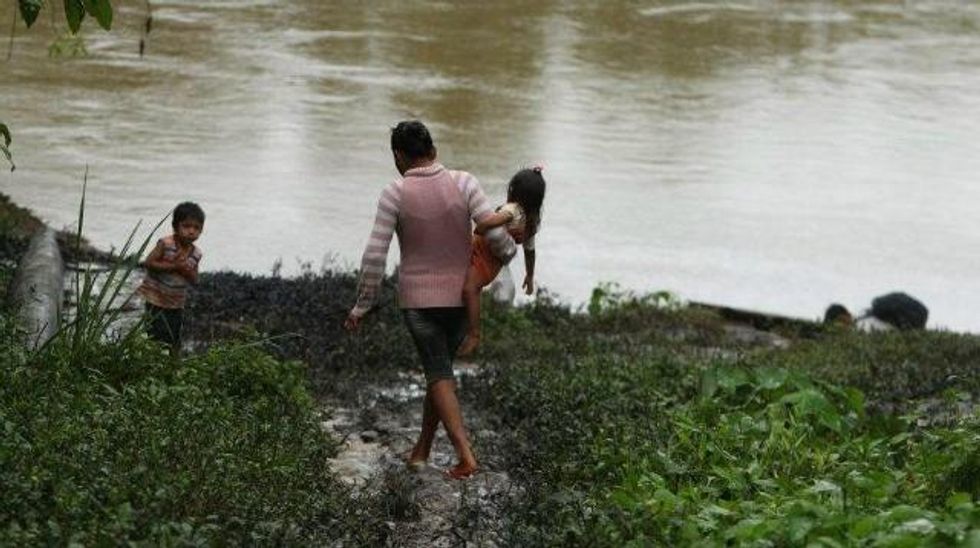
"It's important to note that the spills...are not isolated cases. Similar emergencies have emerged as a result of defects in sections of the pipeline," the national environmental regulator said, according to the Guardian.
Reuters reports that the regulator "ordered Petroperu to replace parts of the pipeline and improve maintenance. " The Guardian reports that Petroperu could face fines of up to $17 million if it is proven that the oil spills have affected local health.
"This environmental disaster is just the latest in a long history of oil and gas leaks in the area," laments Indigenous rights group Survival International, observing that "[m]ore" than 70% of the Peruvian Amazon has been leased by the government to oil companies."
The group translates a call to action by AIDESEP. This organization fights for indigenous people in the Peruvian Amazon, in which it pleads for "international public opinion, the media, NGOs and civil society to pay attention to this serious event that puts in danger the lives of thousands of people living in the area who have traditionally been neglected."