

SUBSCRIBE TO OUR FREE NEWSLETTER
Daily news & progressive opinion—funded by the people, not the corporations—delivered straight to your inbox.
5
#000000
#FFFFFF
To donate by check, phone, or other method, see our More Ways to Give page.
Daily news & progressive opinion—funded by the people, not the corporations—delivered straight to your inbox.
America is not a Christian nation, nor a nation for whites, nor a nation for the rich alone. It is a nation built on principles shared by all who live in it, and Islam has always been part of that inheritance.
“If there is no struggle, there is no progress.” —Frederick Douglass
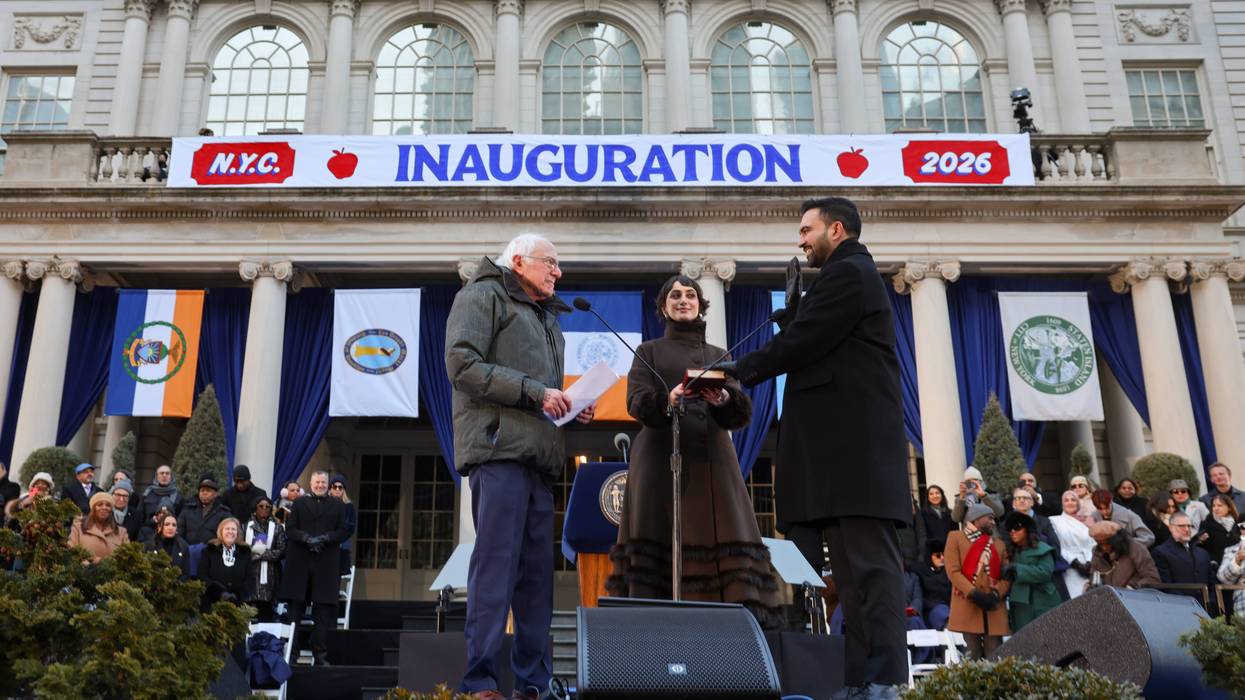
America’s story has always been a story of struggle—for liberty, for justice, for recognition. On a cold January afternoon outside City Hall, Zohran Mamdani stepped into that struggle. Raising his right hand, he took the oath of office as mayor of New York City—the first Muslim ever to hold the city’s highest office—embodying Douglass’ truth: Progress demands courage, perseverance, and the relentless pursuit of inclusion.
The headlines captured the surface: a 25-minute inaugural address, roughly 4,000 spectators, a private swearing in just after midnight at the Old City Hall subway station, appearances by Rep. Alexandria Ocasio-Cortez (D-N.Y.) and Sen. Bernie Sanders (I-Vt.). But the moment ran far deeper. Mamdani’s inauguration was not only a municipal milestone; it was the latest chapter in a debate as old as the republic itself: where Muslims belong in the American story—and whether they ever truly have.
That question stretches back to July 30, 1788, when North Carolina ratified the Constitution. Anti-federalist William Lancaster warned that by rejecting religious tests for office, the new nation might allow Muslims to govern. “Papists may occupy that chair,” he cautioned, “and Mahometans may take it. I see nothing against it.” A warning, then. A prophecy, now.
When Mamdani declared, “New York belongs to all who live in it,” he answered a question first posed in fear in 1788, tested in war, dramatized by Muhammad Ali, and deferred for generations.
There were no Muslim candidates in 1788. But there were Muslims in America—thousands of enslaved Africans whose presence exposed the republic’s deepest contradiction. Between 5 and 20% of enslaved Africans were Muslim, many literate in Arabic, bearing names like Fatima, Ali, Hassan, and Said. Their faith was violently suppressed, yet fragments endured—in memory, language, and resistance.
Even the founding generation reflected this tension. Thomas Jefferson studied the Quran and treated Islam as a serious intellectual tradition, even as he owned enslaved Muslims. Islam existed in theory, in human reality, and yet was denied civic recognition.
That tension carried forward into the nation’s greatest moral reckoning: the Civil War.
Muslims fought for the Union. Mohammed Kahn enlisted in the 43rd New York Infantry. Nicholas Said—born Mohammed Ali ben Said in Nigeria, raised Muslim, later converted to Christianity—served as a sergeant in the 55th Massachusetts Colored Regiment and as a Union clerk. Captain Moses Osman held a high-ranking post in the 104th Illinois Infantry. Union rosters show names like Ali, Hassan, and Said, hinting at a wider Muslim presence than history often acknowledges.
Yet rifles were not the only weapons. Islam entered the moral imagination through words and witness. Sen. Charles Sumner, nearly beaten on the Senate floor, quoted the Quran to condemn slavery. Ayuba Suleiman Diallo—Job ben Solomon—had already unsettled transatlantic assumptions through literacy, eloquence, and dignity. His story endured into the Civil War, republished in 1864 to reinforce the war’s moral purpose. Overseas, Hussein Pasha of Tunisia urged the US to abolish slavery “in the name of humanity,” showing Muslim advocacy was part of a global ethical conversation.
Muslims remained largely invisible in America’s public self-understanding—until the 20th century produced a figure too large to ignore.
Muhammad Ali, still the most recognizable man on Earth decades after his gold medal at the 1960 Rome Olympics, transformed boxing and American consciousness alike. He was named “Athlete of the Century” by Sports Illustrated, GQ, and the BBC; “Kentuckian of the Century” by his home state; and became a global icon through speed, grace, and audacious charm.
Ali’s significance extended far beyond the ring. By insisting on the name Muhammad Ali instead of Cassius Clay, he forced America to confront the legacy of slavery embedded in naming itself. His embrace of Islam was unapologetic and public. His refusal to be drafted into the Vietnam War cost him his title and livelihood, yet anticipated the anti-war movement. His fights in Kinshasa, Manila, and Kuala Lumpur shifted attention from superpower dominance toward global conscience.
Ali’s humanitarian work was relentless: delivering over 232 million meals, medical supplies to children in Jakarta, orphans in Liberia, street children in Morocco. At home, he visited soup kitchens, hospitals, advocated for children’s protections, and taught tolerance in schools through his book Healing. For this, he was honored as a United Nations Messenger of Peace, cited by Amnesty International, and recognized by President Jimmy Carter as “Mr. International Friendship.”
Ali showed the nation something fundamental: that Islam is American. That Muslims have always belonged to the moral and civic fabric of this country. That a nation built on life, liberty, and the pursuit of happiness, on religious tolerance, on care for the poor, is naturally aligned with Islam. Mamdani is American not in spite of his faith, but because Islam is American.
It is against this long arc—from slavery to abolition, civil rights, global conscience, and the moral courage of Muhammad Ali—that Zohran Mamdani’s inauguration comes into focus.
Mamdani’s life traces modern routes of migration and belonging. Born in Kampala, Uganda to parents with roots in South Asia, he was raised in New York City. Yet his rise fulfills an older constitutional promise. In his inaugural address, he thanked his parents—“Mama and Baba”—acknowledged family “from Kampala to Delhi,” and recalled taking his oath of American citizenship on Pearl Street.
When Mamdani declared, “New York belongs to all who live in it,” he answered a question first posed in fear in 1788, tested in war, dramatized by Muhammad Ali, and deferred for generations. He named mosques alongside churches, synagogues, temples, gurdwaras, and mandirs, making visible what history had long rendered partial. When he spoke of halal cart vendors, Palestinian New Yorkers, Black homeowners, and immigrant families bound together by labor and hope, he articulated a civic vision rooted in lived American reality.
Notably, Mamdani did not frame his Muslim identity as something to defend. It simply existed. “Where else,” he asked, “could a Muslim kid like me grow up eating bagels and lox every Sunday?” Hybridity was not an exception. It was inheritance.
Yet it is equally important to recognize that Mamdani’s historic victory does not make him infallible, nor should it. The fact that he is the first Muslim mayor of New York City is not a personal achievement alone—it reflects the barriers that Muslims, like many others, have historically faced in participating fully in American democracy. Discrimination, racial and religious bias, and systemic obstacles made this moment possible only now, not because of any failing on his part. He will, like all mayors before him, make mistakes. He will face limits, criticism, and flaws—because he is human. To hold him to an impossible standard would be to misunderstand both history and democracy.
There is, too, something unmistakably American about Mamdani’s politics. By invoking La Guardia, Dinkins, and de Blasio; by embracing democratic socialism without apology; by grounding his agenda in labor, affordability, and collective responsibility, he situates himself firmly in an American tradition—one that echoes the abolitionists, the New Deal, and the moral courage of Ali.
And as Malcolm X reminds us, this is the guiding principle for American civic life: “I believe in the brotherhood of man, all men, but I don’t believe in forcing anyone to accept it.”
This is what makes the moment historic. Not that a Muslim has finally entered American politics, but that an old constitutional anxiety—once voiced as a warning—has become an ordinary fact of civic life. Islam, Mamdani, and the ideals of this nation converge in a single, undeniable truth: America is not a Christian nation, nor a nation for whites, nor a nation for the rich alone. It is a nation built on principles shared by all who live in it, and Islam has always been part of that inheritance.
The work, as Mamdani said, has only just begun. But the story his inauguration tells—that Muslims were enslaved at the nation’s birth, debated at its founding, fought in its wars, shaped its abolitionist conscience, transformed its civil rights culture, and now govern its greatest city—is no longer hypothetical.
It stands, unmistakably, on the steps of City Hall.
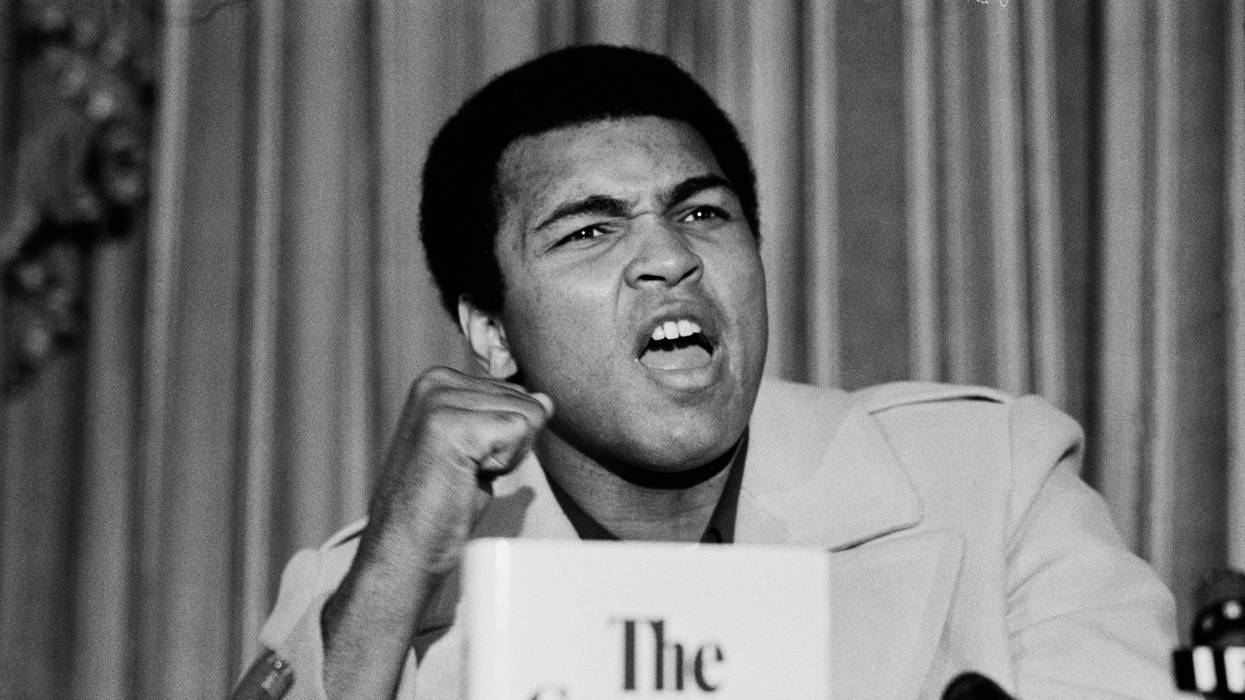
At least once a week, a stranger writing a book, magazine article, newspaper feature, or blog; representing a documentary film, radio serial, or podcast; researching a paper for middle school, high school, or college asks me for an interview about Muhammad Ali. I'm on the short list of live resources because I began covering him when he was Cassius Clay and I was starting out as a New York Times sports reporter.
Other than, I guess, Abraham Lincoln or Jesus Christ, the current go-to-guy for a quick symbolic fix of history, spirituality, and spectacle is that heavyweight boxer who called himself The Greatest. Somehow, he's now right up there with two other once super-polarizing figures -- the greatest American president and the greatest Christian of all time.
I've been wondering lately just how Ali actually reached such heights. There are plenty of people alive today who once hated him and yet, in American popular culture, he's now a secular saint.
"I've always thought that Ali's journey from youthful ignorance to a hard-earned enlightenment was one of the most inspiring stories in the history of sports."
He would only have been 80 years old on January 17th. He died in 2016 at 74. While Lincoln and Christ were dramatically killed in their prime, Ali's life began fading away before our eyes while he was still in his thirties. That was when he gradually began losing his voice (and oh, what a voice it was!), his mobility, and his expressive affect, first from the pummeling that boxing gave him and then from Parkinson's Disease.
I rarely refuse interview requests about him. As one of a diminishing group of old, mostly white male journalists who knew Clay before he was champion, I feel an obligation to help set straight a willfully misinterpreted biography. I'm also always curious about why strangers are so fascinated by Ali and who they think he really was.
In recent years, they've ranged from the documentary king Ken Burns to an eighth-grader from California named Harmony. Like most of the scores of others, their questions were remarkably sharp and well-prepared, although most of them lean toward the Ali industry's common image of him as a fiery social warrior who arrived fully formed at a time in need of just such a hero.
That image is easier than dealing with his early espousal of a separatist cult preaching that white people were devils genetically created by an evil scientist. On Allah's chosen day of retribution, went the dogma of the Nation of Islam cult to which he then belonged, the Mother of Planes would bomb all but the righteous, who were to be spirited away. It was also easier than remembering Ali's repudiation of his early mentor, Malcolm X. Ali chose the Nation's leader, Elijah Muhammad, over him, a betrayal that may have doomed Malcolm to assassination.
Years after leaving the sect and converting to orthodox Islam, Ali offered a far more measured message. While he still gave the Nation of Islam credit for offering him a black-is-beautiful message at a time of low self-esteem and persecution, he also said definitively that "color doesn't make a man a devil. It's the heart and soul and mind that count. What's on the outside is only decoration."
And he admitted that he had made a mistake in turning his back on Malcolm, partly in fear for his own life.
The Operatic Life
I've always thought that Ali's journey from youthful ignorance to a hard-earned enlightenment was one of the most inspiring stories in the history of sports, perhaps even a kind of morality play or, at the least, an opera.
And so, I was hardly surprised last month, on the same day I answered an Austrian journalist's emailed Ali questions, to learn that, thanks to Covid-19, Opera Las Vegas had indeed postponed the opening of a new opera, "Approaching Ali."
Meanwhile, the Ali Center in Louisville was sponsoring a star-studded virtual event celebrating what would have been his 80th birthday. And the Smithsonian Channel announced a new two-hour documentary, Cassius X: Becoming Ali, about the five-year "spiritual and ideological journey" in which, from 1959 to 1964, that callow young boxer was transformed into a world champion. (And, yes, I'm a talking head in it, along with Burns's eight-hour epic and too many others.)
All of this leaves us with the question of how Ali -- or at least a version of Ali -- became the Last American Hero. The American dream may be coming apart at the seams, but the glory of The Greatest is in full flower and still growing. Why?
The simplest answer - and the most discouraging - may be the right one. There is no one else. In the age of Trump, the Hero Pool has dried up, if at least you ignore the endless movie characters based on comic book super people (or creatures). Even my own childhood fave, Superman, who early in his career battled the Nazis, has lost his dominance.
In America, the terrible tribalization of the Trump era has made it almost impossible to consider any kind of consensus hero worship in any genre (Dr. King, Dr. Fauci, Dr. Who?) while culture was becoming as politicized as politics. The usual default for hero worship, sports, has turned into an all-star disaster area and perhaps a leading reason for the idol abyss of the present moment.
A Roster of Hyped (and Then Discredited) Heroes
Lately, almost every sport has contributed a major disappointment in the form of a hyped hero who came up all too short. Recently and typically, the popular golfer Phil Mickelson was one of a group of PGA pros who signed up for a lucrative tournament in Saudi Arabia (with its murderous regime) at about the same time the number-one tennis player, Novak Djokovic, was trying unsuccessfully to stay and play in Australia while unvaxxed.
As we inched toward the February 13th Super Bowl, many began rooting not for but against fan darling Green Bay Packers quarterback Aaron Rodgers who turned out to be another unvaxxed slickster. When the Pittsburgh Steelers were eliminated from the playoffs, their long-time superstar quarterback Ben Roethlisberger was relieved of a full-scale moral review, but he won't be able to avoid it when he becomes a candidate for the Hall of Fame.
Among the sportswriters who vote for the future immortals, baseball has similarly had a long-simmering argument over the moral qualifications for its Hall of Fame candidates. And that, as it happens, offers a controversy all its own. Since induction brings a substantial boost in sideshow income, isn't it a conflict of interest for so-called journalists to reward their subjects that way?
In any case, the argument over qualifications seems to have boiled down to skirmishes between the Moralists, who can't abide the likes of Barry Bonds, Roger Clemens, Alex Rodriguez, or Curt Schilling, all of whom have been accused of using performance enhancing drugs, and the Analytics, who believe that only statistics should be the basis for such final judgments. (Allegations of drug use or bad behavior be damned.)
Such arguments have devalued the very idea of a Hall of Fame because the statistically minded sportswriters come across as mindless boosters hiding behind numbers, while the Moralists seem like all-too-tiresome finger-pointers. How do you get heroes out of that?
The answer is: you don't. So you go back to Ali, who was stripped of his heavyweight title in 1967 after refusing to be drafted into the Vietnam-era Army for religious reasons. It's always worth recalling that he was not penalized by some federal agency or central governing sports body, but rather by scores of politically appointed local boxing commissions.
Hero and Villain
Ali immediately became both hero and villain, celebrated for a principled stand against the Vietnam War ("Why should they ask me to put on a uniform and go 10,000 miles from home and drop bombs and bullets on brown people in Vietnam after so-called Negro people in Louisville are treated like dogs and denied simple human rights?... I ain't got no quarrel with them Vietcong"), vilified for rejecting his country's call of duty, and sentenced to five years in jail for refusing induction, later overturned by the Supreme Court. The passion of those 55-year-old reactions to Ali's draft avoidance were echoed in 2016, several weeks after his death when, in one of sports' most symbolic acts, Colin Kaepernick refused to stand for the national anthem before a pro football game and instead took a knee.
As that season unfolded and Kaepernick became a right-wing target, it seemed as though the San Francisco 49ers' quarterback would prove a worthy successor to Ali as an all-American hero-in-chief. He, too, was clearly taking a personally dangerous and politically principled stand and his avowed purpose -- to call attention to discrimination against people of color -- seemed unassailable.
But even as Ali remained a secular saint, Kaepernick would be maligned and smoothly sideswiped. He really wasn't such a good quarterback, it was said (although he had led his team to the Super Bowl), and anyway he was nothing but a pawn of the Black Lives Matter movement. Most damaging for Kaepernick, I think, was the lack of white support, especially among other National Football League players. (Black support wasn't so widespread, either.) Ali, of course, never lost the favor of the millions of young white fans against the draft.
Ali's herohood remains unsullied, especially because it's been sanitized. The fearsome social warrior of 1967 came, in the end, to be celebrated as something of a teddy bear.
Ringing the Wrong Bell
The issue of neutering a feared social warrior has been covered most trenchantly by Thomas Hauser, the lawyer and novelist who is Ali's most exhaustive and reliable chronicler. His description of Ali as "a beacon of hope for oppressed people all over the world" as well as "the embodiment of love" whose "dreams inspired the world," has clearly led to his antipathy toward what he sees as the relentless commercialization of Ali. No example of this was more symbolic than his appearance at the New York Stock Exchange on December 31, 1999. Hauser says he thought Ali should have celebrated that millennial moment "at a soup kitchen or homeless shelter to draw attention to the plight of the disadvantaged."
Ali, according to Hauser, was, however, adept at avoiding making rich white people feel guilty or even uncomfortable. The cruelest Ali had ever been publicly was to his most formidable opponent, Joe Frazier, a Black man -- calling him a "gorilla," while mocking his nose, lips, and skin.
"In real life," writes Hauser, "Ali played the race card against Frazier in a particularly mean-spirited way. For the entertainment of white America, he labeled Joe as ugly and dumb. And at the same time, speaking to Black America, he branded Frazier an Uncle Tom, turning him into an object of derision and scorn within the Black community."
One of the harshest observers of Ali's commodification, Mike Marqusee, author of Redemption Song: Muhammad Ali and the Spirit of the Sixties, broadened such a critique by writing:
"Ali's power in the third world grew precisely because he was a symbol of defiance against racism and the use of United States military power abroad. And those issues are very much alive today; so, it means a lot to the powers that be if Ali can be used to suggest to the rest of the world that they aren't problems anymore. [Ali's] history is now being plundered and deliberately obscured to sell commercial products and, more significantly, ideas."
No wonder I looked for hope in Harmony. After the Zoom interview and some follow-up e-mails, I asked the California eighth grader if she and her project colleagues would answer two short questions: Based on your research, what do you think Ali should be remembered for now? Is that the same thing you might have thought before you did your research?
Generously, Harmony offered the views of her classmate, Yaseen, who wrote that he thinks "Ali should be remembered for being arguably the most iconic athlete of all time and as a hero because he taught young Black people that they could do anything and he should also be remembered for the positivity and love he spread in his life." Before researching his life, he had merely thought that Ali "was a good boxer."
That was positive. And then, the day that Yaseen's tribute arrived, part of a weekend that would include my birthday, as well as Ali's and Dr. Martin Luther King, Jr.'s, a request arrived from a Purdue University graduate student for information about Superman's role in American culture. Many years ago, I had been involved in a TV show that peripherally addressed that subject. Of course, I agreed to answer his questions and started plowing through old notes where I found a reference to a 1978 DC comic book called "Superman vs. Muhammad Ali" in which the two team up to defeat an alien invasion of America.
My heart raced at that. Alien invasion? We're in the middle of one right now. They're called greedy, gutless Republicans and they seem to be winning. And worse yet, they have a hero whose seedy charisma and shamelessness is enough to inflame his nervous and needy followers.
Spoiler alert: in the comic, the good guys win and Ali shouts, "Superman, WE are the greatest!"
And it's true. Unlike Trump, the champ was willing to share the glory. What more can we expect from a "hero" these days?
The greatest athletes in America are standing up for justice at a critical time.
Despite unprecedented, multiracial demonstrations across the country protesting police violence against African Americans, the horrors keep on coming.
Last week, Jacob Blake was shot seven times in the back by a policeman in Kenosha, Wisconsin. As the anger has grown, some of the protests have been marred by vandalism and looting. Now armed right-wing militia groups are escalating the tensions. In Kenosha, two demonstrators were murdered and one wounded by a 17-year-old Trump supporter illegally wielding an assault weapon.
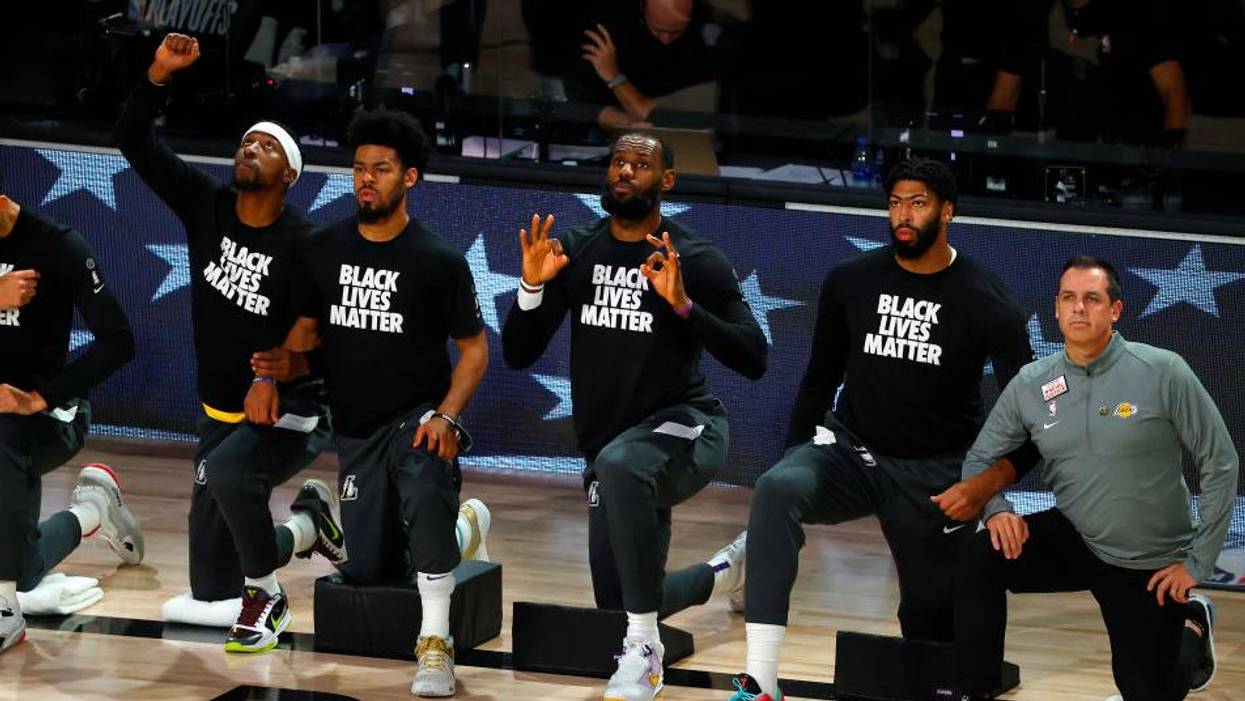
It is into this cauldron that the professional basketball players of the NBA stood up, forcing a suspension of the playoffs, to support the call for justice. Their example was picked up by others--the WNBA, baseball players, tennis champions like Naomi Osaka and more.
This takes courage. Great athletes are taught to focus on their sport and to ignore their power in the culture. Owners, agents, managers and fans see them as entertainment, not as citizens or leaders.
Yet the very God-given gifts, discipline and skills that make a great athlete contribute to their capacity for leadership. In the Old Testament, little David honed his skill with a sling. When an oppressive horde led by a giant named Goliath threatened the Hebrew people, David stepped up, hurling the stone that slew the giant and saved his people.
Now America's greatest athletes are standing up, calling this country to change. They know that they will face criticism and abuse. They know that they could be risking their careers and livelihood.
When LeBron James, Dwayne Wade, Chris Bosh and the Miami Heat players stood up in response to the death of Trayvon Martin, Americans across the country took notice. The same is true now as the current athletes focus on Breonna Taylor, George Floyd, Jacob Blake and the others they name.
They know the risks, but they also know that when they leave the court or playing field and return to their families, they are just another Black person to the police, and must worry about how to protect their sons and daughters, sisters and brothers, or even themselves. Both Sterling Brown of the Milwaukee Bucks and Thabo Sefolosha of the Houston Rockets were victims of police lawlessness.
Here the example and leadership of LeBron James has been critical. Athletes across the world look up to him. When LeBron uses his platform to speak out--even in the face of insults from the president and others--he sets a tone and an example for others. In my opinion, he uses his gifts and platform so responsibly because it is his way of thanking God by serving others.
Dr. Martin Luther King Jr. used his gifts and platform to change the culture. Today, athletes are using their commitment to call this country to its senses.
Great athletes have often been pacesetters. When Heavyweight Champion Jack Johnson stood up to racially biased and arbitrary social mores, he impacted the culture. When Joe Lewis defeated Max Schmeling, he pummeled the entire Nazi theory and racist ideology. When Jesse Owens became the world's fastest man at the Berlin Olympics, Adolf Hitler wouldn't shake his hand, but when Owens came home, he told me President Roosevelt wouldn't shake his hand either. Jackie Robinson broke the racial barrier in baseball and bore the physical and psychological scars from doing it.
At the height of his career, Muhammad Ali, became a conscientious objector to the Vietnam War, and paid the price of years stolen from his career. Every athlete should be grateful to Curt Flood for ending the reserve clause and gaining athletes the right to free agency to negotiate the best deal they could. Colin Kaepernick launched his nonviolent campaign against police killing of Black people four years ago that has cost him his career.
The athletes had to stop business as usual to gain attention. They have been in intense meetings figuring out how they can most be effective. They understand that the murders can't go on; the system must change. They are calling on others to join them. They are putting their time and their resources on the line. They've now convinced NBA owners to turn their arenas into polling places where people might vote safely.
Their actions have already had effect. It is too easy for cynical politicians and entrenched interests to turn attention from the injustice to the excesses that mar those protesting it. The players have forced our attention back to the injustice and to the core demand that Black Lives Matter. For that, they deserve our respect and our support.
Colin Kaepernick may yet get his day in court.
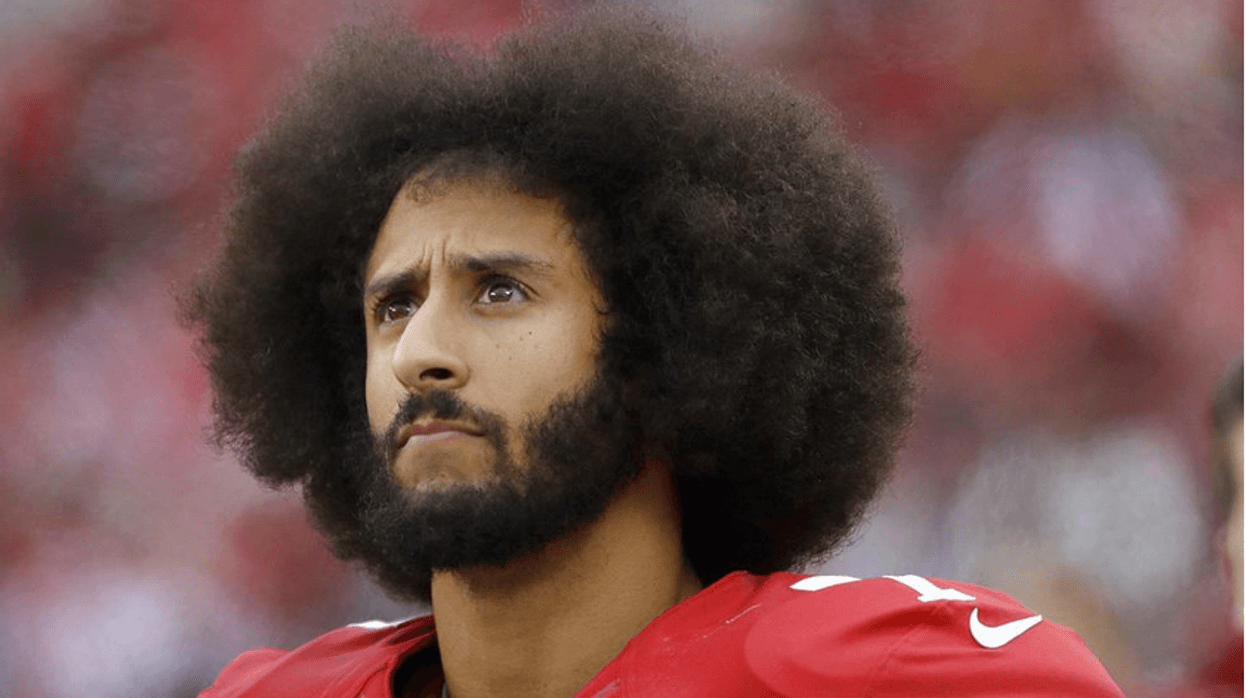
Kaepernick is the talented former NFL quarterback who in 2016 began a protest against police brutality and institutionalized racial discrimination by kneeling during the playing of the national anthem. Other players joined the protests.
Kaepernick wasn't protesting the anthem or the flag. He was calling on the country to live up to its principles.
President Trump led the outcry against the protesters, slurring any player who takes a knee as a "son of a bitch." The league owners panicked. One result was that Kaepernick -- one of the most talented quarterbacks in a league that suffers a shortage of skilled players in that position -- found himself locked out of a job.
He couldn't even get a tryout. He filed a grievance against the league and the 32 teams, calling the action against him a violation of the league's players contract, as well as an affront to free speech.
An arbitrator handed down a decision Thursday to send Kaepernick's grievance to trial and dismissed the owners' motion for summary judgment, finding that Kaepernick had raised sufficient evidence that there was an express or implied agreement between the teams to keep him out of the league.
The collusion is obvious. According to the Wall Street Journal, Dallas Cowboys owner Jerry Jones stated in a sworn deposition that Trump instructed him to tell the owners that the president would continue to attack the league as long as the protests continued.
"This is a very winning, strong issue for me," Trump said, according to the deposition, brazenly admitting to the race-based poison politics that he practices with venom. It isn't hard to realize that the owners, terrified that continued Trump attacks would damage their revenues, decided to lock Kaepernick out as a warning to other players and, of course, they made a sacrificial offering to Trump.
Kaepernick is being punished for expressing his beliefs. He stands in a long tradition of African-American champions who were punished for stepping out of line.
Kaepernick is being punished for expressing his beliefs. He stands in a long tradition of African-American champions who were punished for stepping out of line.
Jack Johnson, the first African-American world heavyweight boxing champion, sparked race riots across the country when he won the title in 1908. He further crossed racial boundaries by "consorting" with white women, three of whom he married. He was convicted of violating the Mann Act for transporting a woman across state lines for immoral purposes -- for an affair that took place before the act was even passed into law. He left the country and spent seven years fighting abroad, before returning to spend months in jail.
Ironically, it was Donald Trump who finally gave him a posthumous pardon from this injustice.
Muhammad Ali, the most famous champion of all, was prosecuted for evading the draft during the Vietnam War. A convert to Islam, he claimed conscientious objector status. In 1967, at the height of his career, he was banned from boxing for three years, and sentenced to prison for five, a conviction the Supreme Court eventually overturned.
Curt Flood, the three-time all-star centerfielder for the St Louis Cardinals, refused to accept a trade in 1969, arguing that baseball's enforcement of lifetime contracts was a clear violation of antitrust laws. The Supreme Court ruled against him, and Flood was essentially blackballed. Finally, in 1998, Congress passed the Curt Flood Act, formally making Major League Baseball play by the same anti-trust rules as other professional sports.
Kaepernick's protest -- joined by fellow athletes across the league -- has brought national attention to the question of police brutality, even as Trump and others have slandered the players by insisting they are insulting the flag and the national anthem.
Kaepernick's grievance -- if the courts are not as intimidated by Trump's tantrums as the owners were -- will expose the self-evident collusion that has locked him out of the league.
The owners should pay dearly for their folly.
Colin Kaepernick is already paying a harsh price for his expressing his views. A talented athlete at the peak of his career is being locked out of his profession.
Jerry Jones says that Trump told him: "Tell everybody, you can't win this one. This one lifts me."
It may "lift" Trump, but it disgraces the owners, the league and the country.

Snatching immigrant babies may have scored some points for President Trump with his base, but it was never going to light up the scoreboard like tackling black jocks. That one really played to the grandstands. The complicated combination of adoration and resentment so many white males feel for those rich, accomplished uber-men is a significant but rarely discussed aspect of fandom, especially in relation to football, that magna cum macho of American sports.
Last September, when the commander-in-chief of toxic masculinity dubbed any football player who didn't stand during the playing of the national anthem a "son of a bitch," the war on black men took a spectacular pop-cultural surge. And unlike white cops who shoot unarmed black men, President Trump didn't even have to claim that he had been afraid.
He should have been, though. After all, he might have sparked a slaves' revolt that, in the end, could do him in. The opportunity to crack the whip on the fantasy plantation called pro football was, however, just too irresistible for him. Whether it will trigger a long-awaited, long-deferred Jock Spring is the big question of the coming season to which there's a critical corollary: Will such sustained activism be supported by the white players of the National Football League as well? That hasn't happened yet and it could change things in major ways.
Trump, once a pro football owner himself, clearly understands a white male mindset in which black football players exist only to provide on-field thrills, never to be humanized, much less allowed to protest inequality and racism.
"For white players it's about the fear of losing their jobs," David Meggyesy, a white former NFL linebacker, who in the 1960s set a standard for radical outspokenness, told me recently. "But too many white fans share Trump's tribalism that includes seeing white players as the brains and black players as the bodies, not too smart, who should just shut up and play."
Trump, once a pro football owner himself, clearly understands a white male mindset in which black football players exist only to provide on-field thrills, never to be humanized, much less allowed to protest inequality and racism. Meanwhile, the players, most of whom know that they are easily replaceable, often lacking guaranteed contracts, exist at the sufferance of their white billionaire team owners, a number of whom were early Trump donors.
Silent Seasons
Looking back, it's little wonder that, for almost half a century, black athletes had been a politically silent segment of the black entertainment industry. The reigning superstars -- O.J. Simpson, Michael Jordan, and Tiger Woods -- collaborated with owners, television, and corporate America in their successful pursuit of record-breaking wealth, while refusing to take stands against racism. Simpson and Woods even denied their own blackness. O.J. once explained to me that he wasn't black or white, he was O.J., while Tiger, with a Thai mother and an African-American father, claimed to be "Cablinasian." They set the standard and its reward system: as long as the players continued to remain apolitical, owners and fans were basically willing to tolerate bad behavior, ostentation, and a sullen refusal to be grateful.
But by 2016, with Trump soon to be elected, O.J. in jail, Tiger in decline, and Jordan now the principal owner of the NBA's Charlotte Hornets, the resistance, led by Colin Kaepernick on that now-famous knee, began to grow. President Trump would be directly dissed when, in April 2017, many New England Patriots declined invitations to the White House after winning the 2017 Super Bowl. That September, after the president disinvited Golden State Warriors star Stephen Curry to the White House for comments he made suggesting that he might not attend a championship ceremony there, the Cleveland Cavaliers' LeBron James chipped in. He addressed Trump in a tweet as "U Bum" and wrote that "going to White House was a great honor until you showed up!" In June 2018, Trump had to cancel a Super Bowl party after most of the Super-Bowl-winning Philadelphia Eagles team indicated they wouldn't be attending. And in June, LeBron and Curry once again said that, whichever of their teams won the NBA championship, neither would be stopping by with the league trophy and a jersey with Trump's name on the back.
That could be part of the reason why, a week before that title tournament began, the president issued a posthumous pardon for Jack Johnson, who in 1908 was the first African-American to become world heavyweight boxing champion. Both Presidents Bush and Obama had declined to pardon him when asked.
In 1913, Johnson had been convicted of transporting a white woman over a state line "for immoral purposes" in violation of the Mann Act. He fled the country but eventually returned to serve prison time. The son of former slaves, Johnson, who died in 1946, became a symbol of black athletic activism for flaunting his money, his bling, and his white paramours.
Sports fans were so outraged by his success and his attitude that the call went out for a "Great White Hope" who would beat him in the ring. Novelist Jack London even begged a retired white champ, Jim Jeffries, to "emerge from his alfalfa farm and remove that smile off Johnson's face." In 1910, in the "fight of the century," Jeffries was soundly beaten and race riots subsequently broke out across the country with hundreds injured and 20 people killed. Back when a boxing champion was the beau ideal of masculinity, it was simply unacceptable to have a black Mr. Man.
Ghosts in the House
Sixty years later, when boxing legend Muhammad Ali returned to the ring (after he had been stripped of his championship title for refusing to be drafted into the Army in a protest against the Vietnam War), he said he had drawn strength from Johnson standing up to his persecutors. Visiting with Ali in those days, I remember him watching old films of Johnson on a bed sheet hung in the living room of his training camp quarters. He kept pointing at Johnson and yelling, "He's the ghost in the house, the ghost in the house!"
Between Johnson and Ali, what I once termed SportsWorld produced plenty of ghosts -- star athletes who were punished for exhibiting a free man's outspokenness in the confines of what filmmaker Ken Burns, in his documentary on Johnson, called "unforgiveable blackness." Brooklyn Dodgers second baseman Jackie Robinson, now a saint for breaking baseball's color barrier, was subjected to pressures that probably led to his fatal heart attack at 53; Ali lost the prime of his boxing career and never made Jordan-style money; sprinters Tommie Smith and John Carlos were thrown off the Olympic team and marginalized for raising their fists in protest against racism at the 1968 Mexico City games. NBA basketball stars Bill Russell and Kareem Abdul Jabbar were treated coldly for their starchy sense of independence and baseball All-Star centerfielder Curt Flood's career went into the tank after he unsuccessfully challenged baseball's former restrictive reserve clause that kept players tethered to the teams holding their contracts.
Each of those lives also represented a grim lesson learned by the generations of black athletes who followed them. You can be forgiven for violence (especially against women) and even greed (if it isn't at the expense of club owners), but you can't challenge the establishment. As Harry Edwards, the sociologist who advised Smith and Carlos before their Olympic demonstration, once told me, white fans prefer the "grinners" when choosing their favorite black athletes, the ones who allow them to feel good about their fandom.
Not coincidentally, it was Edwards, in his role as an official guidance counselor for the San Francisco 49ers, who advised Colin Kaepernick in his brilliant and apparently career-ending refusal to stand for the anthem.
Again, the empire struck back, as it had 48 years earlier against Smith and Carlos. Without either official acknowledgement or explanation, club owners have simply denied Kaepernick, a skilled quarterback in his prime, a chance to work. In that group decision, the arrogance of the National Football League seemed modeled on the Olympic Committee's. The severity of the response was also an updated affirmation that, in SportsWorld, star athletes are never to repudiate the values of the establishment, that independence will be quashed.
The Heritage
Sportswriter Howard Bryant, author of The Heritage: Black Athletes, A Divided America, and the Politics of Patriotism, traces the recent rise of black activism to a post-9/11 transformation of sports events into celebrations of the military and the police even as African Americans were victimized in America. In an interview with Dave Zirin, Bryant said:
"And now we have black players being turned against their own country by the White House and by the people who own the teams, and it is deliberate. It's deliberate and it's designed to demonize not only the black athlete, but the black concern over police brutality: to turn fighting police brutality into being un-American. It has essentially turned the American flag into a symbol of whiteness and turned the players who are protesting police brutality into symbols of anti-Americanism, which could not be further from the truth.
Zirin himself co-authored Things That Make White People Uncomfortable with star Seattle Seahawks defensive lineman Michael Bennett, who decided last year not to stand for the anthem "to honor the founding principles of this country." That was soon after the alt-right, neo-Nazi violence in Charlottesville, Virginia, that the president did anything but condemn. In response, Bennett wrote: "I can't hide behind the glamour and glitz of football and fame. The reality is that I'm a Black man in America and I am going to be a Black man in America long after I'm out of this league."
While no one can doubt the physical courage that NFL players are paid to display in game after game at the risk of disability and early death, moral courage is another matter. Once you get beyond figures like Kaepernick, his 49ers teammate Eric Reid (who has also been shunned by the NFL), Bennett, Philadelphia Eagles safety Malcolm Jenkins, and -- a true rarity in these years -- his white teammate defensive end Chris Long, things thin out relatively quickly.
"For all the talk of color-blind team brotherhood and shared goals, the racialism that black players live with every day is simply not shared by whites. It would be great if a Tom Brady, an Aaron Rodgers had the balls to step forward."
Those pro football players who want to protest without necessarily meeting Kaepernidk's end will be challenged further in the coming season by new league rules. In a clear concession to Trump and the preponderance of owners who backed him, the NFL decided several months ago that players must stand for the national anthem or be subject to fines. Alternatively, they may remain out of sight in the locker room until the anthem is over, which, of course, is just another way of shutting them up (or down).
For a variety of reasons, despite the president's focus on them, National Football League players are not in the same progressive league as their basketball equivalents, although the NFL and the NBA are both about 70% black. Basketball superstars like LeBron, Curry, and Carmelo Anthony, as well as white coaches Gregg Popovich and Steve Kerr have spoken out strongly against Trump and racial inequality. Oscar Robertson, now 79, an all-time NBA star and activist, has, for instance, wondered out loud just where the white allies of the protesting black football players might be.
"They don't fully understand the issues yet," said Meggysey, now 76, in a phone interview. He became an official of the NFL players union long after his football days ended and now he concludes, "For all the talk of color-blind team brotherhood and shared goals, the racialism that black players live with every day is simply not shared by whites. It would be great if a Tom Brady, an Aaron Rodgers had the balls to step forward. Thank God for Colin. Every so often a hero comes forward. Ali, Smith and Carlos, Billie Jean King. You can only hope their message is delivered."
Then he laughed and added, "You know, this new rule about staying in the locker-room during the anthem, it doesn't say for how long or when you have to come out. If they could just all get together and delay the TV broadcast of the game for ten or fifteen minutes, cost millions in commercials, who knows. Maybe that's something the owners and Trump would understand."
They would also understand that a wider resistance among young men who posture as warriors but too often act like the serfs of the owners, coaches, and even doctors who use them as avatars of their own macho dreams of power could make common cause with those in the grandstands. Sports fans, seeing activist athletes finally standing up as the multi-colored brotherhood they are supposed to be, might figure out which side they are really on.
Reaction to the death of Muhammad Ali this weekend was reverential, and why not? As obituaries explained at great length, Ali was more than just a great boxer. He was a "civil rights activist," a "champion of free speech," a "humanitarian," a "tireless human rights ambassador and philanthropist" known for "gentle generosity."
Reaction to the death of Muhammad Ali this weekend was reverential, and why not? As obituaries explained at great length, Ali was more than just a great boxer. He was a "civil rights activist," a "champion of free speech," a "humanitarian," a "tireless human rights ambassador and philanthropist" known for "gentle generosity."
Reading this, one might imagine that Ali lived the kind of life that made everyone admire him. The truth is quite opposite. During the prime of his life, Ali was widely hated. Politicians and news commentators denounced him as a cowardly, anti-American traitor. The legislature of his home state, Kentucky, passed a resolution declaring that he had brought discredit to the state and to "thousands who gave their lives for this country." Even other African-American athletes, including Joe Louis and Jackie Robinson, criticized him.
This is a wonderful lesson in the way we whitewash figures who harshly criticize America's conduct in the world. While they live and speak, we abhor them. Years later, when they are conveniently gone, we forget the ferocity of their words and pretend they were part of America's happy family.
If Ali was a gentle giant beloved by all, he symbolizes our goodness and the unity of our society. Yet he was much more than that. Ali sacrificed years at the peak of his career because he hated what his country was doing to nonwhite people far away. As he was about to enter prison for refusing induction into the Army, he explained his motive: "My conscience won't let me go shoot my brother, or some darker people, some poor, hungry people in the mud, for big powerful America."
Ali believed it was wrong and even sinful for the United States to bomb faraway lands because their people or leaders do not behave as we wish. His message is every bit as urgent today as it was when he first began preaching it. Yet in the fawning coverage that has followed his death, Ali comes across as a friendly grandpa rather than a passionate critic of American foreign policy.
His case is hardly unique. Not long before Ali died, much publicity was given to the death of another relentless advocate of peace, the Rev. Daniel Berrigan. Like Ali, Berrigan was jailed for actions that stemmed from his antimilitarist convictions. At one protest, he denounced "the Catholic Church, other Christian bodies, and the synagogues of America, with their silence and cowardice in the face of our country's crimes." Obituaries did not ignore his activism -- they could not, since it was the center of his life -- but many portrayed him as an eccentric oddball and suggested that he would be remembered for his poetry and "wry wit."
Martin Luther King Jr. has suffered the same fate. Today he is an icon, universally revered, and even honored with a statue on the Washington Mall. Most of us have come to share his belief that African-Americans deserve civil rights. We congratulate ourselves for having heeded his antiracist message.
That was not, however, King's only message. He detested what he called "smooth patriotism," and was horrified by the American compulsion to bomb, invade, and occupy countries on other continents. "We increased our troop commitments in support of governments which were singularly corrupt, inept, and without popular support," he said in one speech. "People read our leaflets and received the regular promises of peace and democracy and land reform. Now they languish under our bombs." Statements like that led the director of the FBI to call King "the most dangerous man in America," all but begging some misguided patriot to kill him. We forget this essential part of King's message because it applies too directly to the foreign policy we follow today.
Activists of earlier generations have suffered the same fate. Radicals from Thoreau to Paul Robeson to Malcolm X now appear on US postage stamps. Mark Twain is remembered as a folksy humorist partly because his vivid denunciations of American intervention are absent from most anthologies. Few today realize that Twain opposed sending "our clean young men to shoulder a discredited musket and do bandit's work," that he believed foreign wars had "debauched America's honor," or that he proposed a new American flag "with the white stripes painted black and the stars replaced by the skull and cross-bones."
Americans who want our country to change the way it acts in the world often feel that we are blazing a new trail. We are not. The idea that the US harms itself and others, by considering itself "indispensable," and by trying to "shape" the politics and culture of faraway countries, was not recently invented. It is as American as apple pie. Yet those who have preached this gospel are either forgotten or -- even worse -- portrayed after death as friendly folks who may have spoken an intemperate word or two but in their hearts loved everything America is and does. Muhammad Ali is the latest to suffer this indignity. We do him, and others who share his antiwar passion, a disservice when we forget crucial aspects of their political identities.
With all the discussion and debate these days about intersectionality and the need for progressives to link our movements against racism and against war, the name of Muhammad Ali belongs right up in our pantheon with Martin Luther King, Malcolm X, Harry Belafonte, Joan Baez, Howard Zinn, and so many other women and men who fought and continue to fight those linked battles together.
In the history of our movements for peace and for justice, the most strategic activists, analysts, and cultural workers were always those who understood the centrality of racism at the core of U.S. wars. They grasped the ways in which U.S. militarism relied on racism at home to recruit its cannon-fodder and to build public support for wars against "the other" -- be they Vietnamese, Cambodians, Nicaraguans, Iraqis, Syrians, Libyans, Somalis, Yemenis, Afghans, or anyone else.
It was Muhammad Ali who first described the Vietnam-era draft as "white people sending black people to fight yellow people to protect the country they stole from the red people." He said no to the draft, refused to step forward to accept the legitimacy of the coerced registration, and was convicted of felony draft resistance. Even though he faced years in prison, he insisted, "Man, I ain't got no quarrel with them Vietcong."
What's perhaps less well known, but absolutely consistent with this man of extraordinary principle, is Ali's 1974 statement in Beirut. That year, Ali visited refugee camps filled with Palestinians dispossessed of their homes in the 1947-1948 Nakba, or "catastrophe" -- the war that attended the founding of the state of Israel. After visiting the camps, Ali announced, "I declare support for the Palestinian struggle to liberate their homeland."
All of those statements were massively controversial at the time.
Not least, Ali's initial resistance to the draft led to his being excluded from professional boxing for years. Yet the boxer and the anti-war and anti-racism movements he was a part of continued their work. And Ali's own presence, principles, and influence was such that in later years the tributes poured in -- including his memorable lighting of the Olympic flame at the otherwise corporate-controlled, ultra-establishment 1996 Atlanta games.
Wracked with the tremors of advanced Parkinson's disease, he held the torch high and stood tall -- somehow with more grace, dignity, and power than any of that year's athletes.
His incandescent presence that night made undeniably clear, once again, that the movements against war and racism that Ali so eloquently spoke for -- and that he remained such an elemental and principled part of -- had already succeeded in transforming public discourse, if not yet public policy, across the United States.
"Everything I did was according to my conscience. I wasn't trying to be a leader. I just wanted to be free." - Muhammad Ali (1942-2016)
In the end, Muhammad Ali wasn't just the most important athlete of his time. And he wasn't just a world-changing activist. He was even more than those things: he was a unified human being. His occupation was inseparable from his aspirations, his spiritual ideals inseparable from his worldly activities.
That's an important lesson for any historical moment, and for this moment more than most.
"Everything I did was according to my conscience. I wasn't trying to be a leader. I just wanted to be free." - Muhammad Ali (1942-2016)
In the end, Muhammad Ali wasn't just the most important athlete of his time. And he wasn't just a world-changing activist. He was even more than those things: he was a unified human being. His occupation was inseparable from his aspirations, his spiritual ideals inseparable from his worldly activities.
That's an important lesson for any historical moment, and for this moment more than most.
Today we are experiencing a global activist wave, the likes of which hasn't been seen since the 1960s. Here in this country, the Black Lives Matter movement has become a powerful force for change. Sen. Bernie Sanders has energized millions of Americans across demographic lines, especially millennials of all races and backgrounds. Labor efforts like the drive for a $15 minimum wage, and movements for the rights of LGBT people and other oppressed communities, are gaining force and winning victories.
But, as in the 1960s, there is fragmentation and sometimes friction among these freedom movements. This can and must be overcome. That's why Bernie Sanders has reached out to social justice groups with considerable success. It's why efforts like the labor-based Fight for $15 and the successful drive for paid leave in Minneapolis are turning to people of color for leadership.
Muhammad Ali bridged a major divide when he refused induction into the armed forces. The civil rights and anti-war movements of the 1960s were often divided by race, kept apart by those who were afraid of losing hard-won gains and by cynics who knew that to divide is to conquer. That division was always artificial, especially since African Americans were disproportionately fighting and dying in Vietnam.
After he was suspended from boxing, Ali spent three years speaking to college students and other groups of all races about both civil rights and Vietnam. When Dr. King came out against the war despite fierce opposition, he cited him, saying:
"Like Muhammad Ali puts it, we are all - black and brown and poor - victims of the same system of oppression."
Ali sometimes said intemperate things, especially in those early days. As a fighter, he could be as brutal as he was beautiful. (Ask Ernie Terrell.) But there is a reason he was so beloved, and it can be summed up in one word: "Integrity."
That word means honest, just, fair, and incorruptible. It also means "unified." It comes from the same Latin root as "integer," meaning "intact" and indivisible like the units that make up numbers. There are no changeable or hidden parts. What you see is what you get.
Muhammad Ali never claimed to be political. His activism wasn't a career choice. When he spoke out on civil rights, when he refused the draft, he was being true to his deepest ethical core.
"I don't have to be what you want me to be," he said. "I'm free to be what I want."
That was an affirmation of every person's right to pursue their own happiness and fulfill their own potential. This independence of spirit freed an entire generation of athletes, artists and professionals to express their own beliefs in the public arena. Some of them showed the same courage Ali showed, and some paid the same high price for their convictions.
Ali was not afraid to be, as Dave Zirin describes him, "dangerous." He could not have accomplished what he did without a willingness to shock and provoke some of the same people who are lionizing him today - in New York, Washington, and Louisville.
When Ali crossed the political gulf that divided the left of the 1960s, he also crossed the false line separating "political people" from the rest of us. He showed us that we are all political. Some of us declare our politics by taking brave stands. Some of us declare our politics with our inaction, our silence, and our fear.
This is a time for coming together and healing divisions. It sounds melodramatic, but it's true: there's no time to lose. The planet is in danger. The trend toward economic and political oligarchy could soon become irreversible. Children of color are dying every day - at gunpoint, from hunger, and for lack of proper health care. Women are being brutalized and denied autonomy in boardrooms, bedrooms, and medical clinics.
Some people will try to keep us divided. Wall Street-funded groups and politicians will keep trying to tell us that there are people called "Bernie Bros" who don't understand social issues, and that people who fight for social justice don't understand or care about class divisions. They'll say that our interests aren't aligned, that a victory for one is not a victory for all.
It's a lie. We are all - black and brown and poor and young and gay and female - victims of the same system of oppression. The needs of each are part of a common struggle, one that's inseparable from our daily lives and occupations. We need to make the fight for a better world part of our everyday existence, just as Ali did.
You can call it 'activism' or you can call it 'integrity.' Whatever you call it, Muhammad Ali still speaks to activists everywhere through his words and his example. It is a gift that cannot die, and we love him for it.
At the opening ceremonies of the 1996 Olympic Games in Atlanta, Muhammad Ali suddenly appeared on a platform in the stadium. Janet Evans, a five-time Olympic medalist in swimming, passed the heavy Olympic torch to Ali. Shaking from Parkinson's disease and perhaps from nervousness, he stood for a moment acknowledging the cheering crowd. Then he lit the cauldron that symbolized the official start of the Olympics.
At the opening ceremonies of the 1996 Olympic Games in Atlanta, Muhammad Ali suddenly appeared on a platform in the stadium. Janet Evans, a five-time Olympic medalist in swimming, passed the heavy Olympic torch to Ali. Shaking from Parkinson's disease and perhaps from nervousness, he stood for a moment acknowledging the cheering crowd. Then he lit the cauldron that symbolized the official start of the Olympics. His role had not been announced in advance, so his appearance was a surprise to all but a handful of the spectators in the stadium and to the billions around the world watching on television. Already one of the most recognizable figures in the world, Ali had been selected to represent the United States, the host country.
This was a long way from the 1960s and 1970s, when, to many white Americans, Ali -- the former Cassius Clay and one-time heavyweight champion of the world -- was vilified as a menacing black man, a symbol of a "foreign" religion (Islam), and a fierce opponent of America's war in Vietnam who defied his government by refusing to be drafted, risking prison and the withdrawal of his boxing title.
Ali, who died Friday at 74, is regarded as one of the greatest boxers in history, even though his career was interrupted for more than three years. At his peak, powerful figures in government, media, and sports inflicted great hardship on the boxer-turned-activist for following his religious and political convictions. But eventually, Ali transcended his role as a sports figure to become a man acclaimed around the world as a person of conscience.
He was born Cassius Clay in Louisville, Kentucky, part of the Jim Crow South. His father was a house painter and his mother was a domestic worker. When he was twelve, Clay's bike was stolen. He told a police officer, Joe Martin, that he wanted to beat up the thief. Martin, who also trained young boxers at a local agym, started working with Clay and quickly recognized his raw talent. Clay won the 1956 Golden Gloves Championship for light heavyweight novices and three years later won the Golden Gloves Tournament and the Amateur Athletic Union's light heavyweight national title. In 1960 the eighteen-year-old Clay won a spot on the U.S. Olympic Boxing Team and returned from Rome a hero with the gold medal. The next week, Clay went to a Louisville restaurant with his medal swinging around his neck and was denied service. He threw his medal in the Ohio River.
Clay quickly turned professional and seemed unbeatable. He won his first nineteen bouts, most of them by knockouts. In 1964, in a match in which he was considered an underdog, he knocked out Sonny Liston to become the heavyweight champion of the world at age twenty-two.
Unlike most boxers, Clay was brash, articulate, and colorful outside the ring. He referred to himself as "The Greatest." He wrote poems predicting which round he would knock out his opponents. As a fighter, Ali was incredibly fast, powerful, and graceful. He told reporters he could "float like a butterfly, sting like a bee."
In his personal life, however, he was on a spiritual quest. In 1962 Malcolm X recruited him to the Nation of Islam, which was known to the public as the "black Muslims" and was almost universally condemned by the mainstream media, by white politicians, and by most civil rights leaders, who disagreed with the Nation of Islam's belief in black separatism. Clay waited until the day after he beat Liston in 1964 to announce that he had joined the Nation of Islam and that he had changed his name to Muhammad Ali.
At that point, the public turned against Ali with even deeper hostility. Most reporters initially refused to call him by his new name and attacked his association with Malcolm X. Even Martin Luther King Jr. told the press, "When Cassius Clay joined the Black Muslims, became a champion of racial segregation and that is what we are fighting against."
Many black Americans who disagreed with the Nation of Islam nevertheless admired Ali's defiance. In 1965, when some Student Nonviolent Coordinating Committee (SNCC) volunteers in Alabama launched an independent political party, the Lowdes County Freedom Organization, using the symbol of a black panther, the slogan on their bumper stickers and T-shirts came straight from Ali: "We Are the Greatest."
Ali's announcement jeopardized many commercial endorsement opportunities. The media pressed Ali to explain his convictions. "I'm the heavyweight champion," he said, "but right now there are some neighborhoods I can't move into."
Despite the controversy, he continued to dominate in the ring, besting all opponents who sought to topple him off his heavyweight throne.
Ali also found himself in another fight -- a battle within the Nation of Islam between Malcolm X and Elijah Muhammad. When Muhammad suspended Malcolm X, Ali sided with Muhammad and broke off all relations with his mentor, with whom he had become close friends. When Malcolm X was assassinated in February 1965, Ali's public comments were chilling: "Malcolm X was my friend and he was the friend of everybody as long as he was a member of Islam... Now I don't want to talk about him."
Despite this break, Ali had absorbed Malcolm X's political views, which were more radical than those of the Nation of Islam. In 1966 Ali was drafted by the U.S. Army. Had he agreed to join the military, he would not have had to fight in Vietnam, but would instead have served as an entertainer for the troops. But Ali refused military service, asserting that his religious beliefs prohibited him from fighting in Vietnam. "I ain't got no quarrel with them Vietcong," Ali explained. Another Ali explanation -- "No Vietcong ever called me nigger," which suggested that U.S. involvement in Southeast Asia was a form of colonialism and racism -- became one of the most famous one-line statements of the 20th century.
"When Ali refused to take that symbolic step forward everyone knew about it moments later," explained Julian Bond, an SNCC leader and later head of the National Association for the Advancement of Colored People (NAACP). "You could hear people talking about it on street corners. It was on everybody's lips. eople who had never thought about the war -- Black and white -- began to think it through because of Ali."
The U.S. government denied Ali's claim for conscientious objector status on the grounds that his objections were political, not religious. Ali reported to the induction center but refused to respond when his name was called. He was arrested and found guilty of refusing to be inducted into the military. He was sentenced to five years in prison, and his passport was revoked. He remained free pending many appeals. Even though he was not in prison, he was banned from boxing after its governing body stripped him of his boxing title and suspended his boxing license--an act that inspired antiwar feelings in the United States and around the world.
Ali was not permitted to box for over three years at the height of his athletic ability, from age twenty-five to twenty-eight. During those years he was a frequent speaker on college campuses, speaking out against the ongoing Vietnam War.
By 1970 public opinion about Vietnam, and about Ali, was changing, and the boxing establishment allowed Ali to fight again. Ali beat Oscar Bonavena at Madison Square Garden. But on March 8, 1971, also at Madison Square Garden, Ali failed in his attempt to regain the heavyweight title from the undefeated Joe Frazier.
Three months later, the U.S. Supreme Court voted 8-0 to reverse his draft evasion conviction. But the Court could not give him back the three years and millions of dollars he lost during his boxing exile.
Ali kept fighting. Between 1971 and 1973, he beat Ken Norton, George Chuvalo, Floyd Patterson, and Frazier in a 1974 rematch. In October of that year the underdog Ali defeated the younger, hard-hitting champion George Foreman with an eighth-round knockout and reclaimed the heavyweight crown, in a fight in Zaire that the media called the "Rumble in the Jungle." The next year Ali defeated Frazier in the "Thrilla in Manila," one of the greatest battles in boxing history. In both Africa and the Philippines, Ali was greeted as a hero by people in the streets.
In February 1978 an overconfident Ali lost his championship belt to Leon Spinks, the 1976 Olympic champion. Friends urged Ali to retire, but he wanted to keep fighting. That September Ali defeated Spinks, becoming boxing's first three-time heavyweight champion. The next June he announced his retirement. He came out of retirement to fight again, revealing a dramatic decline in his skills. He retired for good in 1981 with an overall professional record of fifty-six wins and five losses.
By then, Ali was possibly the most recognized individual in the world, not only for his boxing achievements but also for his political views and courage. He left the Nation of Islam in 1975 (at the death of Elijah Muhammad), converting to Sunni Islam in 1982. He announced that he had Parkinson's disease in 1984. His physical condition quickly deteriorated, but he remained active.
After his retirement, he devoted much of his time to world travel and humanitarian work, such as his efforts with Amnesty International. In 1990 Ali traveled to Baghdad to negotiate for the release of U.S. hostages held by Saddam Hussein. After ten days of negotiations, which included Ali's submitting to the indignity of a strip search prior to meeting with Saddam, he returned to the United States with the fifteen former captives.
In 1998 he was chosen to be a UN Messenger of Peace because of his work in developing countries. In 2005 he received the Presidential Medal of Freedom and in 2009 the President's Award from the NAACP for his public service efforts. His last public appearance was at a fundraising event for Parkinson's fundraiser in April in Phoenix, where he lived.
Political activism has never been widespread among athletes. Since the 1950s, only a handful of athletes have challenged the political status quo. Perhaps not surprisingly, most dissident athletes have been African Americans. Jackie Robinson used his celebrity as first black in modern major league baseball as a platform to speak out for civil rights). Bill Russell led his teammates on boycotts of segregated facilities while starring for the Boston Celtics. Olympic track medalists John Carlos and Tommie Smith created an international furor with their black power salute at the 1968 Olympics in Mexico City, which hurt their subsequent professional careers. Coaches and team executives told Dave Meggyesy, a white All-Pro linebacker for the St. Louis Cardinals in the late 1960s, that his antiwar views were detrimental to his team and his career. As he recounts in his memoir Out of Their League, Meggyesy refused to back down, was consequently benched, and retired at age 28 while still in his athletic prime.
In 1969 All-Star St. Louis Cardinal outfielder Curt Flood refused to accept being traded to the Philadelphia Phillies. He objected to being treated like a piece of property and to the restriction placed on his freedom by the reserve clause, which allowed teams to trade players without their having any say in the matter. Flood, an African American, considered himself a "well-paid slave." With support from the players union, Flood sued Major League Baseball. In 1970 the US Supreme Court ruled against Flood, but five years later the reserve clause had been abolished and players became free agents, paid according to their abilities and their value to their teams.
In the 1970s tennis great Arthur Ashe campaigned against apartheid well before the movement gained widespread support. In 1992 he was arrested outside the White House in a protest against American treatment of Haitian refugees. In the 1970s and 1980s, tennis star Billie Jean King, followed by Martina Navratilova, spoke out for women's rights and gay and lesbian rights.
In 2003, just before the United States invaded Iraq, Dallas Mavericks guard Steve Nash wore a T-shirt during the National Basketball Association (NBA) All-Star weekend that said "No War. Shoot for Peace." Several other pro athletes -- including NBA players Etan Thomas, Josh Howard, Adam Morrison, and Adonal Foyle, baseball's Carlos Delgado, and tennis star Martina Navratilova -- raised their voices against the war in Iraq. In 2010 a number of baseball players publicly opposed Arizona's controversial anti-immigration law.
With the exception of Robinson, however, none of these jocks for justice had the impact that Ali had on public opinion. His fame, his sacrifice, and his lifetime commitment to peace and human rights is unequaled in the sports world.
Boxing great Muhammad Ali, known around the world as a humanitarian who spoke out forcefully against racial inequality, social injustice, and the Vietnam War during the 1960's, has died at the age of 74.
| #MuhammadAli Tweets |
The news of the athlete's passing was confirmed by several news outlets late Friday night as well as a brief statement released on behalf of the family.
"After a 32-year battle with Parkinson's disease, Muhammad Ali has passed away at the age of 74. The three-time World Heavyweight Champion boxer died this evening," said family spokesperson Bob Gunnell in the statement.
In addition to those using #MuhammadAli hashtag on Twitter, the Guardian newspaper was also capturing and cataloging reactions to the news from around the world.
According to reports, Ali had been receiving treatment related to respiratory problems at a hospital in Arizona.
Though regarded as one of the great boxers and individual athletes of all time and widely cherished for his tenacious wit and swagger, Ali--who was born Cassius Clay on January 17, 1942 before converting to Islam and changing his name later in life--was equally heralded for his humanitarian work and taking bold political stances, even when they put his career in jeopardy.
Drafted for by the U.S. government into the Vietnam War in 1967, Ali refused to go.
"My conscience won't let me go shoot my brother, or some darker people, or some poor hungry people in the mud for big powerful America," he famously said. "And shoot them for what? They never called me nigger, they never lynched me, they didn't put no dogs on me, they didn't rob me of my nationality, rape and kill my mother and father. ... Shoot them for what? How can I shoot them poor people? Just take me to jail."
Watch:
And separately, he is quoted as saying:
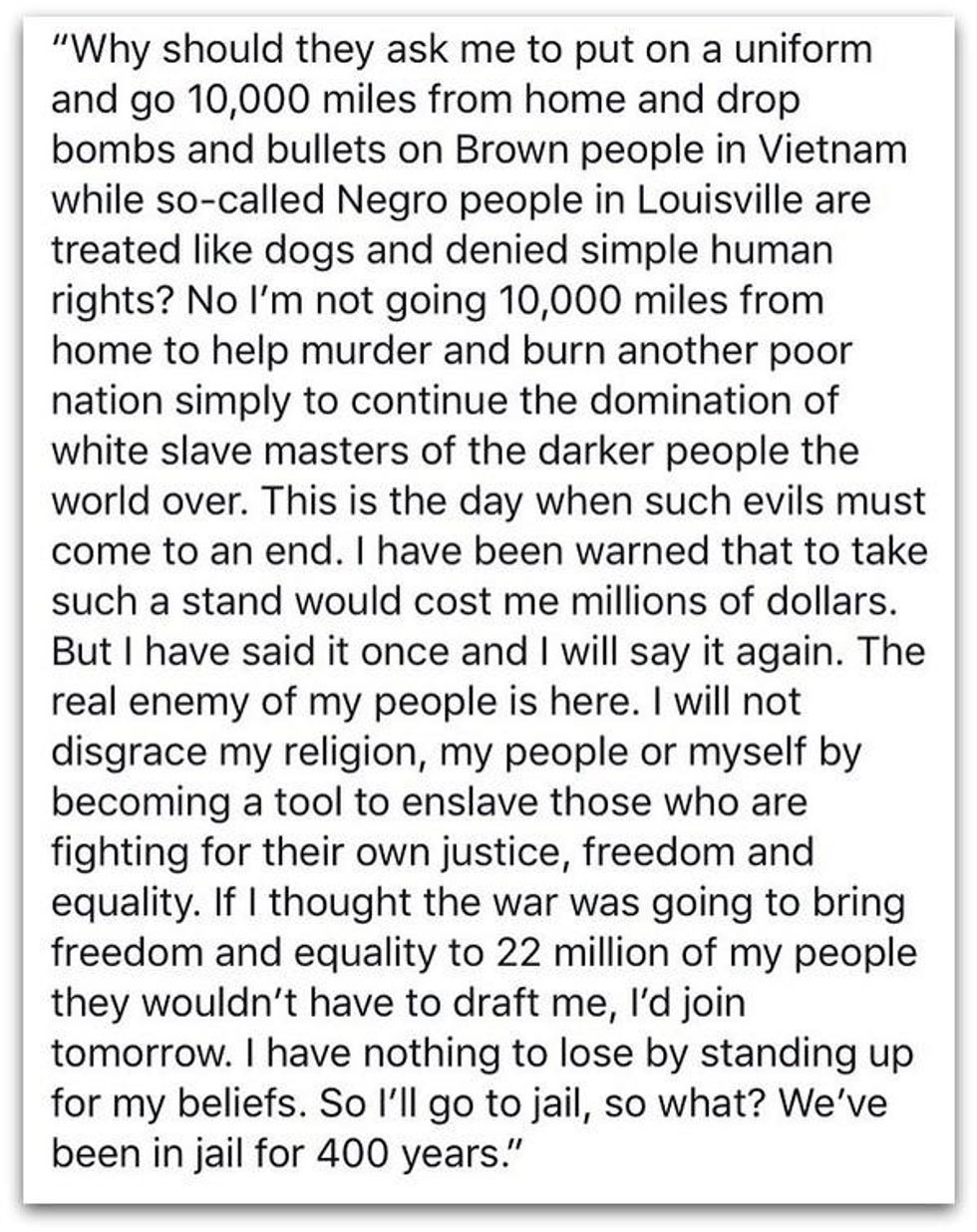
Though his refusal was celebrated by many, Sports Illustrates explains how it did not come without consequences:
Ali would not box for almost four years, as he appealed his arrest all the way to the Supreme Court, which overturned his conviction. Ali would go on to win the heavyweight title two more times, in 1974 and 1978. Along the way, Ali fought in some of the most iconic bouts in boxing history, including a trilogy of fights with rival Joe Frazier and "The Rumble in the Jungle" against George Foreman.
In 1984, Ali was diagnosed with Parkinson's disease, though he maintained a public presence for many years following. In recent years, Ali largely remained out of the spotlight, as his health declined in light of his disease.
Ali's legacy in and out of the ring made him one of the most well-known Americans ever. Sports Illustrated named him Sportsman of the Century in 1999, while the BBC named him Sports Personality of the Century. Last year, SI renamed its Legacy Award in Ali's honor.
In 2002, journalist Gary Younge, in a piece titled simply 'The Fighter,' attempted to describe how a "fresh-faced amateur boxer from Kentucky"--who went on to become known by the unsubtle nickname "The Greatest"--came to symbolize the struggle of black and other oppressed people, not only in the United States, but around the world. Ali, Younge wrote, was a
part of the social history of his time; he just refused to let mainstream society set the pace. Asked by one commentator what kind of champion he intended to be after he beat Liston in 1964, Ali replied: "I don't have to be what you want me to be. I can be what I want to be and I'm free to think what I want to think." It was a powerful statement for a young black man to make, not only in the US but just about anywhere at the time.
It was a statement that could find meaning in Mississippi, where civil rights workers would risk and sometimes lose their lives fighting segregation; but equally in the newly independent and soon-to-be independent states in Africa and the Caribbean. It was the year Nelson Mandela was sentenced to life imprisonment for opposing apartheid and Martin Luther King was awarded the Nobel peace prize for doing the same thing. This was one of the few times last century when the interests of African-Americans and the interests of the broader diaspora converged. With different means and different results in vastly different circumstances, they were all fighting for the vote and civil rights.
"Sure, we identified with the blacks in Africa," said John Lewis, then a leader of the Student Nonviolent Coordinating Committee and now a congressman in Atlanta. "And we were thrilled by what was going on. They were getting their freedom and we still didn't have ours in what we believed was a free country. We couldn't even get a hamburger and a Coke at the soda fountain. What was happening in Africa, finally, had tremendous influence on us." With his visits to Ghana and tours of other African states, Ali encapsulated that mood long before he met George Foreman in Kinshasa for the Rumble in the Jungle.
After retiring from boxing in 1981, ABC News reports how the celebrated fighter "entrenched himself in charitable work and humanitarian causes -- from serving as a United Nations "Messenger of Peace" to supporting hunger and poverty relief. He appeared on the lecture circuit, although the frequency of his appearances lessened when his speech began to slur from his advancing disease."
Dipping his toes into the political ring during this year's presidential race in the U.S., Ali made a point to release a statement following declarations by Donald Trump that he would, if elected, institute a total ban on Muslims entering the country.
"I am a Muslim and there is nothing Islamic about killing innocent people in Paris, San Bernardino, or anywhere else in the world," Ali said in a statement. "True Muslims know that the ruthless violence of so called Islamic Jihadists goes against the very tenets of our religion." He also called on Muslims to "stand up to those who use Islam to advance their own personal agenda."
Quoted in this Sports Magazine article in 2014, Thomas Hauser, Muhammad Ali's official biographer, said that his big concern in terms of Ali's legacy was that he had become "famous simply for being famous."
Most people, continued Hauser, "know that he stood up for his principles, but they really don't know what his principles were. Really, to fully appreciate what he meant, you almost had to live through his times - and every day pick up the newspaper to find something about this man." Though famous throughout the world during the peaks of his career, explained Hauser, fewer and fewer people possess an independent recollection of the man as "a fighter" or as the powerful "social force" he was during those early years.
"You have to remember that when Ali beat Sonny Liston [in 1964], it was a crime in many states for black people and white people to marry," Hauser explained. "Segregation was the law of the land, and when he burst upon the scene, an awful lot of black people thought it was better to be white. Reggie Jackson - a very famous baseball player - said that to me. That before Muhammad Ali, there were times when he was ashamed of being black, but that obviously he is proud of being black now. Muhammad Ali was part of that growth process for him. Every time Ali said 'I'm so pretty', what he was really saying - before it became fashionable - was 'black is beautiful'. And he became a beacon of hope not just for black people, but for oppressed people all over the world."
In fact, as Younge acknowledges in his own personal reflection of Ali: "I was one of those children. At home we had a rabbit - a black rabbit with a white patch around its eye - that we called Muhammad," remembers Younge. "And I had a T-shirt, with wording stretching over my toddler's pot belly reading: 'Float like a butterfly, sting like a bee.' I never thought I was nothing. But when I wore that T-shirt, I felt like a million dollars."