SUBSCRIBE TO OUR FREE NEWSLETTER
Daily news & progressive opinion—funded by the people, not the corporations—delivered straight to your inbox.
5
#000000
#FFFFFF
To donate by check, phone, or other method, see our More Ways to Give page.
Daily news & progressive opinion—funded by the people, not the corporations—delivered straight to your inbox.
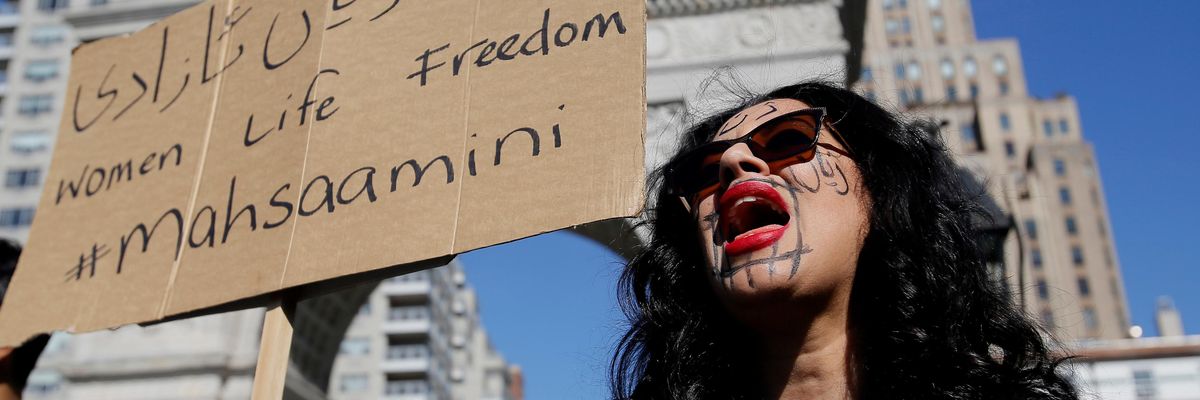
A woman shouts slogans during a "Woman, Life, Freedom" protest in support of Iranians defying their country's oppressive theocracy on October 15, 2022 in New York City. (Photo: Leonardo Munoz/VIEWpress via Getty Images)
Nearly 40 progressive U.S. organizations on Wednesday expressed support for Iranians--especially women and girls--who are defiantly protesting Iran's oppressive theocracy, even at the cost of what rights groups say is hundreds of their lives.
"As U.S. organizations committed to women's rights and justice across the world, we stand in solidarity with the brave people of Iran, overwhelmingly Iranian women and girls, who are demonstrating for their basic rights and strongly condemn the outrageous, widespread, and systematic human rights violations of the Iranian government seeking to silence the Iranian people's demand," the 39 groups, led by the National Iranian American Council, said in a statement.
The signatories continued:
Since the killing of 22-year-old Mahsa (Jhina) Amini at the hands of Iran's so-called morality police, Iranian protesters have bravely demonstrated for an end to the nation's mandatory hijab laws and broader system of repression. Women's rights have been the catalyst of these youth-led protests: giving voice and momentum to deeply held grievances of many Iranians that go to the very core of a system that has failed to serve its people, which is why these protests have cut across Iranian society.
This injustice is compounded by the reaction of the state to protests, which have been met with internet shutdowns and brutal violence from the Iranian security forces, including beatings, mass arrests, and deadly force. More than two hundred have been killed--and that number is likely higher--and thousands have been arrested for voicing their demands and hopes for a brighter future.
"We steadfastly support the Iranian people's demands of 'Women, Life, Freedom,' condemn the decades of oppression at the hands of the Iranian authorities, and call on them to halt their outrageous violence against peaceful protesters, release all prisoners of conscience, and heed the rightful calls of Iranian people for change," the groups' statement affirmed.
Many of the victims of the Iranian crackdown have been members of ethnic minorities, including Baluchis, Kurds, and Azeris.
One Azeri, 16-year-old Asra Panahi, died after security forces stormed Shahed Girls High School in Ardabil on October 13 and brutally attacked students who refused to sing a song praising Iranian Supreme Leader Ayatollah Ali Khamenei. Iranian authorities dispute the cause of Panahi's death, claiming she suffered from a congenital heart condition.
In what many Iranians now call "Bloody Friday," regime forces shot dead at least 66 Baluchi people, including children, and wounded hundreds more during an attack on worshippers after Friday prayers in Zahedan on September 30.
Some Kurdish-Iranians have fled the country, risking being shot dead by Iranian security forces along one of the world's most militarized borders in a bid to find refuge in Iraqi Kurdistan. Those fleeing include women, some of whom have joined Kurdish armed forces.
One 19-year-old Kurdish-Iranian who made the perilous journey to take up arms in defense of her people described her treatment at the hands of Iranian forces in Sanandaj, a Kurdish-majority city that's seen the biggest protests outside the capital Tehran.
"They pulled my hair. They beat me. They dragged me," the woman, whose real name is not given to protect her safety, told CNN. "At the same time, I could see the same thing happening to many other people, including children."
"I want to fight for the rights of women," she added. "I want to fight for human rights."
Dear Common Dreams reader, It’s been nearly 30 years since I co-founded Common Dreams with my late wife, Lina Newhouser. We had the radical notion that journalism should serve the public good, not corporate profits. It was clear to us from the outset what it would take to build such a project. No paid advertisements. No corporate sponsors. No millionaire publisher telling us what to think or do. Many people said we wouldn't last a year, but we proved those doubters wrong. Together with a tremendous team of journalists and dedicated staff, we built an independent media outlet free from the constraints of profits and corporate control. Our mission has always been simple: To inform. To inspire. To ignite change for the common good. Building Common Dreams was not easy. Our survival was never guaranteed. When you take on the most powerful forces—Wall Street greed, fossil fuel industry destruction, Big Tech lobbyists, and uber-rich oligarchs who have spent billions upon billions rigging the economy and democracy in their favor—the only bulwark you have is supporters who believe in your work. But here’s the urgent message from me today. It's never been this bad out there. And it's never been this hard to keep us going. At the very moment Common Dreams is most needed, the threats we face are intensifying. We need your support now more than ever. We don't accept corporate advertising and never will. We don't have a paywall because we don't think people should be blocked from critical news based on their ability to pay. Everything we do is funded by the donations of readers like you. When everyone does the little they can afford, we are strong. But if that support retreats or dries up, so do we. Will you donate now to make sure Common Dreams not only survives but thrives? —Craig Brown, Co-founder |
Nearly 40 progressive U.S. organizations on Wednesday expressed support for Iranians--especially women and girls--who are defiantly protesting Iran's oppressive theocracy, even at the cost of what rights groups say is hundreds of their lives.
"As U.S. organizations committed to women's rights and justice across the world, we stand in solidarity with the brave people of Iran, overwhelmingly Iranian women and girls, who are demonstrating for their basic rights and strongly condemn the outrageous, widespread, and systematic human rights violations of the Iranian government seeking to silence the Iranian people's demand," the 39 groups, led by the National Iranian American Council, said in a statement.
The signatories continued:
Since the killing of 22-year-old Mahsa (Jhina) Amini at the hands of Iran's so-called morality police, Iranian protesters have bravely demonstrated for an end to the nation's mandatory hijab laws and broader system of repression. Women's rights have been the catalyst of these youth-led protests: giving voice and momentum to deeply held grievances of many Iranians that go to the very core of a system that has failed to serve its people, which is why these protests have cut across Iranian society.
This injustice is compounded by the reaction of the state to protests, which have been met with internet shutdowns and brutal violence from the Iranian security forces, including beatings, mass arrests, and deadly force. More than two hundred have been killed--and that number is likely higher--and thousands have been arrested for voicing their demands and hopes for a brighter future.
"We steadfastly support the Iranian people's demands of 'Women, Life, Freedom,' condemn the decades of oppression at the hands of the Iranian authorities, and call on them to halt their outrageous violence against peaceful protesters, release all prisoners of conscience, and heed the rightful calls of Iranian people for change," the groups' statement affirmed.
Many of the victims of the Iranian crackdown have been members of ethnic minorities, including Baluchis, Kurds, and Azeris.
One Azeri, 16-year-old Asra Panahi, died after security forces stormed Shahed Girls High School in Ardabil on October 13 and brutally attacked students who refused to sing a song praising Iranian Supreme Leader Ayatollah Ali Khamenei. Iranian authorities dispute the cause of Panahi's death, claiming she suffered from a congenital heart condition.
In what many Iranians now call "Bloody Friday," regime forces shot dead at least 66 Baluchi people, including children, and wounded hundreds more during an attack on worshippers after Friday prayers in Zahedan on September 30.
Some Kurdish-Iranians have fled the country, risking being shot dead by Iranian security forces along one of the world's most militarized borders in a bid to find refuge in Iraqi Kurdistan. Those fleeing include women, some of whom have joined Kurdish armed forces.
One 19-year-old Kurdish-Iranian who made the perilous journey to take up arms in defense of her people described her treatment at the hands of Iranian forces in Sanandaj, a Kurdish-majority city that's seen the biggest protests outside the capital Tehran.
"They pulled my hair. They beat me. They dragged me," the woman, whose real name is not given to protect her safety, told CNN. "At the same time, I could see the same thing happening to many other people, including children."
"I want to fight for the rights of women," she added. "I want to fight for human rights."
Nearly 40 progressive U.S. organizations on Wednesday expressed support for Iranians--especially women and girls--who are defiantly protesting Iran's oppressive theocracy, even at the cost of what rights groups say is hundreds of their lives.
"As U.S. organizations committed to women's rights and justice across the world, we stand in solidarity with the brave people of Iran, overwhelmingly Iranian women and girls, who are demonstrating for their basic rights and strongly condemn the outrageous, widespread, and systematic human rights violations of the Iranian government seeking to silence the Iranian people's demand," the 39 groups, led by the National Iranian American Council, said in a statement.
The signatories continued:
Since the killing of 22-year-old Mahsa (Jhina) Amini at the hands of Iran's so-called morality police, Iranian protesters have bravely demonstrated for an end to the nation's mandatory hijab laws and broader system of repression. Women's rights have been the catalyst of these youth-led protests: giving voice and momentum to deeply held grievances of many Iranians that go to the very core of a system that has failed to serve its people, which is why these protests have cut across Iranian society.
This injustice is compounded by the reaction of the state to protests, which have been met with internet shutdowns and brutal violence from the Iranian security forces, including beatings, mass arrests, and deadly force. More than two hundred have been killed--and that number is likely higher--and thousands have been arrested for voicing their demands and hopes for a brighter future.
"We steadfastly support the Iranian people's demands of 'Women, Life, Freedom,' condemn the decades of oppression at the hands of the Iranian authorities, and call on them to halt their outrageous violence against peaceful protesters, release all prisoners of conscience, and heed the rightful calls of Iranian people for change," the groups' statement affirmed.
Many of the victims of the Iranian crackdown have been members of ethnic minorities, including Baluchis, Kurds, and Azeris.
One Azeri, 16-year-old Asra Panahi, died after security forces stormed Shahed Girls High School in Ardabil on October 13 and brutally attacked students who refused to sing a song praising Iranian Supreme Leader Ayatollah Ali Khamenei. Iranian authorities dispute the cause of Panahi's death, claiming she suffered from a congenital heart condition.
In what many Iranians now call "Bloody Friday," regime forces shot dead at least 66 Baluchi people, including children, and wounded hundreds more during an attack on worshippers after Friday prayers in Zahedan on September 30.
Some Kurdish-Iranians have fled the country, risking being shot dead by Iranian security forces along one of the world's most militarized borders in a bid to find refuge in Iraqi Kurdistan. Those fleeing include women, some of whom have joined Kurdish armed forces.
One 19-year-old Kurdish-Iranian who made the perilous journey to take up arms in defense of her people described her treatment at the hands of Iranian forces in Sanandaj, a Kurdish-majority city that's seen the biggest protests outside the capital Tehran.
"They pulled my hair. They beat me. They dragged me," the woman, whose real name is not given to protect her safety, told CNN. "At the same time, I could see the same thing happening to many other people, including children."
"I want to fight for the rights of women," she added. "I want to fight for human rights."