

SUBSCRIBE TO OUR FREE NEWSLETTER
Daily news & progressive opinion—funded by the people, not the corporations—delivered straight to your inbox.
5
#000000
#FFFFFF
To donate by check, phone, or other method, see our More Ways to Give page.
Daily news & progressive opinion—funded by the people, not the corporations—delivered straight to your inbox.
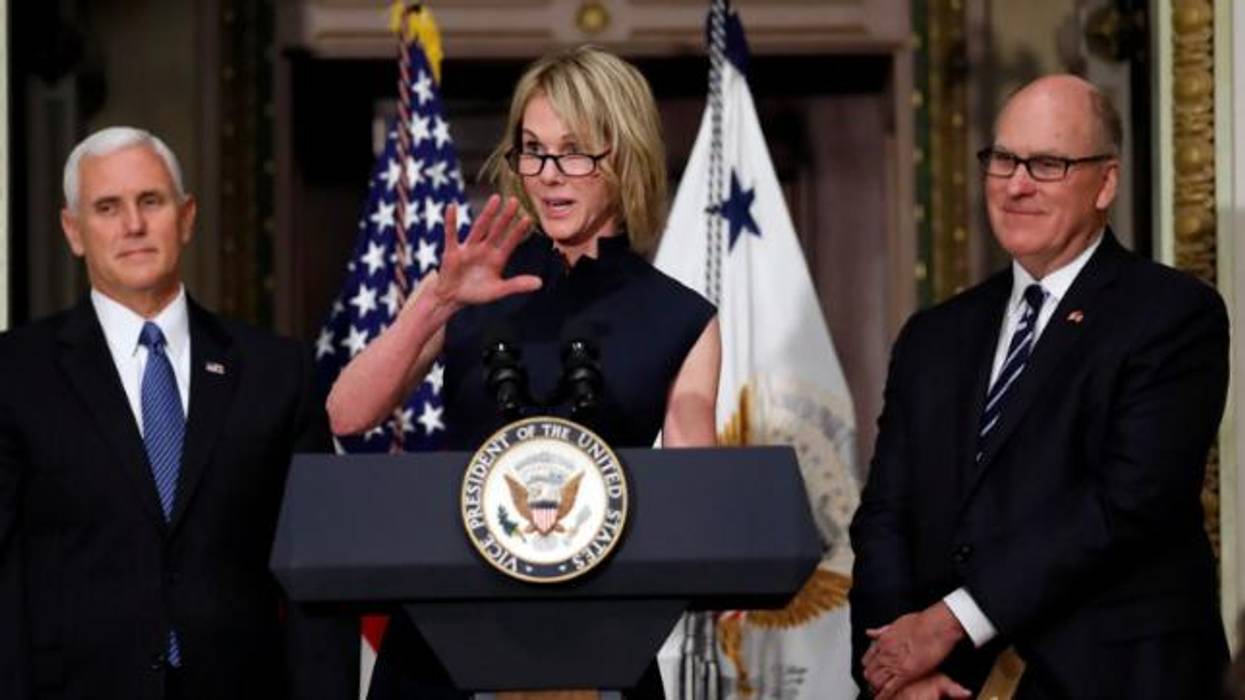
Environmentalists on Wednesday said they are appalled by President Donald Trump's decision to promote yet another "anti-science, anti-climate, pro-pollution" figure to a key diplomatic role during such a perilous moment for the planet.
Trump nominated GOP mega-donor and climate denier Kelly Knight Craft as U.S. ambassador to the United Nations last week.
"We have little confidence that Ms. Craft will be a competent advocate for clean air, safe water, and adequate public health either here or abroad if her nomination is confirmed."
--Wenonah Hauter, Food & Water Watch"Trump's nomination of Kelly Craft for U.N. ambassador is a slap in the face of climate science and human rights," Wenonah Hauter, executive director of Food & Water Watch, said in a statement.
Hauter said she is "disgusted but not surprised" by Trump's decision--which comes after the president's previous nominee, former State Department spokesperson and Fox News commentator Heather Nauert, withdrew her name from consideration--and added, "[A]t a time when the United States should be working harder than ever with the rest of the world to address our deepening climate crisis, to select an admitted climate denier to represent us before the U.N. is especially egregious."
"We have little confidence that Ms. Craft will be a competent advocate for clean air, safe water, and adequate public health either here or abroad if her nomination is confirmed," Hauter concluded. "We strongly urge the Senate to reject Ms. Craft's nomination out of hand."
Both Craft and her billionaire coal magnate husband are major donors to the Republican Party and Trump. According to the New York Times, "the couple donated more than $2 million to Mr. Trump's candidacy and inauguration."
Craft, who is currently serving as U.S. ambassador to Canada, made headlines in 2017 after she said during an interview with the Canadian Broadcast Corporation that she respects "both sides" of climate science, despite the overwhelming scientific consensus that human activity is driving global warming and threatening the future of the planet.
"I believe there are scientists on both sides that are accurate," Craft declared. "I think that both sides have their own results from their studies and I appreciate and I respect both sides of the science."
Watch:
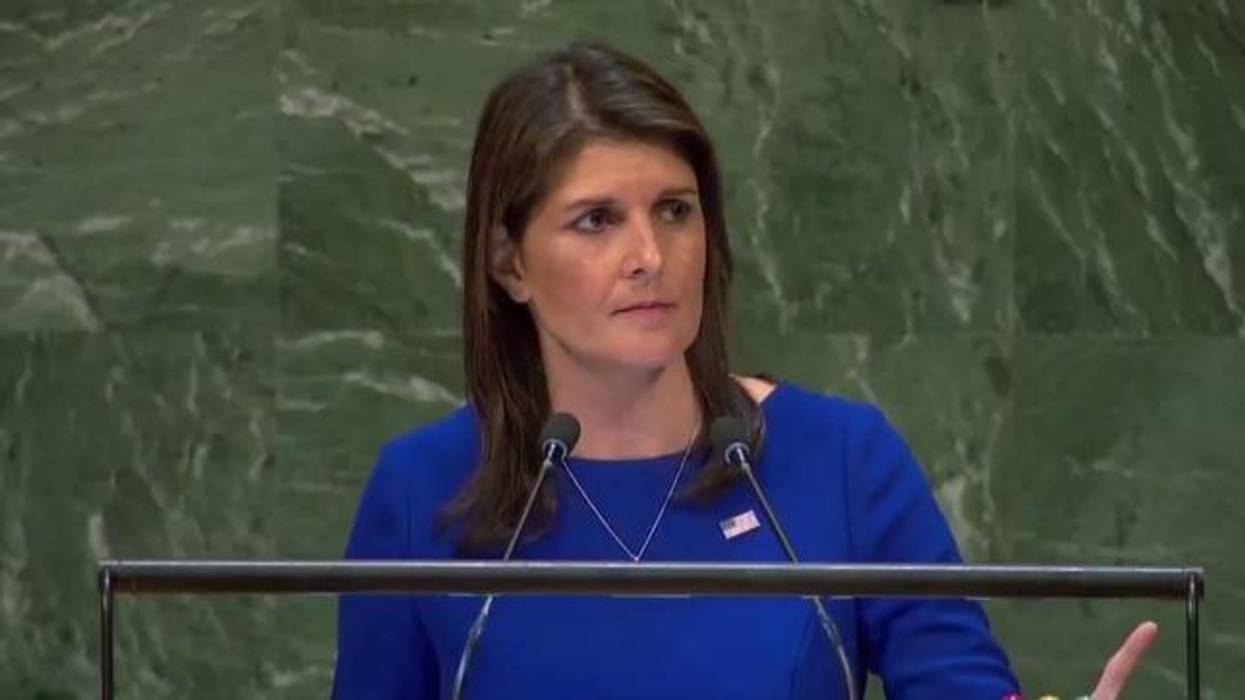
In a blow to Nikki Haley in her final weeks as U.S. ambassador to the United Nations, the General Assembly on Thursday overwhelmingly adopted a resolution calling for an end to the Israeli occupation just after the body rejected a U.S. resolution condemning Hamas.
Haley's resolution, which, per a procedural vote, needed a two-thirds majority for adoption, received 87 votes in favor to 57 against. There were 33 abstentions. It condemned "Hamas for repeatedly firing rockets into Israel and for inciting violence," and called for the group to stop using "airborne incendiary devices."
Gaza, which Hamas controls, has been described as "the scene of a humanitarian disaster" as a result of Israeli policies, and Israel's military assaults against the territory--facilitated by U.S. weaponry--have been globally blasted as "massacres" and tantamount to war crimes.
Denouncing the vote, Haley asked her "Arab brothers and sisters" to "let go" of their "hatred of Israel," later adding that "both sides" would do well to "let this go."
An Irish resolution, meanwhile, entitled "Comprehensive, Just, and Lasting Peace in the Middle East," easily passed with 156 votes in favor to six against with 12 abstentions. Australia, Israel, Liberia, Marshall Islands, and Nauru joined the United States in voting against it. It called for an end to Israel's occupation of Palestine including East Jerusalem, and affirmed support for a two-state solution based on pre-1967 borders.
Ireland's ambassador to the U.N. Geraldine Byrne Nason said that "settlement activity, violence, and terrorism" are all barriers to achieving such peace. She added, "A settlement of the conflict must meet Israeli and Palestinian security needs and Palestinian aspirations for statehood and sovereignty, and resolve all final status issues."
President Donald Trump announced Friday his intention to nominate State Department spokeswoman and former Fox News anchor Heather Nauert to fill Haley's role. When it comes to Israel, Nauert will likely bring continuity. According to the Jerusalem Post, "In her briefings, when asked about controversial Israeli policies or decisions, she almost always defers to the Israeli government."
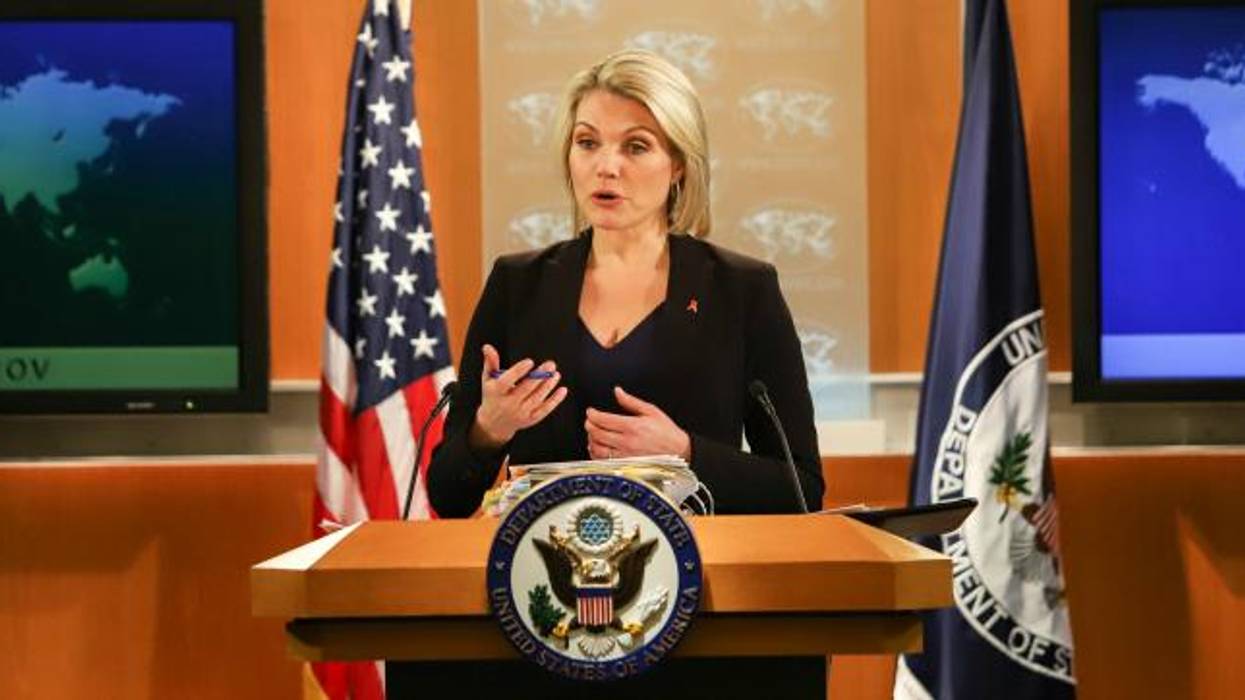
As President Donald Trump confirmed on Friday that he will nominate State Department spokeswoman and former Fox News anchor Heather Nauert as U.S. ambassador to the United Nations, critics argued that while the president's decision to select someone with zero diplomatic experience to represent the U.S. before the international community is "appalling," the belligerent foreign policy and contempt for human rights that Nauert will be in charge of selling is immeasurably more dangerous.
"The U.S. is breaking treaties, cutting foreign aid, imposing unilateral sanctions, threatening other countries, expanding the arms race, and gravely endangering the global environment. Global peace itself is being put at risk."
-- Jeffrey Sachs, Columbia University
"Appointing a Fox News talking head to represent our country at the United Nations is completely in character [for Trump]," argued Brian Dixon, senior vice president for media and government relations for the Population Connection Action Fund. "Nauert brings no experience, no understanding and, frankly, no interest in learning. Her main claim to this role is her willingness to defend the indefensible as a spokesperson."
Nauert's nomination comes as the Trump administration is ratcheting up tensions with Iran, defending Saudi Arabia's brutal murder of journalist Jamal Khashoggi and its continued assault on Yemen, and contributing to the climate crisis by withdrawing from the Paris accord and propagandizing on behalf of the fossil fuel industry.
In an email to Common Dreams, Columbia University professor Jeffrey Sachs argued that it is these broad and dangerous developments--not the appointment of Nauert or any other individual--that should be the deepest cause for alarm among advocates for peace and global cooperation.
"The worrying aspect of the U.S. is not a particular appointment but the aggressive, unilateralist foreign policy of the Trump administration," Sachs said. "The U.S. is breaking treaties, cutting foreign aid, imposing unilateral sanctions, engaging in beggar-thy-neighbor trade protectionism, threatening other countries, expanding the arms race, and gravely endangering the global environment. Global peace itself is being put at risk."
If confirmed by the Senate, Nauert will take the place of Nikki Haley, the current warmongering U.N. ambassador who announced in October that she is resigning from her post at the end of the year.
As The Jerusalem Post noted, Haley was a staunch and unequivocal defender of Israel's brutal occupation of Palestinian territory and America's broader interventionist and imperial foreign policy. Nauert is expected to bring more of the same.
"In her briefings, when asked about controversial Israeli policies or decisions, she almost always defers to the Israeli government," the Post noted.
According to CNN, Trump ultimately favored Nauert over other candidates because of her unwavering willingness to defend him and effectively peddle the White House's aggressive line on television.
"She's excellent," Trump said of Nauert on Thursday. "She's been with us a long time. She's been a supporter for a long time."

As "shocking and gruesome" new details surrounding Saudi Arabia's alleged torture and assassination of Washington Post journalist Jamal Khashoggi continued to trickle out on Tuesday--with anonymous Turkish officials telling the press that the prominent dissident was beaten, killed by lethal injection, and cut into pieces by the head autopsy doctor of the Saudi defense forces--U.S. President Donald Trump accepted wholesale Saudi Crown Prince Mohammed Bin Salman's increasingly implausible claim that he had zero knowledge of what "took place" two weeks ago inside the kingdom's Turkish consulate.
"These shocking and gruesome details would explain why U.S. intelligence sources told CNN and other American media outlets that they were 'utterly shocked' at what the content of the recordings presented to them by the Turkish authorities."
--Jamal Elshayyal, Al Jazeera
"Just spoke with the Crown Prince of Saudi Arabia who totally denied any knowledge of what took place in their Turkish consulate," Trump wrote on Twitter after a short phone conversation with the heir to the Saudi throne. "He was with Secretary of State Mike Pompeo during the call, and told me that he has already started, and will rapidly expand, a full and complete investigation into this matter. Answers will be forthcoming shortly."
Trump's tweets came just after Al Jazeera's Jamal Elshayyal reported that--contrary to reports the Saudis' are preparing to float a claim that Khashoggi's death was the result of a botched interrogation--the journalist was "beaten as soon as he entered the consulate" right in front of the Saudi consul general and was not interrogated.
Citing Turkish officials who reportedly have access to audio recordings, Jamal Elshayyal wrote that Khashoggi was tortured, killed by lethal injection, and dismembered by the Saudi military's head autopsy doctor, who insisted "that music be played while he cut up the journalist's body."
"These shocking and gruesome details would explain why U.S. intelligence sources told CNN and other American media outlets that they were 'utterly shocked' at what the content of the recordings presented to them by the Turkish authorities," Elshayyal observed.
Following Turkish investigators' examination of the Saudi consulate on Monday, Turkey's President Recep Tayyip Erdogan told reporters that officials are looking into the possible presence of "toxic materials" inside the Saudi consulate and whether those materials were "removed by painting them over."
These latest revelations from anonymous Turkish officials as well as Turkey's president come just hours after Pompeo finished an all-smiles meeting with the Saudi crown prince and King Salman, during which--according to State Department spokesperson Heather Nauert--the U.S. secretary of state "thanked the King for Saudi Arabia's strong partnership with the United States" and applauded the murderous regime for vowing to carry out "a thorough, transparent, and timely investigation of Jamal Khashoggi's disappearance."
The Saudi regime's explanation of what took place in its Turkish consulate two weeks ago has changed dramatically over the past week as new evidence has continued to emerge and as the international community has pressed for a credible investigation.
"The president is willingly and knowingly doing the counter messaging for the Saudi kingdom. He floated the 'rogue attackers' theory and [is] now vouching for their transparent denials and vows to investigate."
--Greg Miller, Washington Post
Initially, the Saudis maintained that Khashoggi left the Turkish consulate alive. Then, when this position become untenable, Trump obediently suggested after a phone call with King Salman that perhaps "rogue killers" flew to Turkey without the knowledge of the regime and murdered Khashoggi.
Meanwhile, CNN and other outlets are reporting that the Saudis are considering releasing a statement admitting that Khashoggi was killed but claiming the murder was the result of an interrogation gone wrong, and that the Saudi leadership had no knowledge of what was taking place.
Every step of the way--as numerous critics have pointed out--Trump has proven to be a willing megaphone for the Saudi regime's rapidly changing narrative, mindlessly repeating it on Twitter and to reporters as it has changed on a day-to-day basis.
"The president is willingly and knowingly doing the counter messaging for the Saudi kingdom," noted Washington Post national security reporter Greg Miller in a tweet on Tuesday. "He floated the 'rogue attackers' theory and [is] now vouching for their transparent denials and vows to investigate."

Amid the political hurricane around Supreme Court nominee Brett Kavanaugh's confirmation hearing and the actual storm devastating North Carolina, Donald Trump's administration struck a significant blow to the nation's refugee program this week that garnered far less attention. Secretary of State Mike Pompeo on Monday announced that the U.S. would reduce the cap on its refugee program to a new low of 30,000 people in 2019. This is the second such reduction by the administration. In 2017, this year's limit was reduced from 110,000 to 45,000, and only about 20,000 people have so far actually been admitted. By comparison, in the last year of President Barack Obama's tenure, the U.S. admitted more than 80,000 refugees.
In his speech justifying the dramatic cut, Pompeo claimed that the U.S. has a "longstanding record of [being] the most generous nation in the world when it comes to protection-based immigration and assistance"--a questionable claim--and went on to announce the new and far lower cap, which he attempted to justify "in consideration of both U.S. national security interest and the urgent need to restore integrity to our overwhelmed asylum system." Pompeo put a positive spin on the dramatic reduction, saying, "The improved refugee policy of this administration serves the national interest of the United States," without explaining how. He ended his speech by pompously claiming, "We are, and continue to be, the most generous nation in the world."
A day later, apparently in response to a letter by Democratic Sens. Dianne Feinstein and Dick Durbin stating that the president needs to consult Congress when making such changes, State Department spokeswoman Heather Nauert said that the 30,000 figure Pompeo had announced was only a proposal.
But whether or not Trump obtains congressional permission to reset refugee limits, he is doing so by fiat, and quietly through internal changes. Melissa Keaney, a staff attorney with the National Immigration Law Center, explained to me in an interview that the discretionary destruction of the refugee program is essentially a backdoor implementation of Trump's "Muslim ban." "For individuals from these Muslim-majority countries that have been targeted through the latest version of the Muslim ban--[they] are feeling the worst repercussions. Their numbers are 98 percent worse than they were under the Obama administration," she said.
A recent Reuters investigation found that the government has slowly whittled away the program "through procedural changes made largely out of public view" and that "the administration has reshaped the U.S. refugee program, slashing overall admissions and all but halting entry for some of the world's most persecuted people, including Syrians, Iraqis, Iranians and Somalis." The administration has done so in various ways, including through reassigning the staff of the Refugee Assistance Program. For example, Reuters reports, "it has reduced by nearly two-thirds the number of officials conducting refugee interviews." As a result, the Reuters investigation found that only "251 Somali refugees have been resettled in America this year, a 97 percent drop from the 8,300 admitted by this point in 2016."
Additionally, the Trump administration's national security justification for cutting the refugee program's scope is not based in fact. Trump's executive order implementing his Muslim ban after his inauguration triggered a review of the existing refugee resettlement program. According to Reuters, "the review concluded that refugees from all countries could safely be allowed to enter with some tightening of vetting, according to seven current or former U.S. officials who helped formulate or were briefed on the findings." However, "White House staff, including [Stephen] Miller and [John] Kelly, were not happy with that conclusion." So Trump and his cohorts ignored the results of their own review and spun a "national security" imperative out of thin air to implement what they wanted to do all along: curtail the entry of brown-skinned foreigners, and especially Muslims.
Keaney's organization, the NILC, is involved with three different lawsuits against the administration over the unfair and discriminatory application of the refugee resettlement process. "All the plaintiffs in our current lawsuit challenging this refugee ban have waited years," she said. "They've gone through all the hurdles and hoops that they have to undergo in terms of medical screenings, security screenings," all of which take years. Many of the NILC's plaintiffs had reached the very last step of the United States' extremely stringent vetting process before being allowed entry when Trump took office--and quickly shattered their families' dreams of being reunited. Although the NILC won a preliminary injunction against the suspension of the refugee program, none of its plaintiffs has been admitted into the country so far. To Keaney, this is a clear indication of "the corruption that we're seeing under this administration, an administration that believes itself to be above the law."
Pompeo's claim that the U.S. is the most generous country in the world is also hollow. The top five nations where refugees end up living are Turkey, Pakistan, Lebanon, Iran and Ethiopia. These nations have smaller populations than the U.S., so the proportional burden on the state is even higher. The U.S. then accepts so-called resettlements of refugees from such countries where they have been granted asylum. The U.S. program for resettling refugees peaked in 2016, when it was the world's most generous, probably as a result of receiving a higher number of applications as the global refugee crisis began exploding. But after Trump slashed the program, Canada is now outpacing the U.S. in the number of people being admitted. Canada's population is one-tenth of the United States'.
At the same time that the U.S. is dramatically scaling back its refugee program, the global refugee crisis continues to grow. The United Nations High Commission for Refugees estimates that there are 25 million refugees worldwide. The majority are from Syria, Afghanistan and South Sudan--three nations where the U.S. has interfered. The U.S. has bombed Syria on a semi-regular basis under the guise of the "war on terror," and Afghanistan continues to be the site of the United States' longest official war.
In his speech, Pompeo made no mention of how our country's wars fuel the refugee crisis, nor did he mention the government's own review of the refugee program that contradicts the administration's assertion and policy.
Ultimately, the slow death of the United States' refugee program must be seen as part of the larger project promoted by Stephen Miller and his ilk to foster the whitening of America. According to Reuters, "Refugees admitted to the United States from the small European country of Moldova, for example, now outnumber those from Syria by three to one, although the number of Syrian refugees worldwide outnumbers the total population of Moldova." Because national security is not an issue, according to the government's own internal review, the only other reason to suppress the number of refugees being resettled in the U.S.--and to do so disproportionately against Muslim refugees--is to pander to the racist elements of Trump's political base and to realize his and his staff's white supremacist views.

Pakistan is challenging the U.S. State Department's official account of a call that happened on Thursday between Secretary of State Mike Pompeo and the nation's new prime minister, Imran Khan, with Pakistan's Ministry of Foreign Affairs demanding that the United States "immediately" amend its "factually incorrect statement."
A statement released after the call by State Department spokesperson Heather Nauert said in part, "Pompeo raised the importance of Pakistan taking decisive action against all terrorists operating in Pakistan and its vital role in promoting the Afghan peace process."
Dr. Mohammad Faisal, a spokesperson for Pakistan's Ministry of Foreign Affairs, responded on Twitter, asserting that "there was no mention at all in the conversation about terrorists operating in Pakistan."
At a press conference following that exchange, Nauert said, "I can only say we stand by our readout."
Throughout his political career, Khan has been an aggressive and outspoken critics of U.S. drone attacks in Pakistan, especially in the tribal areas that run along the border with neighboring Afghanistan.
During the press conference, Nauert called Pakistan "an important partner" in the region, and added that "the secretary had a good call with the new prime minister and we look forward to having a good relationship with them in the future."
Pakistani Foreign Minister Shah Mehmood Qureshi on Friday confirmed that Pompeo is scheduled to visit Pakistan on Sept. 5. While Qureshi said the conversation between Khan and Pompeo was "very good," telling reporters, "You will be surprised to know that the Pompeo urged a productive bilateral relationship with Pakistan," he reiterated his nation's call for a correction.
Khan, a former cricket star, was sworn in as prime minister last week following the electoral victory of his party, Pakistan Tehreek-e-Insaf (PTI), in July. As Common Dreams has reported, Khan ran on "vows to address Pakistan's widespread poverty, confront rampant corruption, and pursue a more 'balanced' foreign policy with the nation's neighbors and the United States."

Pointing to "provocative" military drills the U.S. and South Korean air forces are conducting in the region, North Korea is warning that the war games could jeopardize a highly anticipated summit scheduled to take place in Singapore next month, which is supposed to bring together the North's leader, Kim Jong Un, and U.S. President Donald Trump.
The warning came as the North abruptly canceled a Wednesday meeting with representatives from South Korea just hours in advance. Denouncing the "Max Thunder" joint drills that kicked off on Friday, Korean Central News Agency (KCNA), the North's state media, said:
This exercise targeting us, which is being carried out across South Korea, is a flagrant challenge to the Panmunjom Declaration and an intentional military provocation running counter to the positive political development on the Korean Peninsula...
The United States will also have to undertake careful deliberations about the fate of the planned North Korea-U.S. summit in light of this provocative military ruckus jointly conducted with the South Korean authorities.
The Associated Press reports that representatives at the Wednesday meeting were planning "to discuss setting up military and Red Cross talks aimed at reducing border tension and restarting reunions between families separated by the Korean War."
Following KCNA's announcement, U.S. State Department spokeswoman Heather Nauert said at a press briefing on Tuesday that the Trump administration had not heard anything from the North or South Korean governments "to indicate that we would not continue conducting these exercises or that we would not continue planning for our meeting between President Trump and Kim Jong Un next month."
The development comes as North Korea proceeds with its plans to destroy Punggye-ri, the complex where the country has conducted all of its known nuclear tests, ahead of the June 12 summit with Trump. The North has said it will invite foreign reporters--including some from the United States--to witness the dismantlement, which is set to occur sometime next week.
KCNA, citing a Ministry of Foreign Affairs statement, reported that "dismantlement of the nuclear test ground will be done in the following sequence--making all tunnels of the test ground collapse by explosion; completely blocking entries; removing all observation facilities, research institutes and structures of guard units on the ground."

This weekend in Gaza, Palestinians buried their dead after Israeli soldiers killed at least 18 Palestinian protesters and wounded hundreds more on Friday. About 30,000 Palestinians had gathered near the fenced barrier separating the Gaza Strip from Israel, both protesting the stifling blockade on their territory and mourning the dispossession of their ancestral lands at the hands of the Israeli state.
As in many other Palestinian protests that take place in the occupied territories, most protesters were unarmed and nonviolent. Families picnicked in the shadow of the Israeli border and flew Palestinian flags. But like so many other Palestinian protests, this one ended in tears.
"I took my grandchildren. We went to a peaceful demonstration," Fayik Sabbagh told The Washington Post. "We went there to tell them this is our land, but what we found was different."
Israeli authorities claimed they opened fire in response to some protesters who had encroached near the fence, burning tires and hurling stones or molotov cocktails. Footage that emerged from the chaotic scene suggested Israeli soldiers targeted unarmed protesters, including some who were running away and were shot from a distance by snipers.
One victim was 20-year-old Badr Sabbagh, Fayik's son, who was killed just minutes after arriving to watch the protests. "He asked for a cigarette, I gave it to him, he had two puffs, and then he was shot in the head," his brother Mohammed told The Post.
The killings marked the worst day of violence in Gaza since the 2014 war between the Islamist group Hamas and the Israeli military, in which the United Nations said at least 1,462 Palestinian civilians died. And the aftermath of the protests underscored both the desperate futility of the Palestinian struggle and the relative impunity with which Israel can snuff out Palestinian lives.
The right-wing government of Israeli Prime Minister Benjamin Netanyahu offered neither sympathy nor remorse. "Israel is acting determinedly and decisively to protect its sovereignty and the security of its citizens," Netanyahu said. Officials described the protest as a "camouflage" for Hamas infiltrators supposedly launching an attack across the fortified border. Defense Minister Avigdor Liberman rebuffed international calls for an investigation, saying that "under no circumstances" would there be an inquiry into the incident and opining that the Israeli soldiers manning the fence "deserve a commendation."
On Saturday, the IDF even boasted that its troops had maintained total control of the situation down to the number of bullets fired. But the Israeli military soon deleted the tweet as more footage surfaced of panicked Palestinians being gunned down while trying to flee.
"These are the predictable outcomes of a manifestly illegal command: Israeli soldiers shooting live ammunition at unarmed Palestinian protesters," said Amit Gilutz, a spokesman for B'Tselem, a Jerusalem-based leftist organization that monitors human rights abuses in the occupied territories. "What is predictable, too, is that no one -- from the snipers on the ground to top officials whose policies have turned Gaza into a giant prison -- is likely to be ever held accountable."
The Israeli leadership had reason to feel comfortable in its defiance. The most vocal criticism from abroad came from Iran and Turkey; censure from either country is more likely a source of relish for Netanyahu than unease. And at the United Nations, the Trump administration blocked the Security Council from issuing a statement that called for an "independent and transparent investigation" and affirmed the Palestinians' right to peaceful protest.
State Department spokeswoman Heather Nauert said the United States was "deeply saddened" by Friday's events. But Jason Greenblatt, Trump's leading envoy for Israeli and Palestinian negotiations, undercut that message by taking Israel's side and pinning the blame on Hamas for the "hostile march."
Indeed, the Trump administration has helped stoke Palestinian outrage. Across the occupied territories, Palestinian factions have called for protests every day until May 15, "the day after the anniversary of Israel's independence in 1948, known to Palestinians as the 'Nakba,' or catastrophe," as my colleagues reported. It also happens that the White House has chosen that date to open its new embassy in Jerusalem, a move that reinforced the Palestinian view that Washington can no longer be trusted as a fair broker in the long-stalled peace process.
Nor can the Palestinians look for much help from their neighbors. As we've discussed in this space, some of the region's key powers -- most notably Egypt and Saudi Arabia -- have moved closer to Israel in recent years. It has become clear that while the stateless Palestinians garner tremendous sympathy from citizens across the Arab world, their plight is a tiresome nuisance for some Arab leaders, who are more keen to crack down on Islamist parties at home or confront Iranian influence abroad.
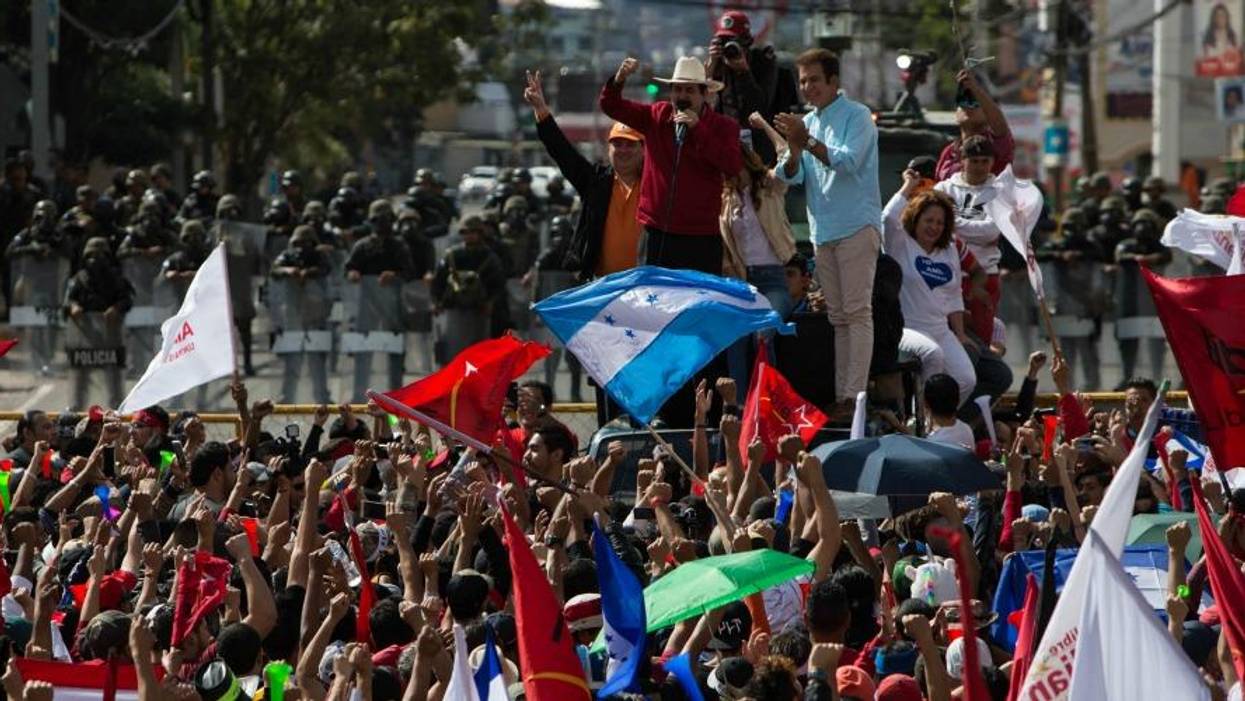
As the usual crowd of neo-conservative regime-changers, liberal humanitarian interventionists, and Israel lobbyists join President Trump in backing anti-government street demonstrations in Iran, their collective silence has been deafening regarding the killing of at least 30 people in Honduras by police, after protests against alleged fraud in that country's recent presidential election.
Do you smell a double standard? You should--and hardly for the first time.
The op-ed pages of major U.S. newspapers weren't filled with columns demanding a tough response last July when Saudi authorities executed four Shia Muslim men for participating in protests against security forces who run a police state much tighter than Iran's. The victims--like other pro-democracy demonstrators who have been condemned to death--were reportedly convicted on the basis of confessions produced through torture.
Nor did many columnists and think-tank pundits complain when security forces in Bahrain killed five protesters last May amid what Human Rights First called a "ferocious crackdown against opposition human rights leaders." The same tough Sunni monarchy crushed huge street protests in 2011 with the help of Saudi troops.
And now, amid serious accusations that the recent presidential elections in Honduras were stolen, where are the voices condemning the killing of protesters there by heavily armed military police?
The protests broke out after a highly suspicious ruling by Honduras's Supreme Electoral Tribunal--delayed for 36 hours because of thousands of missing vote tally sheets--handed a narrow and unconvincing victory to the incumbent conservative presidential candidate, Juan Orlando Hernandez, in the Nov. 26 national election.
His party took power after a military coup in 2009, which the Obama administration, to its great discredit, eventually endorsed. Hernandez himself was first elected president in 2013, apparently with the help of funds stolen from the Honduran Social Security Institute. A 2010 State Department cable stated that "he has consistently supported US interests." He enjoys the respect and friendship of President Trump's Chief of Staff John Kelly, who got to know the Honduran president while heading the U.S. Southern Command.
Hernandez's run for re-election last fall violated the Honduran constitution, which grants presidents only one term in office. It was supremely ironic: the military coup in 2009 was predicated on the charge that the left-leaning president at the time, Manuel Zelaya, was contemplating running for a second term, which he staunchly denied.
The only consistent standard shared by the Honduran military and Washington, then as now, is to support conservative governments in Central America.
Within days of Hernandez's latest alleged electoral victory, the Trump administration cleared the way to him receiving $644 million in aid appropriated by Congress, by certifying that his government was fighting corruption and defending human rights.
At the time, the election tribunal had not yet even certified the results; the Hernandez government had suspended constitutional rights; and police were battling protesters in the streets with tear gas, water cannons, and gunfire.
Moreover, the government's record on corruption is debatable at best. Testimony by a convicted Honduran drug kingpin in New York last spring implicated the brother of President Hernandez (who denied the charge) in a money laundering operation. The same kingpin reportedly also gave U.S. authorities a recorded conversation with another trafficker who claimed to have made a quarter-million dollar payoff intended for the president himself.
In addition, President Hernandez's security minister--in charge of the country's national police force--was accused by another former trafficker of helping to facilitate shipments of cocaine from Colombia to Honduras. As a military officer, he attended courses in counterinsurgency and psychological operations at the U.S. military's School of the Americas in Fort Benning, Georgia.
Under his purview, noted the Washington Post's Ishaan Tharoor, "the country's security forces, enriched and empowered in the shadow of the U.S. war on drugs, have been accused of human rights abuses and targeting dissidents, including allegations surrounding the 2016 assassination of Berta Caceres, an environmental activist and outspoken opponent of Hernandez."
In late December, unsurprisingly, the State Department endorsed the election tribunal's dubious declaration of Hernandez as the winner. It also called on both sides to refrain from violence.
Human rights groups took a harder line.
" Amnesty International has accused the government of deploying 'dangerous and illegal tactics to silence any dissenting voices,' while the United Nations and Inter-American Commission on Human Rights have denounced torture of detainees in military installations and said they were 'alarmed by the illegal and excessive use of force to disperse protests,' reported the Guardian at the beginning of 2018. "But the US-backed government has rejected a request by the Organization of American States (OAS) to send a special delegate to investigate abuses."
Bottom line: In Iran, U.S. economic sanctions are contributing to the misery that drives protesters to the streets. In Honduras, by contrast, U.S. military aid supports many of the security forces that are killing protesters much closer to home. Yet most pundits with a national platform in the U.S. media ignore Honduras while insisting that Washington must denounce the Iranian government for its crackdown on dissidents. Go figure.

Amid not-so-subtle calls for regime change in Iran, critics on Monday blasted President Donald Trump and his neoconservative allies on the right for misrepresenting and exploiting recent protests in the nation.
Trump wrote on Twitter before 5am: "Iran is failing at every level despite the terrible deal made with them by the Obama Administration. The great Iranian people have been repressed for many years. They are hungry for food & for freedom. Along with human rights, the wealth of Iran is being looted. TIME FOR CHANGE!"
Other Republicans weighed in on the demonstrations as well.
Sen. John McCain (R-Ariz.), a notorious war hawk who infamously joked about bombing Iran a decade ago, tweeted: "The U.S. stands with the brave protesters who yearn for freedom, peace, and an end to corruption in Iran." Nuclear deal foe and U.S. Ambassador to the United Nations Nikki Haley praised the "Iranian people [who] are now finding their voice." Sen. Lindsey Graham (R-S.C.), who once called Iranians "cheaters and liars," said the protests show the Iran nuclear deal isn't working and that he would lay out what a "better deal would look like and ... would stand with the Iranian people the entire time."
State Department spokesperson Heather Nauert tweeted that "Secretary Tillerson reiterates the United States' deep respect for the Iranian people. We call on all nations to stand with us in demanding the regime respect their basic human rights." The tweet came less than two weeks after it was revealed that Tillerson told State Dept. employees that allies and adversaries should get different treatment for human rights abuses.
Former U.S. Ambassador to the United Nations and serial advocate for bombing innocent people and overthrowing foreign governments he dislikes John Bolton said clearly that regime change should be the goal of the protests, and praised Trump for "taking the side of the demonstrators." Israeli President Benjamin Netanyahu, meanwhile, even wished "the Iranian people success in their noble quest for freedom."
Commentators on social media were quick to point out the shallowness of such calls:
According to Trita Parsi, founder and president of the National Iranian American Council (NIAC), "there are still more questions than answers" about the ongoing protests that erupted last week and have left at least 12 people dead.
The size of the protests is much smaller than those of 2009, according to reports, but Iranian lawyer and Nobel Peace laureate Shirin Ebadi told Italian newspaper La Repubblica Sunday she believes "the protests are not going to end soon" and could very well swell. At the moment though, writes Reza Marashi, research director for NIAC, "these protests more closely resemble a continuation of Iran's long-standing civil rights movement rather than an attempt to overthrow the government."
But Marashi says one thing is clear: "Washington would be wise to acknowledge the limits of its power inside Iran. Policymakers and pundits cannot change this simple truth: The problems are Iranian, the protestors are Iranian, and the solution will be Iranian."