

SUBSCRIBE TO OUR FREE NEWSLETTER
Daily news & progressive opinion—funded by the people, not the corporations—delivered straight to your inbox.
5
#000000
#FFFFFF
To donate by check, phone, or other method, see our More Ways to Give page.
Daily news & progressive opinion—funded by the people, not the corporations—delivered straight to your inbox.
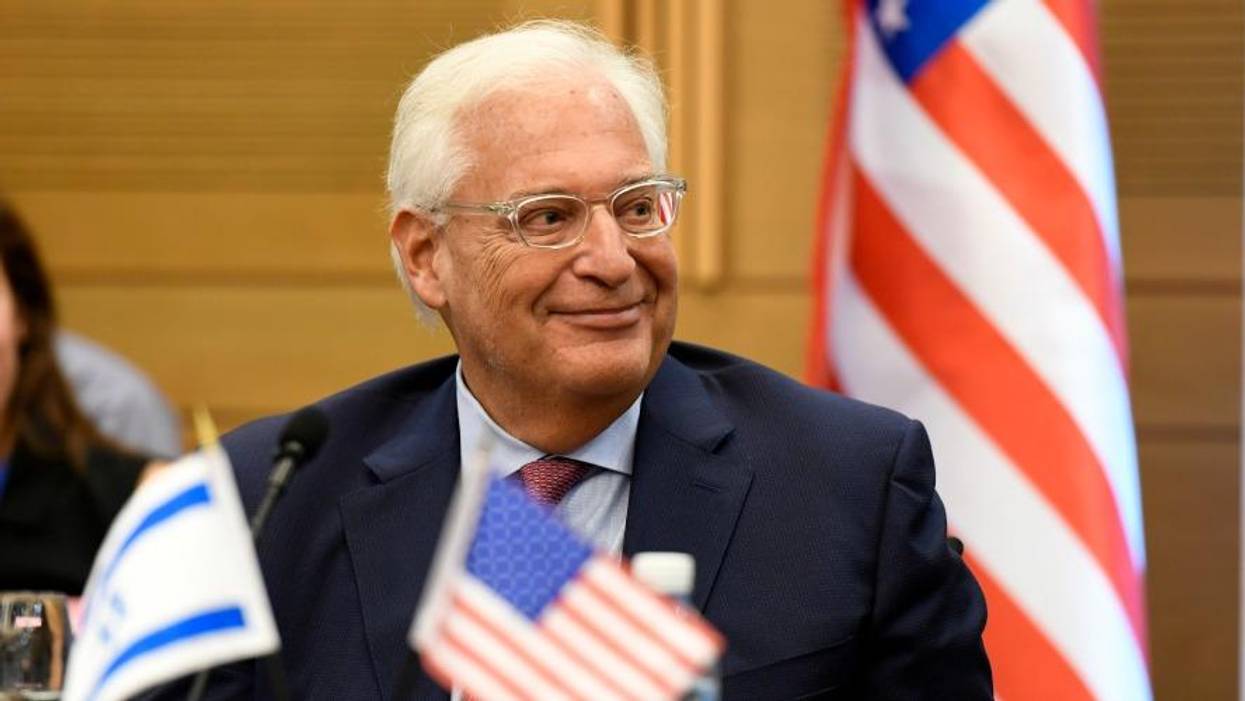
Further solidifying human rights advocates' fears that the Trump administration's policy on the Israeli-Palestinian conflict is solely focused on satisfying the Israeli government, a top U.S. diplomat in the region suggested Tuesday that Israel's authority in the Middle East is God-ordained.
At an event marking the first anniversary of the U.S. embassy's move from Tel Aviv to Jerusalem, U.S. Ambassdor to Israel David Friedman remarked that the relationship between the two countries is growing stronger because "Israel has one secret weapon that no other country has: Israel is on the side of God."
The comments came hours before Palestinians gathered at the Israel-Gaza border to mark a different anniversary--71 years after the Nakba when about 700,000 Palestinians were forced from their homes when Israel was established.
Friedman's remarks were met with disbelief and outrage from critics including James Zogby, president of the Arab American Institute.
Yousef Munayyer, who heads the U.S. Campaign for Palestinian Rights, argued that such a statement from a top Trump administration official undermines any hope that may still remain that the current U.S. government hopes to reach an equitable solution to the conflict.
Daniel C. Kurtzer, a former U.S. ambassador to Israel who served in the Clinton and George W. Bush administrations, said the remark would have been more suitable coming from "the far-right Orthodox Jewish community" than a government official.
"As the supposed ambassador of the United States government and all its people, it is an extremely inappropriate comment," Kurtzer told the New York Times.
The transfer of the U.S. embassy to Jerusalem last year also coincided with Nakba Day, when the Israeli military killed nearly 60 Palestinian protesters who were holding border demonstrations, as Trump administration members celebrated miles away.
In addition to moving the embassy--over the objections of the United Nations and several U.S. allies--the U.S. has also slashed Palestinian aid, putting millions at an even greater risk for malnutrition and disease than they already are due to Israel's occupation and blockade. The Trump administration also closed the Palestinian Liberation Organization in Washington, D.C. in 2018, drawing accusations of "American collusion with Israel's occupation" from the PLO.
Saeb Erakat, the Palestinians' chief negotiator who has accused the Trump administration of destroying the possibility of a two-state solution with its vehemently pro-Israel policy, wrote that Friedman's comments represent a new extreme position in President Donald Trump's agenda.
What ambassador Friedman is telling Palestinians--Christians and Muslims," he wrote on Twitter, is "that God is against them (or that they're enemies of God). This was never an American position."
The United States appears to be marching in lockstep with the Israeli government's extremist surge with the likely confirmation of David Friedman, President Donald Trump's choice for U.S. ambassador to Israel.
The Senate Foreign Relations Committee voted to approve Friedman on Thursday with Democrat Sen. Bob Menendez of New Jersey joining the panel's Republicans in a 12-9 vote. His confirmation now heads to the full Senate, where Democrats don't have the ability to block his nomination.
As Anna Massoglia, political researcher for the Center for Responsive Politics' Open Secrets project, noted on Twitter:
The nomination of Friedman, a hard-line conservative, provoked outrage over his views supporting settlement expansion onto Palestinian territory, his dismissal of the two-state solution, and his advocacy for moving the U.S. embassy from Tel Aviv to Jerusalem (among other things).
Following the committee vote, Jewish Voice for Peace (JVP) said that Friedman's "dedication to advancing Israel's illegal settlement enterprise, his support for extremist Israeli policies, harsh attitude towards critics of Israel's occupation, and anti-Palestinian racism and Islamophobia should disqualify him from appointment as U.S. ambassador to Israel."
Notably, the committee's ranking minority member Sen. Ben Cardin (D-Md.) publicly denounced Friedman after he was swarmed by calls opposing the nomination, which JVP said was "a testament to the efforts of grassroots constituents who are working to hold their elected officials accountable to a vision of equal rights and justice for all people in the region."
Friedman's ascension to power comes at the same time that the Israeli government has moved to clamp down on free expression.
On Monday evening, the Israeli Parliament passed a law that bans entry to foreigners that publicly support the pro-Palestinian rights Boycott, Divestment, and Sanctions (BDS) movement, which also coincides with a massive expansion of settlement construction in the West Bank.
The new law also applies to those who speak out against the new settlements.
While it is unclear how Israel plans to implement the ban, Michael Sfard, an Israeli lawyer and political activist specializing in international human rights, said that is a clear violation of international human rights law.
"Countries have wide discretion to allow are deny entry to foreigners," Sfard told Mondoweiss. "However, international human rights law prohibits discrimination on the basis of a person's opinion and provides freedom of conscious and thought. The law is definitely a violation of both."
While the pro-Israeli lobby group J Street is concerned that that measure will "further isolate the country [and] validate Israel's critics," it coincides not only with the rise of Friedman but also with an effort within the United States to censor the BDS movement.
Following its passage, the U.S. State Department gave a muted rebuke of the law, which it defended as being the "sovereign" right of Israel.
"While we oppose boycotts and sanctions of the state of Israel, we also support firmly freedom of expression," said State Department spokesperson Mark Toner. "That said, it's--this is a sovereign decision for Israel to make regarding its borders."
For his part, Friedman co-authored a November 2016 op-ed which argued that the BDS effort should be "viewed as inherently anti-Semitic" as it is based on the "false notion that Israel is an occupier." The commentary also called on the U.S. to "take strong measures, both diplomatic and legislative, to thwart" the movement.
David Friedman, the newly appointed United States Ambassador to Israel, is on a crusade. Two weeks before the elections, he wrote an oped in the Jerusalem Post that reveals his unflinching fervor: "As American Jews numbering some six million souls... we have been given an opportunity that our ancestors could not have dreamed of....
David Friedman, the newly appointed United States Ambassador to Israel, is on a crusade. Two weeks before the elections, he wrote an oped in the Jerusalem Post that reveals his unflinching fervor: "As American Jews numbering some six million souls... we have been given an opportunity that our ancestors could not have dreamed of.... Instead of having to confront the challenges of murderous enemies... we have been entrusted a legacy by the greatest of generations that preceded us to ensure that Israel survives and flourishes as a light unto the nations and a permanent home for the Jewish people."
Friedman's crusade has three primary aims: to fortify Israel's colonial project, undermine the U.S.-Iran Nuclear deal, and to vilify liberals, particularly Jewish liberals.
The first two objectives are revealed very clearly in a 16-point action plan, written by Friedman and Jason Dov Grennblatt this past November.
First, the plan declares that the "U.S. will recognize Jerusalem as the eternal and indivisible capital of the Jewish state and Mr. Trump's Administration will move the U.S. embassy to Jerusalem." Simultaneously, the two-state solution is presented as defunct, not due to the geographic reality created by over half a million Jewish settlers taking over Palestinian land, but because "Palestinians are unwilling to renounce violence against Israel or recognize Israel's right to exist as a Jewish state." The problem is, in Friedman's view, that the two major Palestinian political parties " regularly promote anti-Semitism and jihad. Such explanations clearly elide the everyday violence experienced by Palestinians, while giving a green light for their ongoing dispossession.
However, the 16-point plan also insists that in order to allow Israel to continue its colonial project unhindered, it is paramount to undermine the international institutions that have attempted to curb Israel's rights-abusive policies. Friedman accordingly suggests that the "U.S. should cut off funds for the UN Human Rights Council" and "should veto any United Nations votes that unfairly single out Israel," while working with the European Union to oppose "special labeling requirements on Israeli products or boycotts on Israeli goods." Indeed, "the U.S. should view the effort to boycott, divest from, and sanction (BDS) Israel as inherently anti-Semitic and take strong measures, both diplomatic and legislative, to thwart actions that are intended to limit commercial relations with Israel."
While anti-Semitism is a recurring trope in the new ambassador's lexicon used as a political weapon to deflect criticism, it is crucial to understand that Friedman is not only a fiery rhetorician, but also a savvy strategist. Indeed, he did not wait for his appointment to become pro-active in assisting the messianic Jewish settlers. In order to help redeem the land of Israel where Jewish people "have lived... for 3,500 years," Friedman joined the American Friends of Bet El, an NGO that raises funds for the West Bank settlement. As the organization's president, he succeeded in soliciting money from the family charity of Jared Kushner, Trump's son-in-law, and thus solidify the connection between the incoming administration and Israel's illegal settlements.
His second objective as ambassador will be to help Prime Minister Netanyahu undermine the 2015 Iran Nuclear deal. Following Netanyahu's cue, Friedman depicts Iran in the document "as the leading state sponsor of terrorism -- putting the Middle East particularly, but the whole world at risk by financing, arming, and training terrorist groups operating around the world." This, Friedman concludes, is a violation of the Joint Comprehensive Plan of Action signed with Iran and justifies the implementation of "tough, new sanctions."
In addition to retracting the Iran deal, Friedman recommends that the Trump Administration strengthen the "unbreakable bond between the United States and Israel" by ensuring that Israel receive "maximum military, strategic and tactical cooperation from the United States." He consequently recommends cancelling the clause in the Memorandum of Understanding, recently signed by the Obama Administration and the Israeli Government, which limits Congress from giving financial support greater than the 3.8 billion dollars it has already promised to provide annually for the next ten years.
Finally, Friedman's third objectives is to delegitimize liberals, or anyone who will stand in the way of his crusade. ;This objective has been most clearly seen in the language he uses to malign those who disagree with his political agenda.
He has depicted media outlets such as the New York Times and the Washington Post as a fifth column, President Barack Obama is labeled an anti-Semite, while Jews active in the pro-Israel lobby J-Street are deemed "worse than kapos -- Jews who turned in their fellow Jews in the Nazi death camps."
Why, one might ask, are they worse than kapos?
Friedman explains: "The kapos faced extraordinary cruelty and who knows what any of us would have done under those circumstances to save a loved one? But J Street? They are just smug advocates of Israel's destruction delivered from the comfort of their secure American sofas - it's hard to imagine anyone worse."
What is particularly frightening about Friedman--like quite a few of Trump's other picks--is that he is on a sacred mission. Thus, anyone who disagrees with his first two objectives is characterized as an apostate, either an anti-Semite or Jihadist, or an apologist for one or the other or both. As someone who has witnessed what U.S. interventionism has wrought in the Middle East since the dawn of the new millennium, Friedman's appointment is not only extremely scary, but like the crusaders of old, it foretells of much bloodshed to come.
First published in Middle East Eye