SUBSCRIBE TO OUR FREE NEWSLETTER
Daily news & progressive opinion—funded by the people, not the corporations—delivered straight to your inbox.
5
#000000
#FFFFFF
To donate by check, phone, or other method, see our More Ways to Give page.
Daily news & progressive opinion—funded by the people, not the corporations—delivered straight to your inbox.
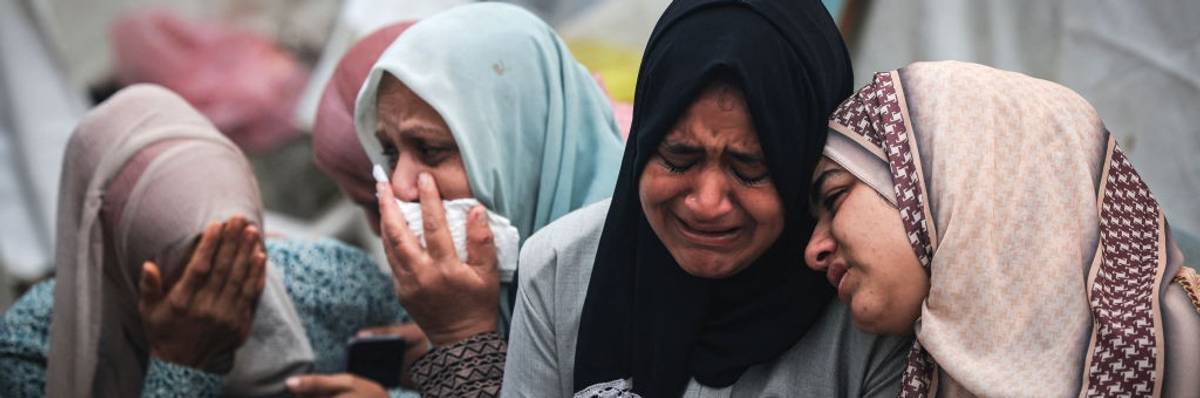
Palestinians mourn their relatives, killed in an overnight Israeli strike on the Al-Maghazi refugee camp, during a mass funeral at the Al-Aqsa hospital in Deir Al-Balah, in the central Gaza Strip, on December 25, 2023.
It’s time to break the cycle. That means living our values, not defying them.
“I am begging the world: stop all the wars, stop killing people, stop killing babies. War is not the answer. . . .War is not how you fix things. This country, Israel, is going through horror. And I know the mothers in Gaza are going through horror. . . .”
I can only kneel in awe.
Yes, there is sanity in the world – moral sanity – even, and especially, now, as revenge rages in Israel, fed by American armaments. There are courageous voices calling not simply for “peace,” essentially understood by much of the world as nothing more than a ceasefire, but for, oh my God, compassion, healing, love. The “enemy” is as human as we are! And waging war against the enemy guarantees nothing but . . . endless war.
The words above are those of Michal Haley, whose beloved son was murdered by Hamas, crying out in a Facebook video: “In my name, I want no vengeance.”
Perhaps what matters most here is that she is not alone. Many courageous people across the planet are speaking out against the current war – the current genocide – from their wounded souls, demanding that the human race transcend its commitment to violence, dominance and revenge, which do nothing but perpetuate the carnage. War equals suicide.
It’s also seductive and lucrative, and built into the planet’s geopolitical infrastructure. It’s so simple: good vs. evil. It makes a great narrative, which much of the media surrenders to. Transcending the mindset of war requires facing life at a far deeper level of complexity, beginning, perhaps, with the understanding that all of humanity and all of life are connected. Most people know this, but the dark psychology of dehumanization – “othering,” creating an enemy to blame for our troubles –retains a prominent place in the collective mind.
Transcending this may be the biggest challenge we face. What’s crucial to understand is that this challenge is underway. South Africa’s charge before the International Court of Justice that Israel is committing genocide against Palestine is one example of this.
As Craig Mokhiber and Phyllis Bennis write: The case “has opened a crack in a 75-year-old wall of impunity through which a light of hope has begun to shine. If global protests can seize the moment to turn that crack into a wider portal towards justice, we may just see the beginnings of real accountability for perpetrators, redress for victims, and attention to the long-neglected root causes of violence: settler-colonialism, occupation, inequality, and apartheid.”
But South Africa’s challenge is only part of the global outrage against Israel’s war on Palestine – and the challenge amounts to more than simply a ceasefire. It is also a cry for transcendence. For instance:
“We condemn the recent attacks on Israeli and Palestinian civilians and mourn such harrowing loss of life. In our grief, we are horrified to see the fight against antisemitism weaponized as a pretext for war crimes with stated genocidal intent.”
This is from an open letter to the world, signed by several thousand Jewish writers, artists and activists, declaring that condemnation of the slaughter of Palestinians is the opposite of antisemitism. The letter continues:
“We find this rhetorical tactic antithetical to Jewish values, which teach us to repair the world, question authority, and champion the oppressed over the oppressor. It is precisely because of the painful history of antisemitism and lessons of Jewish texts that we advocate for the dignity and sovereignty of the Palestinian people. We refuse the false choice between Jewish safety and Palestinian freedom; between Jewish identity and ending the oppression of Palestinians. In fact, we believe the rights of Jews and Palestinians go hand-in-hand. The safety of each people depends on the other’s.”
Oh my God, this is what matters: the cessation of the stripping of religion from its deepest values and turning it into a game of dominance. My religion’s better than yours! We are at a stage of our existence where we must begin disarming our hatred and fear and facing the future with – you might say – empowered compassion. We must begin living our deepest values, not simply “defending” them. This is moral sanity.
And the voices of the people who are saying this with the most courageous clarity are the ones who have been wounded by, or who have lost loved ones to, the moral insanity that continues to cut swaths across our world.
Here’s another such voice, one of many quoted by Orly Noy in +972 Magazine. The words are those of Maoz Inon, whose parents were killed in the Oct. 7 Hamas attack: “My parents were people of peace. . . . Revenge is not going to bring my parents back to life. It is not going to bring back other Israelis and Palestinians killed either. It is going to do the opposite. . . . We must break the cycle.”
Yes, yes, yes! Please, please, please! It is time to break the cycle. I address the words to Joe Biden, along with everyone else. It’s not sufficient to tell Israel to “be careful” when it uses our bombs, to try to avoid killing (too many) children.
It’s time to break the cycle. That means living our values, not defying them. That means ceasing to wage war.
Dear Common Dreams reader, It’s been nearly 30 years since I co-founded Common Dreams with my late wife, Lina Newhouser. We had the radical notion that journalism should serve the public good, not corporate profits. It was clear to us from the outset what it would take to build such a project. No paid advertisements. No corporate sponsors. No millionaire publisher telling us what to think or do. Many people said we wouldn't last a year, but we proved those doubters wrong. Together with a tremendous team of journalists and dedicated staff, we built an independent media outlet free from the constraints of profits and corporate control. Our mission has always been simple: To inform. To inspire. To ignite change for the common good. Building Common Dreams was not easy. Our survival was never guaranteed. When you take on the most powerful forces—Wall Street greed, fossil fuel industry destruction, Big Tech lobbyists, and uber-rich oligarchs who have spent billions upon billions rigging the economy and democracy in their favor—the only bulwark you have is supporters who believe in your work. But here’s the urgent message from me today. It's never been this bad out there. And it's never been this hard to keep us going. At the very moment Common Dreams is most needed, the threats we face are intensifying. We need your support now more than ever. We don't accept corporate advertising and never will. We don't have a paywall because we don't think people should be blocked from critical news based on their ability to pay. Everything we do is funded by the donations of readers like you. When everyone does the little they can afford, we are strong. But if that support retreats or dries up, so do we. Will you donate now to make sure Common Dreams not only survives but thrives? —Craig Brown, Co-founder |
“I am begging the world: stop all the wars, stop killing people, stop killing babies. War is not the answer. . . .War is not how you fix things. This country, Israel, is going through horror. And I know the mothers in Gaza are going through horror. . . .”
I can only kneel in awe.
Yes, there is sanity in the world – moral sanity – even, and especially, now, as revenge rages in Israel, fed by American armaments. There are courageous voices calling not simply for “peace,” essentially understood by much of the world as nothing more than a ceasefire, but for, oh my God, compassion, healing, love. The “enemy” is as human as we are! And waging war against the enemy guarantees nothing but . . . endless war.
The words above are those of Michal Haley, whose beloved son was murdered by Hamas, crying out in a Facebook video: “In my name, I want no vengeance.”
Perhaps what matters most here is that she is not alone. Many courageous people across the planet are speaking out against the current war – the current genocide – from their wounded souls, demanding that the human race transcend its commitment to violence, dominance and revenge, which do nothing but perpetuate the carnage. War equals suicide.
It’s also seductive and lucrative, and built into the planet’s geopolitical infrastructure. It’s so simple: good vs. evil. It makes a great narrative, which much of the media surrenders to. Transcending the mindset of war requires facing life at a far deeper level of complexity, beginning, perhaps, with the understanding that all of humanity and all of life are connected. Most people know this, but the dark psychology of dehumanization – “othering,” creating an enemy to blame for our troubles –retains a prominent place in the collective mind.
Transcending this may be the biggest challenge we face. What’s crucial to understand is that this challenge is underway. South Africa’s charge before the International Court of Justice that Israel is committing genocide against Palestine is one example of this.
As Craig Mokhiber and Phyllis Bennis write: The case “has opened a crack in a 75-year-old wall of impunity through which a light of hope has begun to shine. If global protests can seize the moment to turn that crack into a wider portal towards justice, we may just see the beginnings of real accountability for perpetrators, redress for victims, and attention to the long-neglected root causes of violence: settler-colonialism, occupation, inequality, and apartheid.”
But South Africa’s challenge is only part of the global outrage against Israel’s war on Palestine – and the challenge amounts to more than simply a ceasefire. It is also a cry for transcendence. For instance:
“We condemn the recent attacks on Israeli and Palestinian civilians and mourn such harrowing loss of life. In our grief, we are horrified to see the fight against antisemitism weaponized as a pretext for war crimes with stated genocidal intent.”
This is from an open letter to the world, signed by several thousand Jewish writers, artists and activists, declaring that condemnation of the slaughter of Palestinians is the opposite of antisemitism. The letter continues:
“We find this rhetorical tactic antithetical to Jewish values, which teach us to repair the world, question authority, and champion the oppressed over the oppressor. It is precisely because of the painful history of antisemitism and lessons of Jewish texts that we advocate for the dignity and sovereignty of the Palestinian people. We refuse the false choice between Jewish safety and Palestinian freedom; between Jewish identity and ending the oppression of Palestinians. In fact, we believe the rights of Jews and Palestinians go hand-in-hand. The safety of each people depends on the other’s.”
Oh my God, this is what matters: the cessation of the stripping of religion from its deepest values and turning it into a game of dominance. My religion’s better than yours! We are at a stage of our existence where we must begin disarming our hatred and fear and facing the future with – you might say – empowered compassion. We must begin living our deepest values, not simply “defending” them. This is moral sanity.
And the voices of the people who are saying this with the most courageous clarity are the ones who have been wounded by, or who have lost loved ones to, the moral insanity that continues to cut swaths across our world.
Here’s another such voice, one of many quoted by Orly Noy in +972 Magazine. The words are those of Maoz Inon, whose parents were killed in the Oct. 7 Hamas attack: “My parents were people of peace. . . . Revenge is not going to bring my parents back to life. It is not going to bring back other Israelis and Palestinians killed either. It is going to do the opposite. . . . We must break the cycle.”
Yes, yes, yes! Please, please, please! It is time to break the cycle. I address the words to Joe Biden, along with everyone else. It’s not sufficient to tell Israel to “be careful” when it uses our bombs, to try to avoid killing (too many) children.
It’s time to break the cycle. That means living our values, not defying them. That means ceasing to wage war.
“I am begging the world: stop all the wars, stop killing people, stop killing babies. War is not the answer. . . .War is not how you fix things. This country, Israel, is going through horror. And I know the mothers in Gaza are going through horror. . . .”
I can only kneel in awe.
Yes, there is sanity in the world – moral sanity – even, and especially, now, as revenge rages in Israel, fed by American armaments. There are courageous voices calling not simply for “peace,” essentially understood by much of the world as nothing more than a ceasefire, but for, oh my God, compassion, healing, love. The “enemy” is as human as we are! And waging war against the enemy guarantees nothing but . . . endless war.
The words above are those of Michal Haley, whose beloved son was murdered by Hamas, crying out in a Facebook video: “In my name, I want no vengeance.”
Perhaps what matters most here is that she is not alone. Many courageous people across the planet are speaking out against the current war – the current genocide – from their wounded souls, demanding that the human race transcend its commitment to violence, dominance and revenge, which do nothing but perpetuate the carnage. War equals suicide.
It’s also seductive and lucrative, and built into the planet’s geopolitical infrastructure. It’s so simple: good vs. evil. It makes a great narrative, which much of the media surrenders to. Transcending the mindset of war requires facing life at a far deeper level of complexity, beginning, perhaps, with the understanding that all of humanity and all of life are connected. Most people know this, but the dark psychology of dehumanization – “othering,” creating an enemy to blame for our troubles –retains a prominent place in the collective mind.
Transcending this may be the biggest challenge we face. What’s crucial to understand is that this challenge is underway. South Africa’s charge before the International Court of Justice that Israel is committing genocide against Palestine is one example of this.
As Craig Mokhiber and Phyllis Bennis write: The case “has opened a crack in a 75-year-old wall of impunity through which a light of hope has begun to shine. If global protests can seize the moment to turn that crack into a wider portal towards justice, we may just see the beginnings of real accountability for perpetrators, redress for victims, and attention to the long-neglected root causes of violence: settler-colonialism, occupation, inequality, and apartheid.”
But South Africa’s challenge is only part of the global outrage against Israel’s war on Palestine – and the challenge amounts to more than simply a ceasefire. It is also a cry for transcendence. For instance:
“We condemn the recent attacks on Israeli and Palestinian civilians and mourn such harrowing loss of life. In our grief, we are horrified to see the fight against antisemitism weaponized as a pretext for war crimes with stated genocidal intent.”
This is from an open letter to the world, signed by several thousand Jewish writers, artists and activists, declaring that condemnation of the slaughter of Palestinians is the opposite of antisemitism. The letter continues:
“We find this rhetorical tactic antithetical to Jewish values, which teach us to repair the world, question authority, and champion the oppressed over the oppressor. It is precisely because of the painful history of antisemitism and lessons of Jewish texts that we advocate for the dignity and sovereignty of the Palestinian people. We refuse the false choice between Jewish safety and Palestinian freedom; between Jewish identity and ending the oppression of Palestinians. In fact, we believe the rights of Jews and Palestinians go hand-in-hand. The safety of each people depends on the other’s.”
Oh my God, this is what matters: the cessation of the stripping of religion from its deepest values and turning it into a game of dominance. My religion’s better than yours! We are at a stage of our existence where we must begin disarming our hatred and fear and facing the future with – you might say – empowered compassion. We must begin living our deepest values, not simply “defending” them. This is moral sanity.
And the voices of the people who are saying this with the most courageous clarity are the ones who have been wounded by, or who have lost loved ones to, the moral insanity that continues to cut swaths across our world.
Here’s another such voice, one of many quoted by Orly Noy in +972 Magazine. The words are those of Maoz Inon, whose parents were killed in the Oct. 7 Hamas attack: “My parents were people of peace. . . . Revenge is not going to bring my parents back to life. It is not going to bring back other Israelis and Palestinians killed either. It is going to do the opposite. . . . We must break the cycle.”
Yes, yes, yes! Please, please, please! It is time to break the cycle. I address the words to Joe Biden, along with everyone else. It’s not sufficient to tell Israel to “be careful” when it uses our bombs, to try to avoid killing (too many) children.
It’s time to break the cycle. That means living our values, not defying them. That means ceasing to wage war.