SUBSCRIBE TO OUR FREE NEWSLETTER
Daily news & progressive opinion—funded by the people, not the corporations—delivered straight to your inbox.
5
#000000
#FFFFFF
To donate by check, phone, or other method, see our More Ways to Give page.
Daily news & progressive opinion—funded by the people, not the corporations—delivered straight to your inbox.
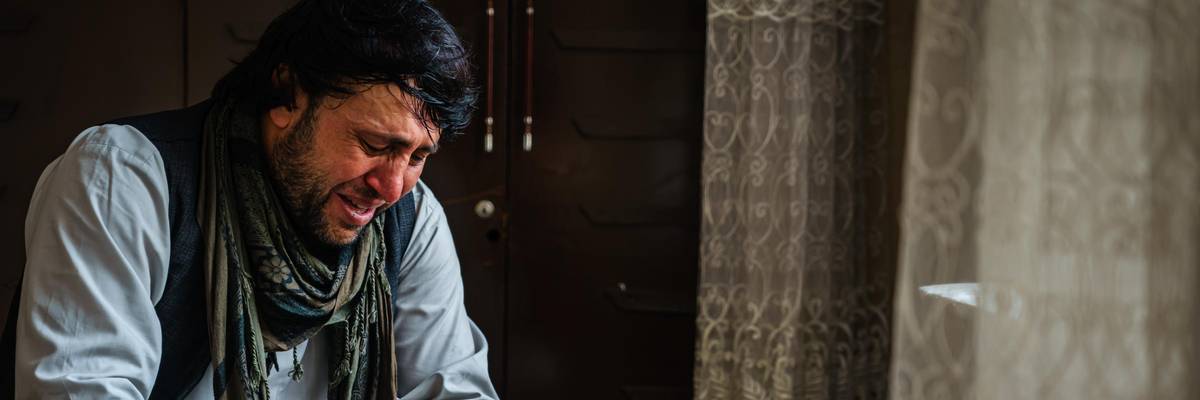
Ajmal Ahmadi weeps alone in a room after members of his family were killed in a U.S. drone strike in Kabul, Afghanistan on August 29, 2021.
Timing is crucial in media and politics—and never more so than when war is at stake. It’s completely unsatisfactory for journalists to toe the war line for years and then finally report on atrocities.
This week, The New York Times reported that the U.S. government made war in Afghanistan while helping to “recruit, train, and pay for lawless bands of militias that pillaged homes and laid waste to entire communities.” Those militias “tortured civilians, kidnapped for ransom, massacred dozens in vendetta killings, and razed entire villages, sowing more than a decade of hatred toward the Afghan government and its American allies.”
Written by a former Kabul bureau chief for the Times, the article appeared under a headline saying that “U.S.-backed militias” in Afghanistan were “worse than the Taliban.”
Now they tell us.
The new reporting made me think of a chapter in my book War Made Invisible titled “Now It Can Be Told.” Here’s an excerpt:
* * * * *
Timing is crucial in media and politics—and never more so than when war is at stake. It’s completely unsatisfactory for journalists to toe the war line for years and then finally report, in effect: Now it can be told—years too late.
Virtually the entire U.S. media establishment gave full-throated support to the U.S. attack on Afghanistan in early October 2001. Twenty years later, many of the same outlets were saying the war was ill-conceived and doomed from the start.
Immediately after the invasion of Iraq began in March 2003, with very few exceptions, even the mainstream news organizations that had been expressing trepidation or opposition swung into line to support the war effort. Two decades later, many of the same media outlets were calling the invasion of Iraq the worst U.S. foreign-policy blunder in history.
A pattern of regret (not to say repentance or remorse) emerged from massive U.S. outlays for venture militarism that failed to triumph in Afghanistan and Iraq, but there is little evidence that the underlying repetition compulsion disorder has been exorcized.
But such framing evades the structural mendacity that remains built into the military-industrial complex, with its corporate media and political wings. War is so normalized that its casualties, as if struck by acts of God, are routinely viewed as victims without victimizers, perhaps no more aggrieved than people suffering the consequences of bad weather.
What American policymakers call mistakes and errors are, for others, more aptly described with words like catastrophes and atrocities. Attributing the U.S. wars to faulty judgment—not premeditated and hugely profitable aggression—is expedient, setting the policy table for supposed resolve to use better judgment next time rather than challenging the presumed prerogative to attack another country at will.
When the warfare in Afghanistan finally ended, major U.S. media—after avidly supporting the invasion and then the occupation—were awash in accounts of how the war had been badly run with ineptitude or deception from the White House and the Pentagon. Some of the media analysis and commentaries might have seemed a bit sheepish, but news outlets preferred not to recall their prior support for the same war in Afghanistan that they were now calling folly.
A pattern of regret (not to say repentance or remorse) emerged from massive U.S. outlays for venture militarism that failed to triumph in Afghanistan and Iraq, but there is little evidence that the underlying repetition compulsion disorder has been exorcized from America’s foreign-policy leadership or major news media, let alone its political economy. On the contrary: the forces that have dragged the United States into an array of wars in numerous countries still retain enormous sway over foreign and military affairs. For those forces, over time, shape-shifting is essential, while the warfare state continues to rule.
The fact that strategies and forms of intervention are evolving, most conspicuously in the direction of further reliance on airpower rather than ground troops, makes the victims of the USA’s firepower even less visible to American eyes. This presents a challenge to take a fresh look at ongoing militarism and insist that the actual consequences for people at the other end of U.S. weaponry be exposed to the light of day—and taken seriously in human terms.
Despite all that has happened since President George W. Bush vowed in mid-September 2001 to “rid the world of the evil-doers,” pivotal issues have been largely dodged by dominant U.S. media and political leaders. The toll that red-white-and-blue militarism takes on other countries is not only a matter of moral principles. The United States is also in jeopardy.
That we live in one interdependent world is no longer debatable. Illusions about American exceptionalism have been conclusively refuted by the global climate emergency and the Covid-19 pandemic, along with the ever-present and worsening dangers of thermonuclear war. On a planet so circular in so many ways, what goes around comes around.
Dear Common Dreams reader, It’s been nearly 30 years since I co-founded Common Dreams with my late wife, Lina Newhouser. We had the radical notion that journalism should serve the public good, not corporate profits. It was clear to us from the outset what it would take to build such a project. No paid advertisements. No corporate sponsors. No millionaire publisher telling us what to think or do. Many people said we wouldn't last a year, but we proved those doubters wrong. Together with a tremendous team of journalists and dedicated staff, we built an independent media outlet free from the constraints of profits and corporate control. Our mission has always been simple: To inform. To inspire. To ignite change for the common good. Building Common Dreams was not easy. Our survival was never guaranteed. When you take on the most powerful forces—Wall Street greed, fossil fuel industry destruction, Big Tech lobbyists, and uber-rich oligarchs who have spent billions upon billions rigging the economy and democracy in their favor—the only bulwark you have is supporters who believe in your work. But here’s the urgent message from me today. It's never been this bad out there. And it's never been this hard to keep us going. At the very moment Common Dreams is most needed, the threats we face are intensifying. We need your support now more than ever. We don't accept corporate advertising and never will. We don't have a paywall because we don't think people should be blocked from critical news based on their ability to pay. Everything we do is funded by the donations of readers like you. When everyone does the little they can afford, we are strong. But if that support retreats or dries up, so do we. Will you donate now to make sure Common Dreams not only survives but thrives? —Craig Brown, Co-founder |
Norman Solomon is the national director of RootsAction.org and executive director of the Institute for Public Accuracy. The paperback edition of his latest book, War Made Invisible: How America Hides the Human Toll of Its Military Machine, includes an afterword about the Gaza war.
This week, The New York Times reported that the U.S. government made war in Afghanistan while helping to “recruit, train, and pay for lawless bands of militias that pillaged homes and laid waste to entire communities.” Those militias “tortured civilians, kidnapped for ransom, massacred dozens in vendetta killings, and razed entire villages, sowing more than a decade of hatred toward the Afghan government and its American allies.”
Written by a former Kabul bureau chief for the Times, the article appeared under a headline saying that “U.S.-backed militias” in Afghanistan were “worse than the Taliban.”
Now they tell us.
The new reporting made me think of a chapter in my book War Made Invisible titled “Now It Can Be Told.” Here’s an excerpt:
* * * * *
Timing is crucial in media and politics—and never more so than when war is at stake. It’s completely unsatisfactory for journalists to toe the war line for years and then finally report, in effect: Now it can be told—years too late.
Virtually the entire U.S. media establishment gave full-throated support to the U.S. attack on Afghanistan in early October 2001. Twenty years later, many of the same outlets were saying the war was ill-conceived and doomed from the start.
Immediately after the invasion of Iraq began in March 2003, with very few exceptions, even the mainstream news organizations that had been expressing trepidation or opposition swung into line to support the war effort. Two decades later, many of the same media outlets were calling the invasion of Iraq the worst U.S. foreign-policy blunder in history.
A pattern of regret (not to say repentance or remorse) emerged from massive U.S. outlays for venture militarism that failed to triumph in Afghanistan and Iraq, but there is little evidence that the underlying repetition compulsion disorder has been exorcized.
But such framing evades the structural mendacity that remains built into the military-industrial complex, with its corporate media and political wings. War is so normalized that its casualties, as if struck by acts of God, are routinely viewed as victims without victimizers, perhaps no more aggrieved than people suffering the consequences of bad weather.
What American policymakers call mistakes and errors are, for others, more aptly described with words like catastrophes and atrocities. Attributing the U.S. wars to faulty judgment—not premeditated and hugely profitable aggression—is expedient, setting the policy table for supposed resolve to use better judgment next time rather than challenging the presumed prerogative to attack another country at will.
When the warfare in Afghanistan finally ended, major U.S. media—after avidly supporting the invasion and then the occupation—were awash in accounts of how the war had been badly run with ineptitude or deception from the White House and the Pentagon. Some of the media analysis and commentaries might have seemed a bit sheepish, but news outlets preferred not to recall their prior support for the same war in Afghanistan that they were now calling folly.
A pattern of regret (not to say repentance or remorse) emerged from massive U.S. outlays for venture militarism that failed to triumph in Afghanistan and Iraq, but there is little evidence that the underlying repetition compulsion disorder has been exorcized from America’s foreign-policy leadership or major news media, let alone its political economy. On the contrary: the forces that have dragged the United States into an array of wars in numerous countries still retain enormous sway over foreign and military affairs. For those forces, over time, shape-shifting is essential, while the warfare state continues to rule.
The fact that strategies and forms of intervention are evolving, most conspicuously in the direction of further reliance on airpower rather than ground troops, makes the victims of the USA’s firepower even less visible to American eyes. This presents a challenge to take a fresh look at ongoing militarism and insist that the actual consequences for people at the other end of U.S. weaponry be exposed to the light of day—and taken seriously in human terms.
Despite all that has happened since President George W. Bush vowed in mid-September 2001 to “rid the world of the evil-doers,” pivotal issues have been largely dodged by dominant U.S. media and political leaders. The toll that red-white-and-blue militarism takes on other countries is not only a matter of moral principles. The United States is also in jeopardy.
That we live in one interdependent world is no longer debatable. Illusions about American exceptionalism have been conclusively refuted by the global climate emergency and the Covid-19 pandemic, along with the ever-present and worsening dangers of thermonuclear war. On a planet so circular in so many ways, what goes around comes around.
Norman Solomon is the national director of RootsAction.org and executive director of the Institute for Public Accuracy. The paperback edition of his latest book, War Made Invisible: How America Hides the Human Toll of Its Military Machine, includes an afterword about the Gaza war.
This week, The New York Times reported that the U.S. government made war in Afghanistan while helping to “recruit, train, and pay for lawless bands of militias that pillaged homes and laid waste to entire communities.” Those militias “tortured civilians, kidnapped for ransom, massacred dozens in vendetta killings, and razed entire villages, sowing more than a decade of hatred toward the Afghan government and its American allies.”
Written by a former Kabul bureau chief for the Times, the article appeared under a headline saying that “U.S.-backed militias” in Afghanistan were “worse than the Taliban.”
Now they tell us.
The new reporting made me think of a chapter in my book War Made Invisible titled “Now It Can Be Told.” Here’s an excerpt:
* * * * *
Timing is crucial in media and politics—and never more so than when war is at stake. It’s completely unsatisfactory for journalists to toe the war line for years and then finally report, in effect: Now it can be told—years too late.
Virtually the entire U.S. media establishment gave full-throated support to the U.S. attack on Afghanistan in early October 2001. Twenty years later, many of the same outlets were saying the war was ill-conceived and doomed from the start.
Immediately after the invasion of Iraq began in March 2003, with very few exceptions, even the mainstream news organizations that had been expressing trepidation or opposition swung into line to support the war effort. Two decades later, many of the same media outlets were calling the invasion of Iraq the worst U.S. foreign-policy blunder in history.
A pattern of regret (not to say repentance or remorse) emerged from massive U.S. outlays for venture militarism that failed to triumph in Afghanistan and Iraq, but there is little evidence that the underlying repetition compulsion disorder has been exorcized.
But such framing evades the structural mendacity that remains built into the military-industrial complex, with its corporate media and political wings. War is so normalized that its casualties, as if struck by acts of God, are routinely viewed as victims without victimizers, perhaps no more aggrieved than people suffering the consequences of bad weather.
What American policymakers call mistakes and errors are, for others, more aptly described with words like catastrophes and atrocities. Attributing the U.S. wars to faulty judgment—not premeditated and hugely profitable aggression—is expedient, setting the policy table for supposed resolve to use better judgment next time rather than challenging the presumed prerogative to attack another country at will.
When the warfare in Afghanistan finally ended, major U.S. media—after avidly supporting the invasion and then the occupation—were awash in accounts of how the war had been badly run with ineptitude or deception from the White House and the Pentagon. Some of the media analysis and commentaries might have seemed a bit sheepish, but news outlets preferred not to recall their prior support for the same war in Afghanistan that they were now calling folly.
A pattern of regret (not to say repentance or remorse) emerged from massive U.S. outlays for venture militarism that failed to triumph in Afghanistan and Iraq, but there is little evidence that the underlying repetition compulsion disorder has been exorcized from America’s foreign-policy leadership or major news media, let alone its political economy. On the contrary: the forces that have dragged the United States into an array of wars in numerous countries still retain enormous sway over foreign and military affairs. For those forces, over time, shape-shifting is essential, while the warfare state continues to rule.
The fact that strategies and forms of intervention are evolving, most conspicuously in the direction of further reliance on airpower rather than ground troops, makes the victims of the USA’s firepower even less visible to American eyes. This presents a challenge to take a fresh look at ongoing militarism and insist that the actual consequences for people at the other end of U.S. weaponry be exposed to the light of day—and taken seriously in human terms.
Despite all that has happened since President George W. Bush vowed in mid-September 2001 to “rid the world of the evil-doers,” pivotal issues have been largely dodged by dominant U.S. media and political leaders. The toll that red-white-and-blue militarism takes on other countries is not only a matter of moral principles. The United States is also in jeopardy.
That we live in one interdependent world is no longer debatable. Illusions about American exceptionalism have been conclusively refuted by the global climate emergency and the Covid-19 pandemic, along with the ever-present and worsening dangers of thermonuclear war. On a planet so circular in so many ways, what goes around comes around.