SUBSCRIBE TO OUR FREE NEWSLETTER
Daily news & progressive opinion—funded by the people, not the corporations—delivered straight to your inbox.
5
#000000
#FFFFFF
To donate by check, phone, or other method, see our More Ways to Give page.
Daily news & progressive opinion—funded by the people, not the corporations—delivered straight to your inbox.
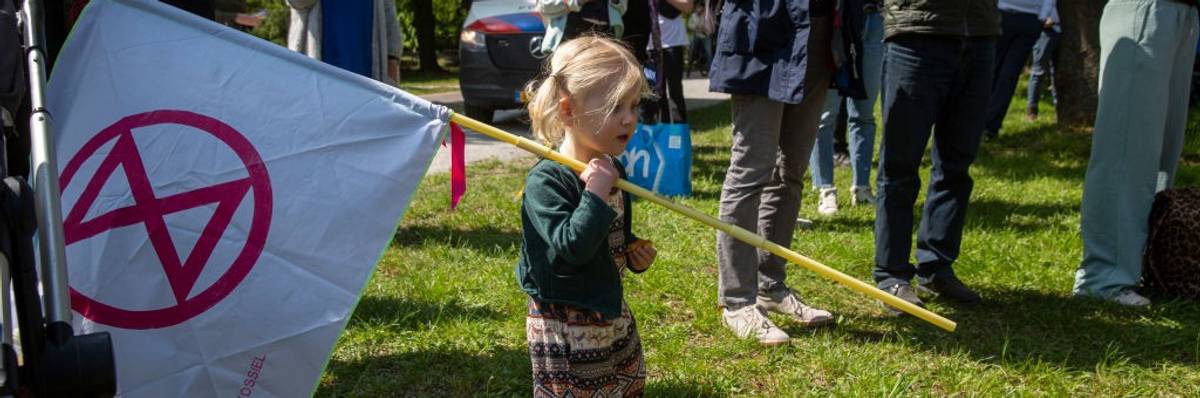
A young girl walks with the Extinction Rebellion flag just before a blockage the A12 motorway during an Extinction Rebellion led protest to command an end to all fossil fuel subsidies on May 27, 2023 in The Hague, Netherlands.
The Maastricht Principles on the Human Rights of Future Generations, launching Thursday, clarify that human rights, including the right to a clean, healthy, and sustainable environment, do not expire.
Like most people, I hope my children and grandchildren will enjoy the wonders of this beautiful planet, including wildlife like the killer whales living in the ocean near my home. But those orcas are endangered by short-sighted human actions, including pollution and over-fishing of salmon.
Do we owe it to our great-grandchildren and future generations to take their interests into account when we make decisions today?
According to a group of international human rights experts that has looked into this question for six years, the answer is a resounding yes. Our great-great-great-grandchildren have human rights—meaning that states, as the primary duty-bearers in human rights law, have legal obligations to protect the rights of future generations.
The Maastricht Principles on the Human Rights of Future Generations will be officially launched on July 13, 2023, alongside the United Nations General Assembly in New York. The Principles clarify that human rights, including the right to a clean, healthy, and sustainable environment, do not have temporal limitations. Human rights apply fully to future generations. More than 60 human rights law experts endorsed the Principles, including several former and current experts appointed by the U.N. Human Rights Council.
Thanks to instruments like the Maastricht Principles, we have the tools needed to tackle today’s challenges while safeguarding the human rights of future generations.
Thinking of future generations is not new to some. For millennia, many Indigenous Peoples have weighed how their choices will affect individuals born seven generations after them. In fact, Indigenous Peoples from various continents were involved in the Principles, which also draw upon consultations with social movements and academics, as well as from a century of legal scholarship, international treaties, and national constitutions and legislation. More than 40 national constitutions already recognize, in some form, the rights of future generations.
The legal implications of this new set of Principles could be far-reaching as they begin to inform our understanding of human rights law in the 21st century. They can be used by governments and courts, including the International Court of Justice, which is set to decide a vital case on state obligations related to the climate emergency.
The Maastricht Principles will likely become a persuasive soft law instrument in the legal toolbox and help end discrimination against future generations. They will be helpful for governments, who must consider the long-term implications of their decisions regarding the green energy transition, shifting to a circular economy, and regulating emerging technologies such as artificial intelligence.
Furthermore, as individuals and organizations seek to hold states accountable for their environmental commitments, there has been an explosion of lawsuits in front of national and international courts. There, too, the Principles may play a role. There are precedents, such as the famous 1993 decision of the Supreme Court of the Philippines, in a case brought on behalf of children concerned about the logging of ancient forests. The Court wrote that the right to a healthy environment applied to both present and future generations to prevent the latter from inheriting “nothing but parched earth incapable of sustaining life.”
Because of the accelerating climate crisis, climate litigation gets much attention: Many groundbreaking cases are in front of courts in the U.S., France, Germany, India, the Netherlands, and South Africa, among others. These cases have real consequences for future generations. Some are led by youth, who are closer than the rest of us to future generations. For example, a climate lawsuit filed by 16 youth plaintiffs went to trial in June 2023 in the U.S. state of Montana, the first American trial to determine whether ongoing government support for fossil fuels, the leading cause of the climate crisis, violates the constitutional rights of youth.
We must prioritize long-term thinking in policymaking, with the energy transition just one of many vital areas.
Many argue that it is hard to consider future generations while struggling with today’s converging crises. They are right. We are facing systemic human rights violations around the world caused by devastating inequality, corporate impunity, and a planetary environmental crisis.
It is disconcerting that, 75 years after the adoption of the Universal Declaration of Human Rights, we still have a long way to go to meet the aspirations of that historic document.
Yet, thanks to instruments like the Maastricht Principles, we have the tools needed to tackle today’s challenges while safeguarding the human rights of future generations. In doing so, our grandchildren and their grandchildren will remember us as the generation who succeeded in our attempt to become ‘good ancestors.’
Dear Common Dreams reader, It’s been nearly 30 years since I co-founded Common Dreams with my late wife, Lina Newhouser. We had the radical notion that journalism should serve the public good, not corporate profits. It was clear to us from the outset what it would take to build such a project. No paid advertisements. No corporate sponsors. No millionaire publisher telling us what to think or do. Many people said we wouldn't last a year, but we proved those doubters wrong. Together with a tremendous team of journalists and dedicated staff, we built an independent media outlet free from the constraints of profits and corporate control. Our mission has always been simple: To inform. To inspire. To ignite change for the common good. Building Common Dreams was not easy. Our survival was never guaranteed. When you take on the most powerful forces—Wall Street greed, fossil fuel industry destruction, Big Tech lobbyists, and uber-rich oligarchs who have spent billions upon billions rigging the economy and democracy in their favor—the only bulwark you have is supporters who believe in your work. But here’s the urgent message from me today. It's never been this bad out there. And it's never been this hard to keep us going. At the very moment Common Dreams is most needed, the threats we face are intensifying. We need your support now more than ever. We don't accept corporate advertising and never will. We don't have a paywall because we don't think people should be blocked from critical news based on their ability to pay. Everything we do is funded by the donations of readers like you. When everyone does the little they can afford, we are strong. But if that support retreats or dries up, so do we. Will you donate now to make sure Common Dreams not only survives but thrives? —Craig Brown, Co-founder |
Like most people, I hope my children and grandchildren will enjoy the wonders of this beautiful planet, including wildlife like the killer whales living in the ocean near my home. But those orcas are endangered by short-sighted human actions, including pollution and over-fishing of salmon.
Do we owe it to our great-grandchildren and future generations to take their interests into account when we make decisions today?
According to a group of international human rights experts that has looked into this question for six years, the answer is a resounding yes. Our great-great-great-grandchildren have human rights—meaning that states, as the primary duty-bearers in human rights law, have legal obligations to protect the rights of future generations.
The Maastricht Principles on the Human Rights of Future Generations will be officially launched on July 13, 2023, alongside the United Nations General Assembly in New York. The Principles clarify that human rights, including the right to a clean, healthy, and sustainable environment, do not have temporal limitations. Human rights apply fully to future generations. More than 60 human rights law experts endorsed the Principles, including several former and current experts appointed by the U.N. Human Rights Council.
Thanks to instruments like the Maastricht Principles, we have the tools needed to tackle today’s challenges while safeguarding the human rights of future generations.
Thinking of future generations is not new to some. For millennia, many Indigenous Peoples have weighed how their choices will affect individuals born seven generations after them. In fact, Indigenous Peoples from various continents were involved in the Principles, which also draw upon consultations with social movements and academics, as well as from a century of legal scholarship, international treaties, and national constitutions and legislation. More than 40 national constitutions already recognize, in some form, the rights of future generations.
The legal implications of this new set of Principles could be far-reaching as they begin to inform our understanding of human rights law in the 21st century. They can be used by governments and courts, including the International Court of Justice, which is set to decide a vital case on state obligations related to the climate emergency.
The Maastricht Principles will likely become a persuasive soft law instrument in the legal toolbox and help end discrimination against future generations. They will be helpful for governments, who must consider the long-term implications of their decisions regarding the green energy transition, shifting to a circular economy, and regulating emerging technologies such as artificial intelligence.
Furthermore, as individuals and organizations seek to hold states accountable for their environmental commitments, there has been an explosion of lawsuits in front of national and international courts. There, too, the Principles may play a role. There are precedents, such as the famous 1993 decision of the Supreme Court of the Philippines, in a case brought on behalf of children concerned about the logging of ancient forests. The Court wrote that the right to a healthy environment applied to both present and future generations to prevent the latter from inheriting “nothing but parched earth incapable of sustaining life.”
Because of the accelerating climate crisis, climate litigation gets much attention: Many groundbreaking cases are in front of courts in the U.S., France, Germany, India, the Netherlands, and South Africa, among others. These cases have real consequences for future generations. Some are led by youth, who are closer than the rest of us to future generations. For example, a climate lawsuit filed by 16 youth plaintiffs went to trial in June 2023 in the U.S. state of Montana, the first American trial to determine whether ongoing government support for fossil fuels, the leading cause of the climate crisis, violates the constitutional rights of youth.
We must prioritize long-term thinking in policymaking, with the energy transition just one of many vital areas.
Many argue that it is hard to consider future generations while struggling with today’s converging crises. They are right. We are facing systemic human rights violations around the world caused by devastating inequality, corporate impunity, and a planetary environmental crisis.
It is disconcerting that, 75 years after the adoption of the Universal Declaration of Human Rights, we still have a long way to go to meet the aspirations of that historic document.
Yet, thanks to instruments like the Maastricht Principles, we have the tools needed to tackle today’s challenges while safeguarding the human rights of future generations. In doing so, our grandchildren and their grandchildren will remember us as the generation who succeeded in our attempt to become ‘good ancestors.’
Like most people, I hope my children and grandchildren will enjoy the wonders of this beautiful planet, including wildlife like the killer whales living in the ocean near my home. But those orcas are endangered by short-sighted human actions, including pollution and over-fishing of salmon.
Do we owe it to our great-grandchildren and future generations to take their interests into account when we make decisions today?
According to a group of international human rights experts that has looked into this question for six years, the answer is a resounding yes. Our great-great-great-grandchildren have human rights—meaning that states, as the primary duty-bearers in human rights law, have legal obligations to protect the rights of future generations.
The Maastricht Principles on the Human Rights of Future Generations will be officially launched on July 13, 2023, alongside the United Nations General Assembly in New York. The Principles clarify that human rights, including the right to a clean, healthy, and sustainable environment, do not have temporal limitations. Human rights apply fully to future generations. More than 60 human rights law experts endorsed the Principles, including several former and current experts appointed by the U.N. Human Rights Council.
Thanks to instruments like the Maastricht Principles, we have the tools needed to tackle today’s challenges while safeguarding the human rights of future generations.
Thinking of future generations is not new to some. For millennia, many Indigenous Peoples have weighed how their choices will affect individuals born seven generations after them. In fact, Indigenous Peoples from various continents were involved in the Principles, which also draw upon consultations with social movements and academics, as well as from a century of legal scholarship, international treaties, and national constitutions and legislation. More than 40 national constitutions already recognize, in some form, the rights of future generations.
The legal implications of this new set of Principles could be far-reaching as they begin to inform our understanding of human rights law in the 21st century. They can be used by governments and courts, including the International Court of Justice, which is set to decide a vital case on state obligations related to the climate emergency.
The Maastricht Principles will likely become a persuasive soft law instrument in the legal toolbox and help end discrimination against future generations. They will be helpful for governments, who must consider the long-term implications of their decisions regarding the green energy transition, shifting to a circular economy, and regulating emerging technologies such as artificial intelligence.
Furthermore, as individuals and organizations seek to hold states accountable for their environmental commitments, there has been an explosion of lawsuits in front of national and international courts. There, too, the Principles may play a role. There are precedents, such as the famous 1993 decision of the Supreme Court of the Philippines, in a case brought on behalf of children concerned about the logging of ancient forests. The Court wrote that the right to a healthy environment applied to both present and future generations to prevent the latter from inheriting “nothing but parched earth incapable of sustaining life.”
Because of the accelerating climate crisis, climate litigation gets much attention: Many groundbreaking cases are in front of courts in the U.S., France, Germany, India, the Netherlands, and South Africa, among others. These cases have real consequences for future generations. Some are led by youth, who are closer than the rest of us to future generations. For example, a climate lawsuit filed by 16 youth plaintiffs went to trial in June 2023 in the U.S. state of Montana, the first American trial to determine whether ongoing government support for fossil fuels, the leading cause of the climate crisis, violates the constitutional rights of youth.
We must prioritize long-term thinking in policymaking, with the energy transition just one of many vital areas.
Many argue that it is hard to consider future generations while struggling with today’s converging crises. They are right. We are facing systemic human rights violations around the world caused by devastating inequality, corporate impunity, and a planetary environmental crisis.
It is disconcerting that, 75 years after the adoption of the Universal Declaration of Human Rights, we still have a long way to go to meet the aspirations of that historic document.
Yet, thanks to instruments like the Maastricht Principles, we have the tools needed to tackle today’s challenges while safeguarding the human rights of future generations. In doing so, our grandchildren and their grandchildren will remember us as the generation who succeeded in our attempt to become ‘good ancestors.’