

SUBSCRIBE TO OUR FREE NEWSLETTER
Daily news & progressive opinion—funded by the people, not the corporations—delivered straight to your inbox.
5
#000000
#FFFFFF
To donate by check, phone, or other method, see our More Ways to Give page.
Daily news & progressive opinion—funded by the people, not the corporations—delivered straight to your inbox.
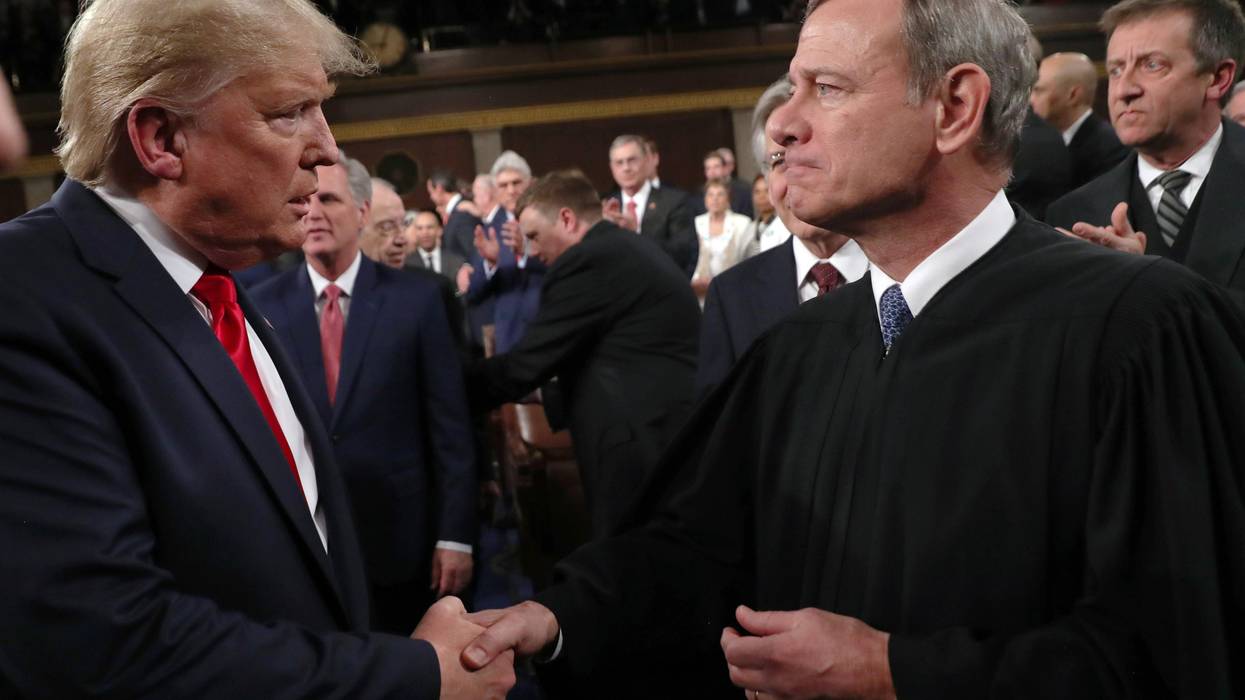
The GOP’s war on judges and juries, along with Justices Thomas’ and Alito’s naked partisanship, are shaking the foundations of the Constitution and American democracy.
The rule of law in the United States may well succumb under the relentless attacks of the convicted felon Donald Trump.
Trump and his Republican abettors are making a giant effort to destroy America’s faith that our judges, jurors, and courts are instruments of justice. The threat is aggravated by a Supreme Court which, instead of modeling judicial integrity, contributes to rising public skepticism by ignoring its own ethical implosion and thwarting efforts to bring Trump to trial for the crimes for which he’s been indicted.
The attacks on the rule of law are all intended to protect Trump and his accomplices from the legal consequences of their attempt to overthrow a free and fair election to steal the presidency through fraudulent and violent methods.
Insofar as the Supreme Court refuses to allow juries to even hear the evidence on whether Trump is innocent or guilty of such charged crimes, the court is also rejecting a government of laws in favor of a government of Trump.
On one front, essentially all Republican politicians now insist that Donald Trump can never be found guilty of any crime. Just as Trumpians take the de facto view that an election is only fair if Trump wins, so they now maintain a trial is only fair if Trump is acquitted. Practical translation: Trump is above the law.
On a second front, Trump’s ethically compromised allies in the Supreme Court have conveniently delayed his other criminal trials while they consider absurd legal theories designed to erase the criminal charges against him. The court’s right-wing majority could well decide to bestow impunity for the attack on the Capitol and the conspiracy to negate the Electoral College vote. Two justices who have signaled their support for the insurrection insist on sitting for these cases, undermining confidence in the courts and in the rule of law by their obvious bias.
Month after month, the criminal Trump has smeared every participant in the judicial process with lies and threats, in a vitriolic effort to intimidate judges, prosecutors, and jurors and to persuade the public that our courts are illegitimate.
Now, with the unanimous jury verdicts of guilt in the first of Trump’s four criminal cases, the Republican swarm has gone into a feeding frenzy.
Their goal: eradicating the very notion that their Great Leader can be subject to the law. Their methods: delegitimize the judicial system; menace everyone in the apparatus of law enforcement; and insinuate a violent response is needed.
Trump’s followers have taken up the call. MAGA threats flood social media, and nearly everyone involved in his prosecutions have been threatened.
“Someone in NY with nothing to lose needs to take care of [trial judge] Merchan,” proposes one of Trump’s acolytes. “Judge needs a hatchet to the face,” says another. “I hope every juror is doxxed and they pay for what they have done,” yet another writes on Trump’s social media platform. “1,000,000 men (armed) need to go to Washington and hang everyone.”
Political violence commonly follows from Trump’s prompts. But even when it doesn’t, judges, jurors, and their family members live in fear. They are suffering because they worked to ensure that we are a society in which conflicts are resolved through courts and law, not vigilante savagery.
In this moment of crisis, the chief justice of the United States should be a champion of the rule of law, explaining that an independent judicial system is essential to a democracy and defending the integrity of the judge and jurors in Trump’s trial.
The chief justice should denounce the reckless GOP claims that the courts are “corrupt,” “rigged,” and “politicized,” and that President Joe Biden organized a giant witch hunt to silence Trump—all claims for which there is zero evidence. Above all, the chief justice should rebuke the calls for violence, explicit or tacit.
Chief Justice John Roberts actual response? Silence.
When the Republican Speaker of the House Mike Johnson suggests that his personal friends on the Supreme Court will surely “step in” to overturn the verdict, Chief Justice Roberts says not one word about the feverish, baseless attacks on the judicial branch of government.
When GOP House Judiciary Committee Chairman Jim Jordan demands the prosecutors in Trump’s case appear at a hearing so he can berate them for the supposed “political prosecution” of Donald Trump, the chief justice ignores this direct assault on the separation of powers and the rule of law.
The chief justice did find time to try to deflect attention from the ethical calamity enveloping the Supreme Court. He was forced to because Justice Samuel Alito has joined Justice Clarence Thomas in shamelessly flouting long-standing canons of judicial ethics.
Justice Thomas simply ignores the fact that his wife Ginni participated in the attempt to overthrow the 2020 election, an attempt that is about to come before the Supreme Court. No one can doubt that a judge in his position—if he participates in the case—might rule in favor of the insurgents in order to protect his wife from potential liability. That is why recusing himself is obviously required. But Thomas won’t.
Justice Alito’s effort to evade responsibility for open political partisanship is still less plausible.
No, Justice Alito, you cannot make the issue go away by claiming it was your wife alone who flew the flag of insurrection and you had nothing to do with it. When you live in a household with someone else, your partner does not display flags on your joint home unless the symbol represents both of your views. Especially when you’re a Supreme Court justice, whose manifest impartiality is a bedrock necessity. If that was not immediately obvious to her, then you tell her so and the flags come down.
In reality, blaming his wife was just an afterthought to give Alito a measure of deniability.
Since Justice Alito is not a total moron and since he does not live on Mars, he is also perfectly aware that Trump and his allies brought 60 lawsuits challenging the 2020 election, and that all of the cases—including cases presided over by many Trump-appointed judges—found no evidence of widespread fraud, no evidence the election was stolen. Which is to say: Justice Alito knows the entire “stop the steal” movement rests on a lie.
This means, too, that Justice Alito is personally aware that the flag flown at his home stands for a falsehood, one that threatens American constitutional democracy. Plainly, he cannot sit as an impartial judge of claims involving individuals who are charged with trying to overthrow the election based on that lie, when he has himself chosen to embrace the lie.
The chief justice’s response to Alito’s and Thomas’s refusal to recuse themselves: a shrug of his shoulders. Each justice makes his or her own decision on what is required by the Supreme Court’s belatedly adopted code of judicial ethics, says Roberts. Nothing more to say.
When Senate Judiciary Committee members invited him to discuss judicial ethics with them, Roberts refused, citing high principles. “Separation of powers concerns and the importance of preserving judicial independence counsel against such appearances.”
But the chief justice got it backwards.
The constitutional principle of the “separation of powers” among the legislative, executive, and judicial branches of government goes hand in hand with the related constitutional principle of “checks and balances.” This is the theory embraced by the Founding Fathers that representative government and the rule of law are protected when each branch of government is restrained by the powers of the other branches.
Under our Constitution, Congress—the legislative branch—was intended to possess powers to constrain and guide the judicial branch as well as the executive branch. Considering effective rules of ethics when the Supreme Court shuts its eyes to ethical problems is plainly within the congressional purview.
The judicial branch does have a duty to defend its independence, and it includes a duty to police assertions of power by those who would undermine it. Power outside the bounds of law, power without accountability, power that defies the will of the people, as expressed in free and fair elections, is the ultimate threat to the rule of law.
Founding Father John Adams famously urged in 1774 that ours be “a government of laws, and not of men.” Republicans who refuse to encompass the possibility of Trump being held responsible for criminal acts are saying that Donald Trump’s will must come first—that Trump’s wish to falsify business records, to possess government documents that don’t belong to him, to hold office after losing an election, to conspire to negate the voting rights of millions should supersede the laws that make such actions illegal. They are demanding we end our government of laws and substitute a government of Donald Trump.
Insofar as the Supreme Court refuses to allow juries to even hear the evidence on whether Trump is innocent or guilty of such charged crimes, the court is also rejecting a government of laws in favor of a government of Trump.
Before German democracy was destroyed in 1933, the Nazis and other right-wing extremists repeatedly engaged in political violence. Between 1919 and 1923, for example, rightists assassinated 400 political figures. Adolf Hitler himself attempted to overthrow the government by violence in 1923.
The German judiciary winked at these crimes, giving light sentences for grave acts of violence and for treasonous efforts to overthrow German’s democracy. The judicial failure to uphold the rule of law contributed to the destruction of the pre-Nazi democratic republic.
Will Chief Justice Roberts’ right-wing majority and the only partly Trumpified federal judiciary defend the rule of law or collaborate in its destruction? The jury, as they say, is out.
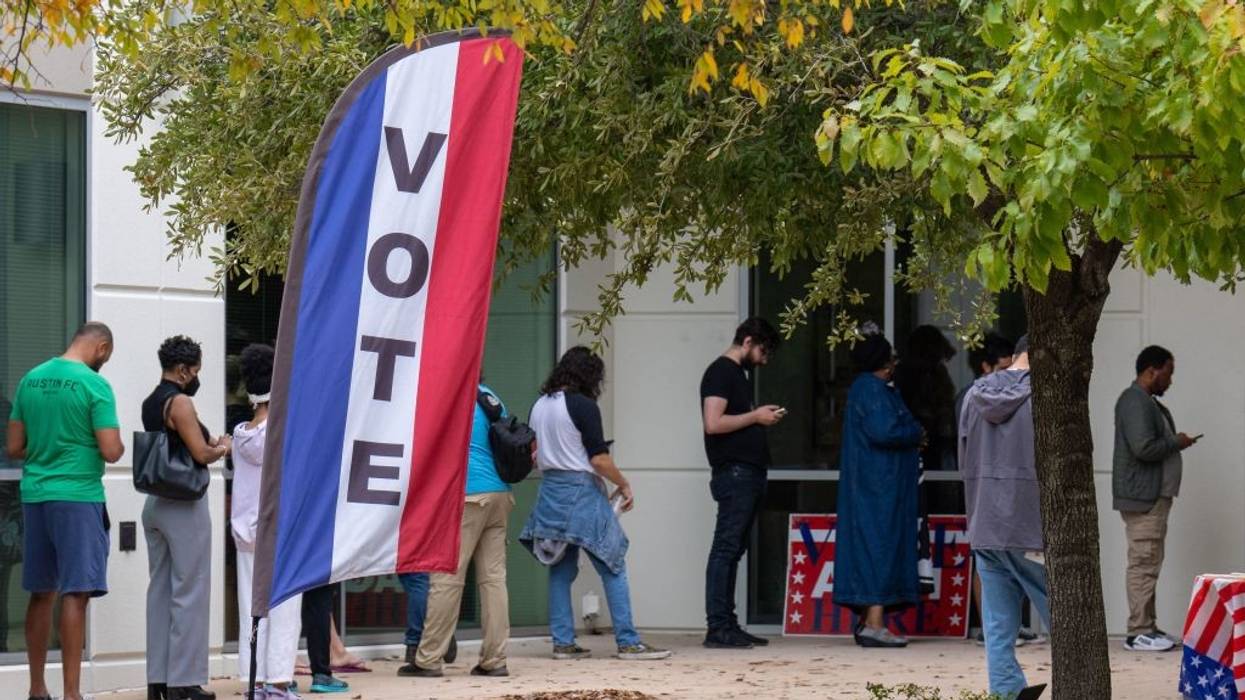
While SB1 is one of many antidemocracy laws enacted by 19 states in the year after the 2020 election, it stands out for its sheer number of restrictive and discriminatory provisions, which largely target Latino and Black voters.
Trial began Monday in a major federal lawsuit challenging a wide-ranging and discriminatory voter suppression law Texas enacted in 2021. The Brennan Center, the Mexican American Legal Defense and Educational Fund, and our other co-counsel represent a wide swath of Texans, including election administrators, community groups, civil rights and voting organizations, and faith-based groups. Over the course of the trial, we will show how Senate Bill 1 violates the Constitution, the Voting Rights Act, and the Americans with Disabilities Act.
While SB1 is one of many antidemocracy laws enacted by 19 states in the year after the 2020 election, it stands out for its sheer number of restrictive and discriminatory provisions, which largely target Latino and Black voters. This is likely the only challenge to such an extensive restrictive voting law that will go to trial between now and the 2024 election.
Among its host of restrictive provisions, the law establishes onerous new rules for voting by mail and curbs voter outreach activities. It also hinders voting assistance for people with language barriers or disabilities and restricts election officials’ and judges’ ability to protect voters from harassment by poll watchers. Like the dozens of restrictive state voting laws that have been enacted nationwide in the last three years, SB1’s proponents claim that it is intended to fight voter fraud. Indeed, its myriad provisions appear to respond directly to baseless claims peddled by Donald Trump and his fellow election deniers about the security of mail-in voting and election administration.
In a state that was already the toughest in the nation to register and vote, Texans now have an even harder time staying on the voter rolls, casting their ballots, and ensuring their ballots are counted.
Yet Texas has never found evidence of widespread fraud—and not for lack of trying. Without the pretext of making elections more secure, SB1 is simply an unconstitutional effort to suppress eligible voters in marginalized communities. It seems no coincidence that after people of color surged in turnout in Texas’s 2018 and 2020 elections, the legislature passed a law that restricts methods of voting favored by Black and Latino voters and impairs voter assistance to those with limited English proficiency or limited literacy.
The plaintiffs in the case, LUPE v. Texas, can attest to the various ways SB1 has created obstacles to the ballot box that infringe on the constitutional right to vote. Voters of color have been disproportionately impacted by these burdens, violating their right to equal protection, the 15th Amendment’s protection against race-based disenfranchisement, and the Voting Rights Act. Our plaintiffs’ anecdotal experiences are backed by state voting records in the wake of the law’s enactment. Brennan Center research shows that just a single provision—which has recently been blocked by a judge—led to massive disenfranchisement with major racial disparities in Texas’s 2022 primaries.
The law’s new rules for mail-in voting required people to write the last four digits of their driver’s license number or social security number on their mail ballot application and mail ballot envelope. Officials had to reject an application or ballot if the number provided didn’t match the number on file in a voter’s registration record, even if that person was eligible to vote. These mismatches weren’t always the result of someone writing the number incorrectly but rather providing a correct number that didn’t coincide with the ID they used when they registered to vote—which could have been more than a decade ago. Tens of thousands of applications and mail ballots were tossed solely for having a missing or mismatched ID number, and nonwhite voters were at least 30% more likely than white voters to have their application or mail ballot rejected. A significant portion of those prevented from voting by mail ultimately didn’t vote at all.
Similarly, the law curtails the ability of people with disabilities or with limited English or literacy skills to get help voting, denying them the equal voting access and assistance they’re entitled to under the Americans with Disabilities Act and the Voting Rights Act. In particular, SB1 imposes new requirements and penalties for voter assisters that have deterred volunteers from aiding voters at the polls. It also makes it a crime to compensate or receive compensation for helping people vote by mail, which prohibits civic organizations from supporting community members who have trouble filling out the forms. Several witnesses will speak to how these provisions made it difficult for them to secure the help they needed to vote in the 2022 election.
Voters aren’t the only ones struggling under SB1. The law also targets election officials and poll workers, who are already facing a torrent of threats, harassment, and abuse. One provision makes it a crime for poll workers to “take any action” that would make a partisan poll watcher’s observation “not reasonably effective.” This unconstitutionally vague directive gives poll workers no clear sense of what they can and can’t do to stop poll watchers from harassing or intimidating voters, leaving poll workers fearful of being prosecuted just for doing their jobs. In the face of this uncertainty, some experienced poll workers have declined to sign up for future elections.
The heavy burdens that Texas’s law imposes at every stage of voting are becoming increasingly apparent. In a state that was already the toughest in the nation to register and vote, Texans now have an even harder time staying on the voter rolls, casting their ballots, and ensuring their ballots are counted. And in the two years since SB1’s enactment, state legislators around the country have continued to push legislation aimed at restricting voting access for Black, Latino, and vulnerable voters and making elections more susceptible to partisan meddling. Leaving these unconstitutional voter suppression measures unchallenged can only serve to spur further attacks on the freedom to vote in Texas and beyond.
"Defendants chose to invite robust defamation claims, with potentially huge financial liability and potentially larger business repercussions, rather than disappoint viewers of Fox News," the lawsuit reads in part.
The state of Oregon and New York City's pension funds filed a lawsuit against Fox Corporation Tuesday, arguing that the company allowed its Fox News channel to air falsehoods surrounding the 2020 election that put shareholders' investments at risk.
The lawsuit, which was filed in the Delaware Court of Chancery, is the most important shareholder action against the company since it settled a defamation suit for a record $787.5 million with Dominion Voting Systems in April. It also comes as experts had long warned the corporation it was leaving itself vulnerable to exactly these kinds of lawsuits by spreading lies that could lead to defamation claims, CNN reported.
"The board of Fox Corporation took a massive risk in pursuing profits by perpetuating and peddling known falsehoods," Oregon Attorney General Ellen Rosenblum said in a statement. "The directors' choices exposed themselves and the company to liability and exposed their shareholders to significant risks. That is the crux of our lawsuit, and we look forward to making our case in court."
"Fox's board of directors has blatantly disregarded the need for journalistic standards and failed to put safeguards in place despite having a business model that invites defamation litigation."
In the aftermath of the 2020 presidential election, both guests and hosts on Fox News repeated the false claim that former President Donald Trump had truly won the election and circulated conspiracy theories justifying this view, such as the lie that Dominion voting machines had swapped Trump votes to votes for President Joe Biden. The lawsuit argues that by catering to the desires of pro-Trump viewers, it failed in its duty to shareholders.
"Defendants chose to invite robust defamation claims, with potentially huge financial liability and potentially larger business repercussions, rather than disappoint viewers of Fox News," the lawsuit reads in part, according to The Associated Press.
Both New York City's pension funds and the state of Oregon have significant investments in Fox Corporation. The city pension funds had $28.1 million worth of shares at the end of July, while the state of Oregon had shares worth $5.2 million as of August 31, its Department of Justice said.
Neither plaintiff has specified an amount of damages, but New York City Comptroller and pension fund manager Brad Lander told The New York Times the city needed to "make the shareholders whole."
"Fox's board of directors has blatantly disregarded the need for journalistic standards and failed to put safeguards in place despite having a business model that invites defamation litigation," Lander said in a statement reported by CNN. "A lack of journalistic standards and a proper strategy to mitigate defamation has clearly harmed Fox's reputation and threatens their bottom line and long-term profitability."
Fox leadership did not comment to any major outlets on the lawsuit.
In addition to the Dominion suit, Fox has faced several other defamation claims, including an upcoming $2.7 billion lawsuit from election technology company Smartmatic and another from Ray Epps, a man from Arizona at the center of a conspiracy theory alleging he ran an FBI plan to instigate the riots at the Capitol on January 6, 2021.
Some groups argue that Fox News should face consequences beyond lawsuits. On July 3, the Media and Democracy project filed a petition with the Federal Communications Commission (FCC) to not renew the broadcast license for FOX 29 Philadelphia (WTXF-TV).
"As an FCC broadcast licensee FOX is bound to broadcast in the public interest, convenience, and necessity," the petitioners wrote. "Instead, it has repeatedly aired false information about election fraud, sowing discord in the country and contributing to harmful and dangerous acts on January 6, 2021."
Media experts and activists Steve Macek and Mitchell Szczepanczyk argued in a column that appeared at Common Dreams last week that the petition had merit.
"Although stripping an established TV station of its broadcast license may seem like an extreme measure," they said, "the Fox Corporation's record of malfeasance and its repeated betrayal of the public trust justifies the action in this case."
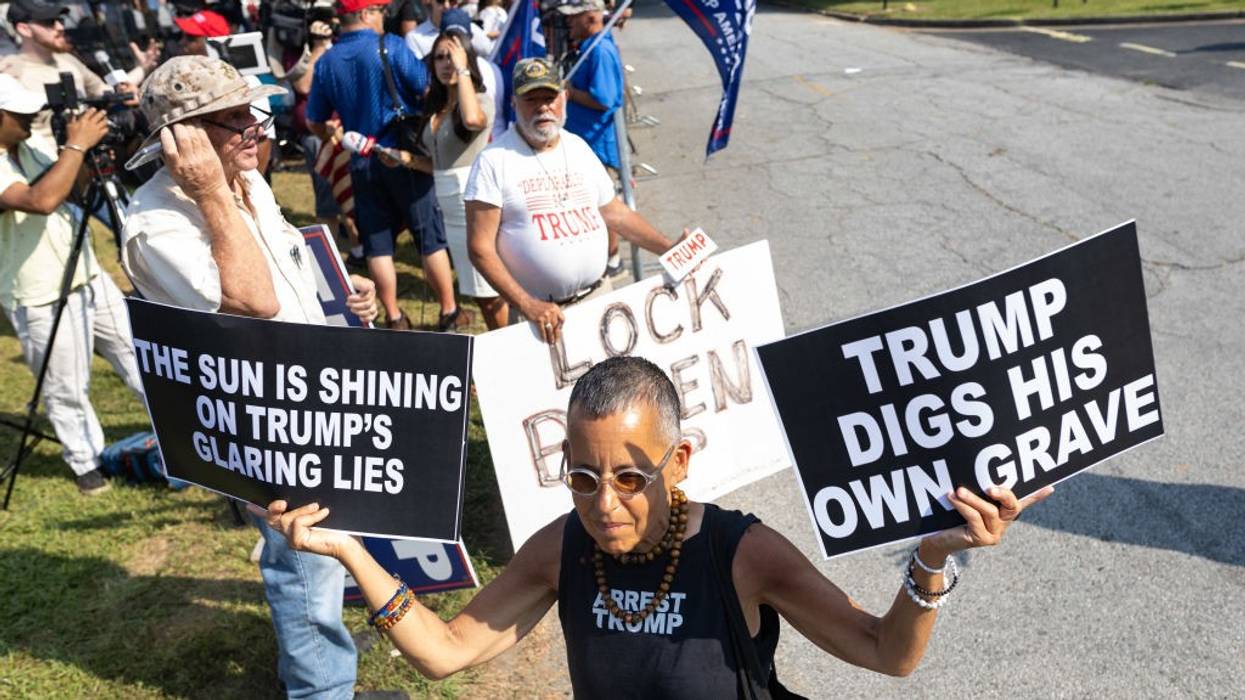
If a man entrusted with the power of the presidency commits crimes against the Constitution and our democracy, that’s more reason to insist he be subject to law, not less.
The day after Donald Trump was arraigned for his alleged effort to steal the 2020 election, he posted a naked threat: “IF YOU GO AFTER ME, I’M COMING AFTER YOU!”
That followed his federal indictment. After he was indicted in Georgia, Trump openly warned a witness not to testify. “I am reading reports that failed former Lt. Governor of Georgia, Jeff Duncan, will be testifying before the Fulton County Grand Jury,” Trump posted. “He shouldn’t.”
As Trump well knows, when he inflames his MAGA disciples, violence commonly follows.
Anyone else convicted of Trump’s crimes would plainly go to prison for years. And anyone else openly threatening witnesses would quickly see their bail revoked.
Now a woman has been arrested for threatening to kill the judge overseeing Trump’s federal election interference case. And the Georgia grand jurors who voted to charge Trump have had their addresses published on an extremist website. Supporters labeled the jurors’ collected addresses a “hit list” and suggested “long range rifles” might be useful.
Obviously, jurors in any of Trump’s trials risk retaliation should they decide the evidence proves him guilty.
Judges explicitly warned Trump not to intimidate witnesses or “prejudice potential jurors.” Which raises an uncomfortable question: Why isn’t he in jail already?
Federal judges take witness tampering seriously—they revoked bail for alleged cryptocurrency crook Sam Bankman-Fried for interfering with witness testimony. That’s simply the rule of law. If you violate the orders under which you’re released pending trial, you go to jail.
Yet Trump remains at liberty, seemingly determined to move the question of his criminal liability from a court of law into the court of public opinion—and get a chance to pardon himself if elected.
This spring, before the first charges against Trump were filed in New York, the former president threatened “potential death and destruction” if he was charged. Judges might well be worried about widespread violence from Trump supporters if he’s actually jailed. Moreover, some conservative commentators seem to regard the notion of locking up a former president as unthinkable.
Yes, things have come to a sorry pass when a president is charged with brazenly violating the law and threatens anyone who’d prosecute him. But if a man entrusted with the power of the presidency commits crimes against the Constitution and our democracy, that’s more reason to insist he be subject to law, not less.
A former top federal prosecutor opined that sending Trump to prison if he were convicted posed “enormous and unprecedented logistical issues.” “Probation, fines, community service, and home confinement are all alternatives,” claimed the former prosecutor.
These alternatives aren’t serious. If convicted, Trump must suffer punishment like anyone else.
Probation is typically reserved for the repentant, and Trump expresses no repentance. For a billionaire who lives in a luxury golf resort, fines or home confinement are a slap on the wrist. (Letting Trump continue charging Secret Service members up to $1,185 per room per night to protect him at Mar-a-Lago would only punish taxpayers.)
And what would community service even consist of?
In truth, the Secret Service can protect Trump more cheaply if he resides in Leavenworth penitentiary with other nonviolent felons. A former Secret Service agent confirmed that protecting Trump in prison poses no great challenge: “If you want to go to prison, you want to go to [a] federal prison,” he said. “They already have their security set up… It’s already safe.”
Anyone else convicted of Trump’s crimes would plainly go to prison for years. And anyone else openly threatening witnesses would quickly see their bail revoked. Applying a different standard to a powerful person reflects only contempt for the rule of law.

Seeking accountability is necessary but not sufficient to repair a democratic system that has been badly damaged by the election denial movement that continues across the country.
As Georgia prosecutors announced the indictment of former President Donald Trump and 18 others for their efforts to overturn the 2020 election, much attention has been paid to the infamous phone call in which Trump told Georgia’s chief election official that he wanted “to find 11,780 votes.” But this phone call was only one part of a broad campaign to pressure Georgia’s public officials to cast doubt on the election results or even disregard the will of the voters. And the effort did not stop on January 6—the lies spread and the futile pursuit to build support for those lies created lasting consequences for elections, both in Georgia and across the country.
By the end of November 2020, most states, including Georgia, had not only finished counting all ballots, but also conducted recounts and post-election audits that confirmed the presidential election outcome every time. In Georgia, counties first counted all ballots using electronic tabulators, then counted all ballots by hand, and then recounted all ballots using different electronic tabulators, each time confirming that Trump had lost the election. Courts across the country had also considered and rejected more than 60 lawsuits that claimed there was outcome-determinative fraud.
Yet on December 3, Trump advisors Rudy Giuliani and John Eastman (both indicted) appeared before the Georgia State Senate, spreading conspiracies about the election, falsely accusing two election workers of fraud, and urging the senators to appoint false electors to support Trump. On December 5, Trump reportedly called Gov. Brian Kemp, demanding that he call for a special legislative session to overturn the election results. Similar calls and meetings continued over the next month with Georgia’s attorney general, state house of representatives, an investigator with the secretary of state’s office, and finally, Secretary of State Brad Raffensperger himself. At each step, Trump and his allies presented baseless claims of widespread fraud that state officials rebuked. In the meantime, Trump’s allies allegedly arranged for a fake slate of Trump-supporting electors to wrongly declare themselves duly elected and assert that Trump won the presidential election.
The Coffee County voting system breach was one of many similar incidents across the country where Trump’s supporters sought to gain access to voting systems and other critical election infrastructure.
The scheme eventually spread from lies about the last election to actions that threaten future elections. The day after the January 6 attack, a Coffee County, Georgia election official who had previously spread conspiracies about Dominion Voting Systems welcomed a team of security researchers into the election office to examine the county’s equipment. The security researchers—who were reportedly paid for by a nonprofit run by Trump ally Sidney Powell and had previously been hired to examine voting systems in Michigan and Nevada—allegedly copied software and data from the county’s voting systems and posted the data to a password-protected site where election deniers across the country could download it. Powell and three others have now been indicted.
The Coffee County voting system breach was one of many similar incidents across the country where Trump’s supporters sought to gain access to voting systems and other critical election infrastructure. Fortunately, officials in Georgia and other states have responded to these breaches by decommissioning the affected equipment and ordering replacements. Colorado and Michigan went a step further by prosecuting the responsible parties. But these breaches still present a significant threat to election security. Although there is no evidence that any voting equipment was manipulated in a way that would impact election results, election deniers have nonetheless used the data obtained to try to create a credible veneer for their allegations of stolen elections. And the incidents may encourage more damaging attacks down the road.
Trump and his allies’ attacks on Georgia’s elections also spurred attacks on the people who run those elections. Ruby Freeman and Shaye Moss, a mother and daughter who served as poll workers in 2020, faced a barrage of violent threats that forced them into hiding after Trump and Giuliani falsely accused them of fraud (Giuliani recently conceded in a court filing that his statements about Freeman and Moss were false). Raffensperger and his family faced similar threats and intimidation that forced them into hiding and prevented them from visiting their grandchildren. The threats of violence against election workers became so widespread, they led Gabe Sterling, then a voting systems manager at the Georgia secretary of state’s office, to publicly plead with Trump to condemn the harassment before someone was killed. In the days before the Georgia indictment, Sterling said that the risk of incendiary lies about election integrity spurring violence against public officials remains his biggest concern.
Here too Georgia has mirrored a broader trend: rising threats and harassment against election workers. The Brennan Center’s April 2023 nationwide survey of election officials found that nearly 1 in 3 have been harassed, abused, or threatened because of their job, and an alarming 1 in 5 are concerned about being physically assaulted on the job in future elections.
Our poll also found that a majority of election officials are worried about political interference in how they do their jobs, including 1 in 9 who are concerned about facing pressure to certify election results in favor of a specific candidate or party in future elections. The relentless pressure campaign on public officials in 2020 surely contributed to this concern, as did the wave of laws that state legislatures passed after 2020 that criminalized a range of election worker activities or that limited election officials’ authority over elections—for example, when the Georgia legislature removed the secretary of state from the state election board.
These attacks have pushed many experienced election workers out of the profession altogether, leaving a significant gap in election administration knowledge. In North Carolina, at least 40 of the state’s 100 counties have replaced their election director over the last four years. And in Nevada, 10 of the state’s 17 counties have changed their top election official since 2020. Nationwide, 1 in 5 local election officials are expected to be administering their first presidential election in 2024. This extensive turnover may risk more administrative errors while running elections, fueling further conspiracies and attacks on our democracy.
Seeking accountability is necessary but not sufficient to repair a democratic system that has been badly damaged by the election denial movement that continues across the country. Ahead of 2024, leaders at all levels of government must not only stand up for the integrity of our election system, but also invest in safeguards to protect the people who run it and our democracy as a whole.

"There is no way I can get a fair trial with the judge 'assigned' to the ridiculous freedom of speech/fair elections case," Trump posted in all capital letters on Truth Social Sunday morning.
Former President Donald Trump lashed out on social media Sunday against the judge who was assigned to try his case in an indictment charging him with conspiring to remain in power after losing the 2020 presidential election.
U.S. District Judge Tanya Chutkan, who was appointed by former president Barack Obama, has handed down some of the toughest sentences to rioters involved with the January 6, 2021, insurrection at the U.S. Capitol, according to The Associated Press.
"There is no way I can get a fair trial with the judge 'assigned' to the ridiculous freedom of speech/fair elections case," Trump posted in all capital letters on Truth Social Sunday morning. "Everybody knows this, and so does she!"
Trump added that his team would be asking for the judge's recusal "on very powerful grounds" and also for the trial to be held outside of Washington, D.C.
Trump's post came just two days after he posted a vaguely threatening message on Truth Social, saying, "If you go after me, I'm coming after you!"
The same day, prosecutors cited his message to Judge Chutkan as they asked her to issue a protective order for evidence in the case, barring Trump or his legal team from sharing certain details with the public. Judge Chutkan gave Trump's team a deadline of 5 pm Monday to respond and denied their request for an extension, as CNN reported.
Trump was indicted Tuesday with four charges of conspiracy and obstruction related to attempts to overturn the results of the 2020 election. On Thursday, he pleaded not guilty to the charges.
"Since being charged, Trump has gone after the prosecutor, the judges, and a major witness."
On Friday, he issued his vague warning to anyone who went after him. Then on Saturday, he attacked former Vice President and current rival in the Republican presidential primary Mike Pence, who testified in April to the federal grand jury investigating the election charges and has repeatedly said that Trump asked him to "choose between him and the Constitution," though he has also said he wouldn't rule out a pardon for Trump if elected, according to CNN.
"WOW, it's finally happened! Liddle' Mike Pence, a man who was about to be ousted as Governor [of] Indiana until I came along and made him V.P., has gone to the Dark Side," Trump posted on Truth Social.
Trump denied ever asking Pence to place him above the Constitution and called the former vice president "delusional."
Then, earlier on Sunday, Trump singled out Special Counsel Jack Smith, calling him "deranged" and lambasting "our highly partisan, and very corrupt, department of injustice."
"By our count, since being charged, Trump has gone after the prosecutor, the judges, and a major witness," Citizens for Responsibility and Ethics in Washington tweeted in response to the news. "He's also made a vague threat against potential witnesses and jurors. Not mistake for a second what he's trying to do."
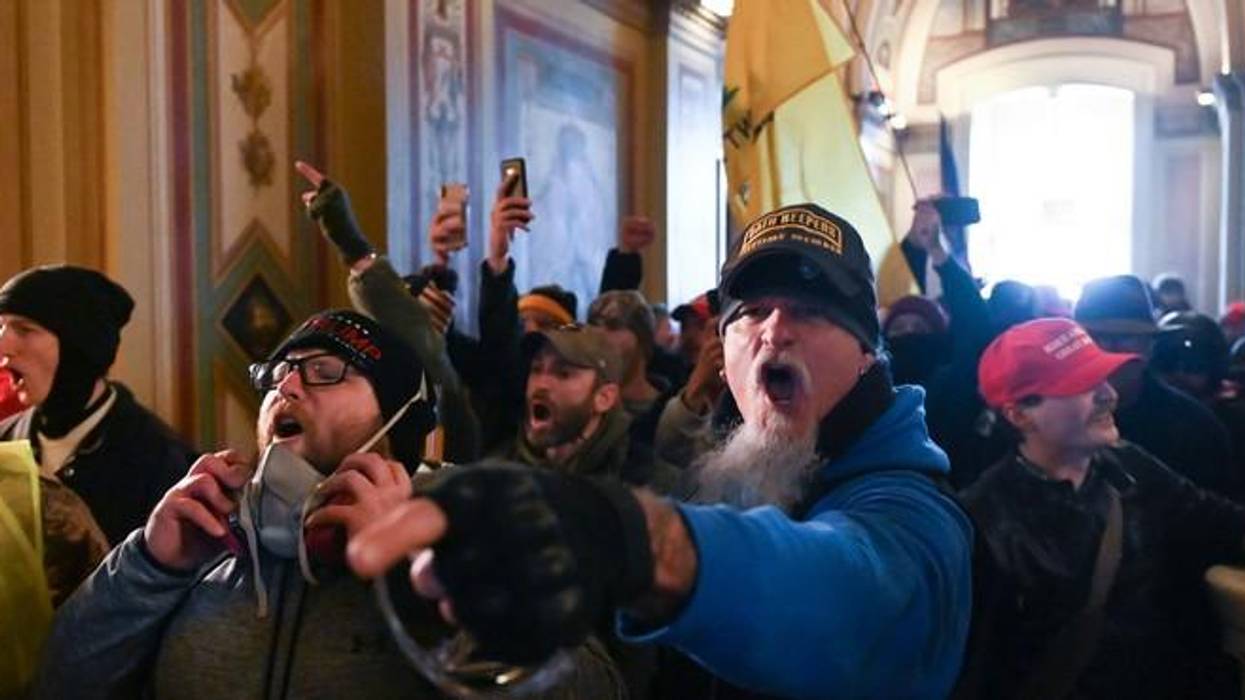
The January 6 indictment is solid as granite, but leaves out the sole criminal prohibition that would disqualify former President Donald Trump from the 2024 ballot.
On August 1, 2023, a federal grand jury indicted former President Donald J. Trump for conspiring to prevent Vice President Mike Pence, through a blizzard of knowing “Stop the Steal” lies, threats, intimidation, and mob violence, from counting judicially vetted state certified electoral votes as stipulated by the Electoral Count Act and the Twelfth Amendment to the United States Constitution.
The January 6 indictment is solid as granite. All the incriminating testimony and evidence is from the former president’s appointees or political supporters, for example, former Attorney General William Barr and former White House Counsel Pat Cipollone. Democrats are nowhere to be seen. Even lavishly compensated private investigators, hired by Trump himself to unearth electoral fraud, came up empty handed.
The knockout is from former Vice President Pence. He testified in various formulations that on January 6, 2021, Trump demanded that he “choose between [Trump] and the Constitution.” Trump’s demand showed his knowledge that he was haranguing the vice president to do something contrary to the Constitution. Trump was not presenting legal arguments in favor of an alternative constitutional understanding. Trump, a few days earlier, had similarly assailed Pence for being “too honest” in denying any constitutional foundation for a lawsuit claiming the vice president possessed the authority to reject state-certified electoral votes.
Section 3 categorically disqualifies from public office at any level of government any official who, after having taken an oath to support the Constitution of the United States, engages in “insurrection” against it.
The uniform advice Trump received from his own lawyers was that the vice president’s constitutional role in “counting” state-certified electoral votes was ministerial. He was not empowered to question their validity. That had been the universal understanding for more than two centuries since the Twelfth Amendment was ratified in 1804. Even one of Trump’s co-conspirators, lawyer John Eastman, conceded Trump’s zany reading of the amendment would not command a single vote in the United States Supreme Court. J. Michael Luttig, former United States Court of Appeals Judge for the Fourth Circuit, a conservative jurist in the mold of the late Justice Antonin Scalia, scoffed at the idea of any role for the vice president in counting state-certified electoral votes other than a ministerial one.
Trump’s private lawyers like Rudy Giuliani, Sidney Powell, Jenna Ellis, and John Eastman face professional or court discipline for their “Stop the Steal” lies. Powell maintained in a defamation lawsuit that “no reasonable person” would have believed her lies were facts.
Historical practice and the Twelfth Amendment’s plain text are reinforced by the four-centuries-old Anglo-American axiom that a man cannot be a judge in his own case. Thus, former Vice President Al Gore lacked power to second-guess the state-certified electoral votes for Republican George W. Bush in the 2000 presidential election in which Gore was Bush’s Democratic opponent. Pence, who was Trump’s running mate, would have faced a similar political conflict if he decided on the validity of state-certified electoral votes cast in 2020.
Trump’s incorrigibly criminal, extraconstitutional state of mind was betrayed by his alarming proclamation on July 23, 2019, hoping to undo the American Revolution: “Then I have Article 2, where I have the right to do anything I want as president,” That is, the rule of law is no longer king, the king is law. Willful ignorance or stupidity is no defense to criminal action.
Any free speech defense mounted by Trump would be DOA. There is no First Amendment right to unleash a tsunami of “Stop the Steal” lies with the ulterior criminal motive of shipwrecking the peaceful transfer of presidential power under the Twelfth Amendment by intimidating the vice president from counting state-certified electoral votes that had survived 61 judicial challenges. Trump nearly succeeded. The indictment states that on January 6, 2021, “at 2: 25 pm, the United States Secret Service was forced to evacuate the vice president to a secure location [in the Capitol]. [There], throughout the afternoon, members of the crowd chanted, ‘Hang Mike Pence!’; ‘Where is Pence? Bring him out!’; and ‘Traitor Pence!’”
Free speech icon Justice Louis D. Brandies confirmed in a concurring opinion in Whitney v. California (1927) that the First Amendment is undisturbed by the prosecution of speech calculated to occasion imminent serious harm. It is difficult to conceive of any greater injury to a democracy founded on the consent of the governed than frustrating the peaceful transfer of presidential power in accord with judicially vetted and politically certified popular votes.
The probability that Trump will testify on his own behalf is zero—too great a risk of perjury. A former Trump lawyer, John Dowd, reportedly was convinced that his client was an inveterate liar.
Even if Trump is convicted of January 6 offenses alleged in the indictment before presidential balloting in November 2024, he could still be a candidate for the presidency. Socialist Eugene Debs, while imprisoned for making anti-war speeches and allegedly violating the Espionage Act, ran for president in 1920 and attracted one million votes. Debs’ sentence was commuted by President Warren G. Harding, who invited him to the White House saying, “I have heard so damned much about you, Mr. Debs, that I am now very glad to meet you personally.”
The sole criminal prohibition that would disqualify Trump from the ballot, under Section 3 of the Fourteenth Amendment, is “insurrection,” made criminal by 18 United States Code Section 2383.
Section 3 categorically disqualifies from public office at any level of government any official who, after having taken an oath to support the Constitution of the United States, engages in “insurrection” against it. Among other things, insurrection means seeking by force, violence, or otherwise to frustrate the ability of the United States to enforce the Constitution or laws. The narrative of the January 6 indictment makes clear that Trump conspired and directly engaged in insurrection against the Constitution on January 6 by attempting to obstruct the enforcement of the Twelfth Amendment and Electoral Count Act.
The House Select Committee to Investigate the January 6 Attack on the United States Capitol made a criminal referral to the Department of Justice recommending prosecution of Trump for assisting or aiding the January 6 insurrection. Trump was impeached by the U.S. House of Representatives for inciting insurrection and a majority of U.S. Senators voted to convict (but short of the two-thirds majority constitutionally required). The Department of Justice has secured multiple convictions against Trump’s January 6 mob for “seditious conspiracy” under 18 U.S.C. 2384, whose elements of proof are virtually indistinguishable from insurrection.
Why then did the indictment omit an insurrection count to disqualify Trump for 2024? And was Special Counsel Jack Smith or Attorney General Merrick Garland the de facto or de jure decider? Under Department of Justice special counsel regulations, the latter is empowered to overrule the former in narrow circumstances.
Without exhausting all the hypotheses, Democrats might wish to see Trump nominated as the Republican presidential candidate in 2024 because they believe he is a sure loser against President Joe Biden and would convulse the Republican Party. Placing that political calculation above the Constitution, i.e., Section 3 of the Fourteenth Amendment, we submit, would be too dismaying for words.
Alternatively, Democrats could believe that disqualifying Trump from the 2024 campaign would taint the outcome in the minds of the considerable number of his deceived supporters and compound political polarization. But to bow to such political calculations would erode the rule of law. The sole loyalty of federal officials from the highest to the lowest is to the Constitution, period.
Perhaps Garland and Smith had non-political legal rationales for their omission. If so, they have not explained it publicly—even though nothing forbids them from candor.
We urge Special Counsel Jack Smith to unilaterally, or with the approval of Attorney General Garland, return to the federal grand jury in Washington, D.C., and ask for a superseding indictment adding a count for insurrection in violation of Section 2383. Not a single word in the factual narrative of the preceding indictment need be changed.
The future of our Republic is too important to be left to shortchanging the fullest legal case against Trump.

The request came after Trump posted on Truth Social, "If you go after me, I'm coming after you!"
The Department of Justice asked the Washington judge presiding over the latest criminal case against former President Donald Trump to issue a protective order for evidence Friday after Trump made an apparently threatening post on social media.
"If you go after me, I'm coming after you!" Trump posted in all capital letters on Truth Social Friday.
Trump's remarks came days after he was indicted for attempting to overturn the results of the 2020 presidential election, in the third criminal case brought against the former president this year, but also the one that experts say is the most serious.
The post also came a day after the current Republican frontrunner pleaded "not guilty" to the charges of conspiracy to defraud the United States, conspiracy to obstruct an official proceeding, obstruction of and attempt to obstruct an official proceeding, and conspiracy against rights.
Prosecutors asked U.S. District Court Judge Tanya Chutkan to issue an order that would restrict the information that Trump and his legal team could share with the public, the Associated Press explained. Orders of this nature are normal in criminal cases.
"If the defendant were to begin issuing public posts using details—or, for example, grand jury transcripts—obtained in discovery here, it could have a harmful chilling effect on witnesses or adversely affect the fair administration of justice in this case."
Special Council Jack Smith said in the filing that a protection order was "particularly important in this case because the defendant has previously issued public statements on social media regarding witnesses, judges, attorneys, and others associated with legal matters pending against him," according to The Hill.
"If the defendant were to begin issuing public posts using details—or, for example, grand jury transcripts—obtained in discovery here, it could have a harmful chilling effect on witnesses or adversely affect the fair administration of justice in this case," Smith continued.
The filing cited Trump's threatening post from Friday in particular, which The New York Times interpreted as an attempt to remind the judge of Trump's history of lashing out at anyone related to a criminal case against him. For example, Trump took to Truth Social earlier this year to promise "death and destruction" if he were charged in Manhattan relating to the hush money he paid porn actress Stormy Daniels.
Friday's protection request came as prosecutors said they were about to turn over a "substantial" amount of evidence to Trump's legal team, "much of which includes sensitive and confidential information," AP reported.
In response, the Trump Republican primary campaign tweeted out a statement minutes after midnight on Saturday.
"The Truth post cited is the definition of political speech, and was in response to the RINO, China-loving, dishonest special interest groups and Super PACs, like the ones funded by the Koch brothers and the Club for No Growth," a Trump spokesperson said in the statement.
However, President of Citizens for Responsibility and Ethics in Washington Noah Bookbinder disagreed.
"There's no First Amendment right to threaten, certainly not to threaten the prosecutors in your case," he tweeted. "Judges and prosecutors have given Donald Trump a long leash for conduct that would not be tolerated from others, but he may be nearing the end of it."
Judge Chutkan said Saturday that Trump's legal team would have until 5 pm Monday to respond to the prosecution's protection request, as AP reported.
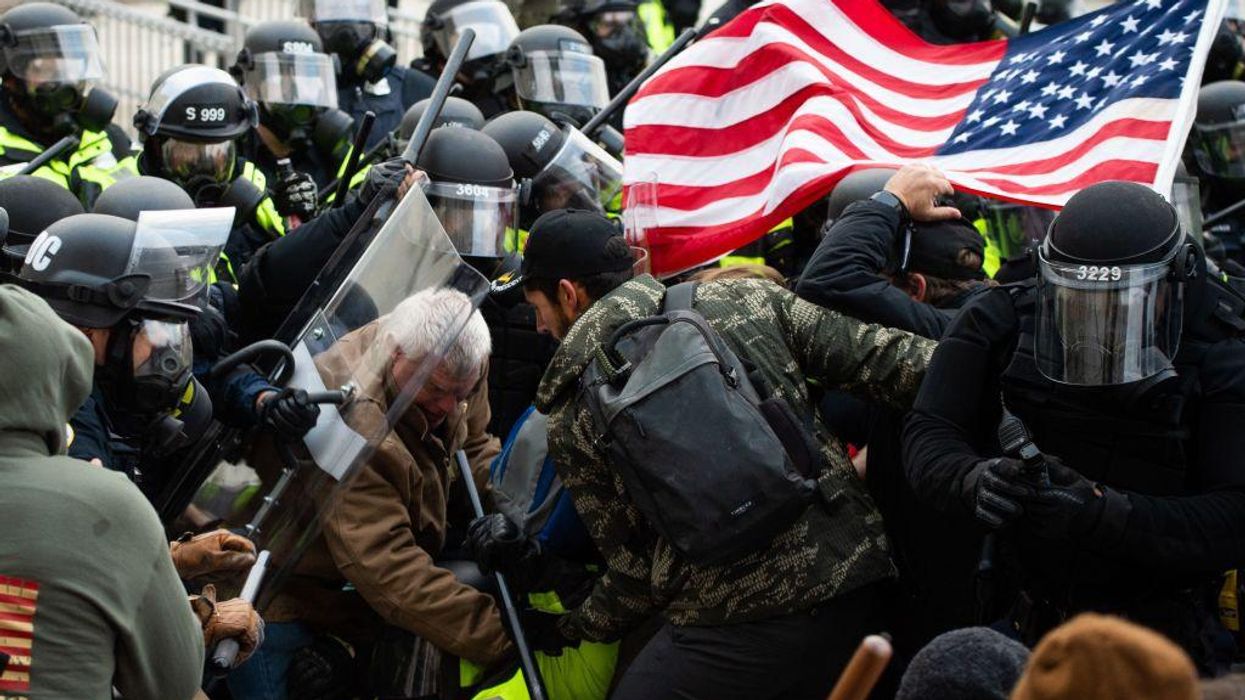
The plot to overturn the 2020 election has spawned an ongoing election denial movement that is undermining voting rights, weakening our electoral system, and making it more vulnerable to future attacks.
For the first time, a former president is facing criminal charges for a wide-ranging conspiracy to thwart American democracy. In painstaking detail, the indictment recounts Donald Trump’s scheme “to overturn the legitimate results of the 2020 presidential election by using knowingly false claims of election fraud.” Regardless of how the case proceeds, one thing is already clear: The attacks on our democracy did not end on January 6, 2021.
The plot to overturn the 2020 election has spawned an ongoing election denial movement that is undermining voting rights, weakening our electoral system, and making it more vulnerable to future attacks. This plan not only builds off the playbook used by Trump and his coconspirators in 2020, but also invokes the same lies about voter fraud and a “stolen” 2020 election detailed in the indictment. Although these thoroughly discredited lies continue to unravel as more and more of their purveyors face accountability, the damage being done in their name is far from over.
Perhaps most jarring are the attacks on election officials and election workers. Since 2020, false claims of voter fraud and election “irregularities” have prompted widespread harassment and threats of violence against election officials and their families. For example, violent threats forced one top local election official in Arizona’s Maricopa County into hiding to protect his safety and that of his family while he presided over the 2022 vote count.
Undoubtedly, Trump’s indictment is a critical step in reckoning with the plot to overturn the 2020 election. But we also need to confront the ongoing antidemocratic attacks that are an outgrowth of that plot.
His experience was not anomalous. A Brennan Center survey of local election officials in March showed that nearly one in three have faced harassment, abuse, or threats for simply doing their jobs. Forty-five percent expressed concern for the physical safety of their colleagues in future elections, and one in five reported that they personally feared being physically assaulted on the job.
Predictably, this fear has led to an exodus among experienced election officials. Across the country, and particularly in battleground states, turnover has rapidly increased. At least one in five said they plan to leave by 2024. In North Carolina alone, turnover has forced at least 40 of the state’s 100 counties to replace their head election official.
Alarmingly, in many instances the people replacing these professionals are election deniers themselves. This amplifies another threat to the stability of our elections: internal attacks on the security of our election administration structure. Following the 2020 election, these “insider threats” included at least 17 incidents in which election officials gave election deniers seeking to uncover fraud unauthorized access to voting equipment and data. For example, Tina Peters, the former clerk of Mesa County, Colorado, is awaiting trial on criminal charges for her role in facilitating a security breach of the county’s Dominion voting machines. As a result, the state announced that the county’s voting equipment would have to be decertified and entirely replaced before the next election.
Election deniers are also weakening our electoral system by strategically undermining voting rights. This tactic is straight out of the Trump campaign’s 2020 playbook, described succinctly by the indictment as an effort to “discount[ ] legitimate votes and subvert[ ] the election result.” Since 2020, at least 28 states have passed 65 laws making it harder to vote. And these efforts show no sign of slowing down. Already in 2023, at least 11 states have enacted restrictive voting laws.
Regardless of their impact on election outcomes, these new laws cause significant, measurable harm by preventing hundreds of thousands of eligible voters from participating in elections and disproportionately targeting voters of color. Not surprisingly, the turnout gap between white and Black voters is now the largest in any presidential or midterm election since at least 2000.
Election deniers have also generated a new threat to free and fair elections: election subversion legislation that enables partisan actors to meddle in election administration. Most troubling are bills that would empower state legislators or their partisan allies to overturn election results—bills that thankfully have not yet passed. But bills that have been enacted are also problematic, including laws that give partisan actors direct control over election administrators or election administration decisions. Since the Brennan Center first started tracking these laws in 2021, at least 28 have passed.
Undoubtedly, Trump’s indictment is a critical step in reckoning with the plot to overturn the 2020 election. But we also need to confront the ongoing antidemocratic attacks that are an outgrowth of that plot. In addition to holding perpetrators accountable, we must shore up our election system so it is less susceptible to attack. That includes passing stronger legal safeguards to protect against efforts to disenfranchise voters and subvert election results. Such protections are found in the John Lewis Voting Rights Advancement Act and the Freedom to Vote Act, which was recently reintroduced in Congress, and similar bills in the states. It also includes robust judicial enforcement of the laws that are currently on the books. Our democracy is still on the line.

All of the charges rest on the claim that Trump and his co-conspirators knew the former president lost the 2020 election, and that his claims of fraud and voting irregularity were unfounded.
The Justice Department announced its second federal indictment of former president Donald J. Trump on Aug. 1, 2023. The charges are groundbreaking and not just because a former president is facing multiple criminal charges.
It’s because these are the first federal charges alleging a former president effectively attempted a particular kind of coup, called an auto-coup, in which he attempted to keep himself in power by illegal means.
The indictment lists four felony charges. All of them rely on the same facts and boil down to the same set of five allegations, many of which have been previously reported.
The indictment charges that all of Trump’s many claims of election irregularities “were false, and the Defendant knew that they were false.”
All of the charges rest on the claim that Trump and his co-conspirators knew the former president lost the 2020 election, and that his claims of fraud and voting irregularity made before and on January 6, 2021, were unfounded.
Three counts in this new indictment allege conspiracies: There is conspiracy to defraud the government; to obstruct an official proceeding—in this case, counting the electoral votes on January 6, 2021; and against the rights of the voters to cast ballots and have them fairly and honestly counted.
The remaining count alleges obstruction of an official proceeding—namely, tallying the electoral vote. The document states that Trump allegedly had the help of six co-conspirators, including four lawyers, a Justice Department official, and a political consultant.
None of them are charged in the indictment, and they are identified by number, not name. This could mean one or more of these people are cooperating with the Justice Department, but not necessarily.
The indictment charges that all of Trump’s many claims of election irregularities “were false, and the Defendant knew that they were false.”
I am a scholar of criminal law and procedure. While Trump is facing multiple other charges, this indictment contains the most serious charges he has faced thus far.
In another case, Trump is being charged in New York with falsifying business records, which is, to some extent, a technical offense. And the Justice Department has charged him in Florida with illegally keeping national security documents, but there is no allegation they were disclosed to foreign agents or represented much more than souvenirs.
This indictment, by contrast, alleges that Trump knowingly worked to hold on to an office he knew he was not entitled to.

In this most recent indictment of Trump, the Justice Department alleges that in November and December 2020, Trump tried to get state legislators to derail the process of certifying the election results in their states. Trump allegedly did this, for example, by asking legislative leaders to call the legislature back into session and approve a resolution that Trump, not Joe Biden, had won.
But all state legislatures certified the election results by December 2020. Trump and his allies then assembled slates of alternate electors in Arizona, Georgia, Michigan, Nevada, New Mexico, Pennsylvania, and Wisconsin—all key states that Biden won. These self-appointed electors prepared alternate election documents to submit to Congress.
The indictment alleges that some of the fraudulent electors were told by co-conspirators that the certificates with their names and votes would be used only if Trump managed to overturn the election results in their state—an event which occurred in none of the seven states. The co-conspirators allegedly later attempted to use the certificates anyway.
The conspiracy charges are helpful to the prosecution because under the rules of evidence, any statements made, or acts done, by a co-conspirator to further the conspiracy can be used against Trump.
Third, Trump and his allies allegedly attempted to have Justice Department officials communicate with states whose electoral votes Trump wanted. They wanted those officials to falsely state that there were active election fraud investigations pending.
Trump and his allies allegedly asked the Justice Department officials to sign a letter they had drafted that asked states to bring their legislatures back into session to reconsider the outcome of the election.
Fourth, the indictment alleges that Trump attempted to persuade then-Vice President Mike Pence that he had the right to reject Biden’s electoral votes, or return those votes to the state legislatures.
And finally, the indictment accuses Trump of being responsible for some of the violence on January 6, 2021, and exploiting the riot at the Capitol by urging members of Congress to delay the electoral vote count proceedings that day.
According to the indictment, Trump called followers to attend a protest rally the morning on January 6, and he “directed them to the Capitol to obstruct the certification proceeding and exert pressure on the Vice President to take the fraudulent actions he had previously refused.”
Then, the indictment continues, “the Defendant and co-conspirators exploited the disruption by redoubling efforts to levy false claims of election fraud and convince members of Congress to further delay the certification based on those claims.”
The conspiracy charges are helpful to the prosecution because under the rules of evidence, any statements made, or acts done, by a co-conspirator to further the conspiracy can be used against Trump.
So, even though Trump is the only person named and indicted in this case, a wide range of evidence from others’ actions will be available against him.
Trump could theoretically serve decades in prison if he is convicted of these charges.
The indictment’s first count, conspiracy to defraud the U.S., has a five-year maximum sentence. Counts 2 and 3, obstruction of an official proceeding and conspiracy to obstruct an official proceeding, carry 20-year maximum sentences.
Count 4, conspiracy against rights, normally has a 10-year maximum sentence. However, the statute provides that “if death results from the acts committed in violation of this section” the sentence may be imprisonment “for any term of years or for life,” or the person “may be sentenced to death.”
There are no cases of a person being charged with crimes based on their acts as president.
Seven people died in connection with the January 6 riots, so it is likely that the question of whether the enhanced sentence is available will come up if there is a conviction. But the Justice Department under Biden has been parsimonious with the death penalty. Based on that and other considerations, it seems highly unlikely that the death penalty would be a realistic option for sentencing in this case.
Many legal questions will have to be resolved in court between the time Trump appears in a Washington, D.C., federal court, initially scheduled for August 3, 2023, and whenever a jury reaches a verdict.
It is clear that a sitting president can be impeached. There are no cases of a person being charged with crimes based on their acts as president. The issue came up in the 1970s, but was rendered moot when President Gerald Ford pardoned former President Richard Nixon.
This case places Trump in a much deeper kind of new legal trouble, and the U.S. in a murky, unexplored political and legal landscape.