SUBSCRIBE TO OUR FREE NEWSLETTER
Daily news & progressive opinion—funded by the people, not the corporations—delivered straight to your inbox.
5
#000000
#FFFFFF
To donate by check, phone, or other method, see our More Ways to Give page.
Daily news & progressive opinion—funded by the people, not the corporations—delivered straight to your inbox.
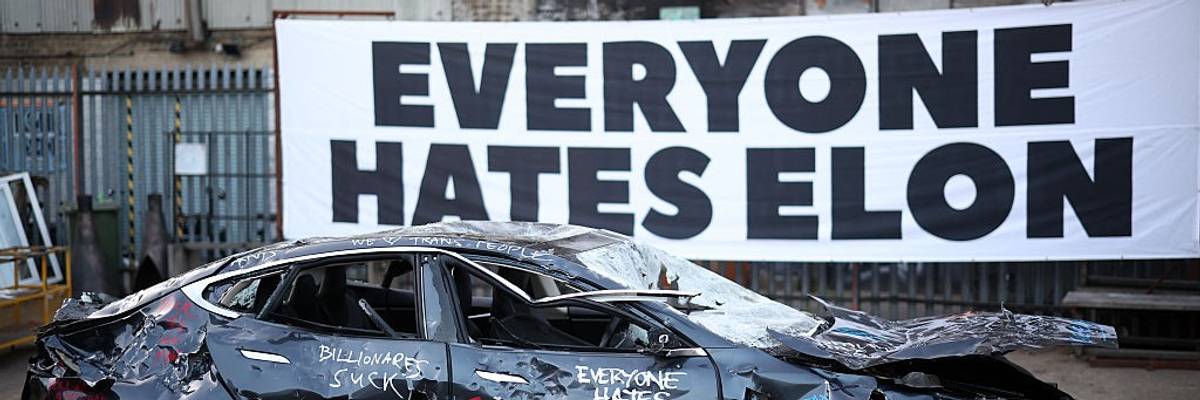
A Tesla car is pictured after being smashed-up at an anti Elon Musk protest, in south London on April 10, 2025.
During the Great Recession, I organized a Toyota boycott that accidentally paved the way for Musk’s rise. Musk probably won’t tell that story, so I will.
Elon Musk's alliance with Donald Trump may be over for now, but the Tesla brand has yet to recover from Musk's high profile foray into far-right politics.
Tesla stock has plummeted precipitously ever since Musk’s embrace of Donald Trump last year. It’s been enough to alarm board members, who are now considering replacing Musk as CEO as public “Tesla Takedown” protests have spread across the country.
Ironically, Musk himself was the beneficiary of a similar boycott years ago — a boycott I ran. And since Musk himself is unlikely to relay the story, I will.
In the aftermath of the 2008 market collapse, Toyota announced plans to shutter its Fremont, California factory and move production to Japan, Canada, Mexico, and Mississippi. Not surprisingly, outrage ensued. Soon after, I received a call from the incoming United Auto Workers president Bob King, who asked me to devise a campaign to challenge the Toyota closing.
For Toyota, it was about abandoning California. For Musk, it’s been about dismantling our government and attacking union rights, among other misdeeds.
The strategy we landed on was to reframe this struggle from one borne by workers alone to one that emphasized the broader damage to California’s economy that the closure would cause.
Back then in California, one of every four vehicles sold was a Toyota. As the New York Times’ Bob Herbert wrote in 2010, the U.S. was “the largest market for Toyota vehicles in the world, larger even than Japan.” And the Corolla, built at the Fremont facility, was “the best-selling car of all time.”
But it was that very success that made them vulnerable.
We knew Fridays, Saturdays, and Sundays were the prime sales days for most car dealerships. We dispatched our ground troops to cover those three days of the week, in shifts of 8 to 10 people, to 50 dealerships in California and 50 more throughout the United states, holding banners proclaiming, “Toyota Kills California Jobs.”
The company’s sales managers panicked, with several complaining to me personally that their sales were hurting. On April 1, 2010, Toyota shuttered the Fremont factory as they had previously announced, but our boycott continued.
Two weeks later, faced with our ongoing boycott, Toyota president Akio Toyoda, the grandson of the company's founder, called Elon Musk, flew to Los Angeles to meet Musk for dinner, and offered a $50 million cash infusion if Musk would take over the old Fremont plant and hire from the laid off workforce.
Musk had been on the brink of signing a deal to open a Tesla plant in Southern California, but this offer — and the boycott that prompted it — abruptly changed his plans.
Not long after, those Fremont workers were making Teslas instead of Toyotas — and employment at the plant has skyrocketed from 4,700 then to over 20,000 today. Musk went on to become the world’s wealthiest man.
Now, Toyota president Akio Toyoda wasn’t exactly like today’s Musk when it comes to public notoriety. But there are some striking similarities between the two cases.
Both car companies claim to be leaders of environmentally sustainable transportation. Like the Prius before it, a drive through any upscale retail parking lot from Los Angeles to New York City today will similarly show a high proportion of Tesla sedans, bought during less fraught times by environmentally conscious consumers.
And both companies have suffered from a strong sense of betrayal among their most loyal customer base. For Toyota, it was about abandoning California. For Musk, it’s been about dismantling our government and attacking union rights, among other misdeeds.
Today, the cratering of Tesla’s stock value, coinciding with nationwide anti-Musk protests at Tesla dealerships, reinforces two important truisms fundamental to a free market: public opinion of brands still affects stock value, and a CEO's behavior can trigger lasting backlash against their brand.
So as the organizer of the boycott that accidentally helped along Musk’s rise to prominence, what’s my advice for the Tesla board today? Make Musk divest his shares and move on.
It’s likely that nothing else will quell these protests.
Dear Common Dreams reader, It’s been nearly 30 years since I co-founded Common Dreams with my late wife, Lina Newhouser. We had the radical notion that journalism should serve the public good, not corporate profits. It was clear to us from the outset what it would take to build such a project. No paid advertisements. No corporate sponsors. No millionaire publisher telling us what to think or do. Many people said we wouldn't last a year, but we proved those doubters wrong. Together with a tremendous team of journalists and dedicated staff, we built an independent media outlet free from the constraints of profits and corporate control. Our mission has always been simple: To inform. To inspire. To ignite change for the common good. Building Common Dreams was not easy. Our survival was never guaranteed. When you take on the most powerful forces—Wall Street greed, fossil fuel industry destruction, Big Tech lobbyists, and uber-rich oligarchs who have spent billions upon billions rigging the economy and democracy in their favor—the only bulwark you have is supporters who believe in your work. But here’s the urgent message from me today. It's never been this bad out there. And it's never been this hard to keep us going. At the very moment Common Dreams is most needed, the threats we face are intensifying. We need your support now more than ever. We don't accept corporate advertising and never will. We don't have a paywall because we don't think people should be blocked from critical news based on their ability to pay. Everything we do is funded by the donations of readers like you. When everyone does the little they can afford, we are strong. But if that support retreats or dries up, so do we. Will you donate now to make sure Common Dreams not only survives but thrives? —Craig Brown, Co-founder |
Elon Musk's alliance with Donald Trump may be over for now, but the Tesla brand has yet to recover from Musk's high profile foray into far-right politics.
Tesla stock has plummeted precipitously ever since Musk’s embrace of Donald Trump last year. It’s been enough to alarm board members, who are now considering replacing Musk as CEO as public “Tesla Takedown” protests have spread across the country.
Ironically, Musk himself was the beneficiary of a similar boycott years ago — a boycott I ran. And since Musk himself is unlikely to relay the story, I will.
In the aftermath of the 2008 market collapse, Toyota announced plans to shutter its Fremont, California factory and move production to Japan, Canada, Mexico, and Mississippi. Not surprisingly, outrage ensued. Soon after, I received a call from the incoming United Auto Workers president Bob King, who asked me to devise a campaign to challenge the Toyota closing.
For Toyota, it was about abandoning California. For Musk, it’s been about dismantling our government and attacking union rights, among other misdeeds.
The strategy we landed on was to reframe this struggle from one borne by workers alone to one that emphasized the broader damage to California’s economy that the closure would cause.
Back then in California, one of every four vehicles sold was a Toyota. As the New York Times’ Bob Herbert wrote in 2010, the U.S. was “the largest market for Toyota vehicles in the world, larger even than Japan.” And the Corolla, built at the Fremont facility, was “the best-selling car of all time.”
But it was that very success that made them vulnerable.
We knew Fridays, Saturdays, and Sundays were the prime sales days for most car dealerships. We dispatched our ground troops to cover those three days of the week, in shifts of 8 to 10 people, to 50 dealerships in California and 50 more throughout the United states, holding banners proclaiming, “Toyota Kills California Jobs.”
The company’s sales managers panicked, with several complaining to me personally that their sales were hurting. On April 1, 2010, Toyota shuttered the Fremont factory as they had previously announced, but our boycott continued.
Two weeks later, faced with our ongoing boycott, Toyota president Akio Toyoda, the grandson of the company's founder, called Elon Musk, flew to Los Angeles to meet Musk for dinner, and offered a $50 million cash infusion if Musk would take over the old Fremont plant and hire from the laid off workforce.
Musk had been on the brink of signing a deal to open a Tesla plant in Southern California, but this offer — and the boycott that prompted it — abruptly changed his plans.
Not long after, those Fremont workers were making Teslas instead of Toyotas — and employment at the plant has skyrocketed from 4,700 then to over 20,000 today. Musk went on to become the world’s wealthiest man.
Now, Toyota president Akio Toyoda wasn’t exactly like today’s Musk when it comes to public notoriety. But there are some striking similarities between the two cases.
Both car companies claim to be leaders of environmentally sustainable transportation. Like the Prius before it, a drive through any upscale retail parking lot from Los Angeles to New York City today will similarly show a high proportion of Tesla sedans, bought during less fraught times by environmentally conscious consumers.
And both companies have suffered from a strong sense of betrayal among their most loyal customer base. For Toyota, it was about abandoning California. For Musk, it’s been about dismantling our government and attacking union rights, among other misdeeds.
Today, the cratering of Tesla’s stock value, coinciding with nationwide anti-Musk protests at Tesla dealerships, reinforces two important truisms fundamental to a free market: public opinion of brands still affects stock value, and a CEO's behavior can trigger lasting backlash against their brand.
So as the organizer of the boycott that accidentally helped along Musk’s rise to prominence, what’s my advice for the Tesla board today? Make Musk divest his shares and move on.
It’s likely that nothing else will quell these protests.
Elon Musk's alliance with Donald Trump may be over for now, but the Tesla brand has yet to recover from Musk's high profile foray into far-right politics.
Tesla stock has plummeted precipitously ever since Musk’s embrace of Donald Trump last year. It’s been enough to alarm board members, who are now considering replacing Musk as CEO as public “Tesla Takedown” protests have spread across the country.
Ironically, Musk himself was the beneficiary of a similar boycott years ago — a boycott I ran. And since Musk himself is unlikely to relay the story, I will.
In the aftermath of the 2008 market collapse, Toyota announced plans to shutter its Fremont, California factory and move production to Japan, Canada, Mexico, and Mississippi. Not surprisingly, outrage ensued. Soon after, I received a call from the incoming United Auto Workers president Bob King, who asked me to devise a campaign to challenge the Toyota closing.
For Toyota, it was about abandoning California. For Musk, it’s been about dismantling our government and attacking union rights, among other misdeeds.
The strategy we landed on was to reframe this struggle from one borne by workers alone to one that emphasized the broader damage to California’s economy that the closure would cause.
Back then in California, one of every four vehicles sold was a Toyota. As the New York Times’ Bob Herbert wrote in 2010, the U.S. was “the largest market for Toyota vehicles in the world, larger even than Japan.” And the Corolla, built at the Fremont facility, was “the best-selling car of all time.”
But it was that very success that made them vulnerable.
We knew Fridays, Saturdays, and Sundays were the prime sales days for most car dealerships. We dispatched our ground troops to cover those three days of the week, in shifts of 8 to 10 people, to 50 dealerships in California and 50 more throughout the United states, holding banners proclaiming, “Toyota Kills California Jobs.”
The company’s sales managers panicked, with several complaining to me personally that their sales were hurting. On April 1, 2010, Toyota shuttered the Fremont factory as they had previously announced, but our boycott continued.
Two weeks later, faced with our ongoing boycott, Toyota president Akio Toyoda, the grandson of the company's founder, called Elon Musk, flew to Los Angeles to meet Musk for dinner, and offered a $50 million cash infusion if Musk would take over the old Fremont plant and hire from the laid off workforce.
Musk had been on the brink of signing a deal to open a Tesla plant in Southern California, but this offer — and the boycott that prompted it — abruptly changed his plans.
Not long after, those Fremont workers were making Teslas instead of Toyotas — and employment at the plant has skyrocketed from 4,700 then to over 20,000 today. Musk went on to become the world’s wealthiest man.
Now, Toyota president Akio Toyoda wasn’t exactly like today’s Musk when it comes to public notoriety. But there are some striking similarities between the two cases.
Both car companies claim to be leaders of environmentally sustainable transportation. Like the Prius before it, a drive through any upscale retail parking lot from Los Angeles to New York City today will similarly show a high proportion of Tesla sedans, bought during less fraught times by environmentally conscious consumers.
And both companies have suffered from a strong sense of betrayal among their most loyal customer base. For Toyota, it was about abandoning California. For Musk, it’s been about dismantling our government and attacking union rights, among other misdeeds.
Today, the cratering of Tesla’s stock value, coinciding with nationwide anti-Musk protests at Tesla dealerships, reinforces two important truisms fundamental to a free market: public opinion of brands still affects stock value, and a CEO's behavior can trigger lasting backlash against their brand.
So as the organizer of the boycott that accidentally helped along Musk’s rise to prominence, what’s my advice for the Tesla board today? Make Musk divest his shares and move on.
It’s likely that nothing else will quell these protests.