

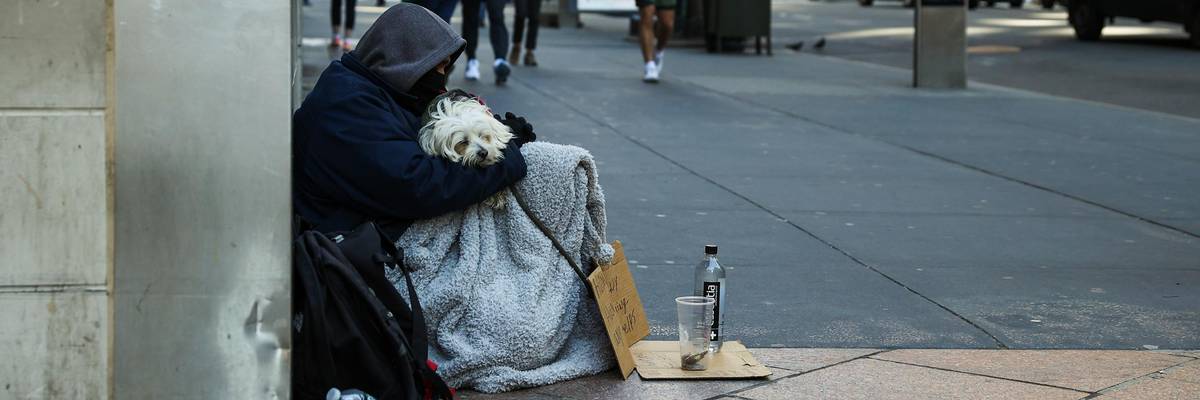
A homeless person is seen near a subway station in New York City on February 21, 2022.
Someone Tell the US Supreme Court: Housing Is a Human Right!
Criminalization is not a legitimate tool to combat houselessness as it subjects people to cruel treatment and arbitrary arrest, punishing them for simply existing in public space because they lack housing.
The United States Supreme Court decision last month in Grants Pass v. Johnson gives local governments across the country the authority to ticket, arrest, and punish unhoused people for simply existing in public spaces. The ruling undermines the right to adequate housing in the U.S.; it is also profoundly cruel and risks an increase in ineffective criminalization.
In its ruling, the court overturned decisions by the U.S. Court of Appeals for the Ninth Circuit in this case and in Martin v. Boise, which limited punishment if there was no other place for a person legally to go or if there was no shelter available. The court said that criminalizing a person for their unhoused status does not violate the prohibition on “cruel and unusual punishments” in the Eighth Amendment to the U.S. Constitution.
Criminalization causes suffering, but does nothing to house people.
The Supreme Court had previously held that authorities may not punish a person based solely on their status, as opposed to their conduct. The Grants Pass majority did not explicitly overrule that precedent, but said the Eighth Amendment only applies to the form of punishment—not the outlawed conduct or status—and that state governments may choose to criminalize whatever they want without violating the Constitution. This ruling opens the door to further punishment of poverty and other statuses.
This decision gives local and state governments a green light to enact and enforce laws banning unhoused people from public spaces, regardless of whether adequate housing or shelter is available to them. States across the country, including Georgia, Texas, Florida, and others, have already passed such laws. A recent study found that the majority of cities examined already had such laws in place.
In Los Angeles, previously limited by the Ninth Circuit precedent, city councilmembers have already begun to explore options to further criminalize unhoused people in light of the Supreme Court decision. Other jurisdictions will likely race to take similar steps, not wanting to be the only areas in their region where unhoused people can safely stay.
Criminalization is not, as the majority opinion claims, a legitimate tool to combat houselessness as it subjects people to cruel treatment and arbitrary arrest, punishing them for simply existing in public space because they lack housing. Criminalization is also proven to be ineffective. It forces unhoused people to hide from view, separating them from helpful services. Criminalization causes suffering, but does nothing to house people. This ruling allows authorities to ignore real solutions, especially providing and preserving affordable housing, because they can simply chase unhoused people away with the threat of criminal enforcement.
An Urgent Message From Our Co-Founder
Dear Common Dreams reader, It’s been nearly 30 years since I co-founded Common Dreams with my late wife, Lina Newhouser. We had the radical notion that journalism should serve the public good, not corporate profits. It was clear to us from the outset what it would take to build such a project. No paid advertisements. No corporate sponsors. No millionaire publisher telling us what to think or do. Many people said we wouldn't last a year, but we proved those doubters wrong. Together with a tremendous team of journalists and dedicated staff, we built an independent media outlet free from the constraints of profits and corporate control. Our mission has always been simple: To inform. To inspire. To ignite change for the common good. Building Common Dreams was not easy. Our survival was never guaranteed. When you take on the most powerful forces—Wall Street greed, fossil fuel industry destruction, Big Tech lobbyists, and uber-rich oligarchs who have spent billions upon billions rigging the economy and democracy in their favor—the only bulwark you have is supporters who believe in your work. But here’s the urgent message from me today. It's never been this bad out there. And it's never been this hard to keep us going. At the very moment Common Dreams is most needed, the threats we face are intensifying. We need your support now more than ever. We don't accept corporate advertising and never will. We don't have a paywall because we don't think people should be blocked from critical news based on their ability to pay. Everything we do is funded by the donations of readers like you. When everyone does the little they can afford, we are strong. But if that support retreats or dries up, so do we. Will you donate now to make sure Common Dreams not only survives but thrives? —Craig Brown, Co-founder |
The United States Supreme Court decision last month in Grants Pass v. Johnson gives local governments across the country the authority to ticket, arrest, and punish unhoused people for simply existing in public spaces. The ruling undermines the right to adequate housing in the U.S.; it is also profoundly cruel and risks an increase in ineffective criminalization.
In its ruling, the court overturned decisions by the U.S. Court of Appeals for the Ninth Circuit in this case and in Martin v. Boise, which limited punishment if there was no other place for a person legally to go or if there was no shelter available. The court said that criminalizing a person for their unhoused status does not violate the prohibition on “cruel and unusual punishments” in the Eighth Amendment to the U.S. Constitution.
Criminalization causes suffering, but does nothing to house people.
The Supreme Court had previously held that authorities may not punish a person based solely on their status, as opposed to their conduct. The Grants Pass majority did not explicitly overrule that precedent, but said the Eighth Amendment only applies to the form of punishment—not the outlawed conduct or status—and that state governments may choose to criminalize whatever they want without violating the Constitution. This ruling opens the door to further punishment of poverty and other statuses.
This decision gives local and state governments a green light to enact and enforce laws banning unhoused people from public spaces, regardless of whether adequate housing or shelter is available to them. States across the country, including Georgia, Texas, Florida, and others, have already passed such laws. A recent study found that the majority of cities examined already had such laws in place.
In Los Angeles, previously limited by the Ninth Circuit precedent, city councilmembers have already begun to explore options to further criminalize unhoused people in light of the Supreme Court decision. Other jurisdictions will likely race to take similar steps, not wanting to be the only areas in their region where unhoused people can safely stay.
Criminalization is not, as the majority opinion claims, a legitimate tool to combat houselessness as it subjects people to cruel treatment and arbitrary arrest, punishing them for simply existing in public space because they lack housing. Criminalization is also proven to be ineffective. It forces unhoused people to hide from view, separating them from helpful services. Criminalization causes suffering, but does nothing to house people. This ruling allows authorities to ignore real solutions, especially providing and preserving affordable housing, because they can simply chase unhoused people away with the threat of criminal enforcement.
- Supreme Court Ruling Will Not Solve America's Housing Crisis ›
- Working Class Pay the Price When Supreme Court Justice Secretly Pal Around With Right-Wing Billionaires ›
- Don’t Let the Supreme Court Get the Last Word on Housing Justice ›
- Liberal Justices Grill Attorney in Supreme Court Case on Criminalizing Homelessness ›
- Opinion | We Need a Movement to Counter the Supreme Court’s Cruelty to Homeless People | Common Dreams ›
- Opinion | A Belly Laugh About the Homeless | Common Dreams ›
- Opinion | US Supreme Court Justices Should Be Deadly Ashamed for What They Have Done to Homeless People | Common Dreams ›
The United States Supreme Court decision last month in Grants Pass v. Johnson gives local governments across the country the authority to ticket, arrest, and punish unhoused people for simply existing in public spaces. The ruling undermines the right to adequate housing in the U.S.; it is also profoundly cruel and risks an increase in ineffective criminalization.
In its ruling, the court overturned decisions by the U.S. Court of Appeals for the Ninth Circuit in this case and in Martin v. Boise, which limited punishment if there was no other place for a person legally to go or if there was no shelter available. The court said that criminalizing a person for their unhoused status does not violate the prohibition on “cruel and unusual punishments” in the Eighth Amendment to the U.S. Constitution.
Criminalization causes suffering, but does nothing to house people.
The Supreme Court had previously held that authorities may not punish a person based solely on their status, as opposed to their conduct. The Grants Pass majority did not explicitly overrule that precedent, but said the Eighth Amendment only applies to the form of punishment—not the outlawed conduct or status—and that state governments may choose to criminalize whatever they want without violating the Constitution. This ruling opens the door to further punishment of poverty and other statuses.
This decision gives local and state governments a green light to enact and enforce laws banning unhoused people from public spaces, regardless of whether adequate housing or shelter is available to them. States across the country, including Georgia, Texas, Florida, and others, have already passed such laws. A recent study found that the majority of cities examined already had such laws in place.
In Los Angeles, previously limited by the Ninth Circuit precedent, city councilmembers have already begun to explore options to further criminalize unhoused people in light of the Supreme Court decision. Other jurisdictions will likely race to take similar steps, not wanting to be the only areas in their region where unhoused people can safely stay.
Criminalization is not, as the majority opinion claims, a legitimate tool to combat houselessness as it subjects people to cruel treatment and arbitrary arrest, punishing them for simply existing in public space because they lack housing. Criminalization is also proven to be ineffective. It forces unhoused people to hide from view, separating them from helpful services. Criminalization causes suffering, but does nothing to house people. This ruling allows authorities to ignore real solutions, especially providing and preserving affordable housing, because they can simply chase unhoused people away with the threat of criminal enforcement.
- Supreme Court Ruling Will Not Solve America's Housing Crisis ›
- Working Class Pay the Price When Supreme Court Justice Secretly Pal Around With Right-Wing Billionaires ›
- Don’t Let the Supreme Court Get the Last Word on Housing Justice ›
- Liberal Justices Grill Attorney in Supreme Court Case on Criminalizing Homelessness ›
- Opinion | We Need a Movement to Counter the Supreme Court’s Cruelty to Homeless People | Common Dreams ›
- Opinion | A Belly Laugh About the Homeless | Common Dreams ›
- Opinion | US Supreme Court Justices Should Be Deadly Ashamed for What They Have Done to Homeless People | Common Dreams ›