SUBSCRIBE TO OUR FREE NEWSLETTER
Daily news & progressive opinion—funded by the people, not the corporations—delivered straight to your inbox.
5
#000000
#FFFFFF
To donate by check, phone, or other method, see our More Ways to Give page.
Daily news & progressive opinion—funded by the people, not the corporations—delivered straight to your inbox.
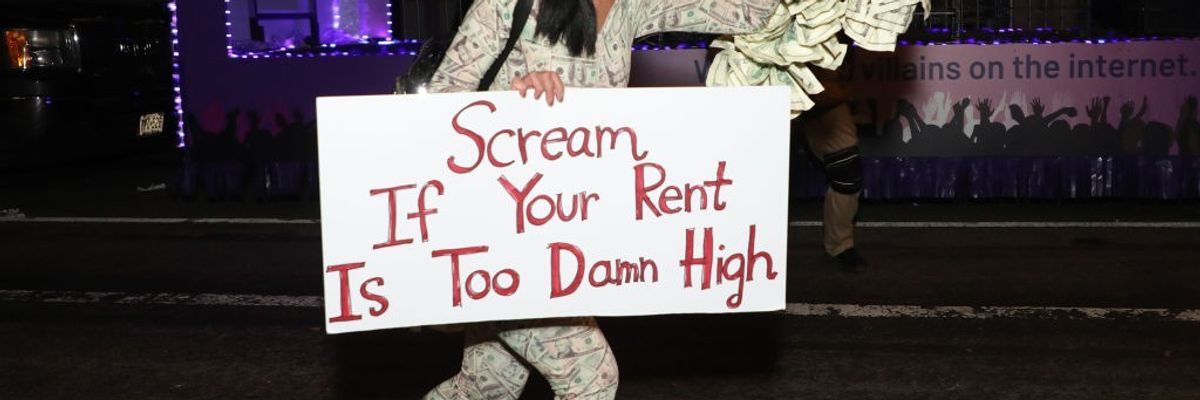
A reveler roller skates with a sign reading, “Scream If Your Rent Is Too Damn High” at the 2022 Halloween Parade on October 31, 2022 in New York City.
If they can’t sleep inside because they’re homeless, and now the Supreme Court forbids them to sleep outside, then where in the world can they sleep?
The homeless problem in America is not funny. It’s serious and apparently growing. It helps little to call people “unhoused” instead of homeless. Under either name, they’re still on the street and need shelter.
But I got a belly laugh recently when it was announced that the reactionary U.S. Supreme Court has solemnly ruled that homeless people could not sleep outside. That struck me as funny. If they can’t sleep inside because they’re homeless, and now the Supreme Court forbids them to sleep outside, then where in the world can they sleep? People have to be somewhere, either inside or outside.
Then I realized it’s not a laughing matter after all. Because of the Supreme Court’s decision, officials in California, Oregon, and several Western states are now moving quickly to force people off the streets and into city shelters. If they don’t have a place to sleep, they have decreed, they must be rounded up like sheep and put into official sheepfolds.
Can Americans summon the compassion for their fellow citizens—for the estimated 650,000 men, women, and children in the U.S. who are currently homeless—to seek a lasting solution to this situation?
That makes a certain amount of sense, and seems to be compassionate, but it isn’t. First, there aren’t enough shelters. Then the cost to city and state budgets is sure to be high. Under this ruling, people become pawns of the civic authorities. When they resist they’re inevitably treated roughly by police, who don’t like herding people instead of fighting crime.
Now California Gov. Gavin Newsom, a possible vice presidential candidate, has announced that the California state police must become involved in rounding up the homeless. What a brilliant move—a bit like the slogan, “Whippings will continue until morale improves.”
But there’s a more sober—even ominous—dimension to this issue. We are all protected by the Eighth Amendment to the Constitution in our Bill of Rights, which forbids cruel and unusual punishment. Under the legal implications of this decision, that right has now been taken away from all the rest of us.
The MAGA-tilted U.S. Supreme Court’s ruling in the case filed by the town of Grants Pass, Oregon, was that homeless people—(who can’t sleep inside because they have no home) have no right to sleep outside either. The court said that forcing them into state or city-run shelters is not cruel and inhumane. What does that mean for them—or for us, if we find ourselves in that perilous condition? We just can’t sleep anywhere we choose. One of our rights has been taken away.
I have a friend who rebuked me for giving money to beggars and the “unhoused” homeless. He said, “There are plenty of government programs and service agencies dedicated to helping those people.” I inquired further and found that there is no “one size fits all” solution when it comes to the indigent. People on the street face multiple problems in getting appropriate aid. Each person has his or her own story to tell. “One size fits all” is not an appropriate answer.
What’s needed is more money to address the problems these people are facing. That includes counseling, better healthcare, adequate social security payments, improved socialization activities, opportunities for useful employment, and above all neighborly treatment. Each person is a child, brother, sister, spouse, parent, or grandparent—“somebody’s darling”—after all. For our own sake as well as theirs, let’s not allow public policy to strip them of their remaining shreds of human dignity.
Can Americans summon the compassion for their fellow citizens—for the estimated 650,000 men, women, and children in the U.S. who are currently homeless—to seek a lasting solution to this situation? Doing so is timely—and requisite for our own humanity.
Dear Common Dreams reader, It’s been nearly 30 years since I co-founded Common Dreams with my late wife, Lina Newhouser. We had the radical notion that journalism should serve the public good, not corporate profits. It was clear to us from the outset what it would take to build such a project. No paid advertisements. No corporate sponsors. No millionaire publisher telling us what to think or do. Many people said we wouldn't last a year, but we proved those doubters wrong. Together with a tremendous team of journalists and dedicated staff, we built an independent media outlet free from the constraints of profits and corporate control. Our mission has always been simple: To inform. To inspire. To ignite change for the common good. Building Common Dreams was not easy. Our survival was never guaranteed. When you take on the most powerful forces—Wall Street greed, fossil fuel industry destruction, Big Tech lobbyists, and uber-rich oligarchs who have spent billions upon billions rigging the economy and democracy in their favor—the only bulwark you have is supporters who believe in your work. But here’s the urgent message from me today. It's never been this bad out there. And it's never been this hard to keep us going. At the very moment Common Dreams is most needed, the threats we face are intensifying. We need your support now more than ever. We don't accept corporate advertising and never will. We don't have a paywall because we don't think people should be blocked from critical news based on their ability to pay. Everything we do is funded by the donations of readers like you. When everyone does the little they can afford, we are strong. But if that support retreats or dries up, so do we. Will you donate now to make sure Common Dreams not only survives but thrives? —Craig Brown, Co-founder |
The homeless problem in America is not funny. It’s serious and apparently growing. It helps little to call people “unhoused” instead of homeless. Under either name, they’re still on the street and need shelter.
But I got a belly laugh recently when it was announced that the reactionary U.S. Supreme Court has solemnly ruled that homeless people could not sleep outside. That struck me as funny. If they can’t sleep inside because they’re homeless, and now the Supreme Court forbids them to sleep outside, then where in the world can they sleep? People have to be somewhere, either inside or outside.
Then I realized it’s not a laughing matter after all. Because of the Supreme Court’s decision, officials in California, Oregon, and several Western states are now moving quickly to force people off the streets and into city shelters. If they don’t have a place to sleep, they have decreed, they must be rounded up like sheep and put into official sheepfolds.
Can Americans summon the compassion for their fellow citizens—for the estimated 650,000 men, women, and children in the U.S. who are currently homeless—to seek a lasting solution to this situation?
That makes a certain amount of sense, and seems to be compassionate, but it isn’t. First, there aren’t enough shelters. Then the cost to city and state budgets is sure to be high. Under this ruling, people become pawns of the civic authorities. When they resist they’re inevitably treated roughly by police, who don’t like herding people instead of fighting crime.
Now California Gov. Gavin Newsom, a possible vice presidential candidate, has announced that the California state police must become involved in rounding up the homeless. What a brilliant move—a bit like the slogan, “Whippings will continue until morale improves.”
But there’s a more sober—even ominous—dimension to this issue. We are all protected by the Eighth Amendment to the Constitution in our Bill of Rights, which forbids cruel and unusual punishment. Under the legal implications of this decision, that right has now been taken away from all the rest of us.
The MAGA-tilted U.S. Supreme Court’s ruling in the case filed by the town of Grants Pass, Oregon, was that homeless people—(who can’t sleep inside because they have no home) have no right to sleep outside either. The court said that forcing them into state or city-run shelters is not cruel and inhumane. What does that mean for them—or for us, if we find ourselves in that perilous condition? We just can’t sleep anywhere we choose. One of our rights has been taken away.
I have a friend who rebuked me for giving money to beggars and the “unhoused” homeless. He said, “There are plenty of government programs and service agencies dedicated to helping those people.” I inquired further and found that there is no “one size fits all” solution when it comes to the indigent. People on the street face multiple problems in getting appropriate aid. Each person has his or her own story to tell. “One size fits all” is not an appropriate answer.
What’s needed is more money to address the problems these people are facing. That includes counseling, better healthcare, adequate social security payments, improved socialization activities, opportunities for useful employment, and above all neighborly treatment. Each person is a child, brother, sister, spouse, parent, or grandparent—“somebody’s darling”—after all. For our own sake as well as theirs, let’s not allow public policy to strip them of their remaining shreds of human dignity.
Can Americans summon the compassion for their fellow citizens—for the estimated 650,000 men, women, and children in the U.S. who are currently homeless—to seek a lasting solution to this situation? Doing so is timely—and requisite for our own humanity.
The homeless problem in America is not funny. It’s serious and apparently growing. It helps little to call people “unhoused” instead of homeless. Under either name, they’re still on the street and need shelter.
But I got a belly laugh recently when it was announced that the reactionary U.S. Supreme Court has solemnly ruled that homeless people could not sleep outside. That struck me as funny. If they can’t sleep inside because they’re homeless, and now the Supreme Court forbids them to sleep outside, then where in the world can they sleep? People have to be somewhere, either inside or outside.
Then I realized it’s not a laughing matter after all. Because of the Supreme Court’s decision, officials in California, Oregon, and several Western states are now moving quickly to force people off the streets and into city shelters. If they don’t have a place to sleep, they have decreed, they must be rounded up like sheep and put into official sheepfolds.
Can Americans summon the compassion for their fellow citizens—for the estimated 650,000 men, women, and children in the U.S. who are currently homeless—to seek a lasting solution to this situation?
That makes a certain amount of sense, and seems to be compassionate, but it isn’t. First, there aren’t enough shelters. Then the cost to city and state budgets is sure to be high. Under this ruling, people become pawns of the civic authorities. When they resist they’re inevitably treated roughly by police, who don’t like herding people instead of fighting crime.
Now California Gov. Gavin Newsom, a possible vice presidential candidate, has announced that the California state police must become involved in rounding up the homeless. What a brilliant move—a bit like the slogan, “Whippings will continue until morale improves.”
But there’s a more sober—even ominous—dimension to this issue. We are all protected by the Eighth Amendment to the Constitution in our Bill of Rights, which forbids cruel and unusual punishment. Under the legal implications of this decision, that right has now been taken away from all the rest of us.
The MAGA-tilted U.S. Supreme Court’s ruling in the case filed by the town of Grants Pass, Oregon, was that homeless people—(who can’t sleep inside because they have no home) have no right to sleep outside either. The court said that forcing them into state or city-run shelters is not cruel and inhumane. What does that mean for them—or for us, if we find ourselves in that perilous condition? We just can’t sleep anywhere we choose. One of our rights has been taken away.
I have a friend who rebuked me for giving money to beggars and the “unhoused” homeless. He said, “There are plenty of government programs and service agencies dedicated to helping those people.” I inquired further and found that there is no “one size fits all” solution when it comes to the indigent. People on the street face multiple problems in getting appropriate aid. Each person has his or her own story to tell. “One size fits all” is not an appropriate answer.
What’s needed is more money to address the problems these people are facing. That includes counseling, better healthcare, adequate social security payments, improved socialization activities, opportunities for useful employment, and above all neighborly treatment. Each person is a child, brother, sister, spouse, parent, or grandparent—“somebody’s darling”—after all. For our own sake as well as theirs, let’s not allow public policy to strip them of their remaining shreds of human dignity.
Can Americans summon the compassion for their fellow citizens—for the estimated 650,000 men, women, and children in the U.S. who are currently homeless—to seek a lasting solution to this situation? Doing so is timely—and requisite for our own humanity.