SUBSCRIBE TO OUR FREE NEWSLETTER
Daily news & progressive opinion—funded by the people, not the corporations—delivered straight to your inbox.
5
#000000
#FFFFFF
To donate by check, phone, or other method, see our More Ways to Give page.
Daily news & progressive opinion—funded by the people, not the corporations—delivered straight to your inbox.
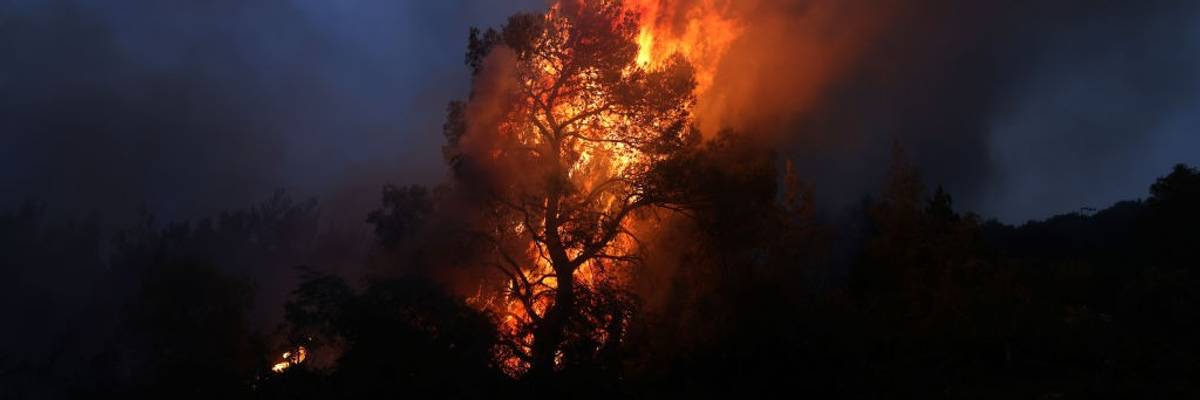
A tree burns during a wildfire in the town of Palaiochori near Athens, Greece, on July 20, 2023.
“We need to hold governments to start to act sensibly now and reduce emissions,” one expert said.
As leading climate scientists watch the devastating, breakneck speed of unfolding climate disasters unfolding across the globe—from record soaring temperatures to catastrophic flooding—many are aghast at how rapidly their worst predictions are being now being played out in real-time.
Some are also now admitting that they might well have underestimated the speed and scale of our impending climate crisis and how bad things could get.
This is deeply ironic because, for years, those scientists who sounded the alarm over climate change were attacked by the oil industry or their funded front groups for exaggerating or playing “chicken little.”
“The research community must be brutally honest. We are on a pathway to 2-3°C, and probably closer to the upper end of that range.”
But now some of the most senior climate scientists on the planet are speaking out about their concerns.
Speaking to the BBC Thursday morning, Sir Bob Watson, who is currently emeritus professor of the UK’s Tyndall Centre for Climate and former chair of the Intergovernmental Panel on Climate Change, said, “I am very concerned. None of the observed changes so far (at +1.2°C) are surprising. But they are more severe than we predicted. We probably underestimated the consequences.”
He added “The research community must be brutally honest. We are on a pathway to 2-3°C, and probably closer to the upper end of that range. We are likely to pass 1.5°C in the mid-2030’s and 2°C around 2060. Current pledges and the policies needed them are totally inadequate.”
As the BBC notes, although Watson’s “comments are candid on the state of action on climate change, many of his colleagues will agree with his conclusion that we are on course for a temperature rise of 2.5°C or more.”
And Watson’s colleagues do concur. Ellen Thomas, a Yale University scientist who studies climate change told TheGuardian “It’s not just the magnitude of change, it’s the rate of change that’s an issue.”
Thomas added: “We have highways and railroads that are set in place, our infrastructure can’t move. Almost all my colleagues have said that, in hindsight, we have underestimated the consequences. Things are moving faster than we thought, which is not good.”
Other leading scientists agree too:
Meanwhile, others are being candid that nothing will change until we reduce our use of fossil fuels. “I’ve been expecting this for 20 years,” Professor Camille Parmesan, from the National Center for Scientific Research and an Intergovernmental Panel on Climate Change report author, told Bloomberg. “This is just going to keep happening given that we’re not reducing emissions.”
Speaking to The Guardian, James Hansen, often seen as the Godfather of climate science, warned we are hurtling towards a superheated climate because “we are damned fools” for not acting sooner. “We have to taste it to believe it.”
He told The Guardian: “There’s a lot more in the pipeline, unless we reduce the greenhouse gas amounts. These superstorms are a taste of the storms of my grandchildren. We are headed wittingly into the new reality—we knew it was coming.”'
“The climate crisis is in the main a fossil fuel crisis.”
“This does not mean that the extreme heat at a particular place this year will recur and grow each year,” he continued. “Weather fluctuations move things around. But the global average temperature will go up and the climate dice will be more and more loaded, including more extreme events.”
In a so far unpeer-reviewed scientific paper, Hansen and colleagues said: “It seems that we are headed into a new frontier of global climate,” one not seen for millions of years.
They warn: “As long as more energy is coming in than going out, we must expect global warming to continue.”
Al Gore is another who is alarmed by what they are witnessing: “Everywhere you look in the world, the extremes have now seemingly reached a new level,” he told The New York Times in an interview. “The temperatures in the North Atlantic and the unprecedented decline of the Antarctic sea ice, both simultaneously. We see it in upstate New York, we see it in Vermont, we see it in southern Japan, we see it in India. We see it in the unprecedented drought in Uruguay and in Argentina.”
“The climate crisis is in the main a fossil fuel crisis,” Gore added. “If the world is not permitted to discuss the phasing down of fossil fuels because the fossil fuel companies don’t want the world to discuss it, that’s the sign of a very flawed process.”
But it’s not too late to act. As Watson said: “We need to hold governments to start to act sensibly now and reduce emissions.” And its not just governments. It’s the oil industry, too; as Gore points out, this is a fossil fuel crisis. Created by the fossil fuel industry. Because their decades-old public relations strategy of denying the evidence, spreading doubt, and delaying action is the reason our world is on fire right now.
Dear Common Dreams reader, It’s been nearly 30 years since I co-founded Common Dreams with my late wife, Lina Newhouser. We had the radical notion that journalism should serve the public good, not corporate profits. It was clear to us from the outset what it would take to build such a project. No paid advertisements. No corporate sponsors. No millionaire publisher telling us what to think or do. Many people said we wouldn't last a year, but we proved those doubters wrong. Together with a tremendous team of journalists and dedicated staff, we built an independent media outlet free from the constraints of profits and corporate control. Our mission has always been simple: To inform. To inspire. To ignite change for the common good. Building Common Dreams was not easy. Our survival was never guaranteed. When you take on the most powerful forces—Wall Street greed, fossil fuel industry destruction, Big Tech lobbyists, and uber-rich oligarchs who have spent billions upon billions rigging the economy and democracy in their favor—the only bulwark you have is supporters who believe in your work. But here’s the urgent message from me today. It's never been this bad out there. And it's never been this hard to keep us going. At the very moment Common Dreams is most needed, the threats we face are intensifying. We need your support now more than ever. We don't accept corporate advertising and never will. We don't have a paywall because we don't think people should be blocked from critical news based on their ability to pay. Everything we do is funded by the donations of readers like you. When everyone does the little they can afford, we are strong. But if that support retreats or dries up, so do we. Will you donate now to make sure Common Dreams not only survives but thrives? —Craig Brown, Co-founder |
As leading climate scientists watch the devastating, breakneck speed of unfolding climate disasters unfolding across the globe—from record soaring temperatures to catastrophic flooding—many are aghast at how rapidly their worst predictions are being now being played out in real-time.
Some are also now admitting that they might well have underestimated the speed and scale of our impending climate crisis and how bad things could get.
This is deeply ironic because, for years, those scientists who sounded the alarm over climate change were attacked by the oil industry or their funded front groups for exaggerating or playing “chicken little.”
“The research community must be brutally honest. We are on a pathway to 2-3°C, and probably closer to the upper end of that range.”
But now some of the most senior climate scientists on the planet are speaking out about their concerns.
Speaking to the BBC Thursday morning, Sir Bob Watson, who is currently emeritus professor of the UK’s Tyndall Centre for Climate and former chair of the Intergovernmental Panel on Climate Change, said, “I am very concerned. None of the observed changes so far (at +1.2°C) are surprising. But they are more severe than we predicted. We probably underestimated the consequences.”
He added “The research community must be brutally honest. We are on a pathway to 2-3°C, and probably closer to the upper end of that range. We are likely to pass 1.5°C in the mid-2030’s and 2°C around 2060. Current pledges and the policies needed them are totally inadequate.”
As the BBC notes, although Watson’s “comments are candid on the state of action on climate change, many of his colleagues will agree with his conclusion that we are on course for a temperature rise of 2.5°C or more.”
And Watson’s colleagues do concur. Ellen Thomas, a Yale University scientist who studies climate change told TheGuardian “It’s not just the magnitude of change, it’s the rate of change that’s an issue.”
Thomas added: “We have highways and railroads that are set in place, our infrastructure can’t move. Almost all my colleagues have said that, in hindsight, we have underestimated the consequences. Things are moving faster than we thought, which is not good.”
Other leading scientists agree too:
Meanwhile, others are being candid that nothing will change until we reduce our use of fossil fuels. “I’ve been expecting this for 20 years,” Professor Camille Parmesan, from the National Center for Scientific Research and an Intergovernmental Panel on Climate Change report author, told Bloomberg. “This is just going to keep happening given that we’re not reducing emissions.”
Speaking to The Guardian, James Hansen, often seen as the Godfather of climate science, warned we are hurtling towards a superheated climate because “we are damned fools” for not acting sooner. “We have to taste it to believe it.”
He told The Guardian: “There’s a lot more in the pipeline, unless we reduce the greenhouse gas amounts. These superstorms are a taste of the storms of my grandchildren. We are headed wittingly into the new reality—we knew it was coming.”'
“The climate crisis is in the main a fossil fuel crisis.”
“This does not mean that the extreme heat at a particular place this year will recur and grow each year,” he continued. “Weather fluctuations move things around. But the global average temperature will go up and the climate dice will be more and more loaded, including more extreme events.”
In a so far unpeer-reviewed scientific paper, Hansen and colleagues said: “It seems that we are headed into a new frontier of global climate,” one not seen for millions of years.
They warn: “As long as more energy is coming in than going out, we must expect global warming to continue.”
Al Gore is another who is alarmed by what they are witnessing: “Everywhere you look in the world, the extremes have now seemingly reached a new level,” he told The New York Times in an interview. “The temperatures in the North Atlantic and the unprecedented decline of the Antarctic sea ice, both simultaneously. We see it in upstate New York, we see it in Vermont, we see it in southern Japan, we see it in India. We see it in the unprecedented drought in Uruguay and in Argentina.”
“The climate crisis is in the main a fossil fuel crisis,” Gore added. “If the world is not permitted to discuss the phasing down of fossil fuels because the fossil fuel companies don’t want the world to discuss it, that’s the sign of a very flawed process.”
But it’s not too late to act. As Watson said: “We need to hold governments to start to act sensibly now and reduce emissions.” And its not just governments. It’s the oil industry, too; as Gore points out, this is a fossil fuel crisis. Created by the fossil fuel industry. Because their decades-old public relations strategy of denying the evidence, spreading doubt, and delaying action is the reason our world is on fire right now.
As leading climate scientists watch the devastating, breakneck speed of unfolding climate disasters unfolding across the globe—from record soaring temperatures to catastrophic flooding—many are aghast at how rapidly their worst predictions are being now being played out in real-time.
Some are also now admitting that they might well have underestimated the speed and scale of our impending climate crisis and how bad things could get.
This is deeply ironic because, for years, those scientists who sounded the alarm over climate change were attacked by the oil industry or their funded front groups for exaggerating or playing “chicken little.”
“The research community must be brutally honest. We are on a pathway to 2-3°C, and probably closer to the upper end of that range.”
But now some of the most senior climate scientists on the planet are speaking out about their concerns.
Speaking to the BBC Thursday morning, Sir Bob Watson, who is currently emeritus professor of the UK’s Tyndall Centre for Climate and former chair of the Intergovernmental Panel on Climate Change, said, “I am very concerned. None of the observed changes so far (at +1.2°C) are surprising. But they are more severe than we predicted. We probably underestimated the consequences.”
He added “The research community must be brutally honest. We are on a pathway to 2-3°C, and probably closer to the upper end of that range. We are likely to pass 1.5°C in the mid-2030’s and 2°C around 2060. Current pledges and the policies needed them are totally inadequate.”
As the BBC notes, although Watson’s “comments are candid on the state of action on climate change, many of his colleagues will agree with his conclusion that we are on course for a temperature rise of 2.5°C or more.”
And Watson’s colleagues do concur. Ellen Thomas, a Yale University scientist who studies climate change told TheGuardian “It’s not just the magnitude of change, it’s the rate of change that’s an issue.”
Thomas added: “We have highways and railroads that are set in place, our infrastructure can’t move. Almost all my colleagues have said that, in hindsight, we have underestimated the consequences. Things are moving faster than we thought, which is not good.”
Other leading scientists agree too:
Meanwhile, others are being candid that nothing will change until we reduce our use of fossil fuels. “I’ve been expecting this for 20 years,” Professor Camille Parmesan, from the National Center for Scientific Research and an Intergovernmental Panel on Climate Change report author, told Bloomberg. “This is just going to keep happening given that we’re not reducing emissions.”
Speaking to The Guardian, James Hansen, often seen as the Godfather of climate science, warned we are hurtling towards a superheated climate because “we are damned fools” for not acting sooner. “We have to taste it to believe it.”
He told The Guardian: “There’s a lot more in the pipeline, unless we reduce the greenhouse gas amounts. These superstorms are a taste of the storms of my grandchildren. We are headed wittingly into the new reality—we knew it was coming.”'
“The climate crisis is in the main a fossil fuel crisis.”
“This does not mean that the extreme heat at a particular place this year will recur and grow each year,” he continued. “Weather fluctuations move things around. But the global average temperature will go up and the climate dice will be more and more loaded, including more extreme events.”
In a so far unpeer-reviewed scientific paper, Hansen and colleagues said: “It seems that we are headed into a new frontier of global climate,” one not seen for millions of years.
They warn: “As long as more energy is coming in than going out, we must expect global warming to continue.”
Al Gore is another who is alarmed by what they are witnessing: “Everywhere you look in the world, the extremes have now seemingly reached a new level,” he told The New York Times in an interview. “The temperatures in the North Atlantic and the unprecedented decline of the Antarctic sea ice, both simultaneously. We see it in upstate New York, we see it in Vermont, we see it in southern Japan, we see it in India. We see it in the unprecedented drought in Uruguay and in Argentina.”
“The climate crisis is in the main a fossil fuel crisis,” Gore added. “If the world is not permitted to discuss the phasing down of fossil fuels because the fossil fuel companies don’t want the world to discuss it, that’s the sign of a very flawed process.”
But it’s not too late to act. As Watson said: “We need to hold governments to start to act sensibly now and reduce emissions.” And its not just governments. It’s the oil industry, too; as Gore points out, this is a fossil fuel crisis. Created by the fossil fuel industry. Because their decades-old public relations strategy of denying the evidence, spreading doubt, and delaying action is the reason our world is on fire right now.