SUBSCRIBE TO OUR FREE NEWSLETTER
Daily news & progressive opinion—funded by the people, not the corporations—delivered straight to your inbox.
5
#000000
#FFFFFF
To donate by check, phone, or other method, see our More Ways to Give page.
Daily news & progressive opinion—funded by the people, not the corporations—delivered straight to your inbox.
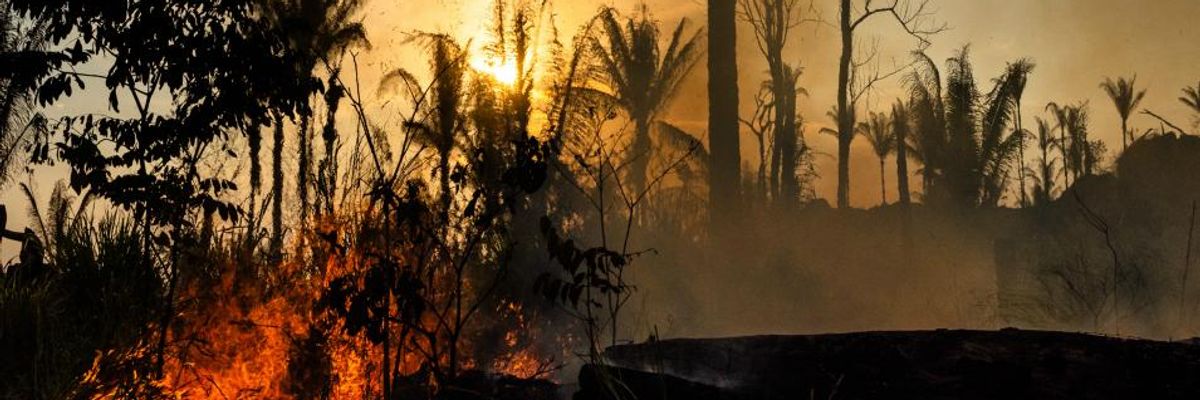
Amazon forest area is burned in rural Novo Progresso north of Brazil on Thursday, August 28, 2019. (Photo: Gustavo Basso/NurPhoto via Getty Images)
New climate models unveiled by French researchers Tuesday showed Earth's average temperature could rise a "terrifying" 6.5-7.0degC above pre-industrial levels by the end of the century if dramatic action is not immediately taken to slash carbon emissions.
The findings, presented at a press conference in Paris, suggest the planet may be warming significantly faster than scientists previously believed as the world's major economies continue to burn fossil fuels at unsustainable rates.
"Unfortunately, our global failure to implement meaningful action on climate change over recent decades has put us in a situation where what we need to do to keep warming to safe levels is extremely simple," Joeri Rogelj, an associate professor at Imperial College London, told AFP. "Global greenhouse gas emissions need to decline today rather than tomorrow, and global CO2 emissions should be brought to net zero."
The new models are expected to form part of the U.N. Intergovernmental Panel on Climate Change's Sixth Assessment Report, which is set to be published in 2021. The IPCC's Fifth Assessment Report, published in 2014, presented a worst-case scenario of five degrees Celsius of warming by the end of the century.
Olivier Boucher, head of the Institute Pierre Simon Laplace Climate Modeling Center in Paris, which developed one of the new models, said the latest data provide a better look at where the climate is heading without drastic changes to global energy production.
"We have better models now," Boucher told AFP on Tuesday. "They have better resolution, and they represent current climate trends more accurately."
Bloomberg reported that just "one of the updated climate models used by the researchers allowed for the global temperature increase to remain below 2degC by the end of the century." That model assumed global carbon neutrality by 2060.
The worst-case scenario of 6.5-7.0degC of warming assumed continued economic expansion driven by growth of fossil fuel production.
The IPCC warned last year that even limiting planetary warming to 1.5degC by the end of the century, the goal of the Paris Climate Agreement, would not prevent many of the disastrous effects of the climate crisis. Warming of 6.5-7.0degC would be catastrophic.
"Higher warming would allow less time to adapt and mean a greater likelihood of passing climate 'tipping points' such as thawing of permafrost, which would further accelerate warming," said Boucher.
In an email to Common Dreams, Penn State University climate scientist Michael E. Mann sounded a note of caution about the dire scenarios predicted by the new models.
"Some earlier versions of the models appeared to underestimate climate sensitivity somewhat," said Mann, "and I suspect that some of these more recent versions are actually over-estimating it a bit."
"I suspect, when all is said and done, we're probably looking at something in the range of 3-4degC and no higher, at least for near-term warming," Mann added. "If we allow the warm[ing] to persist for centuries, then other long-term positive feedbacks (vicious cycles) could kick in, giving us substantially more warming."
Dear Common Dreams reader, It’s been nearly 30 years since I co-founded Common Dreams with my late wife, Lina Newhouser. We had the radical notion that journalism should serve the public good, not corporate profits. It was clear to us from the outset what it would take to build such a project. No paid advertisements. No corporate sponsors. No millionaire publisher telling us what to think or do. Many people said we wouldn't last a year, but we proved those doubters wrong. Together with a tremendous team of journalists and dedicated staff, we built an independent media outlet free from the constraints of profits and corporate control. Our mission has always been simple: To inform. To inspire. To ignite change for the common good. Building Common Dreams was not easy. Our survival was never guaranteed. When you take on the most powerful forces—Wall Street greed, fossil fuel industry destruction, Big Tech lobbyists, and uber-rich oligarchs who have spent billions upon billions rigging the economy and democracy in their favor—the only bulwark you have is supporters who believe in your work. But here’s the urgent message from me today. It's never been this bad out there. And it's never been this hard to keep us going. At the very moment Common Dreams is most needed, the threats we face are intensifying. We need your support now more than ever. We don't accept corporate advertising and never will. We don't have a paywall because we don't think people should be blocked from critical news based on their ability to pay. Everything we do is funded by the donations of readers like you. When everyone does the little they can afford, we are strong. But if that support retreats or dries up, so do we. Will you donate now to make sure Common Dreams not only survives but thrives? —Craig Brown, Co-founder |
New climate models unveiled by French researchers Tuesday showed Earth's average temperature could rise a "terrifying" 6.5-7.0degC above pre-industrial levels by the end of the century if dramatic action is not immediately taken to slash carbon emissions.
The findings, presented at a press conference in Paris, suggest the planet may be warming significantly faster than scientists previously believed as the world's major economies continue to burn fossil fuels at unsustainable rates.
"Unfortunately, our global failure to implement meaningful action on climate change over recent decades has put us in a situation where what we need to do to keep warming to safe levels is extremely simple," Joeri Rogelj, an associate professor at Imperial College London, told AFP. "Global greenhouse gas emissions need to decline today rather than tomorrow, and global CO2 emissions should be brought to net zero."
The new models are expected to form part of the U.N. Intergovernmental Panel on Climate Change's Sixth Assessment Report, which is set to be published in 2021. The IPCC's Fifth Assessment Report, published in 2014, presented a worst-case scenario of five degrees Celsius of warming by the end of the century.
Olivier Boucher, head of the Institute Pierre Simon Laplace Climate Modeling Center in Paris, which developed one of the new models, said the latest data provide a better look at where the climate is heading without drastic changes to global energy production.
"We have better models now," Boucher told AFP on Tuesday. "They have better resolution, and they represent current climate trends more accurately."
Bloomberg reported that just "one of the updated climate models used by the researchers allowed for the global temperature increase to remain below 2degC by the end of the century." That model assumed global carbon neutrality by 2060.
The worst-case scenario of 6.5-7.0degC of warming assumed continued economic expansion driven by growth of fossil fuel production.
The IPCC warned last year that even limiting planetary warming to 1.5degC by the end of the century, the goal of the Paris Climate Agreement, would not prevent many of the disastrous effects of the climate crisis. Warming of 6.5-7.0degC would be catastrophic.
"Higher warming would allow less time to adapt and mean a greater likelihood of passing climate 'tipping points' such as thawing of permafrost, which would further accelerate warming," said Boucher.
In an email to Common Dreams, Penn State University climate scientist Michael E. Mann sounded a note of caution about the dire scenarios predicted by the new models.
"Some earlier versions of the models appeared to underestimate climate sensitivity somewhat," said Mann, "and I suspect that some of these more recent versions are actually over-estimating it a bit."
"I suspect, when all is said and done, we're probably looking at something in the range of 3-4degC and no higher, at least for near-term warming," Mann added. "If we allow the warm[ing] to persist for centuries, then other long-term positive feedbacks (vicious cycles) could kick in, giving us substantially more warming."
New climate models unveiled by French researchers Tuesday showed Earth's average temperature could rise a "terrifying" 6.5-7.0degC above pre-industrial levels by the end of the century if dramatic action is not immediately taken to slash carbon emissions.
The findings, presented at a press conference in Paris, suggest the planet may be warming significantly faster than scientists previously believed as the world's major economies continue to burn fossil fuels at unsustainable rates.
"Unfortunately, our global failure to implement meaningful action on climate change over recent decades has put us in a situation where what we need to do to keep warming to safe levels is extremely simple," Joeri Rogelj, an associate professor at Imperial College London, told AFP. "Global greenhouse gas emissions need to decline today rather than tomorrow, and global CO2 emissions should be brought to net zero."
The new models are expected to form part of the U.N. Intergovernmental Panel on Climate Change's Sixth Assessment Report, which is set to be published in 2021. The IPCC's Fifth Assessment Report, published in 2014, presented a worst-case scenario of five degrees Celsius of warming by the end of the century.
Olivier Boucher, head of the Institute Pierre Simon Laplace Climate Modeling Center in Paris, which developed one of the new models, said the latest data provide a better look at where the climate is heading without drastic changes to global energy production.
"We have better models now," Boucher told AFP on Tuesday. "They have better resolution, and they represent current climate trends more accurately."
Bloomberg reported that just "one of the updated climate models used by the researchers allowed for the global temperature increase to remain below 2degC by the end of the century." That model assumed global carbon neutrality by 2060.
The worst-case scenario of 6.5-7.0degC of warming assumed continued economic expansion driven by growth of fossil fuel production.
The IPCC warned last year that even limiting planetary warming to 1.5degC by the end of the century, the goal of the Paris Climate Agreement, would not prevent many of the disastrous effects of the climate crisis. Warming of 6.5-7.0degC would be catastrophic.
"Higher warming would allow less time to adapt and mean a greater likelihood of passing climate 'tipping points' such as thawing of permafrost, which would further accelerate warming," said Boucher.
In an email to Common Dreams, Penn State University climate scientist Michael E. Mann sounded a note of caution about the dire scenarios predicted by the new models.
"Some earlier versions of the models appeared to underestimate climate sensitivity somewhat," said Mann, "and I suspect that some of these more recent versions are actually over-estimating it a bit."
"I suspect, when all is said and done, we're probably looking at something in the range of 3-4degC and no higher, at least for near-term warming," Mann added. "If we allow the warm[ing] to persist for centuries, then other long-term positive feedbacks (vicious cycles) could kick in, giving us substantially more warming."