SUBSCRIBE TO OUR FREE NEWSLETTER
Daily news & progressive opinion—funded by the people, not the corporations—delivered straight to your inbox.
5
#000000
#FFFFFF
To donate by check, phone, or other method, see our More Ways to Give page.
Daily news & progressive opinion—funded by the people, not the corporations—delivered straight to your inbox.
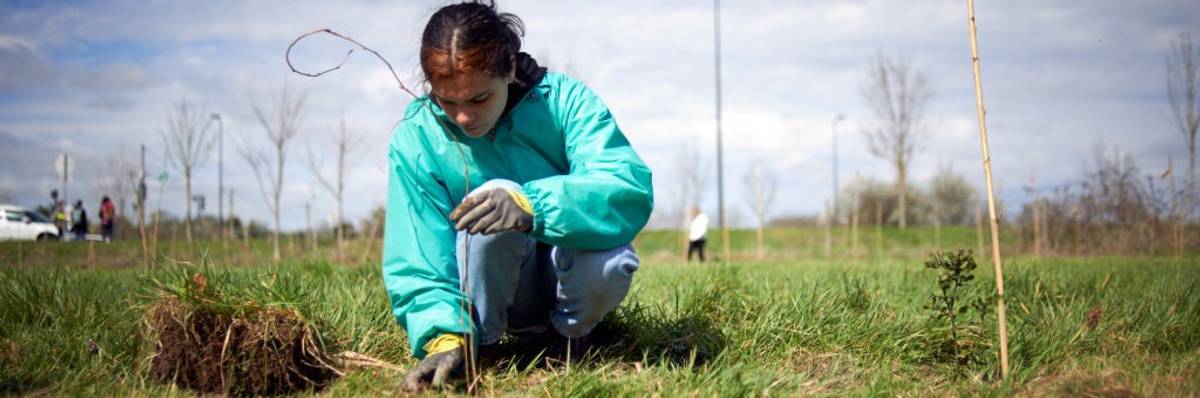
An activist plants a tree in a meadow in Toulouse that has been slated for development.
We are each responsible for acting for ecological justice, today and throughout the year.
Growing up on a small farm in New England, my family was tied to the rhythms of the seasons and the land. We guided our calendar and lives by when to plant tomatoes, harvest corn, and seed the winter rye. The connection to the natural world felt timeless, and the land, ever enduring.
Each summer, Red would show up on our doorstep and stay a few weeks. Red was a giant in my child's eyes, certainly more than six feet tall—and he had a wagon like Professor Marvel in the opening scene of The Wizard of Oz. Red may have been one of the last of the itinerant "rag men" that would go from farm to farm, offering services like repairing pots and pans, fixing farm implements, and telling stories for food and shelter. He always showed up—like the seasons—and we treated him like the friend he was.
Most of all, I remember Red's stories. He would say to me, "The world is a precious place, and we need to take care of it. It needs us to reuse everything, reduce what we use, and cycle as much as we can back to Mother Earth."
Each of us is responsible for enacting change, no matter how large or small the effort.
I didn't have the language then for what he was talking about, but now, I see him as an important figure in my life because he instilled in me a lifelong commitment to change our human relationship to the planet. We simply must do better. I became a teacher, and eventually, a leader in nonprofit and educational organizations dedicated to ecological and social justice values.
Everyone, including the Earth, deserves the fair division of resources, opportunities, privileges and more. Imagine if we could set aside half of the Earth for biodiversity and use the other half to power human society. In 2017, renowned biologist E.O. Wilson proposed this idea in his book, Half-Earth. Furthermore, what if the for-profit sector paid for it? The current planetary generation could ensure the viability of the planet for future generations.
We know from scholarly research that it only takes a small number of people to create the conditions for positive social change. When people take collective action, their communities benefit. We are collecting stories this year, but more importantly, we are showing the impact that our students, alums, faculty, staff, Trustees, and other stakeholders have on their own communities. Like the butterfly effect, even small actions can have a large impact.
Fielding Graduate University acts to secure the sustainability of our biodiverse ecosystem, health equity, society, and culture. Fielding was founded in Santa Barbara 49 years ago upon the idea that graduate education can be a vehicle for positive social change that leads to social and ecological justice. In 2023, the President's Sustainability Advisory Council designated this year as our Fielding Ecological and Social Justice Service Year.
Fielding is also committed to justice, diversity, equity, and inclusion through access and success for our students and, more expansively, to our community partners and colleagues. We believe that we walk together with others and strive for harmony, which means seeking mutual understanding across differences. We specifically affirm and honor our Indigenous communities, both in Fielding's headquarters in Santa Barbara and across the world. We recognize the deep history, ecological knowledge, expansive scholarship, and critical sovereignty of our Indigenous peoples.
Our human society is at a moment when we can choose the path that honors both our ancestors and descendants. Each of us is responsible for enacting change, no matter how large or small the effort. We know that simple changes can significantly reduce our impact, and, cumulatively, give the natural cycles around us time to recover. Reduce the amount of meat you eat, reduce your own food waste, fly less, buy less, re-use more. It's not complicated.
On this Earth Day, I encourage you to act. Participate in a cleanup in your community, create a natural lawn, participate in a neighborhood bird count, plant a tree. You could also volunteer for any nonprofit organization.
As for Fielding, we remain steadfast in our resolve for ecological and social justice so we can leave the world in a better place than we found it. Like Red and so many others before us, I invite you to do the same.
Dear Common Dreams reader, It’s been nearly 30 years since I co-founded Common Dreams with my late wife, Lina Newhouser. We had the radical notion that journalism should serve the public good, not corporate profits. It was clear to us from the outset what it would take to build such a project. No paid advertisements. No corporate sponsors. No millionaire publisher telling us what to think or do. Many people said we wouldn't last a year, but we proved those doubters wrong. Together with a tremendous team of journalists and dedicated staff, we built an independent media outlet free from the constraints of profits and corporate control. Our mission has always been simple: To inform. To inspire. To ignite change for the common good. Building Common Dreams was not easy. Our survival was never guaranteed. When you take on the most powerful forces—Wall Street greed, fossil fuel industry destruction, Big Tech lobbyists, and uber-rich oligarchs who have spent billions upon billions rigging the economy and democracy in their favor—the only bulwark you have is supporters who believe in your work. But here’s the urgent message from me today. It's never been this bad out there. And it's never been this hard to keep us going. At the very moment Common Dreams is most needed, the threats we face are intensifying. We need your support now more than ever. We don't accept corporate advertising and never will. We don't have a paywall because we don't think people should be blocked from critical news based on their ability to pay. Everything we do is funded by the donations of readers like you. When everyone does the little they can afford, we are strong. But if that support retreats or dries up, so do we. Will you donate now to make sure Common Dreams not only survives but thrives? —Craig Brown, Co-founder |
Growing up on a small farm in New England, my family was tied to the rhythms of the seasons and the land. We guided our calendar and lives by when to plant tomatoes, harvest corn, and seed the winter rye. The connection to the natural world felt timeless, and the land, ever enduring.
Each summer, Red would show up on our doorstep and stay a few weeks. Red was a giant in my child's eyes, certainly more than six feet tall—and he had a wagon like Professor Marvel in the opening scene of The Wizard of Oz. Red may have been one of the last of the itinerant "rag men" that would go from farm to farm, offering services like repairing pots and pans, fixing farm implements, and telling stories for food and shelter. He always showed up—like the seasons—and we treated him like the friend he was.
Most of all, I remember Red's stories. He would say to me, "The world is a precious place, and we need to take care of it. It needs us to reuse everything, reduce what we use, and cycle as much as we can back to Mother Earth."
Each of us is responsible for enacting change, no matter how large or small the effort.
I didn't have the language then for what he was talking about, but now, I see him as an important figure in my life because he instilled in me a lifelong commitment to change our human relationship to the planet. We simply must do better. I became a teacher, and eventually, a leader in nonprofit and educational organizations dedicated to ecological and social justice values.
Everyone, including the Earth, deserves the fair division of resources, opportunities, privileges and more. Imagine if we could set aside half of the Earth for biodiversity and use the other half to power human society. In 2017, renowned biologist E.O. Wilson proposed this idea in his book, Half-Earth. Furthermore, what if the for-profit sector paid for it? The current planetary generation could ensure the viability of the planet for future generations.
We know from scholarly research that it only takes a small number of people to create the conditions for positive social change. When people take collective action, their communities benefit. We are collecting stories this year, but more importantly, we are showing the impact that our students, alums, faculty, staff, Trustees, and other stakeholders have on their own communities. Like the butterfly effect, even small actions can have a large impact.
Fielding Graduate University acts to secure the sustainability of our biodiverse ecosystem, health equity, society, and culture. Fielding was founded in Santa Barbara 49 years ago upon the idea that graduate education can be a vehicle for positive social change that leads to social and ecological justice. In 2023, the President's Sustainability Advisory Council designated this year as our Fielding Ecological and Social Justice Service Year.
Fielding is also committed to justice, diversity, equity, and inclusion through access and success for our students and, more expansively, to our community partners and colleagues. We believe that we walk together with others and strive for harmony, which means seeking mutual understanding across differences. We specifically affirm and honor our Indigenous communities, both in Fielding's headquarters in Santa Barbara and across the world. We recognize the deep history, ecological knowledge, expansive scholarship, and critical sovereignty of our Indigenous peoples.
Our human society is at a moment when we can choose the path that honors both our ancestors and descendants. Each of us is responsible for enacting change, no matter how large or small the effort. We know that simple changes can significantly reduce our impact, and, cumulatively, give the natural cycles around us time to recover. Reduce the amount of meat you eat, reduce your own food waste, fly less, buy less, re-use more. It's not complicated.
On this Earth Day, I encourage you to act. Participate in a cleanup in your community, create a natural lawn, participate in a neighborhood bird count, plant a tree. You could also volunteer for any nonprofit organization.
As for Fielding, we remain steadfast in our resolve for ecological and social justice so we can leave the world in a better place than we found it. Like Red and so many others before us, I invite you to do the same.
Growing up on a small farm in New England, my family was tied to the rhythms of the seasons and the land. We guided our calendar and lives by when to plant tomatoes, harvest corn, and seed the winter rye. The connection to the natural world felt timeless, and the land, ever enduring.
Each summer, Red would show up on our doorstep and stay a few weeks. Red was a giant in my child's eyes, certainly more than six feet tall—and he had a wagon like Professor Marvel in the opening scene of The Wizard of Oz. Red may have been one of the last of the itinerant "rag men" that would go from farm to farm, offering services like repairing pots and pans, fixing farm implements, and telling stories for food and shelter. He always showed up—like the seasons—and we treated him like the friend he was.
Most of all, I remember Red's stories. He would say to me, "The world is a precious place, and we need to take care of it. It needs us to reuse everything, reduce what we use, and cycle as much as we can back to Mother Earth."
Each of us is responsible for enacting change, no matter how large or small the effort.
I didn't have the language then for what he was talking about, but now, I see him as an important figure in my life because he instilled in me a lifelong commitment to change our human relationship to the planet. We simply must do better. I became a teacher, and eventually, a leader in nonprofit and educational organizations dedicated to ecological and social justice values.
Everyone, including the Earth, deserves the fair division of resources, opportunities, privileges and more. Imagine if we could set aside half of the Earth for biodiversity and use the other half to power human society. In 2017, renowned biologist E.O. Wilson proposed this idea in his book, Half-Earth. Furthermore, what if the for-profit sector paid for it? The current planetary generation could ensure the viability of the planet for future generations.
We know from scholarly research that it only takes a small number of people to create the conditions for positive social change. When people take collective action, their communities benefit. We are collecting stories this year, but more importantly, we are showing the impact that our students, alums, faculty, staff, Trustees, and other stakeholders have on their own communities. Like the butterfly effect, even small actions can have a large impact.
Fielding Graduate University acts to secure the sustainability of our biodiverse ecosystem, health equity, society, and culture. Fielding was founded in Santa Barbara 49 years ago upon the idea that graduate education can be a vehicle for positive social change that leads to social and ecological justice. In 2023, the President's Sustainability Advisory Council designated this year as our Fielding Ecological and Social Justice Service Year.
Fielding is also committed to justice, diversity, equity, and inclusion through access and success for our students and, more expansively, to our community partners and colleagues. We believe that we walk together with others and strive for harmony, which means seeking mutual understanding across differences. We specifically affirm and honor our Indigenous communities, both in Fielding's headquarters in Santa Barbara and across the world. We recognize the deep history, ecological knowledge, expansive scholarship, and critical sovereignty of our Indigenous peoples.
Our human society is at a moment when we can choose the path that honors both our ancestors and descendants. Each of us is responsible for enacting change, no matter how large or small the effort. We know that simple changes can significantly reduce our impact, and, cumulatively, give the natural cycles around us time to recover. Reduce the amount of meat you eat, reduce your own food waste, fly less, buy less, re-use more. It's not complicated.
On this Earth Day, I encourage you to act. Participate in a cleanup in your community, create a natural lawn, participate in a neighborhood bird count, plant a tree. You could also volunteer for any nonprofit organization.
As for Fielding, we remain steadfast in our resolve for ecological and social justice so we can leave the world in a better place than we found it. Like Red and so many others before us, I invite you to do the same.