SUBSCRIBE TO OUR FREE NEWSLETTER
Daily news & progressive opinion—funded by the people, not the corporations—delivered straight to your inbox.
5
#000000
#FFFFFF
To donate by check, phone, or other method, see our More Ways to Give page.
Daily news & progressive opinion—funded by the people, not the corporations—delivered straight to your inbox.
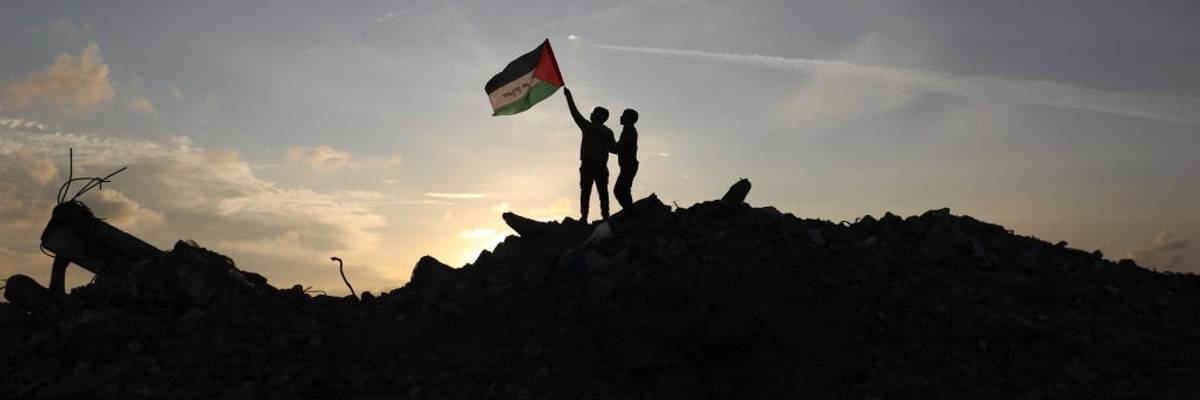
Children hold a Palestinian flag as they stand on rubble while Palestinians in the Bureij Refugee Camp, strive to maintain their routines under challenging conditions, surrounded by destroyed buildings, as the implementation of a cease-fire agreement is anticipated in the coming days in Gaza City, Gaza on January 17, 2025.
Portraying the people of Gaza only as victims may hold Israel accountable for its genocide, but it fails to recognize the agency Palestinians have earned and deserve.
Following every Israeli war on Gaza, numerous narratives emerge. Some claim victory for one side and defeat for the other, while others—knowingly or unknowingly—attempt to exploit the aftermath for their own purposes.
The latter is not always nefarious, as the humanitarian calamities resulting from Israel's actions are undeniable—especially as Israel and its allies often use aid to Palestinians as bargaining chips for political concessions or to exert pressure on the strip and its leadership.
This dynamic often results in the exploitation of Palestinian suffering to raise funds, sometimes by organizations with high overhead costs, leaving independent researchers puzzled over the discrepancies between the funds collected and the funds allocated.
The new narrative must position Gaza as the heart of the Palestinian struggle, as a model for humanity, and as the central path for the liberation of Palestine—which, thanks to Gaza, now seems closer than ever.
Additionally, Gaza lacks an independent commission to track all received funds and their usage, which leads to controversies and public accusations at times.
However, this is a topic for another discussion. The issue at hand here is the portrayal of Gaza's victims—particularly children—without dignity or respect for their privacy, all in the name of helping Palestinian victims.
Throughout the latest Israeli assault on Gaza, the desperation of many Palestinian families, faced with famine and extermination, led them to seek help from international donors, often turning to online donation platforms.
Many of these personal fundraisers were, of course, legitimate, as Gaza was entirely pushed past the point of starvation. Yet, suspicious accounts also appeared, raising money for individuals—real or imagined—who had not sought assistance.
Perhaps future researchers will uncover how Gaza has been exploited by online profiteers and determine how to regulate such practices.
We hesitated to raise this issue during the war, fearing that a single misstep could have dire consequences for an individual or a family. Now that a cease-fire has been signed, it is crucial to open the conversation to scrutiny.
The latest Israeli war on Gaza was not ordinary, but then, no previous wars have been anything but destructive and lethal. For Israel, it was a genocide—a war aimed at exterminating Gaza's population through mass killings and driving the survivors into Egypt.
Thanks to the legendary steadfastness of Gaza's resistance and the unbending spirit of its people, Israel failed. As Israeli writer David K. Rees said, "For the first time, Israel just lost a war"
This is the Gaza that most Palestinians want us to know and remember—a symbol of collective strength and resistance. Their hope is that this message can reverberate around the world, not only to elevate the centrality of Gaza and Palestine in all political discourse but also to inspire oppressed groups globally to fight for their rights unapologetically.
Sadly, though sometimes understandably, that message is not one many are eager to champion.
Many will continue to see Palestinians only as victims. While this narrative may hold Israel accountable for its genocide, it fails to recognize the agency Palestinians have earned and deserve.
However, at times, this viewpoint can be understandable, especially in charitable causes, where the immediate need for aid must be addressed. Yet, it is possible to strike a balance—between meeting the urgent needs of victims and honoring their dignity, resilience, and collective power.
The exploitation of Palestinians, especially their children, as tools for fundraising must end. Gaza's children, many of whom are amputees, should not be paraded in the most degrading manner to appeal to wealthy donors. The world already knows what Israel has done to the Palestinian people—especially the children of Gaza, who suffer the highest rate of child amputations globally.
This is not to deny the suffering. We are proud and humbled by every Palestinian child—whether martyred, injured, amputated, or emotionally scarred. However, instead of portraying them as helpless victims, we must celebrate them as poets, artists, reporters, and representatives of their people.
The time has come for a new narrative, one fundamentally different from those that have emerged in the wake of previous wars. The new narrative must position Gaza as the heart of the Palestinian struggle, as a model for humanity, and as the central path for the liberation of Palestine—which, thanks to Gaza, now seems closer than ever.
To betray this fact is to betray Gaza and all its sacrifices. A victim-only narrative that ignores the larger political context risks undoing the gains made by Palestinian popular resistance in Gaza and inadvertently helping Israel reintroduce a fear-driven discourse. After 15 months of relentless genocide, Israel has failed to instill fear in Gaza's population—and it must not succeed in rebuilding it.
Yes, we must spare no effort to help Gaza rebuild and resume its historical role as the leader of the Palestinian liberation movement. But we must do so with sensitivity, compassion, and above all, respect for Gaza and its unparalleled sacrifices.
Dear Common Dreams reader, It’s been nearly 30 years since I co-founded Common Dreams with my late wife, Lina Newhouser. We had the radical notion that journalism should serve the public good, not corporate profits. It was clear to us from the outset what it would take to build such a project. No paid advertisements. No corporate sponsors. No millionaire publisher telling us what to think or do. Many people said we wouldn't last a year, but we proved those doubters wrong. Together with a tremendous team of journalists and dedicated staff, we built an independent media outlet free from the constraints of profits and corporate control. Our mission has always been simple: To inform. To inspire. To ignite change for the common good. Building Common Dreams was not easy. Our survival was never guaranteed. When you take on the most powerful forces—Wall Street greed, fossil fuel industry destruction, Big Tech lobbyists, and uber-rich oligarchs who have spent billions upon billions rigging the economy and democracy in their favor—the only bulwark you have is supporters who believe in your work. But here’s the urgent message from me today. It's never been this bad out there. And it's never been this hard to keep us going. At the very moment Common Dreams is most needed, the threats we face are intensifying. We need your support now more than ever. We don't accept corporate advertising and never will. We don't have a paywall because we don't think people should be blocked from critical news based on their ability to pay. Everything we do is funded by the donations of readers like you. When everyone does the little they can afford, we are strong. But if that support retreats or dries up, so do we. Will you donate now to make sure Common Dreams not only survives but thrives? —Craig Brown, Co-founder |
Following every Israeli war on Gaza, numerous narratives emerge. Some claim victory for one side and defeat for the other, while others—knowingly or unknowingly—attempt to exploit the aftermath for their own purposes.
The latter is not always nefarious, as the humanitarian calamities resulting from Israel's actions are undeniable—especially as Israel and its allies often use aid to Palestinians as bargaining chips for political concessions or to exert pressure on the strip and its leadership.
This dynamic often results in the exploitation of Palestinian suffering to raise funds, sometimes by organizations with high overhead costs, leaving independent researchers puzzled over the discrepancies between the funds collected and the funds allocated.
The new narrative must position Gaza as the heart of the Palestinian struggle, as a model for humanity, and as the central path for the liberation of Palestine—which, thanks to Gaza, now seems closer than ever.
Additionally, Gaza lacks an independent commission to track all received funds and their usage, which leads to controversies and public accusations at times.
However, this is a topic for another discussion. The issue at hand here is the portrayal of Gaza's victims—particularly children—without dignity or respect for their privacy, all in the name of helping Palestinian victims.
Throughout the latest Israeli assault on Gaza, the desperation of many Palestinian families, faced with famine and extermination, led them to seek help from international donors, often turning to online donation platforms.
Many of these personal fundraisers were, of course, legitimate, as Gaza was entirely pushed past the point of starvation. Yet, suspicious accounts also appeared, raising money for individuals—real or imagined—who had not sought assistance.
Perhaps future researchers will uncover how Gaza has been exploited by online profiteers and determine how to regulate such practices.
We hesitated to raise this issue during the war, fearing that a single misstep could have dire consequences for an individual or a family. Now that a cease-fire has been signed, it is crucial to open the conversation to scrutiny.
The latest Israeli war on Gaza was not ordinary, but then, no previous wars have been anything but destructive and lethal. For Israel, it was a genocide—a war aimed at exterminating Gaza's population through mass killings and driving the survivors into Egypt.
Thanks to the legendary steadfastness of Gaza's resistance and the unbending spirit of its people, Israel failed. As Israeli writer David K. Rees said, "For the first time, Israel just lost a war"
This is the Gaza that most Palestinians want us to know and remember—a symbol of collective strength and resistance. Their hope is that this message can reverberate around the world, not only to elevate the centrality of Gaza and Palestine in all political discourse but also to inspire oppressed groups globally to fight for their rights unapologetically.
Sadly, though sometimes understandably, that message is not one many are eager to champion.
Many will continue to see Palestinians only as victims. While this narrative may hold Israel accountable for its genocide, it fails to recognize the agency Palestinians have earned and deserve.
However, at times, this viewpoint can be understandable, especially in charitable causes, where the immediate need for aid must be addressed. Yet, it is possible to strike a balance—between meeting the urgent needs of victims and honoring their dignity, resilience, and collective power.
The exploitation of Palestinians, especially their children, as tools for fundraising must end. Gaza's children, many of whom are amputees, should not be paraded in the most degrading manner to appeal to wealthy donors. The world already knows what Israel has done to the Palestinian people—especially the children of Gaza, who suffer the highest rate of child amputations globally.
This is not to deny the suffering. We are proud and humbled by every Palestinian child—whether martyred, injured, amputated, or emotionally scarred. However, instead of portraying them as helpless victims, we must celebrate them as poets, artists, reporters, and representatives of their people.
The time has come for a new narrative, one fundamentally different from those that have emerged in the wake of previous wars. The new narrative must position Gaza as the heart of the Palestinian struggle, as a model for humanity, and as the central path for the liberation of Palestine—which, thanks to Gaza, now seems closer than ever.
To betray this fact is to betray Gaza and all its sacrifices. A victim-only narrative that ignores the larger political context risks undoing the gains made by Palestinian popular resistance in Gaza and inadvertently helping Israel reintroduce a fear-driven discourse. After 15 months of relentless genocide, Israel has failed to instill fear in Gaza's population—and it must not succeed in rebuilding it.
Yes, we must spare no effort to help Gaza rebuild and resume its historical role as the leader of the Palestinian liberation movement. But we must do so with sensitivity, compassion, and above all, respect for Gaza and its unparalleled sacrifices.
Following every Israeli war on Gaza, numerous narratives emerge. Some claim victory for one side and defeat for the other, while others—knowingly or unknowingly—attempt to exploit the aftermath for their own purposes.
The latter is not always nefarious, as the humanitarian calamities resulting from Israel's actions are undeniable—especially as Israel and its allies often use aid to Palestinians as bargaining chips for political concessions or to exert pressure on the strip and its leadership.
This dynamic often results in the exploitation of Palestinian suffering to raise funds, sometimes by organizations with high overhead costs, leaving independent researchers puzzled over the discrepancies between the funds collected and the funds allocated.
The new narrative must position Gaza as the heart of the Palestinian struggle, as a model for humanity, and as the central path for the liberation of Palestine—which, thanks to Gaza, now seems closer than ever.
Additionally, Gaza lacks an independent commission to track all received funds and their usage, which leads to controversies and public accusations at times.
However, this is a topic for another discussion. The issue at hand here is the portrayal of Gaza's victims—particularly children—without dignity or respect for their privacy, all in the name of helping Palestinian victims.
Throughout the latest Israeli assault on Gaza, the desperation of many Palestinian families, faced with famine and extermination, led them to seek help from international donors, often turning to online donation platforms.
Many of these personal fundraisers were, of course, legitimate, as Gaza was entirely pushed past the point of starvation. Yet, suspicious accounts also appeared, raising money for individuals—real or imagined—who had not sought assistance.
Perhaps future researchers will uncover how Gaza has been exploited by online profiteers and determine how to regulate such practices.
We hesitated to raise this issue during the war, fearing that a single misstep could have dire consequences for an individual or a family. Now that a cease-fire has been signed, it is crucial to open the conversation to scrutiny.
The latest Israeli war on Gaza was not ordinary, but then, no previous wars have been anything but destructive and lethal. For Israel, it was a genocide—a war aimed at exterminating Gaza's population through mass killings and driving the survivors into Egypt.
Thanks to the legendary steadfastness of Gaza's resistance and the unbending spirit of its people, Israel failed. As Israeli writer David K. Rees said, "For the first time, Israel just lost a war"
This is the Gaza that most Palestinians want us to know and remember—a symbol of collective strength and resistance. Their hope is that this message can reverberate around the world, not only to elevate the centrality of Gaza and Palestine in all political discourse but also to inspire oppressed groups globally to fight for their rights unapologetically.
Sadly, though sometimes understandably, that message is not one many are eager to champion.
Many will continue to see Palestinians only as victims. While this narrative may hold Israel accountable for its genocide, it fails to recognize the agency Palestinians have earned and deserve.
However, at times, this viewpoint can be understandable, especially in charitable causes, where the immediate need for aid must be addressed. Yet, it is possible to strike a balance—between meeting the urgent needs of victims and honoring their dignity, resilience, and collective power.
The exploitation of Palestinians, especially their children, as tools for fundraising must end. Gaza's children, many of whom are amputees, should not be paraded in the most degrading manner to appeal to wealthy donors. The world already knows what Israel has done to the Palestinian people—especially the children of Gaza, who suffer the highest rate of child amputations globally.
This is not to deny the suffering. We are proud and humbled by every Palestinian child—whether martyred, injured, amputated, or emotionally scarred. However, instead of portraying them as helpless victims, we must celebrate them as poets, artists, reporters, and representatives of their people.
The time has come for a new narrative, one fundamentally different from those that have emerged in the wake of previous wars. The new narrative must position Gaza as the heart of the Palestinian struggle, as a model for humanity, and as the central path for the liberation of Palestine—which, thanks to Gaza, now seems closer than ever.
To betray this fact is to betray Gaza and all its sacrifices. A victim-only narrative that ignores the larger political context risks undoing the gains made by Palestinian popular resistance in Gaza and inadvertently helping Israel reintroduce a fear-driven discourse. After 15 months of relentless genocide, Israel has failed to instill fear in Gaza's population—and it must not succeed in rebuilding it.
Yes, we must spare no effort to help Gaza rebuild and resume its historical role as the leader of the Palestinian liberation movement. But we must do so with sensitivity, compassion, and above all, respect for Gaza and its unparalleled sacrifices.