SUBSCRIBE TO OUR FREE NEWSLETTER
Daily news & progressive opinion—funded by the people, not the corporations—delivered straight to your inbox.
5
#000000
#FFFFFF
To donate by check, phone, or other method, see our More Ways to Give page.
Daily news & progressive opinion—funded by the people, not the corporations—delivered straight to your inbox.
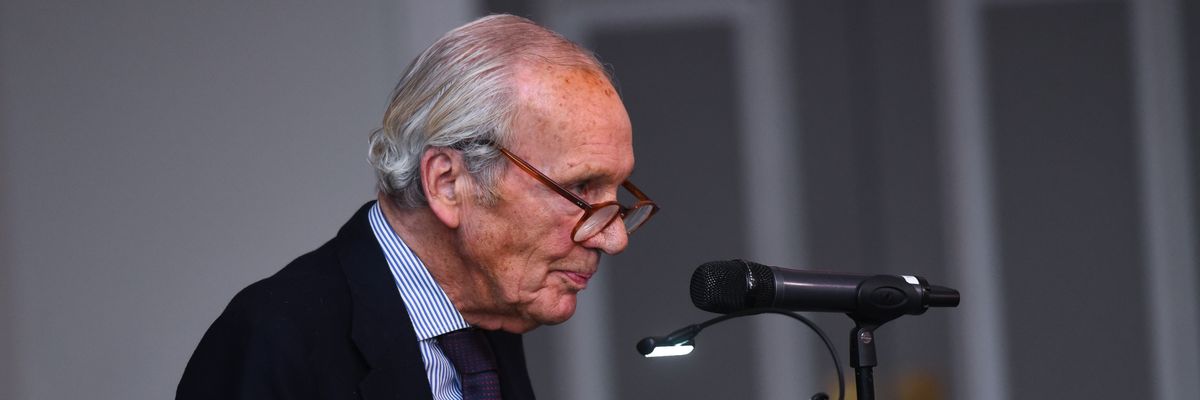
Lewis Lapham speaks at Lapham's Quarterly, Decades Ball, 2019 at 583 Park Avenue on March 25, 2019 in New York City.
Lapham came to see the world as an interwoven tapestry of history, culture, power structures, hypocrisies, and the foibles and possibilities of the humans who dominate Planet Earth.
In 2000, I received a call from Lewis Lapham, the storied editor of the venerable, Harper’s Magazine (launched in 1850) requesting an in-person interview during my Green Party presidential campaign. Accustomed to reporters clinging to the single question about “being a spoiler” and my usual rebuttals (“focus on the spoiled political system”), I was pleased by Mr. Lapham’s interest in our broad and deep agenda, modes of campaigning, and the historical context of Third Parties breaking important new ground. He returned to New York and wrote a cover story on our campaign at the time of a near blackout of our candidacy by the mainstream media.
After a remarkably productive career as a reporter, editor, author, and essayist (his writing was likened to the biting satires of Mark Twain and H.L. Mencken), Lewis Lapham passed away last month in Rome at the age of 89.
Lapham, born to a wealthy, political family in San Francisco, came to see the world as an interwoven tapestry of history, culture, power structures, hypocrisies, and the foibles and possibilities of the humans who dominate Planet Earth. His “renaissance” approach made Harper’s an exciting, challenging magazine during his tenure from the 1980s until 2006. He waded into each edition with an essay that reflected agonizing concentration. He once told me that he always had great difficulty writing, which may explain how finely tuned were his many varied literary contributions. Thought-provoking pieces were handwritten amid a swirl of non-stop cigarette smoking.
A defiant opponent of the Bush/Cheney criminal invasion of Iraq in 2003, he argued for the impeachment of Bush in 2006.
Seeing him as a national treasure, I offered to secure 1,000 subscriptions to Harper’s if he would stop smoking his several packs a day. Choose between the expansion of his readership or stay as an addicted victim of the notorious tobacco industry.
NBC’s “Today Show” got wind of this exchange and put us both on the air. I made my case, but, though his usual courteous self, he wouldn’t budge. Nicotine won the day. In the succeeding years, we would exchange telephone calls to assess the outrages of the day.
Lapham was not content with opening minds to “beautiful and strange” imaginations for the world; he waded into controversies. A defiant opponent of the Bush/Cheney criminal invasion of Iraq in 2003, he argued for the impeachment of Bush in 2006. Still, he offered the pages of Harper’s to conservatives such as William Buckley of the National Review and introduced new writers who were denied an audience by other editors. He encouraged the search for eye-opening, factual one-liners (e.g., the famous Harper’s Index) that conveyed points of grotesque inversions of society’s priorities, corporate greed, governmental wrongdoing, and more.
In 2007, still pursuing his belief that the reading public had to be provided with contrasting viewpoints, the contributions of the wise minds from the ancient classics to the present-day sagacities, Lapham started Lapham’s Quarterly—a truly unique publication.
Running about 225 pages, the Quarterly included many pictures, artwork, and other visuals in color to go along with the prose and the meticulous footnoting all brought together by his small, energetic staff of historical retrievers and synthesizers. Each publication came with an opening essay by Lapham, who was always striving to make the whole greater than the sum of its insightful parts.
Every June, until the Quarterly was temporarily suspended in late 2023, Lapham would have a large celebratory fund-raising dinner in New York City. Celebrities from many fields spoke briefly; there was entertainment and the reserved Founder stayed pretty much in the background, though undoubtedly musing about the emerging scenes.
Taking a cue from Lapham’s famous concision, here is a list of some of the thematic titles of the Quarterly that each had only one word or two words such as: “Luck,” “States of Mind,” “Night,” “Water,” “Democracy,” “Trade,” “Music,” “Fear,” “Discovery,” “Home,” “Flesh,” “Swindle & Fraud,” “Crimes & Punishments,” “Fashion,” “Philanthropy,” “Time,” “Youth,” “States of War,” “About Money,” “Medicine,” “Revolutions,” “Spies,” “Animals,” “Death,” “Rule of Law,” and “Happiness.” Each volume was framed by Lapham’s interpretative, introductory essay. His expansive range knew no bounds.
He won numerous major awards for his magazine writing and was inducted into the American Society of Magazine Editors Hall of Fame in 2007. His last book, a collection of his columns, was titled Age of Folly: America Abandons Its Democracy (2016) which denounced both President Bill Clinton and President George W. Bush along with a “plutocracy of the superrich, by the superrich, and for the superrich.” Lapham also created television programs and documentaries.
There was, however, a tragedy surrounding Lapham’s career—he worked within an aliterate, ahistorical corporate and commercial culture.
Given the contemporary crises and approaching omnicides, both the Quarterly and Harper’s should have large circulations with pulsating readers. Alas, though supported and managed admirably by Rick MacArthur, Harper’s emits profound cries in the wilderness. (See Harper’s at: harpers.org). The Quarterly struggled even more than Harper’s to put forces into motion. Instagram, TikTok, Internet gaming, gambling, and gossip command the short attention span of the younger generation, with luminous exceptions.
Lapham’s Quarterly is, however, a classic series, that can nourish and motivate children of the future with the structured knowledge, experience, and observations related in its picturesque volumes. That is, if the young adopt the belief that “Readers think and Thinkers read,” as a prelude to their democratic civic engagement for a just world. (See Lapham’s Quarterly at: www.laphamsquarterly.org).
Dear Common Dreams reader, It’s been nearly 30 years since I co-founded Common Dreams with my late wife, Lina Newhouser. We had the radical notion that journalism should serve the public good, not corporate profits. It was clear to us from the outset what it would take to build such a project. No paid advertisements. No corporate sponsors. No millionaire publisher telling us what to think or do. Many people said we wouldn't last a year, but we proved those doubters wrong. Together with a tremendous team of journalists and dedicated staff, we built an independent media outlet free from the constraints of profits and corporate control. Our mission has always been simple: To inform. To inspire. To ignite change for the common good. Building Common Dreams was not easy. Our survival was never guaranteed. When you take on the most powerful forces—Wall Street greed, fossil fuel industry destruction, Big Tech lobbyists, and uber-rich oligarchs who have spent billions upon billions rigging the economy and democracy in their favor—the only bulwark you have is supporters who believe in your work. But here’s the urgent message from me today. It's never been this bad out there. And it's never been this hard to keep us going. At the very moment Common Dreams is most needed, the threats we face are intensifying. We need your support now more than ever. We don't accept corporate advertising and never will. We don't have a paywall because we don't think people should be blocked from critical news based on their ability to pay. Everything we do is funded by the donations of readers like you. When everyone does the little they can afford, we are strong. But if that support retreats or dries up, so do we. Will you donate now to make sure Common Dreams not only survives but thrives? —Craig Brown, Co-founder |
In 2000, I received a call from Lewis Lapham, the storied editor of the venerable, Harper’s Magazine (launched in 1850) requesting an in-person interview during my Green Party presidential campaign. Accustomed to reporters clinging to the single question about “being a spoiler” and my usual rebuttals (“focus on the spoiled political system”), I was pleased by Mr. Lapham’s interest in our broad and deep agenda, modes of campaigning, and the historical context of Third Parties breaking important new ground. He returned to New York and wrote a cover story on our campaign at the time of a near blackout of our candidacy by the mainstream media.
After a remarkably productive career as a reporter, editor, author, and essayist (his writing was likened to the biting satires of Mark Twain and H.L. Mencken), Lewis Lapham passed away last month in Rome at the age of 89.
Lapham, born to a wealthy, political family in San Francisco, came to see the world as an interwoven tapestry of history, culture, power structures, hypocrisies, and the foibles and possibilities of the humans who dominate Planet Earth. His “renaissance” approach made Harper’s an exciting, challenging magazine during his tenure from the 1980s until 2006. He waded into each edition with an essay that reflected agonizing concentration. He once told me that he always had great difficulty writing, which may explain how finely tuned were his many varied literary contributions. Thought-provoking pieces were handwritten amid a swirl of non-stop cigarette smoking.
A defiant opponent of the Bush/Cheney criminal invasion of Iraq in 2003, he argued for the impeachment of Bush in 2006.
Seeing him as a national treasure, I offered to secure 1,000 subscriptions to Harper’s if he would stop smoking his several packs a day. Choose between the expansion of his readership or stay as an addicted victim of the notorious tobacco industry.
NBC’s “Today Show” got wind of this exchange and put us both on the air. I made my case, but, though his usual courteous self, he wouldn’t budge. Nicotine won the day. In the succeeding years, we would exchange telephone calls to assess the outrages of the day.
Lapham was not content with opening minds to “beautiful and strange” imaginations for the world; he waded into controversies. A defiant opponent of the Bush/Cheney criminal invasion of Iraq in 2003, he argued for the impeachment of Bush in 2006. Still, he offered the pages of Harper’s to conservatives such as William Buckley of the National Review and introduced new writers who were denied an audience by other editors. He encouraged the search for eye-opening, factual one-liners (e.g., the famous Harper’s Index) that conveyed points of grotesque inversions of society’s priorities, corporate greed, governmental wrongdoing, and more.
In 2007, still pursuing his belief that the reading public had to be provided with contrasting viewpoints, the contributions of the wise minds from the ancient classics to the present-day sagacities, Lapham started Lapham’s Quarterly—a truly unique publication.
Running about 225 pages, the Quarterly included many pictures, artwork, and other visuals in color to go along with the prose and the meticulous footnoting all brought together by his small, energetic staff of historical retrievers and synthesizers. Each publication came with an opening essay by Lapham, who was always striving to make the whole greater than the sum of its insightful parts.
Every June, until the Quarterly was temporarily suspended in late 2023, Lapham would have a large celebratory fund-raising dinner in New York City. Celebrities from many fields spoke briefly; there was entertainment and the reserved Founder stayed pretty much in the background, though undoubtedly musing about the emerging scenes.
Taking a cue from Lapham’s famous concision, here is a list of some of the thematic titles of the Quarterly that each had only one word or two words such as: “Luck,” “States of Mind,” “Night,” “Water,” “Democracy,” “Trade,” “Music,” “Fear,” “Discovery,” “Home,” “Flesh,” “Swindle & Fraud,” “Crimes & Punishments,” “Fashion,” “Philanthropy,” “Time,” “Youth,” “States of War,” “About Money,” “Medicine,” “Revolutions,” “Spies,” “Animals,” “Death,” “Rule of Law,” and “Happiness.” Each volume was framed by Lapham’s interpretative, introductory essay. His expansive range knew no bounds.
He won numerous major awards for his magazine writing and was inducted into the American Society of Magazine Editors Hall of Fame in 2007. His last book, a collection of his columns, was titled Age of Folly: America Abandons Its Democracy (2016) which denounced both President Bill Clinton and President George W. Bush along with a “plutocracy of the superrich, by the superrich, and for the superrich.” Lapham also created television programs and documentaries.
There was, however, a tragedy surrounding Lapham’s career—he worked within an aliterate, ahistorical corporate and commercial culture.
Given the contemporary crises and approaching omnicides, both the Quarterly and Harper’s should have large circulations with pulsating readers. Alas, though supported and managed admirably by Rick MacArthur, Harper’s emits profound cries in the wilderness. (See Harper’s at: harpers.org). The Quarterly struggled even more than Harper’s to put forces into motion. Instagram, TikTok, Internet gaming, gambling, and gossip command the short attention span of the younger generation, with luminous exceptions.
Lapham’s Quarterly is, however, a classic series, that can nourish and motivate children of the future with the structured knowledge, experience, and observations related in its picturesque volumes. That is, if the young adopt the belief that “Readers think and Thinkers read,” as a prelude to their democratic civic engagement for a just world. (See Lapham’s Quarterly at: www.laphamsquarterly.org).
In 2000, I received a call from Lewis Lapham, the storied editor of the venerable, Harper’s Magazine (launched in 1850) requesting an in-person interview during my Green Party presidential campaign. Accustomed to reporters clinging to the single question about “being a spoiler” and my usual rebuttals (“focus on the spoiled political system”), I was pleased by Mr. Lapham’s interest in our broad and deep agenda, modes of campaigning, and the historical context of Third Parties breaking important new ground. He returned to New York and wrote a cover story on our campaign at the time of a near blackout of our candidacy by the mainstream media.
After a remarkably productive career as a reporter, editor, author, and essayist (his writing was likened to the biting satires of Mark Twain and H.L. Mencken), Lewis Lapham passed away last month in Rome at the age of 89.
Lapham, born to a wealthy, political family in San Francisco, came to see the world as an interwoven tapestry of history, culture, power structures, hypocrisies, and the foibles and possibilities of the humans who dominate Planet Earth. His “renaissance” approach made Harper’s an exciting, challenging magazine during his tenure from the 1980s until 2006. He waded into each edition with an essay that reflected agonizing concentration. He once told me that he always had great difficulty writing, which may explain how finely tuned were his many varied literary contributions. Thought-provoking pieces were handwritten amid a swirl of non-stop cigarette smoking.
A defiant opponent of the Bush/Cheney criminal invasion of Iraq in 2003, he argued for the impeachment of Bush in 2006.
Seeing him as a national treasure, I offered to secure 1,000 subscriptions to Harper’s if he would stop smoking his several packs a day. Choose between the expansion of his readership or stay as an addicted victim of the notorious tobacco industry.
NBC’s “Today Show” got wind of this exchange and put us both on the air. I made my case, but, though his usual courteous self, he wouldn’t budge. Nicotine won the day. In the succeeding years, we would exchange telephone calls to assess the outrages of the day.
Lapham was not content with opening minds to “beautiful and strange” imaginations for the world; he waded into controversies. A defiant opponent of the Bush/Cheney criminal invasion of Iraq in 2003, he argued for the impeachment of Bush in 2006. Still, he offered the pages of Harper’s to conservatives such as William Buckley of the National Review and introduced new writers who were denied an audience by other editors. He encouraged the search for eye-opening, factual one-liners (e.g., the famous Harper’s Index) that conveyed points of grotesque inversions of society’s priorities, corporate greed, governmental wrongdoing, and more.
In 2007, still pursuing his belief that the reading public had to be provided with contrasting viewpoints, the contributions of the wise minds from the ancient classics to the present-day sagacities, Lapham started Lapham’s Quarterly—a truly unique publication.
Running about 225 pages, the Quarterly included many pictures, artwork, and other visuals in color to go along with the prose and the meticulous footnoting all brought together by his small, energetic staff of historical retrievers and synthesizers. Each publication came with an opening essay by Lapham, who was always striving to make the whole greater than the sum of its insightful parts.
Every June, until the Quarterly was temporarily suspended in late 2023, Lapham would have a large celebratory fund-raising dinner in New York City. Celebrities from many fields spoke briefly; there was entertainment and the reserved Founder stayed pretty much in the background, though undoubtedly musing about the emerging scenes.
Taking a cue from Lapham’s famous concision, here is a list of some of the thematic titles of the Quarterly that each had only one word or two words such as: “Luck,” “States of Mind,” “Night,” “Water,” “Democracy,” “Trade,” “Music,” “Fear,” “Discovery,” “Home,” “Flesh,” “Swindle & Fraud,” “Crimes & Punishments,” “Fashion,” “Philanthropy,” “Time,” “Youth,” “States of War,” “About Money,” “Medicine,” “Revolutions,” “Spies,” “Animals,” “Death,” “Rule of Law,” and “Happiness.” Each volume was framed by Lapham’s interpretative, introductory essay. His expansive range knew no bounds.
He won numerous major awards for his magazine writing and was inducted into the American Society of Magazine Editors Hall of Fame in 2007. His last book, a collection of his columns, was titled Age of Folly: America Abandons Its Democracy (2016) which denounced both President Bill Clinton and President George W. Bush along with a “plutocracy of the superrich, by the superrich, and for the superrich.” Lapham also created television programs and documentaries.
There was, however, a tragedy surrounding Lapham’s career—he worked within an aliterate, ahistorical corporate and commercial culture.
Given the contemporary crises and approaching omnicides, both the Quarterly and Harper’s should have large circulations with pulsating readers. Alas, though supported and managed admirably by Rick MacArthur, Harper’s emits profound cries in the wilderness. (See Harper’s at: harpers.org). The Quarterly struggled even more than Harper’s to put forces into motion. Instagram, TikTok, Internet gaming, gambling, and gossip command the short attention span of the younger generation, with luminous exceptions.
Lapham’s Quarterly is, however, a classic series, that can nourish and motivate children of the future with the structured knowledge, experience, and observations related in its picturesque volumes. That is, if the young adopt the belief that “Readers think and Thinkers read,” as a prelude to their democratic civic engagement for a just world. (See Lapham’s Quarterly at: www.laphamsquarterly.org).