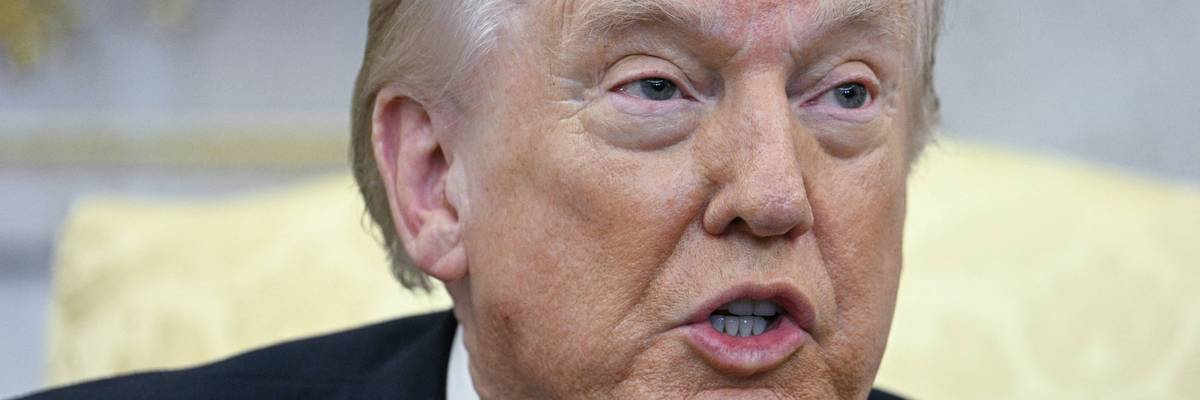
US President Donald Trump speaks during a bilateral meeting with the Taoiseach of Ireland Micheál Martin in the Oval Office of the White House in Washington, DC on March 17, 2026.
The 'Empathy Deficit' of the Powerful
What is commonly thought of as power—power over others, aka, dominance—isn’t power at all. It’s an illusion of power that weakens, and perhaps destroys, those who hold it.
I’m trying to return to the book I started writing a decade ago, and doing so has pulled my awareness of and relationship to the events of 2026 into the larger consciousness the book is struggling to address: What is power?
Can we broaden and expand this word? Can we merge it with collective awareness—you know, the idea of working together? Can we expand our awareness beyond the sense of dominance: power with, rather than power over? Yes, power with, in the “love thy enemy” sense, but without the cynicism and ignorance that usually accompany the word “love."
When we think of power, as I discuss in the book, the word itself commands that we carve the concept into something isolated and wieldable: a sword, a gun, a scepter. Power means power over. There is no basic concept of power—seemingly no word for power in the English language—that also means collaboration, collective participation: people working together, individually empowered at the same time that the larger whole is empowered.
Even when we examine the dark side of power—as in, power corrupts—the examination seems to hover as a warning rather than open up to larger awareness. Consider, for instance, this 2017 article in The Atlantic by Jerry Useem, titled (fasten your seatbelts!) “Power Causes Brain Damage,” which discusses a concept he calls “hubris syndrome.” The essential point the article makes is that people who gain a significant amount of power over others lose the ability to empathize with—or mime, as the article puts it—people in general, the lesser mortals who must follow the boss’ orders. Why am I suddenly thinking of Donald Trump, the world’s “Power Jesus”?
Let’s break the automatic linguistic link right now between power and dominance. True power enlarges the whole; it doesn’t isolate.
This inability to express or feel empathy, it turns out, is serious. It isolates the powerful into their own stereotypes and egotistical certainties, which lessens their ability to make good, or even rational, decisions. (Right, Donald?). And hubris syndrome isn’t merely psychological; it’s also physiological.
Citing neuroscience research, Useem writes:
And when he put the heads of the powerful and the not-so-powerful under a transcranial-magnetic-stimulation machine, he found that power, in fact, impairs a specific neural process, ‘mirroring,’ that may be a cornerstone of empathy. Which gives a neurological basis to what (psychologist Dacher) Keltner has termed the ‘power paradox’: Once we have power, we lose some of the capacities we needed to gain it in the first place.
Useem quotes authors David Owen and Jonathan Davidson, who define hubris syndrome as “a disorder of the possession of power, particularly power which has been associated with overwhelming success, held for a period of years and with minimal constraint on the leader.” Its 14 clinical features, he adds, include: “manifest contempt for others, loss of contact with reality, restless or reckless actions, and displays of incompetence.”
The idea is that we’re naturally connected and subconsciously “mimic” others: We laugh when others laugh, tense up when others grow tense. It’s not faking an emotion to fit in; it’s participating in, feeling, the collective emotion that fills the room. “It helps trigger the same feelings those others are experiencing and provides a window into where they are coming from,” Useem writes. But: Powerful people “stop simulating the experience of others,” leading to what the psychologist calls an “empathy deficit,” which saps the powerful of most, or maybe all, of their social skill, leaving them, even as they generate endless obeisance, socially isolated souls.
The conclusion to be drawn here is that what is commonly thought of as power—power over others, aka, dominance—isn’t power at all. It’s an illusion of power that weakens, and perhaps destroys, those who hold it. Consider the rise and fall of dictators, the toppling of empires, the comeuppance of kings and queens. Let them eat cake.
The article does an excellent job pointing all this out, but at a certain point it falls into a linguistic trap. Useem writes despairingly: “This is a depressing finding. Knowledge is supposed to be power. But what good is knowing that power deprives you of knowledge?”
My answer is this: Knowledge in all its basic innocence is, indeed, power, but rarely is this “power over” someone. Knowledge of how to walk, how to read... this is a child claiming her life. And the entire family is empowered. As the child learns how to function independently, Mom and Dad learn how to parent. Yes, knowledge—power—can be used to further the interests of our darkest impulses. We can use what we learn to blackmail, extort, cheat, bully, win, etc., etc. But let’s break the automatic linguistic link right now between power and dominance. True power enlarges the whole; it doesn’t isolate. As the child learns to function, the family grows.
Yes, the power of self-defense is sometimes necessary, at the individual and, yes, the national level. And power can enable us to win, whether a game or a fight. Hurray! But the point my unfinished book is trying to make is that such power exists in a larger context, just as we exist in a larger context—and this context is ever opening and expanding before us. The US relationship to the rest of the world is larger than Donald Trump’s, or any president’s, ego. It’s larger than our military.
Rather, every last one of us, from newborns to geezers, is a participant in creating who we are, and who we are becoming. Perhaps no one says it better than Pierre Teilhard de Chardin: “Driven by the forces of love, the fragments of the world seek each other so that the world may come into being."
We are at a crossroads
This country and this world are at a monumental crossroads. In a few short weeks, US voters will have an opportunity to beat back the forces of fascism and confront the billionaires who are rigging the economy, our media system, and our democracy, making it increasingly impossible for ordinary people to get by. We’re not just talking about the election. We’re talking about what must be done once these fascist elements are vanquished from power. We need a bolder set of solutions than what either major party has so far been willing to offer and a working-class movement ready to fight like hell for it. Trump didn't emerge from nowhere. The conditions that fueled MAGA authoritarianism were created by decades of radical neoliberal economic policies and a corrupt political system dominated by corporate interests. They slashed taxes on the super-rich, promising that the benefits would trickle down. They said giveaways to the corporate titans would make life more affordable for the rest of us. It was all bullshit. And when a bitter, betrayed populace searches for someone to blame, right-wing demagogues have little trouble finding scapegoats. People know when they're being lied to, but you won't hear any of this from the corporate media. Only independent journalism—powered and funded by people who believe in building a better world—can deliver truly trustworthy daily news. Our Fall Campaign is underway, and we need your help. To power our newsroom through the rest of the year, we need to raise $125,000 by midnight on October 31. So if you share our vision, please contribute whatever you can to sustain our work. |
I’m trying to return to the book I started writing a decade ago, and doing so has pulled my awareness of and relationship to the events of 2026 into the larger consciousness the book is struggling to address: What is power?
Can we broaden and expand this word? Can we merge it with collective awareness—you know, the idea of working together? Can we expand our awareness beyond the sense of dominance: power with, rather than power over? Yes, power with, in the “love thy enemy” sense, but without the cynicism and ignorance that usually accompany the word “love."
When we think of power, as I discuss in the book, the word itself commands that we carve the concept into something isolated and wieldable: a sword, a gun, a scepter. Power means power over. There is no basic concept of power—seemingly no word for power in the English language—that also means collaboration, collective participation: people working together, individually empowered at the same time that the larger whole is empowered.
Even when we examine the dark side of power—as in, power corrupts—the examination seems to hover as a warning rather than open up to larger awareness. Consider, for instance, this 2017 article in The Atlantic by Jerry Useem, titled (fasten your seatbelts!) “Power Causes Brain Damage,” which discusses a concept he calls “hubris syndrome.” The essential point the article makes is that people who gain a significant amount of power over others lose the ability to empathize with—or mime, as the article puts it—people in general, the lesser mortals who must follow the boss’ orders. Why am I suddenly thinking of Donald Trump, the world’s “Power Jesus”?
Let’s break the automatic linguistic link right now between power and dominance. True power enlarges the whole; it doesn’t isolate.
This inability to express or feel empathy, it turns out, is serious. It isolates the powerful into their own stereotypes and egotistical certainties, which lessens their ability to make good, or even rational, decisions. (Right, Donald?). And hubris syndrome isn’t merely psychological; it’s also physiological.
Citing neuroscience research, Useem writes:
And when he put the heads of the powerful and the not-so-powerful under a transcranial-magnetic-stimulation machine, he found that power, in fact, impairs a specific neural process, ‘mirroring,’ that may be a cornerstone of empathy. Which gives a neurological basis to what (psychologist Dacher) Keltner has termed the ‘power paradox’: Once we have power, we lose some of the capacities we needed to gain it in the first place.
Useem quotes authors David Owen and Jonathan Davidson, who define hubris syndrome as “a disorder of the possession of power, particularly power which has been associated with overwhelming success, held for a period of years and with minimal constraint on the leader.” Its 14 clinical features, he adds, include: “manifest contempt for others, loss of contact with reality, restless or reckless actions, and displays of incompetence.”
The idea is that we’re naturally connected and subconsciously “mimic” others: We laugh when others laugh, tense up when others grow tense. It’s not faking an emotion to fit in; it’s participating in, feeling, the collective emotion that fills the room. “It helps trigger the same feelings those others are experiencing and provides a window into where they are coming from,” Useem writes. But: Powerful people “stop simulating the experience of others,” leading to what the psychologist calls an “empathy deficit,” which saps the powerful of most, or maybe all, of their social skill, leaving them, even as they generate endless obeisance, socially isolated souls.
The conclusion to be drawn here is that what is commonly thought of as power—power over others, aka, dominance—isn’t power at all. It’s an illusion of power that weakens, and perhaps destroys, those who hold it. Consider the rise and fall of dictators, the toppling of empires, the comeuppance of kings and queens. Let them eat cake.
The article does an excellent job pointing all this out, but at a certain point it falls into a linguistic trap. Useem writes despairingly: “This is a depressing finding. Knowledge is supposed to be power. But what good is knowing that power deprives you of knowledge?”
My answer is this: Knowledge in all its basic innocence is, indeed, power, but rarely is this “power over” someone. Knowledge of how to walk, how to read... this is a child claiming her life. And the entire family is empowered. As the child learns how to function independently, Mom and Dad learn how to parent. Yes, knowledge—power—can be used to further the interests of our darkest impulses. We can use what we learn to blackmail, extort, cheat, bully, win, etc., etc. But let’s break the automatic linguistic link right now between power and dominance. True power enlarges the whole; it doesn’t isolate. As the child learns to function, the family grows.
Yes, the power of self-defense is sometimes necessary, at the individual and, yes, the national level. And power can enable us to win, whether a game or a fight. Hurray! But the point my unfinished book is trying to make is that such power exists in a larger context, just as we exist in a larger context—and this context is ever opening and expanding before us. The US relationship to the rest of the world is larger than Donald Trump’s, or any president’s, ego. It’s larger than our military.
Rather, every last one of us, from newborns to geezers, is a participant in creating who we are, and who we are becoming. Perhaps no one says it better than Pierre Teilhard de Chardin: “Driven by the forces of love, the fragments of the world seek each other so that the world may come into being."
- Poverty Is Both a Political and a Moral Choice Made By the Powerful ›
- The Vivid Dangers of Our Indifference to a Hellish World ›
- The Emotional Power of Photography: From the Civil Rights Movement to Iraq, How Empathy Can Impact Change ›
- Why So Little Empathy and Compassion Within American Culture? ›
- Empathy Deficit Disorder ›
I’m trying to return to the book I started writing a decade ago, and doing so has pulled my awareness of and relationship to the events of 2026 into the larger consciousness the book is struggling to address: What is power?
Can we broaden and expand this word? Can we merge it with collective awareness—you know, the idea of working together? Can we expand our awareness beyond the sense of dominance: power with, rather than power over? Yes, power with, in the “love thy enemy” sense, but without the cynicism and ignorance that usually accompany the word “love."
When we think of power, as I discuss in the book, the word itself commands that we carve the concept into something isolated and wieldable: a sword, a gun, a scepter. Power means power over. There is no basic concept of power—seemingly no word for power in the English language—that also means collaboration, collective participation: people working together, individually empowered at the same time that the larger whole is empowered.
Even when we examine the dark side of power—as in, power corrupts—the examination seems to hover as a warning rather than open up to larger awareness. Consider, for instance, this 2017 article in The Atlantic by Jerry Useem, titled (fasten your seatbelts!) “Power Causes Brain Damage,” which discusses a concept he calls “hubris syndrome.” The essential point the article makes is that people who gain a significant amount of power over others lose the ability to empathize with—or mime, as the article puts it—people in general, the lesser mortals who must follow the boss’ orders. Why am I suddenly thinking of Donald Trump, the world’s “Power Jesus”?
Let’s break the automatic linguistic link right now between power and dominance. True power enlarges the whole; it doesn’t isolate.
This inability to express or feel empathy, it turns out, is serious. It isolates the powerful into their own stereotypes and egotistical certainties, which lessens their ability to make good, or even rational, decisions. (Right, Donald?). And hubris syndrome isn’t merely psychological; it’s also physiological.
Citing neuroscience research, Useem writes:
And when he put the heads of the powerful and the not-so-powerful under a transcranial-magnetic-stimulation machine, he found that power, in fact, impairs a specific neural process, ‘mirroring,’ that may be a cornerstone of empathy. Which gives a neurological basis to what (psychologist Dacher) Keltner has termed the ‘power paradox’: Once we have power, we lose some of the capacities we needed to gain it in the first place.
Useem quotes authors David Owen and Jonathan Davidson, who define hubris syndrome as “a disorder of the possession of power, particularly power which has been associated with overwhelming success, held for a period of years and with minimal constraint on the leader.” Its 14 clinical features, he adds, include: “manifest contempt for others, loss of contact with reality, restless or reckless actions, and displays of incompetence.”
The idea is that we’re naturally connected and subconsciously “mimic” others: We laugh when others laugh, tense up when others grow tense. It’s not faking an emotion to fit in; it’s participating in, feeling, the collective emotion that fills the room. “It helps trigger the same feelings those others are experiencing and provides a window into where they are coming from,” Useem writes. But: Powerful people “stop simulating the experience of others,” leading to what the psychologist calls an “empathy deficit,” which saps the powerful of most, or maybe all, of their social skill, leaving them, even as they generate endless obeisance, socially isolated souls.
The conclusion to be drawn here is that what is commonly thought of as power—power over others, aka, dominance—isn’t power at all. It’s an illusion of power that weakens, and perhaps destroys, those who hold it. Consider the rise and fall of dictators, the toppling of empires, the comeuppance of kings and queens. Let them eat cake.
The article does an excellent job pointing all this out, but at a certain point it falls into a linguistic trap. Useem writes despairingly: “This is a depressing finding. Knowledge is supposed to be power. But what good is knowing that power deprives you of knowledge?”
My answer is this: Knowledge in all its basic innocence is, indeed, power, but rarely is this “power over” someone. Knowledge of how to walk, how to read... this is a child claiming her life. And the entire family is empowered. As the child learns how to function independently, Mom and Dad learn how to parent. Yes, knowledge—power—can be used to further the interests of our darkest impulses. We can use what we learn to blackmail, extort, cheat, bully, win, etc., etc. But let’s break the automatic linguistic link right now between power and dominance. True power enlarges the whole; it doesn’t isolate. As the child learns to function, the family grows.
Yes, the power of self-defense is sometimes necessary, at the individual and, yes, the national level. And power can enable us to win, whether a game or a fight. Hurray! But the point my unfinished book is trying to make is that such power exists in a larger context, just as we exist in a larger context—and this context is ever opening and expanding before us. The US relationship to the rest of the world is larger than Donald Trump’s, or any president’s, ego. It’s larger than our military.
Rather, every last one of us, from newborns to geezers, is a participant in creating who we are, and who we are becoming. Perhaps no one says it better than Pierre Teilhard de Chardin: “Driven by the forces of love, the fragments of the world seek each other so that the world may come into being."
- Poverty Is Both a Political and a Moral Choice Made By the Powerful ›
- The Vivid Dangers of Our Indifference to a Hellish World ›
- The Emotional Power of Photography: From the Civil Rights Movement to Iraq, How Empathy Can Impact Change ›
- Why So Little Empathy and Compassion Within American Culture? ›
- Empathy Deficit Disorder ›