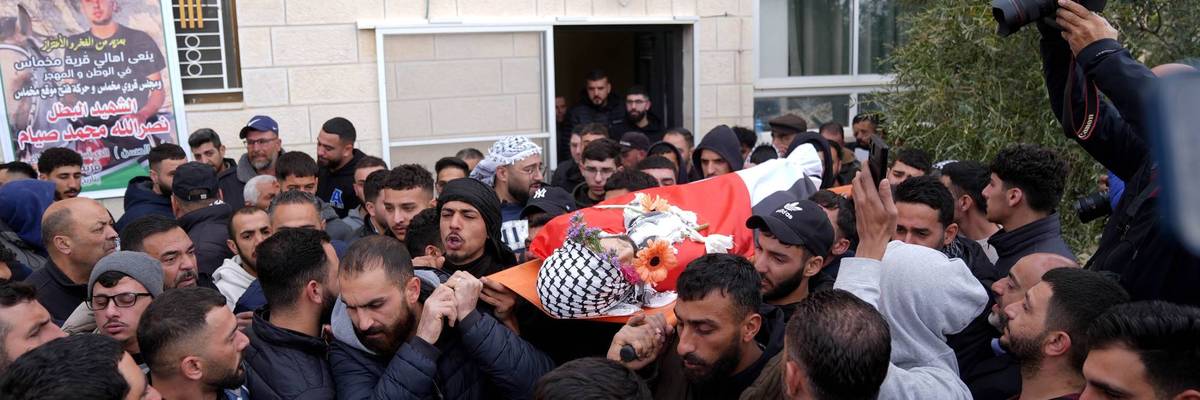
Palestinians attend the funeral of Nasrullah Mohammed Jamal Abu Siyam, who was killed after Israeli settlers opened fire during a raid on the town of Mukhmas, northeast of East Jerusalem, on February 19, 2026.
The All Too Ordinary Death of Nasrallah Abu Siyam
What happened to Nasrallah was not unusual; in fact, it was entirely predictable. It reflects a pattern Palestinians living in the occupied West Bank have been forced to live with for decades.
I’ve grown accustomed to the violence in Palestine; to seeing my brothers and sisters stripped from their homes and taken away from life itself. That violence has always felt close. And yet, with Nasrallah Abu Siyam, it became unmistakable.
Not only was he my age, he was born just miles from my hometown. An American citizen. Living an ordinary life. Dreaming of ordinary things. And still, he was shot and killed by Israeli settlers, simply for helping guard his fam ily’s livestock in the occupied West Bank.
In nearly every way, his life mirrored mine. The only difference was where he stood. And that difference, it seems, was enough.
What happened to Nasrallah was not unusual; in fact, it was entirely predictable. It reflects a pattern Palestinians living in the occupied West Bank have been forced to live with for decades—one in which violence is routine, accountability is absent, and loss is absorbed without consequence.
Nasrallah Abu Siyam lived an ordinary life. He should have been afforded the ordinary right to keep it.
That pattern is clearest in how these moments of violence unfold. In Mukhmas, the village where Nasrallah was killed, a resident described what happened plainly:
“When the settlers saw the army, they were encouraged and started shooting live bullets.”
In other words, the presence of the occupying forces did not interrupt the violence; it emboldened it. This is a reality Palestinians have long understood— that the forces ostensibly tasked with “maintaining order” often function instead as a mechanism for enabling and inflicting violence.
Time and time again, Palestinians are left to bury the result.The scale of that violence is not abstract, nor is it disputed.
Between October 2023 and October 2025 alone, more than 1,100 Palestinians were killed in the occupied West Bank by Israeli forces and settlers—229 of them children. That means more than 1 in 5 of those killed were children. In that same span of time, over 10,900 Palestinians were wounded and nearly 21,000 were detained.
And yet, none of this devastation takes place on a battlefield. There is no armed group to point to, no battle to cite. What remains is an occupied territory where civilian death, injury, and detention occur as a matter of policy and practice—not as rare or exceptional events.
By this point, it may sound like a broken record—not just from me, but from years of warnings repeating what the international community has recorded and then promptly ignored. But repetition becomes inevitable when impunity is preserved at every level.
Impunity—that, I must say—does not exist in a vacuum. It is sustained through material support, political protection, and deliberate silence. All of which the United States is deeply embedded in: in the weapons supplied, in the cover extended, and in what goes unsaid. When Americans like Nasrallah Abu Siyam—at least six of them in the past two years—are killed under an occupation supported by US authority, and little is said and less is done, that silence becomes a statement in itself.
Put simply, it is a statement of how Palestinian life—American or not—is weighed, and how little that weight has meant in the political world.
No power should have the authority to dictate which lives are expendable—and which are not. Nasrallah Abu Siyam lived an ordinary life. He should have been afforded the ordinary right to keep it. But again, that failure is not abstract. It has a name, a place, and a date.
This piece was originally published on Substack.
We are at a crossroads
This country and this world are at a monumental crossroads. In a few short weeks, US voters will have an opportunity to beat back the forces of fascism and confront the billionaires who are rigging the economy, our media system, and our democracy, making it increasingly impossible for ordinary people to get by. We’re not just talking about the election. We’re talking about what must be done once these fascist elements are vanquished from power. We need a bolder set of solutions than what either major party has so far been willing to offer and a working-class movement ready to fight like hell for it. Trump didn't emerge from nowhere. The conditions that fueled MAGA authoritarianism were created by decades of radical neoliberal economic policies and a corrupt political system dominated by corporate interests. They slashed taxes on the super-rich, promising that the benefits would trickle down. They said giveaways to the corporate titans would make life more affordable for the rest of us. It was all bullshit. And when a bitter, betrayed populace searches for someone to blame, right-wing demagogues have little trouble finding scapegoats. People know when they're being lied to, but you won't hear any of this from the corporate media. Only independent journalism—powered and funded by people who believe in building a better world—can deliver truly trustworthy daily news. Our Fall Campaign is underway, and we need your help. To power our newsroom through the rest of the year, we need to raise $125,000 by midnight on October 31. So if you share our vision, please contribute whatever you can to sustain our work. |
I’ve grown accustomed to the violence in Palestine; to seeing my brothers and sisters stripped from their homes and taken away from life itself. That violence has always felt close. And yet, with Nasrallah Abu Siyam, it became unmistakable.
Not only was he my age, he was born just miles from my hometown. An American citizen. Living an ordinary life. Dreaming of ordinary things. And still, he was shot and killed by Israeli settlers, simply for helping guard his fam ily’s livestock in the occupied West Bank.
In nearly every way, his life mirrored mine. The only difference was where he stood. And that difference, it seems, was enough.
What happened to Nasrallah was not unusual; in fact, it was entirely predictable. It reflects a pattern Palestinians living in the occupied West Bank have been forced to live with for decades—one in which violence is routine, accountability is absent, and loss is absorbed without consequence.
Nasrallah Abu Siyam lived an ordinary life. He should have been afforded the ordinary right to keep it.
That pattern is clearest in how these moments of violence unfold. In Mukhmas, the village where Nasrallah was killed, a resident described what happened plainly:
“When the settlers saw the army, they were encouraged and started shooting live bullets.”
In other words, the presence of the occupying forces did not interrupt the violence; it emboldened it. This is a reality Palestinians have long understood— that the forces ostensibly tasked with “maintaining order” often function instead as a mechanism for enabling and inflicting violence.
Time and time again, Palestinians are left to bury the result.The scale of that violence is not abstract, nor is it disputed.
Between October 2023 and October 2025 alone, more than 1,100 Palestinians were killed in the occupied West Bank by Israeli forces and settlers—229 of them children. That means more than 1 in 5 of those killed were children. In that same span of time, over 10,900 Palestinians were wounded and nearly 21,000 were detained.
And yet, none of this devastation takes place on a battlefield. There is no armed group to point to, no battle to cite. What remains is an occupied territory where civilian death, injury, and detention occur as a matter of policy and practice—not as rare or exceptional events.
By this point, it may sound like a broken record—not just from me, but from years of warnings repeating what the international community has recorded and then promptly ignored. But repetition becomes inevitable when impunity is preserved at every level.
Impunity—that, I must say—does not exist in a vacuum. It is sustained through material support, political protection, and deliberate silence. All of which the United States is deeply embedded in: in the weapons supplied, in the cover extended, and in what goes unsaid. When Americans like Nasrallah Abu Siyam—at least six of them in the past two years—are killed under an occupation supported by US authority, and little is said and less is done, that silence becomes a statement in itself.
Put simply, it is a statement of how Palestinian life—American or not—is weighed, and how little that weight has meant in the political world.
No power should have the authority to dictate which lives are expendable—and which are not. Nasrallah Abu Siyam lived an ordinary life. He should have been afforded the ordinary right to keep it. But again, that failure is not abstract. It has a name, a place, and a date.
This piece was originally published on Substack.
I’ve grown accustomed to the violence in Palestine; to seeing my brothers and sisters stripped from their homes and taken away from life itself. That violence has always felt close. And yet, with Nasrallah Abu Siyam, it became unmistakable.
Not only was he my age, he was born just miles from my hometown. An American citizen. Living an ordinary life. Dreaming of ordinary things. And still, he was shot and killed by Israeli settlers, simply for helping guard his fam ily’s livestock in the occupied West Bank.
In nearly every way, his life mirrored mine. The only difference was where he stood. And that difference, it seems, was enough.
What happened to Nasrallah was not unusual; in fact, it was entirely predictable. It reflects a pattern Palestinians living in the occupied West Bank have been forced to live with for decades—one in which violence is routine, accountability is absent, and loss is absorbed without consequence.
Nasrallah Abu Siyam lived an ordinary life. He should have been afforded the ordinary right to keep it.
That pattern is clearest in how these moments of violence unfold. In Mukhmas, the village where Nasrallah was killed, a resident described what happened plainly:
“When the settlers saw the army, they were encouraged and started shooting live bullets.”
In other words, the presence of the occupying forces did not interrupt the violence; it emboldened it. This is a reality Palestinians have long understood— that the forces ostensibly tasked with “maintaining order” often function instead as a mechanism for enabling and inflicting violence.
Time and time again, Palestinians are left to bury the result.The scale of that violence is not abstract, nor is it disputed.
Between October 2023 and October 2025 alone, more than 1,100 Palestinians were killed in the occupied West Bank by Israeli forces and settlers—229 of them children. That means more than 1 in 5 of those killed were children. In that same span of time, over 10,900 Palestinians were wounded and nearly 21,000 were detained.
And yet, none of this devastation takes place on a battlefield. There is no armed group to point to, no battle to cite. What remains is an occupied territory where civilian death, injury, and detention occur as a matter of policy and practice—not as rare or exceptional events.
By this point, it may sound like a broken record—not just from me, but from years of warnings repeating what the international community has recorded and then promptly ignored. But repetition becomes inevitable when impunity is preserved at every level.
Impunity—that, I must say—does not exist in a vacuum. It is sustained through material support, political protection, and deliberate silence. All of which the United States is deeply embedded in: in the weapons supplied, in the cover extended, and in what goes unsaid. When Americans like Nasrallah Abu Siyam—at least six of them in the past two years—are killed under an occupation supported by US authority, and little is said and less is done, that silence becomes a statement in itself.
Put simply, it is a statement of how Palestinian life—American or not—is weighed, and how little that weight has meant in the political world.
No power should have the authority to dictate which lives are expendable—and which are not. Nasrallah Abu Siyam lived an ordinary life. He should have been afforded the ordinary right to keep it. But again, that failure is not abstract. It has a name, a place, and a date.
This piece was originally published on Substack.