SUBSCRIBE TO OUR FREE NEWSLETTER
Daily news & progressive opinion—funded by the people, not the corporations—delivered straight to your inbox.
5
#000000
#FFFFFF
To donate by check, phone, or other method, see our More Ways to Give page.
Daily news & progressive opinion—funded by the people, not the corporations—delivered straight to your inbox.
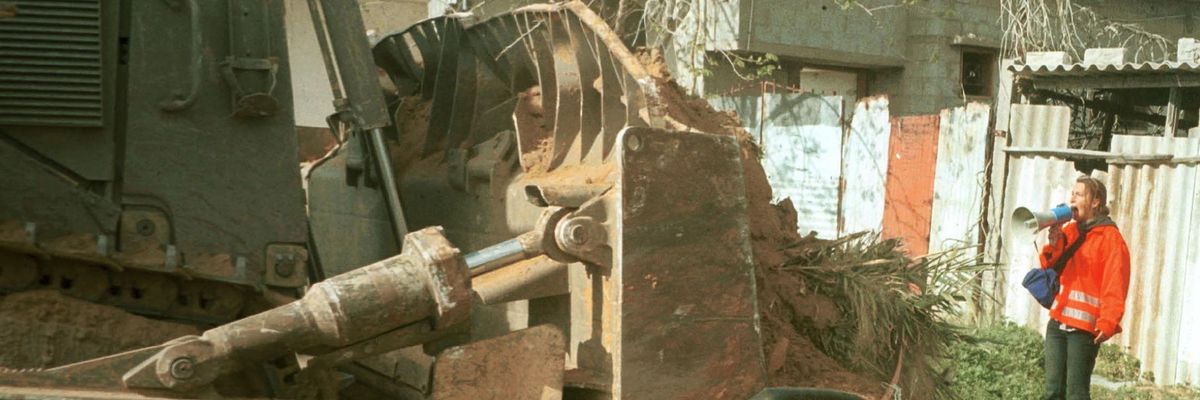
International Solidarity Movement activist Rachel Corrie faces down an Israel Defense Forces bulldozer just before it crushed her to death in Rafah, Gaza on March 16, 2003.
One Palestinian journalist said the slain American activist "became a worldwide symbol of freedom and a source of inspiration for everyone who dreams of a world of justice and peace."
Palestinian rights activists on Thursday remembered the life and legacy of Rachel Corrie, the American human rights defender who was crushed to death by an Israeli military bulldozer on March 16, 2003 while trying to shield a Palestinian home from demolition in occupied Gaza.
"Rachel was 23 when she was killed. She could have satisfied her conscience by protesting against global injustice in a demonstration in America or by calling for a boycott of the aggressors," Palestinian journalist and activist Ahmed Abu Artema—who is from Rafah, where Corrie was killed—wrote for Mondoweiss.
"But her high sense of morality was not satisfied with these symbolic gestures," he added. "Her conscience would not rest without complete involvement, without standing side-by-side with us. That's why she came to Palestine."
Hanan Ashrawi, a Palestinian politician, scholar, and activist, called Corrie "an icon of resistance, freedom, and self-sacrifice."
"Palestine is forever grateful," she added. "Always in our hearts. Rest in love and peace."
Corrie, who hailed from Olympia, Washington, was a volunteer with the International Solidarity Movement (ISM), a Palestinian-led group resisting the Israeli occupation of Palestine through nonviolent direct action.
"No amount of reading, attendance at conferences, documentary viewing, and word-of-mouth could have prepared me for the reality of the situation here," Corrie wrote to family and friends on February 7, 2003, adding that she had "very few words to describe" what she saw in Gaza.
"An 8-year-old child was shot and killed by an Israeli tank two days before I got here," she said.
"I feel like I'm witnessing the systematic destruction of a people's ability to survive," Corrie told a reporter two days before she was killed.
On the afternoon of March 16, Corrie received an urgent call from ISM activists telling her to rush to the home of Samir Nasrallah, a pharmacist who lived with his wife and three children near the Egyptian border in Rafah. Israel Defense Forces (IDF) troops were in the process of destroying homes in the area and ISM activists feared the Nasrallah's residence was next, as it was one of the few houses left standing in the area.
Corrie hurried to the home, clad in a fluorescent orange jacket and carrying a megaphone. As the IDF's American-made Caterpillar D9R armored bulldozer approached Nasrallah's home, Corrie stood in its path and was fatally injured. She was rushed to a nearby hospital, where she died.
Corrie was not the last ISM activist to be killed or seriously wounded by Israeli forces. A month after her death, 21-year-old British student Tom Hurndall was shot in the head by an IDF sniper as he attempted to rescue Palestinian children from an Israeli tank that was firing in their direction. The shooting left Hurndall in a coma; he died nine months later in a London hospital.
IDF officials denied intentionally killing Corrie, despite court testimony from army officers that Corrie and other activists were legitimate military targets who were "doomed to death" for resisting Israeli occupation forces.
An IDF investigation concluded that Corrie had not been crushed to death by the bulldozer, despite an Israeli autopsy that concluded her death was caused by "pressure on the chest with fractures of the ribs and vertebrae of the dorsal spinal column and scapulas, and tear wounds in the right lung."
The IDF called Corrie's death a "regrettable accident" while blaming the ISM activists for their own harm because by "placing themselves in a combat zone."
Efforts in the United States by Corrie's family, activist groups, and U.S. Rep. Brian Baird (D-Wash.) to achieve accountability and justice for Corrie bore no fruit.
While Corrie once wrote that she felt protected by "the difficulties the Israeli army would face if they shot an unarmed U.S. citizen," there were no such difficulties, just as there were no repercussions after Israeli warplanes killed 34 American sailors and wounded 173 others during a 1967 attack on the USS Liberty—an attack numerous top U.S. officials believe was deliberate.
In 2012, an Israeli court ruled against Corrie's parents, who had sued the IDF, with the judge claiming the activist's death was the "result of an accident she brought upon herself."
Former U.S. President Jimmy Carter condemned the ruling as a confirmation of the "climate of impunity which facilitates Israeli human rights violations."
"Rachel's case was cast aside by Israel's colonial courts. But Rachel won," Abu Artema wrote Thursday. "She became a worldwide symbol of freedom and a source of inspiration for everyone who dreams of a world of justice and peace."
"Israel may have killed her," he added, "but Rachel Corrie lives on in all of us."
Dear Common Dreams reader, It’s been nearly 30 years since I co-founded Common Dreams with my late wife, Lina Newhouser. We had the radical notion that journalism should serve the public good, not corporate profits. It was clear to us from the outset what it would take to build such a project. No paid advertisements. No corporate sponsors. No millionaire publisher telling us what to think or do. Many people said we wouldn't last a year, but we proved those doubters wrong. Together with a tremendous team of journalists and dedicated staff, we built an independent media outlet free from the constraints of profits and corporate control. Our mission has always been simple: To inform. To inspire. To ignite change for the common good. Building Common Dreams was not easy. Our survival was never guaranteed. When you take on the most powerful forces—Wall Street greed, fossil fuel industry destruction, Big Tech lobbyists, and uber-rich oligarchs who have spent billions upon billions rigging the economy and democracy in their favor—the only bulwark you have is supporters who believe in your work. But here’s the urgent message from me today. It's never been this bad out there. And it's never been this hard to keep us going. At the very moment Common Dreams is most needed, the threats we face are intensifying. We need your support now more than ever. We don't accept corporate advertising and never will. We don't have a paywall because we don't think people should be blocked from critical news based on their ability to pay. Everything we do is funded by the donations of readers like you. When everyone does the little they can afford, we are strong. But if that support retreats or dries up, so do we. Will you donate now to make sure Common Dreams not only survives but thrives? —Craig Brown, Co-founder |
Palestinian rights activists on Thursday remembered the life and legacy of Rachel Corrie, the American human rights defender who was crushed to death by an Israeli military bulldozer on March 16, 2003 while trying to shield a Palestinian home from demolition in occupied Gaza.
"Rachel was 23 when she was killed. She could have satisfied her conscience by protesting against global injustice in a demonstration in America or by calling for a boycott of the aggressors," Palestinian journalist and activist Ahmed Abu Artema—who is from Rafah, where Corrie was killed—wrote for Mondoweiss.
"But her high sense of morality was not satisfied with these symbolic gestures," he added. "Her conscience would not rest without complete involvement, without standing side-by-side with us. That's why she came to Palestine."
Hanan Ashrawi, a Palestinian politician, scholar, and activist, called Corrie "an icon of resistance, freedom, and self-sacrifice."
"Palestine is forever grateful," she added. "Always in our hearts. Rest in love and peace."
Corrie, who hailed from Olympia, Washington, was a volunteer with the International Solidarity Movement (ISM), a Palestinian-led group resisting the Israeli occupation of Palestine through nonviolent direct action.
"No amount of reading, attendance at conferences, documentary viewing, and word-of-mouth could have prepared me for the reality of the situation here," Corrie wrote to family and friends on February 7, 2003, adding that she had "very few words to describe" what she saw in Gaza.
"An 8-year-old child was shot and killed by an Israeli tank two days before I got here," she said.
"I feel like I'm witnessing the systematic destruction of a people's ability to survive," Corrie told a reporter two days before she was killed.
On the afternoon of March 16, Corrie received an urgent call from ISM activists telling her to rush to the home of Samir Nasrallah, a pharmacist who lived with his wife and three children near the Egyptian border in Rafah. Israel Defense Forces (IDF) troops were in the process of destroying homes in the area and ISM activists feared the Nasrallah's residence was next, as it was one of the few houses left standing in the area.
Corrie hurried to the home, clad in a fluorescent orange jacket and carrying a megaphone. As the IDF's American-made Caterpillar D9R armored bulldozer approached Nasrallah's home, Corrie stood in its path and was fatally injured. She was rushed to a nearby hospital, where she died.
Corrie was not the last ISM activist to be killed or seriously wounded by Israeli forces. A month after her death, 21-year-old British student Tom Hurndall was shot in the head by an IDF sniper as he attempted to rescue Palestinian children from an Israeli tank that was firing in their direction. The shooting left Hurndall in a coma; he died nine months later in a London hospital.
IDF officials denied intentionally killing Corrie, despite court testimony from army officers that Corrie and other activists were legitimate military targets who were "doomed to death" for resisting Israeli occupation forces.
An IDF investigation concluded that Corrie had not been crushed to death by the bulldozer, despite an Israeli autopsy that concluded her death was caused by "pressure on the chest with fractures of the ribs and vertebrae of the dorsal spinal column and scapulas, and tear wounds in the right lung."
The IDF called Corrie's death a "regrettable accident" while blaming the ISM activists for their own harm because by "placing themselves in a combat zone."
Efforts in the United States by Corrie's family, activist groups, and U.S. Rep. Brian Baird (D-Wash.) to achieve accountability and justice for Corrie bore no fruit.
While Corrie once wrote that she felt protected by "the difficulties the Israeli army would face if they shot an unarmed U.S. citizen," there were no such difficulties, just as there were no repercussions after Israeli warplanes killed 34 American sailors and wounded 173 others during a 1967 attack on the USS Liberty—an attack numerous top U.S. officials believe was deliberate.
In 2012, an Israeli court ruled against Corrie's parents, who had sued the IDF, with the judge claiming the activist's death was the "result of an accident she brought upon herself."
Former U.S. President Jimmy Carter condemned the ruling as a confirmation of the "climate of impunity which facilitates Israeli human rights violations."
"Rachel's case was cast aside by Israel's colonial courts. But Rachel won," Abu Artema wrote Thursday. "She became a worldwide symbol of freedom and a source of inspiration for everyone who dreams of a world of justice and peace."
"Israel may have killed her," he added, "but Rachel Corrie lives on in all of us."
Palestinian rights activists on Thursday remembered the life and legacy of Rachel Corrie, the American human rights defender who was crushed to death by an Israeli military bulldozer on March 16, 2003 while trying to shield a Palestinian home from demolition in occupied Gaza.
"Rachel was 23 when she was killed. She could have satisfied her conscience by protesting against global injustice in a demonstration in America or by calling for a boycott of the aggressors," Palestinian journalist and activist Ahmed Abu Artema—who is from Rafah, where Corrie was killed—wrote for Mondoweiss.
"But her high sense of morality was not satisfied with these symbolic gestures," he added. "Her conscience would not rest without complete involvement, without standing side-by-side with us. That's why she came to Palestine."
Hanan Ashrawi, a Palestinian politician, scholar, and activist, called Corrie "an icon of resistance, freedom, and self-sacrifice."
"Palestine is forever grateful," she added. "Always in our hearts. Rest in love and peace."
Corrie, who hailed from Olympia, Washington, was a volunteer with the International Solidarity Movement (ISM), a Palestinian-led group resisting the Israeli occupation of Palestine through nonviolent direct action.
"No amount of reading, attendance at conferences, documentary viewing, and word-of-mouth could have prepared me for the reality of the situation here," Corrie wrote to family and friends on February 7, 2003, adding that she had "very few words to describe" what she saw in Gaza.
"An 8-year-old child was shot and killed by an Israeli tank two days before I got here," she said.
"I feel like I'm witnessing the systematic destruction of a people's ability to survive," Corrie told a reporter two days before she was killed.
On the afternoon of March 16, Corrie received an urgent call from ISM activists telling her to rush to the home of Samir Nasrallah, a pharmacist who lived with his wife and three children near the Egyptian border in Rafah. Israel Defense Forces (IDF) troops were in the process of destroying homes in the area and ISM activists feared the Nasrallah's residence was next, as it was one of the few houses left standing in the area.
Corrie hurried to the home, clad in a fluorescent orange jacket and carrying a megaphone. As the IDF's American-made Caterpillar D9R armored bulldozer approached Nasrallah's home, Corrie stood in its path and was fatally injured. She was rushed to a nearby hospital, where she died.
Corrie was not the last ISM activist to be killed or seriously wounded by Israeli forces. A month after her death, 21-year-old British student Tom Hurndall was shot in the head by an IDF sniper as he attempted to rescue Palestinian children from an Israeli tank that was firing in their direction. The shooting left Hurndall in a coma; he died nine months later in a London hospital.
IDF officials denied intentionally killing Corrie, despite court testimony from army officers that Corrie and other activists were legitimate military targets who were "doomed to death" for resisting Israeli occupation forces.
An IDF investigation concluded that Corrie had not been crushed to death by the bulldozer, despite an Israeli autopsy that concluded her death was caused by "pressure on the chest with fractures of the ribs and vertebrae of the dorsal spinal column and scapulas, and tear wounds in the right lung."
The IDF called Corrie's death a "regrettable accident" while blaming the ISM activists for their own harm because by "placing themselves in a combat zone."
Efforts in the United States by Corrie's family, activist groups, and U.S. Rep. Brian Baird (D-Wash.) to achieve accountability and justice for Corrie bore no fruit.
While Corrie once wrote that she felt protected by "the difficulties the Israeli army would face if they shot an unarmed U.S. citizen," there were no such difficulties, just as there were no repercussions after Israeli warplanes killed 34 American sailors and wounded 173 others during a 1967 attack on the USS Liberty—an attack numerous top U.S. officials believe was deliberate.
In 2012, an Israeli court ruled against Corrie's parents, who had sued the IDF, with the judge claiming the activist's death was the "result of an accident she brought upon herself."
Former U.S. President Jimmy Carter condemned the ruling as a confirmation of the "climate of impunity which facilitates Israeli human rights violations."
"Rachel's case was cast aside by Israel's colonial courts. But Rachel won," Abu Artema wrote Thursday. "She became a worldwide symbol of freedom and a source of inspiration for everyone who dreams of a world of justice and peace."
"Israel may have killed her," he added, "but Rachel Corrie lives on in all of us."