SUBSCRIBE TO OUR FREE NEWSLETTER
Daily news & progressive opinion—funded by the people, not the corporations—delivered straight to your inbox.
5
#000000
#FFFFFF
To donate by check, phone, or other method, see our More Ways to Give page.
Daily news & progressive opinion—funded by the people, not the corporations—delivered straight to your inbox.
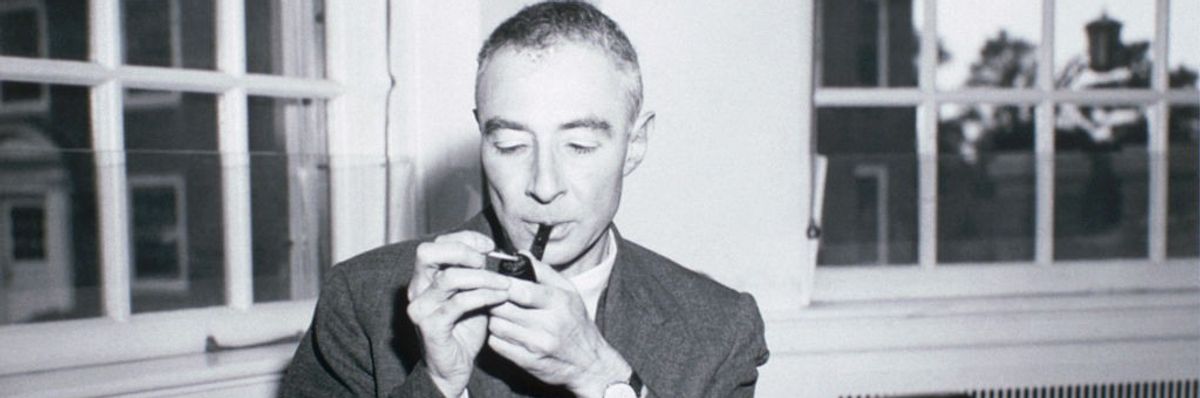
J. Robert Oppenheimer in his office.
“We believe,” he wrote in 1945, “that the safety of this nation—as opposed to its ability to inflict damage on an enemy power—cannot lie wholly or even primarily in its scientific or technical prowess.”
A mere 55 years after his death, the U.S. government has restored J. Robert Oppenheimer’s security clearance, which the Atomic Energy Commission had taken away from him in 1954, declaring him to be not simply a communist but, in all likelihood, a Soviet spy.
Oppenheimer, of course, is the father of the atomic bomb. He led the Manhattan Project during World War II, which birthed Little Boy and Fat Man, the bombs we dropped on Hiroshima and Nagasaki in August 1945, killing several hundred thousand people and ending the war. What happened next, however, was the Cold War, and suddenly commies—our former allies—were the personification of evil, and they were everywhere. The American government, in its infinite wisdom, knew it had no choice but to continue its nuclear weapons program and, for the sake of peace, put the world on the brink of Armageddon.
Hello, H-bomb!
War, the building block of the world’s governmental entities for uncounted millennia, had evolved to the brink of human extinction. Official government policy amounted to this: So what?
“A key element in the case against Oppenheimer,” the Times reported, “was derived from his resistance to early work on the hydrogen bomb, which could explode with 1,000 times the force of an atomic bomb.”
Oppenheimer challenged this official policy and shattered his career. Indeed, he saw immediately, as the newly developed bomb was tested at Alamogordo, New Mexico, on July 16, 1945, that Planet Earth was in danger. A team of physicists had just exposed its ultimate vulnerability and he famously noted, as he witnessed the mushroom cloud, that words of Hindu scripture from the Bhagavad-Gita entered his mind: “Now I am become Death, the destroyer of worlds.”
He had not opposed dropping the bombs on Hiroshima and Nagasaki, as some of the Manhattan Project scientists, such as Leo Szilard, did, but when the war ended he became deeply committed to eliminating all possibility of future wars. One of the first actions he took, a week after the bombings, was to write a letter to Secretary of War Henry Stimson, urging him to embrace common sense regarding further development of nuclear weapons.
“We believe,” he wrote, “that the safety of this nation—as opposed to its ability to inflict damage on an enemy power—cannot lie wholly or even primarily in its scientific or technical prowess. It can be based only on making future wars impossible. It is our unanimous and urgent recommendation to you that, despite the present incomplete exploitation of technical possibilities in this field, all steps be taken, all necessary international arrangements be made, to this one end.”
Making future wars impossible! What if American political forces had sufficient sanity to listen to Oppenheimer? Several months after writing this letter, he paid a visit to President Harry Truman, attempting to discuss the placement of international control over further nuclear development. The president would have none of that. He kicked Oppenheimer out of the Oval Office.
Oppenheimer maintained his commitment to the transcendence of war, working with the Atomic Energy Commission to control the use of nuclear weapons—and standing firm in his opposition to the creation of the hydrogen bomb. He continued his opposition even as the bomb’s development progressed and nuclear tests began spreading fallout over “expendable” parts of the world. But, uh oh. Along came the McCarthy era and the accompanying Red Scare.
And in 1954, after 19 days of secret hearings, the Atomic Energy Commission revoked Oppenheimer’s security clearance. As The New York Times noted, this “brought his career to a humiliating end. Until then a hero of American science, he lived out his life a broken man.” He died at age 62 in 1967.
“A key element in the case against Oppenheimer,” the Times reported, “was derived from his resistance to early work on the hydrogen bomb, which could explode with 1,000 times the force of an atomic bomb. The physicist Edward Teller had long advocated a crash program to devise such a weapon, and told the 1954 hearing that he mistrusted Oppenheimer’s judgment. ‘I would feel personally more secure,’ he testified, ‘if public matters would rest in other hands.’”
But of course the “black mark of shame” that remained stuck to Oppenheimer for the rest of his life was that he was a commie, and maybe a spy—in other words, totally anti-American. This was the basic lie used against those who challenged the tenets of the Cold War. The commission’s secret hearings remained classified for 60 years. After they were declassified in 2014, historians expressed amazement that they contained virtually no damning evidence of any sort against Oppenheimer, and lots of testimony sympathetic to him. The revelations here seem primarily to expose the government’s interest in covering its own lies.
It was this past December that Energy Secretary Jennifer Granholm, chairman of the department that the Atomic Energy Commission had morphed into, nullified the revocation of Oppenheimer’s security clearance, declaring the 1954 hearing a “flawed process.” Getting the government to undo its wrong was a long, arduous process, embarked on by Kai Bird and Martin J. Sherwin, the authors of American Prometheus: The Triumph and Tragedy of J. Robert Oppenheimer. It took them about 16 years. They finally succeeded in clearing his name.
And while I applaud their enormous effort and its result, I also note it isn’t finished yet. This is more than simply a personal matter: the righting of a bureaucratic wrong done to one man. The future of humanity remains at stake. The U.S. government has spent multi-trillions of dollars on nuclear weapons development over the years, conducted a thousand-plus nuclear tests, and is currently in possession of 5,244 nuclear warheads, out of an insane global total of some 12,500. Perhaps it’s time to start listening to—and hearing—Oppenheimer’s words.
Dear Common Dreams reader, It’s been nearly 30 years since I co-founded Common Dreams with my late wife, Lina Newhouser. We had the radical notion that journalism should serve the public good, not corporate profits. It was clear to us from the outset what it would take to build such a project. No paid advertisements. No corporate sponsors. No millionaire publisher telling us what to think or do. Many people said we wouldn't last a year, but we proved those doubters wrong. Together with a tremendous team of journalists and dedicated staff, we built an independent media outlet free from the constraints of profits and corporate control. Our mission has always been simple: To inform. To inspire. To ignite change for the common good. Building Common Dreams was not easy. Our survival was never guaranteed. When you take on the most powerful forces—Wall Street greed, fossil fuel industry destruction, Big Tech lobbyists, and uber-rich oligarchs who have spent billions upon billions rigging the economy and democracy in their favor—the only bulwark you have is supporters who believe in your work. But here’s the urgent message from me today. It's never been this bad out there. And it's never been this hard to keep us going. At the very moment Common Dreams is most needed, the threats we face are intensifying. We need your support now more than ever. We don't accept corporate advertising and never will. We don't have a paywall because we don't think people should be blocked from critical news based on their ability to pay. Everything we do is funded by the donations of readers like you. When everyone does the little they can afford, we are strong. But if that support retreats or dries up, so do we. Will you donate now to make sure Common Dreams not only survives but thrives? —Craig Brown, Co-founder |
A mere 55 years after his death, the U.S. government has restored J. Robert Oppenheimer’s security clearance, which the Atomic Energy Commission had taken away from him in 1954, declaring him to be not simply a communist but, in all likelihood, a Soviet spy.
Oppenheimer, of course, is the father of the atomic bomb. He led the Manhattan Project during World War II, which birthed Little Boy and Fat Man, the bombs we dropped on Hiroshima and Nagasaki in August 1945, killing several hundred thousand people and ending the war. What happened next, however, was the Cold War, and suddenly commies—our former allies—were the personification of evil, and they were everywhere. The American government, in its infinite wisdom, knew it had no choice but to continue its nuclear weapons program and, for the sake of peace, put the world on the brink of Armageddon.
Hello, H-bomb!
War, the building block of the world’s governmental entities for uncounted millennia, had evolved to the brink of human extinction. Official government policy amounted to this: So what?
“A key element in the case against Oppenheimer,” the Times reported, “was derived from his resistance to early work on the hydrogen bomb, which could explode with 1,000 times the force of an atomic bomb.”
Oppenheimer challenged this official policy and shattered his career. Indeed, he saw immediately, as the newly developed bomb was tested at Alamogordo, New Mexico, on July 16, 1945, that Planet Earth was in danger. A team of physicists had just exposed its ultimate vulnerability and he famously noted, as he witnessed the mushroom cloud, that words of Hindu scripture from the Bhagavad-Gita entered his mind: “Now I am become Death, the destroyer of worlds.”
He had not opposed dropping the bombs on Hiroshima and Nagasaki, as some of the Manhattan Project scientists, such as Leo Szilard, did, but when the war ended he became deeply committed to eliminating all possibility of future wars. One of the first actions he took, a week after the bombings, was to write a letter to Secretary of War Henry Stimson, urging him to embrace common sense regarding further development of nuclear weapons.
“We believe,” he wrote, “that the safety of this nation—as opposed to its ability to inflict damage on an enemy power—cannot lie wholly or even primarily in its scientific or technical prowess. It can be based only on making future wars impossible. It is our unanimous and urgent recommendation to you that, despite the present incomplete exploitation of technical possibilities in this field, all steps be taken, all necessary international arrangements be made, to this one end.”
Making future wars impossible! What if American political forces had sufficient sanity to listen to Oppenheimer? Several months after writing this letter, he paid a visit to President Harry Truman, attempting to discuss the placement of international control over further nuclear development. The president would have none of that. He kicked Oppenheimer out of the Oval Office.
Oppenheimer maintained his commitment to the transcendence of war, working with the Atomic Energy Commission to control the use of nuclear weapons—and standing firm in his opposition to the creation of the hydrogen bomb. He continued his opposition even as the bomb’s development progressed and nuclear tests began spreading fallout over “expendable” parts of the world. But, uh oh. Along came the McCarthy era and the accompanying Red Scare.
And in 1954, after 19 days of secret hearings, the Atomic Energy Commission revoked Oppenheimer’s security clearance. As The New York Times noted, this “brought his career to a humiliating end. Until then a hero of American science, he lived out his life a broken man.” He died at age 62 in 1967.
“A key element in the case against Oppenheimer,” the Times reported, “was derived from his resistance to early work on the hydrogen bomb, which could explode with 1,000 times the force of an atomic bomb. The physicist Edward Teller had long advocated a crash program to devise such a weapon, and told the 1954 hearing that he mistrusted Oppenheimer’s judgment. ‘I would feel personally more secure,’ he testified, ‘if public matters would rest in other hands.’”
But of course the “black mark of shame” that remained stuck to Oppenheimer for the rest of his life was that he was a commie, and maybe a spy—in other words, totally anti-American. This was the basic lie used against those who challenged the tenets of the Cold War. The commission’s secret hearings remained classified for 60 years. After they were declassified in 2014, historians expressed amazement that they contained virtually no damning evidence of any sort against Oppenheimer, and lots of testimony sympathetic to him. The revelations here seem primarily to expose the government’s interest in covering its own lies.
It was this past December that Energy Secretary Jennifer Granholm, chairman of the department that the Atomic Energy Commission had morphed into, nullified the revocation of Oppenheimer’s security clearance, declaring the 1954 hearing a “flawed process.” Getting the government to undo its wrong was a long, arduous process, embarked on by Kai Bird and Martin J. Sherwin, the authors of American Prometheus: The Triumph and Tragedy of J. Robert Oppenheimer. It took them about 16 years. They finally succeeded in clearing his name.
And while I applaud their enormous effort and its result, I also note it isn’t finished yet. This is more than simply a personal matter: the righting of a bureaucratic wrong done to one man. The future of humanity remains at stake. The U.S. government has spent multi-trillions of dollars on nuclear weapons development over the years, conducted a thousand-plus nuclear tests, and is currently in possession of 5,244 nuclear warheads, out of an insane global total of some 12,500. Perhaps it’s time to start listening to—and hearing—Oppenheimer’s words.
A mere 55 years after his death, the U.S. government has restored J. Robert Oppenheimer’s security clearance, which the Atomic Energy Commission had taken away from him in 1954, declaring him to be not simply a communist but, in all likelihood, a Soviet spy.
Oppenheimer, of course, is the father of the atomic bomb. He led the Manhattan Project during World War II, which birthed Little Boy and Fat Man, the bombs we dropped on Hiroshima and Nagasaki in August 1945, killing several hundred thousand people and ending the war. What happened next, however, was the Cold War, and suddenly commies—our former allies—were the personification of evil, and they were everywhere. The American government, in its infinite wisdom, knew it had no choice but to continue its nuclear weapons program and, for the sake of peace, put the world on the brink of Armageddon.
Hello, H-bomb!
War, the building block of the world’s governmental entities for uncounted millennia, had evolved to the brink of human extinction. Official government policy amounted to this: So what?
“A key element in the case against Oppenheimer,” the Times reported, “was derived from his resistance to early work on the hydrogen bomb, which could explode with 1,000 times the force of an atomic bomb.”
Oppenheimer challenged this official policy and shattered his career. Indeed, he saw immediately, as the newly developed bomb was tested at Alamogordo, New Mexico, on July 16, 1945, that Planet Earth was in danger. A team of physicists had just exposed its ultimate vulnerability and he famously noted, as he witnessed the mushroom cloud, that words of Hindu scripture from the Bhagavad-Gita entered his mind: “Now I am become Death, the destroyer of worlds.”
He had not opposed dropping the bombs on Hiroshima and Nagasaki, as some of the Manhattan Project scientists, such as Leo Szilard, did, but when the war ended he became deeply committed to eliminating all possibility of future wars. One of the first actions he took, a week after the bombings, was to write a letter to Secretary of War Henry Stimson, urging him to embrace common sense regarding further development of nuclear weapons.
“We believe,” he wrote, “that the safety of this nation—as opposed to its ability to inflict damage on an enemy power—cannot lie wholly or even primarily in its scientific or technical prowess. It can be based only on making future wars impossible. It is our unanimous and urgent recommendation to you that, despite the present incomplete exploitation of technical possibilities in this field, all steps be taken, all necessary international arrangements be made, to this one end.”
Making future wars impossible! What if American political forces had sufficient sanity to listen to Oppenheimer? Several months after writing this letter, he paid a visit to President Harry Truman, attempting to discuss the placement of international control over further nuclear development. The president would have none of that. He kicked Oppenheimer out of the Oval Office.
Oppenheimer maintained his commitment to the transcendence of war, working with the Atomic Energy Commission to control the use of nuclear weapons—and standing firm in his opposition to the creation of the hydrogen bomb. He continued his opposition even as the bomb’s development progressed and nuclear tests began spreading fallout over “expendable” parts of the world. But, uh oh. Along came the McCarthy era and the accompanying Red Scare.
And in 1954, after 19 days of secret hearings, the Atomic Energy Commission revoked Oppenheimer’s security clearance. As The New York Times noted, this “brought his career to a humiliating end. Until then a hero of American science, he lived out his life a broken man.” He died at age 62 in 1967.
“A key element in the case against Oppenheimer,” the Times reported, “was derived from his resistance to early work on the hydrogen bomb, which could explode with 1,000 times the force of an atomic bomb. The physicist Edward Teller had long advocated a crash program to devise such a weapon, and told the 1954 hearing that he mistrusted Oppenheimer’s judgment. ‘I would feel personally more secure,’ he testified, ‘if public matters would rest in other hands.’”
But of course the “black mark of shame” that remained stuck to Oppenheimer for the rest of his life was that he was a commie, and maybe a spy—in other words, totally anti-American. This was the basic lie used against those who challenged the tenets of the Cold War. The commission’s secret hearings remained classified for 60 years. After they were declassified in 2014, historians expressed amazement that they contained virtually no damning evidence of any sort against Oppenheimer, and lots of testimony sympathetic to him. The revelations here seem primarily to expose the government’s interest in covering its own lies.
It was this past December that Energy Secretary Jennifer Granholm, chairman of the department that the Atomic Energy Commission had morphed into, nullified the revocation of Oppenheimer’s security clearance, declaring the 1954 hearing a “flawed process.” Getting the government to undo its wrong was a long, arduous process, embarked on by Kai Bird and Martin J. Sherwin, the authors of American Prometheus: The Triumph and Tragedy of J. Robert Oppenheimer. It took them about 16 years. They finally succeeded in clearing his name.
And while I applaud their enormous effort and its result, I also note it isn’t finished yet. This is more than simply a personal matter: the righting of a bureaucratic wrong done to one man. The future of humanity remains at stake. The U.S. government has spent multi-trillions of dollars on nuclear weapons development over the years, conducted a thousand-plus nuclear tests, and is currently in possession of 5,244 nuclear warheads, out of an insane global total of some 12,500. Perhaps it’s time to start listening to—and hearing—Oppenheimer’s words.